Midjourney launches an ultrasonic medical scanner: hardware pivot or fireworks?
On June 18, 2026, Midjourney unveiled its first physical product: a full-body ultrasonic scanner. For creators who count on Midjourney for their images, here is what it really changes.
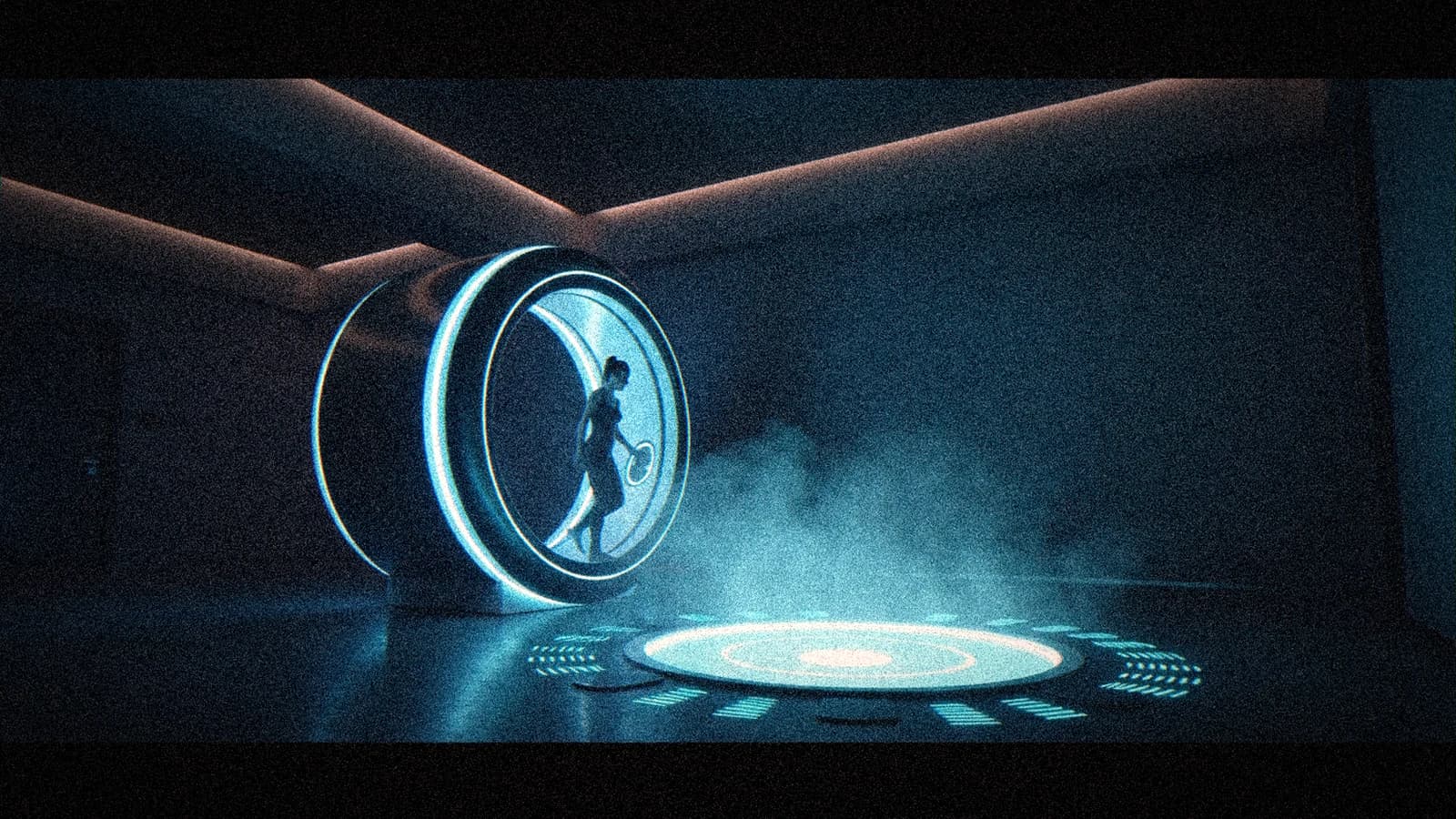
On June 18, 2026 in San Francisco, Midjourney held a live presentation to announce its first hardware product. Everyone was perhaps expecting a camera, a holographic display, something tied to visual creation. What they put out: a full-body ultrasonic scanner that promises to do in 60 seconds what an MRI does in 45 minutes.
The internet reacted with a mix of fascination and bewilderment. Elon Musk replied "Cool." The rest of the web summed up the situation with "nobody saw this coming."
For us, the creators who use Midjourney daily to generate images, concept art and production visuals, the question is simple: what does it change?
What Midjourney Medical really is
The device is called Midjourney Scanner. It works with ultrasonic waves, not X-rays. You step into a kind of shallow basin, you lower yourself into the water, a ring of 358,000 ultrasonic sensors sweeps your body from all angles, and 60 seconds later you have a complete tomographic image.
The comparison put forward by Midjourney: 10 times cheaper than an MRI, 60 times faster. These figures come from the prototype, not a validated commercial product. The first Midjourney spa (in San Francisco, Union Square) is expected to open in 2027.
The announced investment exceeds 74 million dollars for this medical division. That is a serious sum, not a weekend whim.
💡 Frank's Cut: Full-body ultrasonic technology has existed for years in research contexts. What Midjourney adds is an image-reconstruction AI to interpret and present these scans in a readable way. That is where their expertise in image generation becomes relevant: they are not just doing hardware, they are building a medical computational-vision pipeline.
The reaction of radiologists (it is cold)
Radiologists were among the first to react on social media, and it was not enthusiastic. The two critical points:
Incidentalomas. When you scan a whole body, you find anomalies that would never have caused the slightest symptom. These findings trigger follow-up exams, biopsies, anxiety. Whole-body preventive medicine with no prior clinical filtering is a subject of serious debate in the medical literature.
Regulatory validation. 20 people tested on the prototype, no FDA clearance, no published clinical study. Between "the images are impressive" and "this device can diagnose reliably", there is a chasm that only years of studies can bridge.
Midjourney invested in the technology. The regulation, the clinical evidence, and the training of operators, that is another story, and probably the real duration of this project.
What it says about Midjourney's strategy
Midjourney is, in terms of revenue, one of the most profitable AI companies on the planet. The image subscription service generates a lot of cash. David Holz, the founder, has spoken publicly about his ambition to "change the human condition", not to sell generation credits.
The company also announced four other hardware projects in parallel development, plus four software initiatives. It is not an isolated PR stunt: it is a company thesis saying that visual AI applies to far more than concept art.
For creators, it is an ambiguous signal. On one hand, Midjourney image gen stays very active: V8.1 became the default model on June 11, 2026, it is 5 times faster than V7, Draft Mode now reaches 24 images per shot. The creative part is not abandoned.
On the other, a portion of the company's cognitive and financial resources is going elsewhere. That is the reality.
Midjourney V8.1 in the meantime
Concretely, for creation work:
- V8.1 is the default model since June 11. No need for
--v 8.1in your prompt, it is activated automatically. - Draft Mode: 24 images per batch, you click Vary to render the one you are interested in at full quality. Cost: half a standard V8.1 SD job.
- HD mode: still available via the settings or
--hd. Generation at twice the size, four times the resolution of V7. Times: 4 seconds in SD, 12 seconds in HD. - Reference consistency: the
--sref(style reference) and--oref(object reference) work very well with V8.1 on production assets like props, costumes, sets.
On a typical AI production workflow, V8.1 significantly speeds up the visual design step before moving to video.
What it changes for you now
Nothing fundamental about your immediate workflow. Midjourney image gen is in good health. V8.1 is solid and fast.
In the medium term, the question is: will Midjourney's diversification strategy dilute the attention paid to the image tool we use? Hard to say. The history of AI startups that scatter themselves is rarely glorious, but Midjourney has comfortable reserves and a solid recurring-revenue base.
The medical pivot, for its part, is going to take years before producing anything commercially viable. The scanners do not integrate into AI video production workflows.
What really interests me, personally: if their AI image-reconstruction expertise reaches medical diagnostic precision, what does it give applied to ultra-realistic texture generation, to character consistency, to 3D reconstruction from an image? The skills are transferable. That is perhaps the real long-term game.
Sources and context
The announcement was covered by Bloomberg on June 18, 2026, confirmed by Engadget and by the official Midjourney blog post. The performance figures (10x cheaper than an MRI, 60 seconds) are company statements about a prototype. The information on V8.1 comes from updates.midjourney.com.
FAQ: Midjourney Medical and the creator impact
Is Midjourney going to stop developing its image tool to focus on medical? No, according to their announcements. V8.1 came out in early June, Draft Mode is active, and Midjourney mentioned four software initiatives in parallel with the hardware projects. Medical is a diversification, not a replacement. To watch if the future announcements change tone.
Is the Midjourney scanner available now? No. The commercial spa is planned for late 2027 in San Francisco. The prototype was tested on about 20 people. There is no medical regulatory clearance to date. It is a long-haul project.
Will this hardware investment affect the price of my Midjourney subscription? Impossible to know with certainty. Midjourney is one of the most profitable AI companies without having raised major external funding. Their subscription revenue base is solid. The medical division operates with 74M+ announced, which suggests a separate capitalization.
Why does an image AI company get into medical? Ultrasonic image-reconstruction AI and diffusion image generation share deep visual processing layers. Midjourney has real competence in modeling the visual space, which quality medical imaging also requires. The bridge is not as arbitrary as it seems, even if the validation constraints are radically different.
Is V8.1 really much better than V7 for production concept art?
Yes, on several points: prompt adherence on complex multi-element scenes, quality of facial details, better physics of materials (fabric, metal, liquid). For storyboard and film or advertising concept art, the gain is noticeable especially with the --sref to maintain visual consistency from one scene to the next.
Which tools should you use alongside Midjourney for an image-to-video pipeline? The classic path remains: Midjourney for concept art and visual references, then a video model (Kling, Veo, Runway) for the animation. To generate the starting cinematic prompt and build your PDF storyboard before moving to generation, the structuring step is often the most underestimated in the pipeline. Our comparison of free AI image generators lists the alternatives in case Midjourney's strategy were to evolve.
Can Midjourney Medical reliably detect serious diseases? That is precisely the question radiologists are asking, and one the prototype has not yet answered. Impressive ultrasonic images do not mean clinically validated diagnostic precision. FDA clearance and comparative studies against MRIs on large cohorts are the indispensable next steps before any conclusion on medical reliability.
Related articles
 Actualité
Seedance 2.0 Mini: ByteDance launches a video model twice as fast and half the price
Dreamina Seedance 2.0 Mini came out on June 17, 2026. Twice as fast as Seedance 2.0 Fast, at half the price. What it changes for creators who produce in volume.
 Actualité
MiniMax launches Hub: an all-in-one AI video platform unveiled at the Shanghai Festival
MiniMax unveiled Hub at the Shanghai International Film Festival on June 15, 2026. A single platform that combines image, video, voice, music and editing in an AI-agent-driven pipeline.
 Actualité
Google cuts Imagen and the Gemini image preview models: migrate before June 24
Google is removing its Imagen 3 models and the Gemini image previews on June 24-25, 2026. If your image workflow goes through the Gemini API, you have less than a week to migrate. Here is what to do.