Google patents a channel of AI videos made just for you
A Google patent describes My Channel, a TV channel of AI-generated videos built from your tastes, with you as the star. What it tells video creators.
Contents · 6 sections
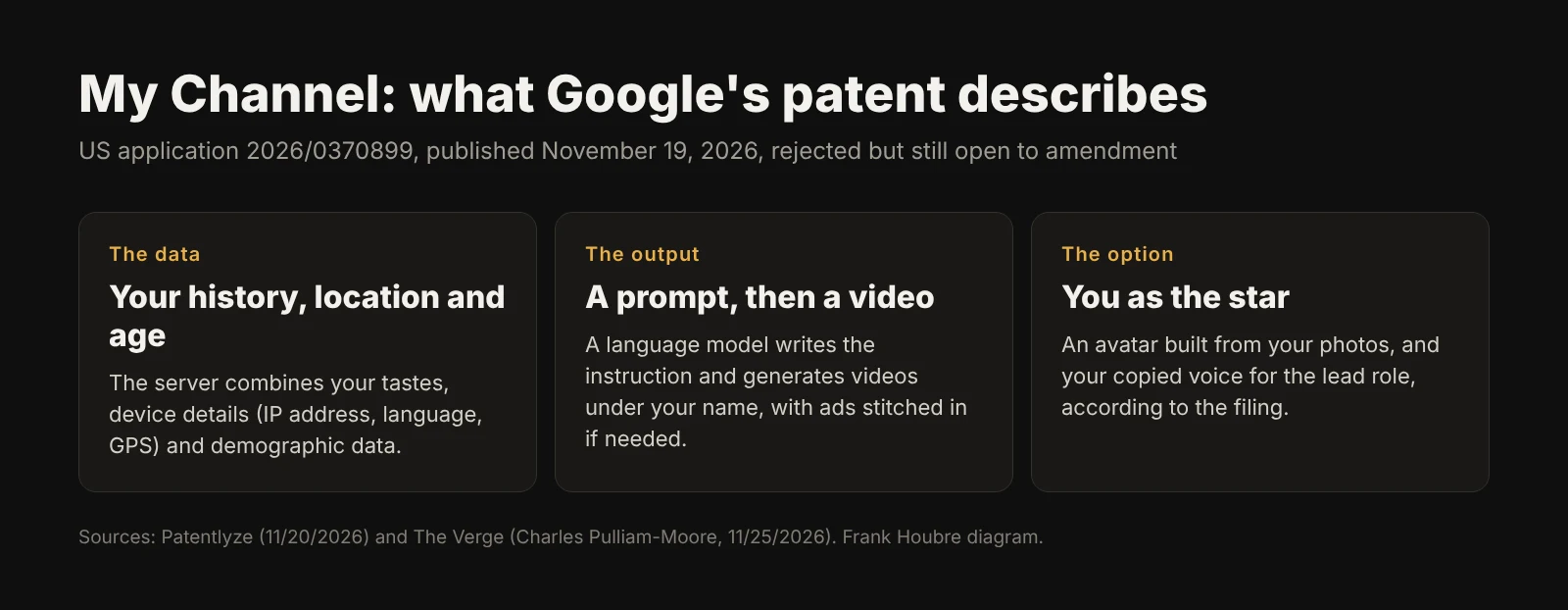
Google has filed a patent application for My Channel: a TV channel where an AI makes videos just for you, based on what you watch, where you are and how old you are. In its fullest version, the system even makes you the star, with an avatar built from your photos and a copy of your voice.
It isn't a product. The US patent office has rejected the application, although Google can still amend it or appeal. But if you make videos, it's worth reading how a major platform pictures what comes next: a feed that no longer recommends our films, and makes its own instead.
This is based on Patentlyze's breakdown, updated on 20 November, Charles Pulliam-Moore's column for The Verge, published on 25 November, and the official publication US 2026/0370899. All were read on 26 November 2026. I haven't read the full patent text, only these summaries and its drawings.
What the patent describes
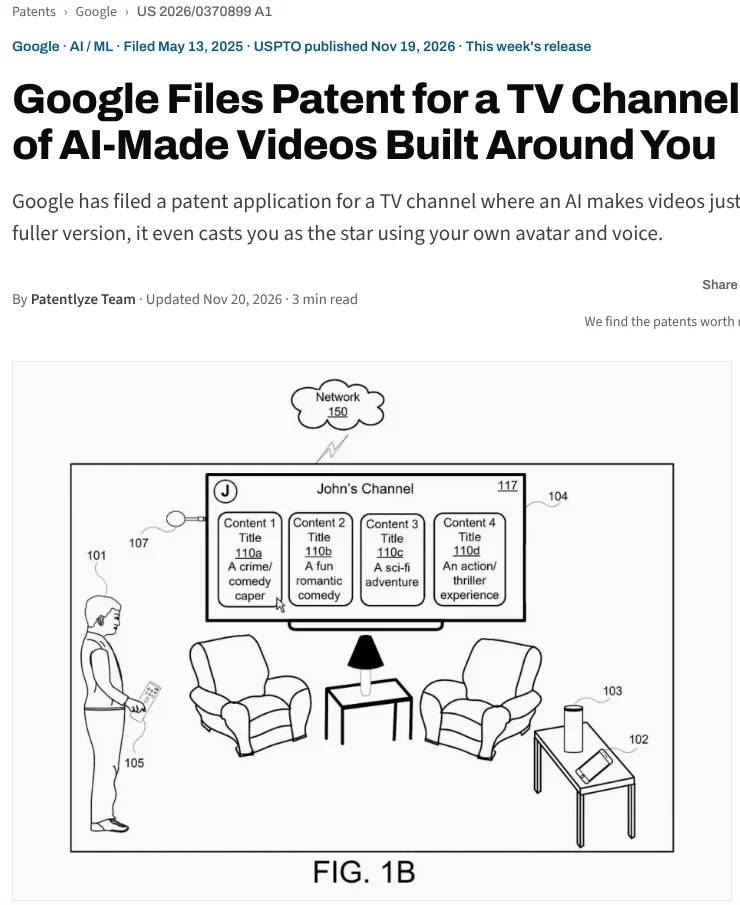
Source: Patentlyze and the patent's figure 1B, captured on 26 November 2026.
The application was filed on 13 May 2025 and published on 19 November 2026. It describes a "My Channel" option in a TV app. Instead of suggesting existing shows, the system asks an AI to create new videos that appear as tiles on a channel with your name on it, like "John's Channel."
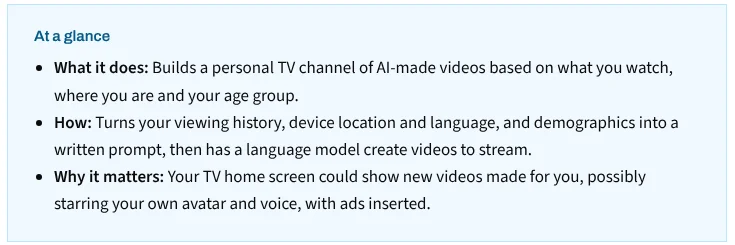
Source: Patentlyze, captured on 26 November 2026.
According to Patentlyze, the server combines three things: your tastes (genres and titles you watch), context from your device (IP address, language, GPS location) and demographic data such as your age bracket. It turns them into a prompt for a language model, which generates the video. A second model can add current news, social trends or sports scores. An ad stitcher can also insert ads into the video.
The Verge imagines what that could look like: someone who watches a lot of videos about Christopher Nolan's The Odyssey would be served a generated film on the same theme. The outlet also notes that the filing mentions connecting to other streaming services.
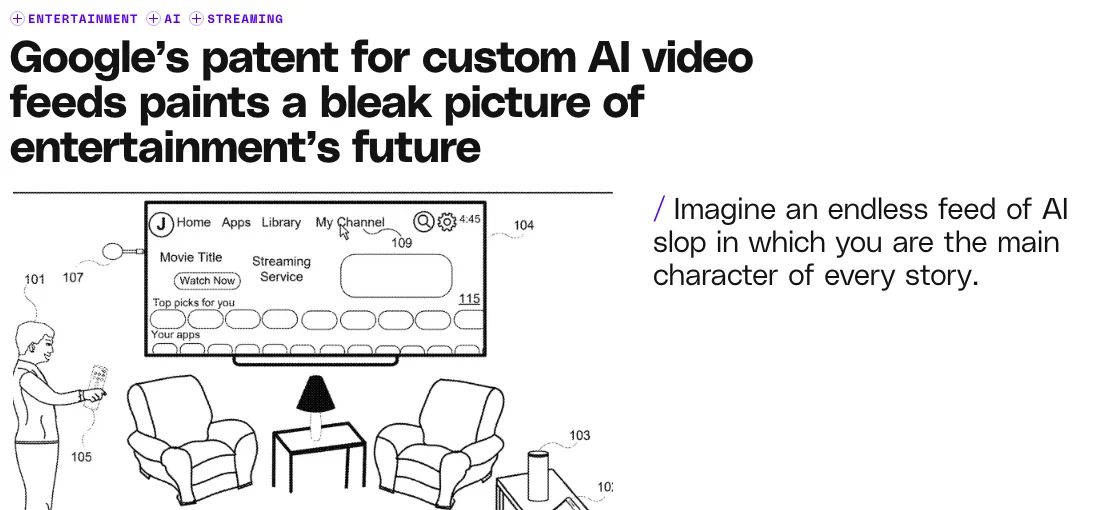
Source: The Verge, captured on 26 November 2026.
Why The Verge is worried
Charles Pulliam-Moore doesn't hold back. For him, the most unsettling part is the idea of making every viewer "the protagonist" of what they watch. An endless supply of tailored content, he writes, doesn't encourage people to empathize with characters or to discover anything outside their comfort zone.
Patentlyze, more neutral, points to a practical limit: generating one video per person takes a lot of computing, while showing a row of recommendations costs almost nothing. And the filing acknowledges that people who share less data get worse results.
My take
I make films with AI, so I'm not going to trash video generation. But there's a real difference between a tool that helps someone tell a story and a machine that produces stories nonstop to keep you watching. My Channel is clearly the second kind.
What strikes me is where the creator sits in this design: nowhere. The story is written by an automatic prompt, from your data. If this ever ships, the value of a video made by someone, with a point of view and real choices, will stand out even more. That's what I learned launching my AI cinema YouTube channel: intention wins, not volume.
And a patent isn't a roadmap. Big companies file thousands. This one is rejected for now.
What it means for you
- Bet on what an AI doesn't make on its own: your eye, your voice, your story. That's what will set you apart from a generated feed.
- Protect your face and voice. The patent describes avatars built from photos and voices. Read what you agree to when an app asks for yours.
- Stay in control of your tools. Using Google Flow to create is different from letting a platform decide what your viewers see.
- Follow patents without panicking. They show where the giants are thinking, not what they'll launch.
What we don't know
- Whether Google will appeal or amend the application after the rejection.
- Which product could use it: the filing names none.
- Which video models would power it, and at what cost.
Frequently asked questions
Quick answers to the questions readers ask most about this article.
What is Google's My Channel?
A system described in a Google patent application: a personal TV channel where an AI generates videos from your viewing history, location and age, according to Patentlyze.
Has Google launched My Channel?
No. It's a patent application, published on 19 November 2026, and the US patent office has rejected it. Google can still amend it or appeal.
Does the patent put users inside the videos?
Yes, as an option: an avatar built from your photos, and your copied voice for the lead character's lines, according to Patentlyze and The Verge.
What data would the system use?
Your tastes (genres and titles you watch), device details such as IP address, language or GPS location, and demographic data such as your age bracket.
Would there be ads?
The filing describes a module that can stitch ads into the generated videos, according to Patentlyze.
Why does it matter for video creators?
Because it shows a platform imagining making the videos itself instead of recommending creators' work. Your point of view and your signature become what sets you apart.
Related articles
 Actualité01
AI training opt-out: OpenAI and Google back one robots.txt
On October 30, OpenAI, Google, Microsoft and Anthropic pledged to honor one robots.txt signal against AI training. What it changes for creators.
 Actualité02
Google Flow and Veo 3.1: audio arrives on all functions, editing gets sharper
Google just extended Veo 3.1 and Flow with native audio on Ingredients to Video, Frames to Video and Extend, plus new precise editing tools. What it changes for AI video creators.
 Actualité03
Google cuts Imagen and the Gemini image preview models: migrate before June 24
Google is removing its Imagen 3 models and the Gemini image previews on June 24-25, 2026. If your image workflow goes through the Gemini API, you have less than a week to migrate. Here is what to do.