AI film YouTube channel: what I learned the hard way
A real account of running an AI film YouTube channel: which format survives, which YouTube rules to read first, and what breaks before anything else.
You finished your first AI short. Three weeks of work, hundreds of generations thrown away, an edit you reworked five times. You put it on YouTube. Forty-seven views in a week, a dozen of them you, checking the thing displays properly on your phone. And the question starts grinding: was the film bad, or is nobody looking for this?
Usually neither. The film is fine. It is sitting on a channel that has no reason to exist in YouTube's eyes, and no reason to be followed in a viewer's. An AI film channel grows differently from a film channel, and differently from a tutorial channel. Here is what I understood after running a channel for years on a completely different subject, then trying to move the same machinery over to AI cinema.
The call you make before the first video: the film or the workshop
Took me a while to accept this. A channel that posts AI films and a channel that posts the making of AI films play different games, and they grow in different ways.
The film channel lives off each release. Every video has to sell itself on its title and thumbnail, to people who have never heard of you. Between two films, the channel is silent. If you put out three shorts a year, you get three shots a year at meeting an audience. That is very little for an algorithm that runs on regular signals.
The workshop channel lives off the process. How you held a character consistent across twelve shots, why you binned a first realistic version, what you changed in your prompt after the fourth failed attempt. These videos speak to people doing the same thing you are, and they come back because they learn something. The film lands at the end of a series, carried by everything published before it.
I lean hard toward the second one. When I told the story behind the art direction of VOIDBORN, the decisions and the mistakes that cost me time, the responses were a different species from the ones the film alone got. People asked technical questions. They came back. The film found its audience elsewhere, at festivals, where it won at the Seoul International AI Film Festival, the Hollywood Indie Festival and the Australian AI Festival. Two channels, two crowds.
💡 Frank's cut: if you are hesitating, ask yourself one thing. Can you hold a release every two weeks for six months with the format you have in mind? If the answer is no, change format before you create the channel, not four videos in.
I already had a channel, and it only helped halfway
I founded Business Dynamite long before I touched AI cinema. An entrepreneurship channel, one subject, a rhythm, a community built over several years. When I started publishing about AI filmmaking, I assumed most of the craft would carry over. Part of it did.
The work habits, yes. Release discipline, knowing how to open a video without making people wait, the reflex to cut anything that does not earn its place, writing the plan before switching anything on. Those are channel skills and they travel with you.
The audience, no. Zero automatic transfer. People who followed me for entrepreneurship did not show up for the art direction of an animated short. A few did. Not the bulk. Every subject rebuilds its audience from nothing, even when the author is the same person, and it stings the first time you see it happen.
The biggest relearning was the vocabulary of titles and thumbnails. In entrepreneurship, a number in the promise works beautifully. In AI cinema, the same number rings false and pulls in people who leave almost immediately. I had to relearn all of it for a subject where the value is visual and not accounting.
If you are coming from another channel, take the work habits and leave the communication recipes behind. Why I left business content for film in the first place is its own story, told in my switch from online business to AI filmmaking.
The YouTube rules an AI channel should read first
This is the most common blind spot. Weeks spent on a film, zero minutes spent on the rules of the platform that will host it. YouTube has set a specific frame around content generated or heavily modified by AI, and that frame has real consequences for your channel.
The official help page puts it plainly: creators are asked to disclose AI-modified or AI-generated content that looks realistic. The disclosure happens at upload, inside YouTube Studio, in the Attributes section, under the Altered or synthetic content setting, where you answer Yes or No.
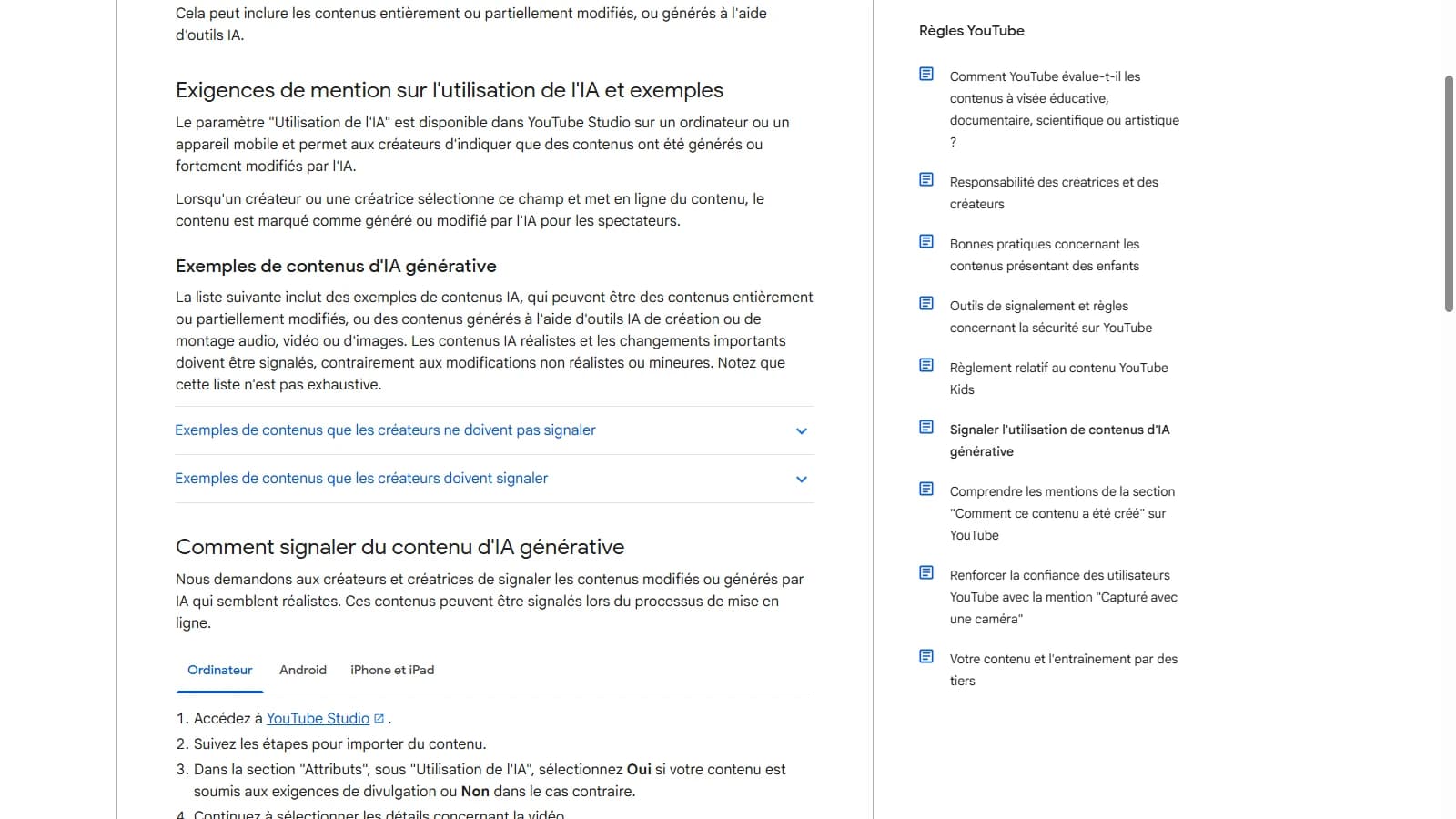
Screenshot of the YouTube help page on disclosing generative AI content, support.google.com, captured 5 October 2026.
Four situations trigger the obligation, as the page lists them:
- You make a real person appear to say or do something they did not say or do.
- Footage of a real event or place is altered.
- A realistic looking scene is generated that never actually happened.
- You create music that is the main element of the video.
Four situations do not trigger it: beauty filters, colour and lighting corrections, cloning your own voice for a voiceover, audio cleanup. The page also notes that non-realistic content and minor edits fall outside the frame, and that its list of examples is not exhaustive.
According to the page on How this content was made labels, when content is not disclosed, YouTube may apply a label itself, and the creator cannot remove it. You do it, or the platform does it for you, on its own criteria.
Where the label shows up varies: in the player for photorealistic content, in the expanded description for non-photorealistic or animated content. If you work in stylised animation, the label is far less visible than it is for photorealism. That detail matters the day you publish a film about something close to the real world.
The full version is on the official page, Disclosing use of altered or synthetic content. It is short, and it saves you months of second-guessing.
💡 Frank's cut: disclose, even when you are unsure. One extra disclosure costs an AI film channel nothing, because the audience already knows it was generated. A missing disclosure on a photorealistic scene costs you a forced label and a dent in your credibility.
The six things YouTube looks at on a channel
The other page worth knowing is the channel monetization policies one. Even if monetization is not your goal, it describes what human reviewers actually inspect, and therefore what a channel judged clean looks like.
Two expectations are written out in full: content should be your own original creation, and if you borrow from someone else you need to change it significantly to make it yours; and your content should not be mass-produced, generic, repetitive or manipulative, and should be made for the enjoyment or education of viewers rather than purely to get views.
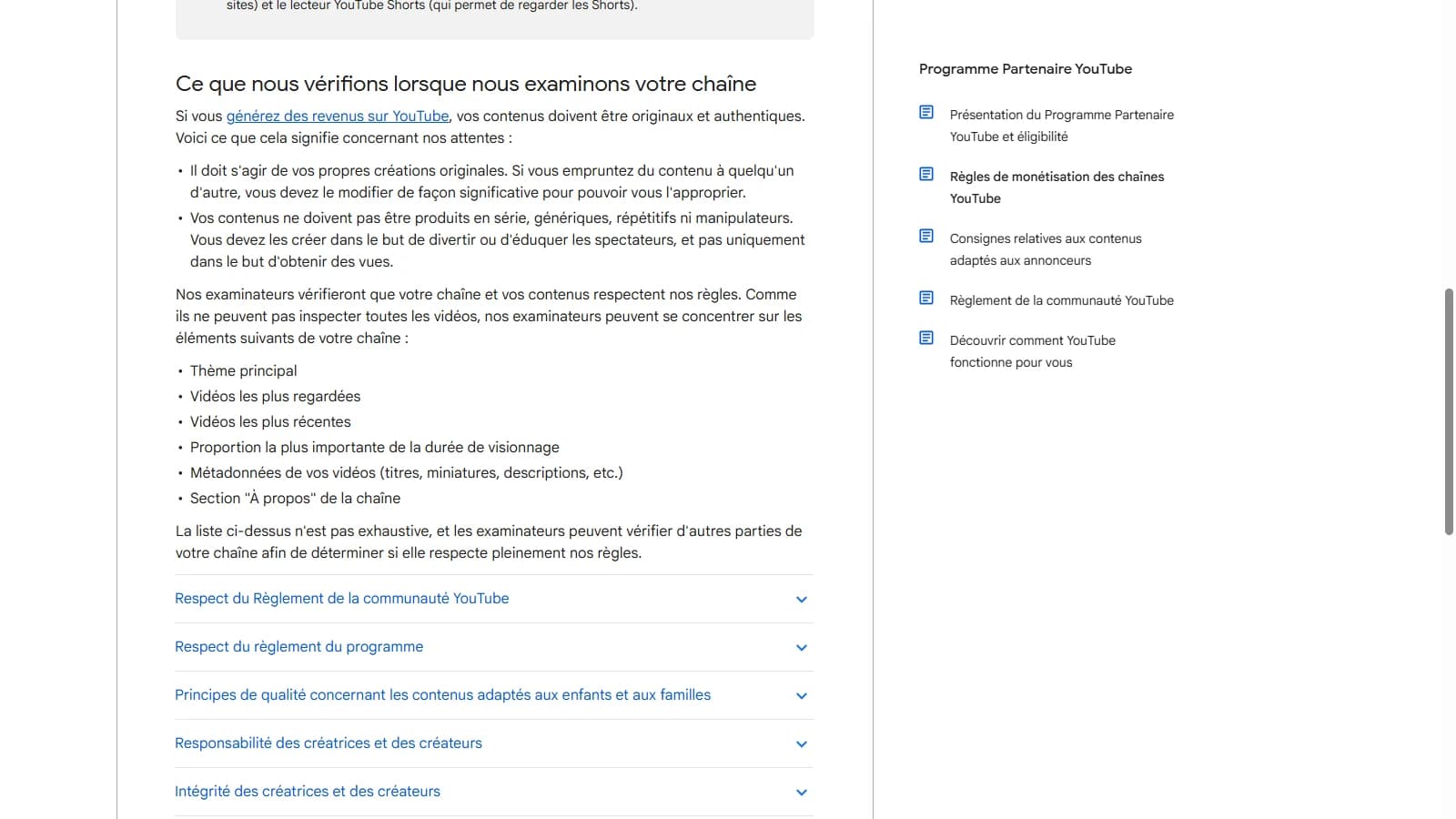
Screenshot of the YouTube channel monetization policies page, support.google.com, captured 5 October 2026. The page lists a last update of 15 July 2025.
The page then lists what reviewers focus on, since they cannot inspect everything:
| What gets reviewed | What it means for an AI channel |
|---|---|
| Main topic | A subject readable in three seconds on your channel page |
| Most viewed videos | Your best video defines you, however old it is |
| Most recent videos | The last five weigh as much as the first fifty |
| Largest proportion of watch time | Whichever format holds people becomes your identity |
| Video metadata (titles, thumbnails, descriptions) | A clickbait title contradicts serious work |
| Channel "About" section | The only place you say who makes this, and why |
The page adds that the list is not exhaustive. I still find it useful as a review grid. Take your channel, walk those six lines, and look at what they say to someone who has never met you. Full source here: YouTube channel monetization policies.
The second expectation is the one that should worry you. A channel putting out three videos a week, all built on the same template, same synthetic voice over interchangeable shots, ticks the definition of mass-produced content almost word for word. And it is tempting, because AI makes that pace easy to hold. That pace is exactly what the rule is aimed at.
A format that fits inside a real working week
This is where most AI film channels die. Not on quality. On pace.
A three minute AI short takes anywhere from a few days to several weeks depending on complexity. Meanwhile the channel publishes nothing. The author comes back six weeks later with a gorgeous film, to an audience that has forgotten him. Then he does it again.
The setup that held best for me splits the work across three levels.
The heavy level, once a quarter. The film. The piece that justifies the channel, the one you send to festivals, the one that proves you can finish something. You make it at your real pace, without lying to yourself about how long it takes.
The middle level, every two weeks. A production segment. Building a character, testing three models on the same shot, explaining an editing choice. Half a day of shooting, because the material already exists: it is the rushes and the failures of the film in progress.
The light level, every week. One shot with commentary, a before and after, the mistake of the day. Two minutes. One hour of work, and it keeps the channel alive between releases.
What makes this work is that all three levels feed off the same project. You are not making three different kinds of content, you are cutting one piece of work into three depths. And the day the film drops, you have six weeks of warmed-up audience sitting on its making of.
When I am hunting angles for the middle and light levels, I use the method I set out in my prompts for finding YouTube video ideas. The difference on an AI film channel is that the raw material is already on your hard drive. Your folders of failed generations are a video idea bank.
Titles, thumbnails and descriptions: the part nobody works on
A creator coming off a month on a film wants to publish. Immediately. The thumbnail gets made in ten minutes on the high of finishing, the title is the name of the film, the description runs two lines. I have done exactly this. It is pure waste.
Thumbnails are a specific problem in AI cinema. You have thousands of images available, all beautiful, none of them saying anything. A beautiful image creates no curiosity. You need visual tension, something that poses a question. What I learned about keeping thumbnails consistent with your AI video applies double here: a viewer who clicks a photorealistic promise and lands on stylised animation is gone almost at once.
For testing, the method in A/B testing AI-generated thumbnails gives you a clean frame. One isolated variable per test, a long enough run, an honest read of the result. On a small channel the volumes are low, and you have to accept that plenty of tests will conclude nothing. One well-run test a month beats four simultaneous unreadable ones.
Descriptions are the most neglected part and the cheapest to fix. They carry production context, the tools used, chapters, and links to the rest of the series. On an AI film channel they also carry transparency: what was generated, what was not, with which model. The workflow in my piece on SEO-optimised YouTube descriptions works as is, as long as you add that transparency block.
💡 Frank's cut: write the title and the thumbnail before you edit the film, not after. If you cannot state a clear promise for a project, often the project itself has no angle. Better to find that out at the start.
Three channel formats, three work economies
I have watched all three of these work, each with its own constraints. None is better in the abstract, they just ask for different things.
| Channel format | Realistic pace | What it demands | Main risk |
|---|---|---|---|
| Films only | 3 to 6 a year | Real artistic ambition and patience | Long silences between releases, channel forgotten |
| Workshop and behind the scenes | 1 to 4 a week | Being able to explain what you do, not just do it | Turning into a tutorial channel and never finishing a film |
| Serialised story | 1 episode a month | A held universe and strict visual consistency | One weak episode breaks the whole series |
The third model is the one I find most interesting right now, and the most demanding. Holding a universe across several episodes takes an art direction discipline I went into in building an author's visual signature with AI. Without it, episode three stops looking like episode one, and viewers feel it immediately.
What breaks, in the order it breaks
I have followed a handful of AI film channels since their first videos, and I have watched several go dark. Here are the failures I keep seeing, roughly in the order they arrive.
The channel with no main topic. A sci-fi short, a ComfyUI tutorial, a model test, a reaction to some AI news. Four videos, four audiences. YouTube has no idea who to show the fifth one to. The repair is simple: pick the topic of your most watched video and temporarily hide whatever does not fit it.
The six week silence. The channel restarts after a long pause and the numbers collapse. No punishment in there, just an audience that got used to your absence again. The repair is the weekly light format described above.
The festival title. Titles that work in official selection do not work in YouTube search. A three word poetic title tells nobody anything. Keep the film's name, but put what the viewer is about to see in front of it.
Forgotten transparency. A comment points out that it is generated, the author answers badly or not at all, and the thread turns into a trial. Transparency stated in the description from the start kills that scenario. On this subject, own it before anyone asks.
Asking the numbers the wrong question. People watch subscriber count, which says nothing about a young channel's health. The useful data is average view duration and click-through rate. If people click and leave, the problem is in the video. If they do not click, the problem is the title or the thumbnail. Two diagnoses, two different jobs, which is why subscribers are such a poor starting indicator.
Confusing the channel with the business. An AI film channel can be a shop window, a lab, a way to recruit collaborators, a teaching support. It can also return nothing at all for a very long time. If the revenue question comes up, I covered the economics of AI video separately, because it is a subject in itself and mixing it into channel-building leads to bad decisions.
If I started again tomorrow, three changes
The first: publish the light format for six weeks before releasing anything ambitious. That gives you a channel already alive on the day the film lands, and it makes you rehearse the publishing machinery while the stakes are low.
The second: write the "About" section on day one, not when it occurs to you. One line on who you are, one on what you make, one on what the next video looks like. It is the only place on the channel where you speak directly, and it is one of the things reviewers look at.
The third: keep a production journal from the first project. Screenshots of failures, the prompts that eventually worked, the real durations. Without that journal, behind-the-scenes videos get reconstructed from memory and sound approximate. With it, they almost write themselves.
FAQ: starting an AI film YouTube channel
Do I have to disclose every AI-generated video on YouTube?
No, but the boundary deserves a careful read. The official help page asks you to disclose AI-modified or AI-generated content that looks realistic, and gives four cases: making a real person say or do something they did not, altering footage of a real event or place, generating a realistic looking scene that never happened, and creating music that is the main element of the video. Beauty filters, colour correction, cloning your own voice for a voiceover and audio cleanup are not covered. In practice, a channel producing photorealistic fiction ends up disclosing almost every time. For stylised animation the reading is more open, but the reflex to disclose is still the safer habit.
Can a pure AI film channel grow without behind-the-scenes videos?
It can, but it takes far more patience and work that carries entirely on its own. The problem is mechanical: a film every three or four months gives you three or four chances a year to meet an audience, on a platform that rewards regularity. Film channels that break through without intermediate content usually lean on another route, festivals, social platforms, specialist press, that drives traffic at release time. Without that outside route, behind-the-scenes content does that job for you, and it costs far less to produce than the film itself.
How long before an AI film channel takes off?
I have no honest number to give you, and I am suspicious of people who do. From experience, the time is counted in months of regular publishing, not in number of videos. A channel that posts fifteen videos in three weeks and then stops has built nothing. A channel that posts once a week for six months has at least given the algorithm and viewers enough to form a view. You control two things: regularity and a clear topic. The rest depends on factors nobody controls.
Which category and description should an AI film channel pick?
The YouTube category matters less than the consistency of the main topic, which is explicitly one of the things reviewed on a channel. Pick a category close to your dominant content, usually Film and Animation for films and Science and Technology or Education for workshop content, then put your effort into the "About" section. It should say in three sentences who makes this, what exactly, and with what approach. It is also the right place to state your transparency about AI use, which saves you repeating it in every description.
Do I need to show my face on an AI film channel?
Not required, and plenty of channels run on voiceover over working footage. A face mainly adds credibility on workshop videos, because it ties a method to a person who actually used it. If you go with voiceover, double down on two things: the writing quality of the commentary, which becomes your only link to the viewer, and transparency about the voice itself. If you clone your own voice, the YouTube help page says that case falls outside the disclosure requirement, but saying so in the description is still a good habit with your audience.
How do I keep my channel from reading as mass-produced content?
The monetization policies state the expectation directly: content should not be mass-produced, generic, repetitive or manipulative, and should be made to entertain or educate viewers rather than purely to collect views. In practice that means avoiding the single template on repeat, the synthetic voice reading a script over interchangeable shots, and high frequency publishing with no personal input. What protects you is a point of view: a decision explained, a mistake recounted, a staging choice defended. AI can produce the images, but the judgement that assembles them has to come from you, and it has to show.
What if YouTube applies an AI label I did not ask for?
The platform plans for that. The page on "How this content was made" labels explains that when content is not disclosed, YouTube may apply a label itself, and the creator cannot remove it. The best protection is disclosing yourself at upload, through the altered or synthetic content setting in the Attributes section of YouTube Studio. If the label appears without you asking, read it as a signal about how your content is being perceived, and adjust your description to take the narrative back rather than letting the label speak alone.
Can I reuse my channel videos in a festival submission?
Not directly, and this is a mistake I nearly made. A festival wants a film, not a making of, and several rulebooks set premiere conditions that can conflict with a prior YouTube release. Read the rules before you publish anything of the film itself. Behind-the-scenes videos published after the festival run, on the other hand, extend a project's life very well, and they give a second life to a film whose selections are over. Order matters: festival first, behind the scenes second, the film itself once the exclusivities lift. I went into the sequencing in my piece on distribution strategies for AI films.
Last thing
An AI film channel stands on two things that have nothing to do with how good your generations are: a pace you can actually hold, and a topic a stranger understands in three seconds. The rest gets fixed along the way.
Start with the light format. Write your "About" section today. Disclose your content when it calls for it, instead of waiting for the platform to do it for you. And keep the ambitious project for the moment the channel already breathes on its own.
Related articles
 Business
Creative career change with AI: from business to film
Why I left online business content for AI filmmaking, what came with me, what I had to drop, and a method to plan your own creative career change.
 Business
AI Film Distribution: Strategies to Explode Your Visibility
A concrete action plan to distribute an AI film, activate the right channels and transform a finished project into a real audience, with a launch workflow, useful KPIs and a creator-oriented FAQ.
 Guides
Adapting a book into an AI film: rights and method
How to check whether a book is free to use, how to get adaptation rights when it is not, and how to cut three hundred pages down to ten minutes.