Adapting a book into an AI film: rights and method
How to check whether a book is free to use, how to get adaptation rights when it is not, and how to cut three hundred pages down to ten minutes.
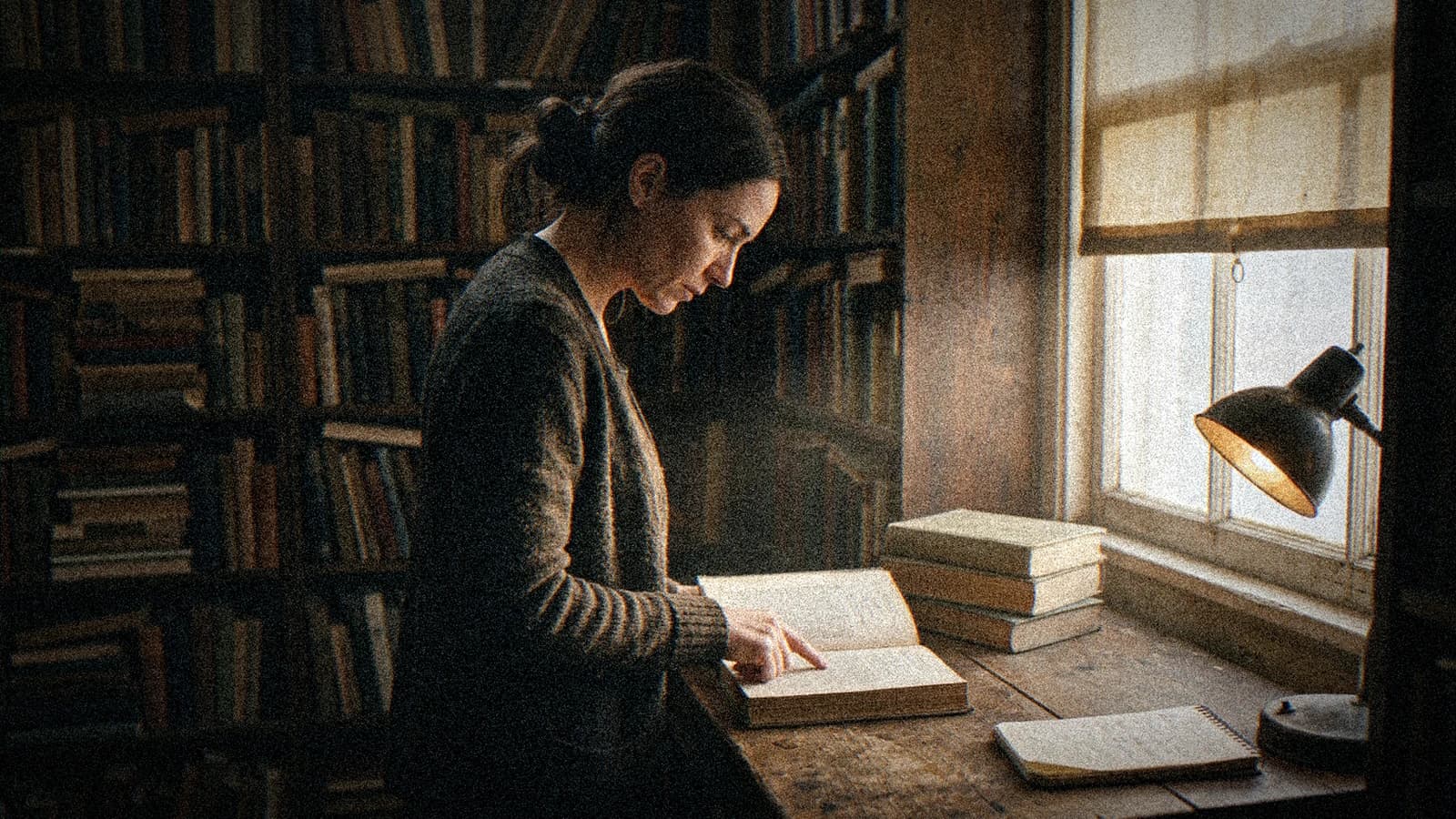
You adapt a novel you love. Six weeks of work, sixty-odd generated shots, a teaser online, a clean edit. Three days later the publisher's rights department asks you to take it all down. You do not understand why. You checked, and the author died well over seventy years ago.
The author, yes. The translator, no.
Turning a book into an AI generated film is two jobs stuck together. A dull bit of legal checking, which takes an afternoon once you know where to look. And a screenwriter's job, which means throwing away ninety percent of a text you love. Generative tools made the images cheap. They changed nothing about the two jobs above them.
Three questions to settle before you plan a single shot
Who holds the audiovisual adaptation rights to this exact text, in this exact version. The name on the cover does not tell you who can sign.
What you are actually adapting. The whole novel, one chapter, a thirty page short story, or just the world. That answer shapes the contract as much as the script.
How many pages you are willing to lose. An eight minute short fits inside two chapters, not inside a four hundred page novel. Every AI adaptation I have watched grind to a halt had skipped that third question.
💡 Frank's cut: I block out half a day for the legal check before writing a single line of script. Half a day wasted if the book is free, six weeks saved if it is not. The maths is easy.
Working out whether the book is still protected
In France, article L123-1 of the intellectual property code sets the rule: the author holds the exclusive right to exploit the work for life, and on their death that right continues for their heirs "for the current calendar year and the seventy years that follow".
The count runs in whole years. An author who died on 10 June 1960 stays protected until 31 December 2030, and the work becomes free on 1 January 2031, not on 11 June 2030.
For a work written by several people, article L123-2 moves the starting point to the death of the last surviving collaborator. Two co-authors, one dying in 1958 and the other in 1991: 1991 is the one that counts. In that example the rule adds thirty-three years on top of what you would have calculated from the first death.
Special regimes also apply to posthumous, anonymous and pseudonymous works, and historical extensions still survive in some cases. If your calculation lands within five years of the tipping point, pay for an hour with a specialist lawyer instead of starting production.
Moral rights never expire. Article L121-1 states that the right to respect for the author's name, standing and work "is perpetual, inalienable and imprescriptible", and that it passes to the heirs. A text in the public domain is free to adapt on the economic side, and heirs can still act if the adaptation distorts the work or buries the author's name. In practice: credit the original author on screen, and think twice before changing the ending.
| Status of the source material | What you can do | What you need |
|---|---|---|
| Author dead for more than 70 full years, original text | Adapt freely | Credit the author, respect the work (moral rights) |
| Same text, but you are working from a recent translation | Nothing without consent | The translator's rights, separately |
| Co-written work, one co-author died recently | Nothing without consent | Consent from every rights holder |
| Author alive or recently deceased | Nothing without consent | A written assignment of audiovisual adaptation rights |
| Free in the US, author died 50 years ago | Nothing in France | A country by country check before any release |
The translation, preface and edition trap
This is what brings down the teaser in the opening. A translation is a protected work in its own right. Article L113-4 is blunt about it: "A composite work is the property of the author who created it, subject to the rights of the author of the pre-existing work." Take a nineteenth century Russian novel whose author died more than seventy years ago: the original text is free, the 2008 French translation is not, and if you adapt the dialogue as you read it, you are adapting the translator's work.
The same logic covers the preface, the notes, the critical apparatus, the cover art, and any annotated edition that added editorial content. The physical object in your hands is often four or five layers of rights stacked on top of each other, with only one of them expired.
Geography adds its own layer. Duke's Center for the Study of the Public Domain publishes a list every year of the works entering the US public domain. On 1 January 2026 it was works published in 1930, under the 95 year term that applies to pre-1978 publications, along with sound recordings from 1925. The list includes As I Lay Dying by Faulkner, The Maltese Falcon by Dashiell Hammett, The Murder at the Vicarage by Agatha Christie, the first Nancy Drew books, and on the film side All Quiet on the Western Front, the Marx Brothers' Animal Crackers, Morocco and The Big Trail.
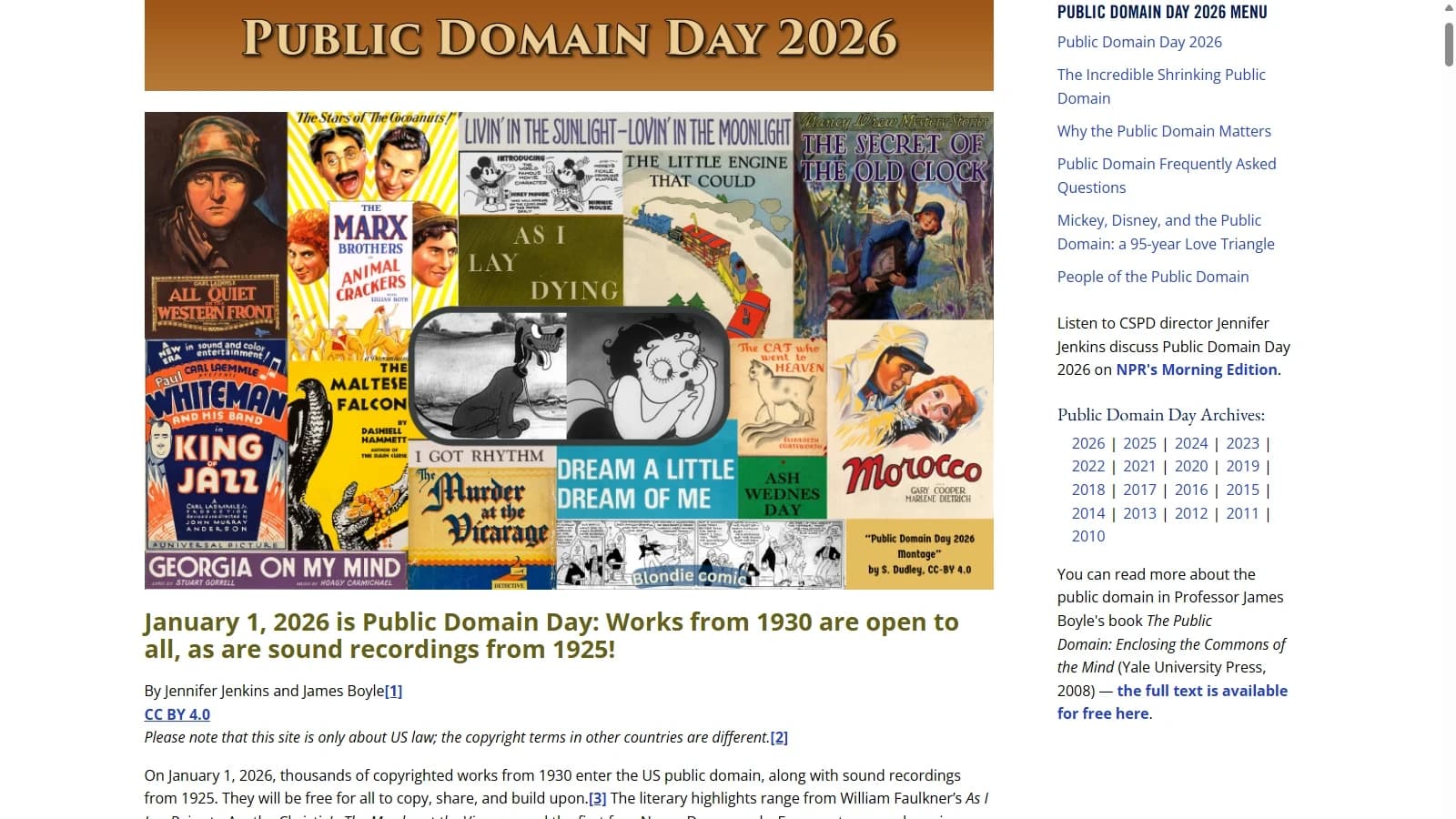
Screenshot of the Public Domain Day 2026 page at the Center for the Study of the Public Domain (Duke Law), taken on 4 October 2026. The italic line under the headline warns that the site covers US law only and that copyright terms differ in other countries.
That warning is the most useful sentence on the whole page. Project Gutenberg prints the same caution on its permissions page: its ebooks are in the US public domain, and it advises readers outside the United States to take professional advice before redistributing, because what is free there is not necessarily free elsewhere. A file you downloaded legally from Gutenberg tells you nothing about the status of that text in your own country.
I write four lines in a file before anything else: author's name and year of death, translator's name and year of death or publication date of the translation, the exact edition I am working from, and the countries I plan to release in. If any one of those lines is still empty, I do not start.
Getting the rights when the book is protected
Article L122-4 sets the baseline: any reproduction or performance made without the author's consent is unlawful, and the text spells out that this covers "translation, adaptation or transformation" too. There is no grey zone to exploit and no runtime below which an adaptation becomes tolerated.
For a book published in France, your first contact is the subsidiary rights or audiovisual rights desk at the publishing house. The address is usually on the publisher's own site. For a foreign author, you go through their literary agent or the original publisher. For an author who died recently, through the heirs, who are sometimes represented by the publisher and sometimes not at all.
Keep the email short. Who you are, exactly what you want to adapt, in what format, at what length, for what kind of release. Say in that first message that the film is made with generative tools. Finding that out later has killed deals that would otherwise have held.
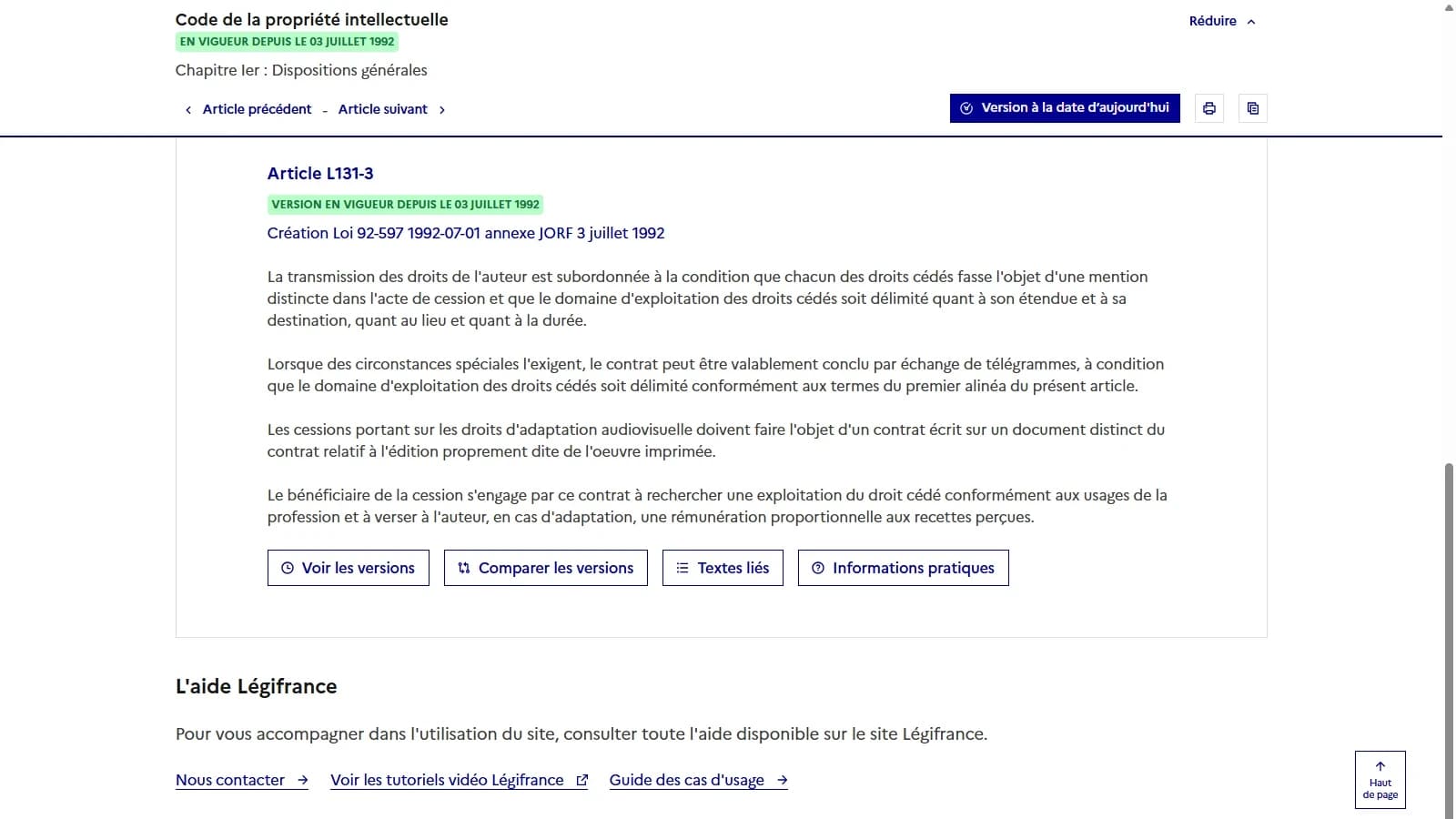
Screenshot of the article L131-3 page of the French intellectual property code on Légifrance, taken on 4 October 2026. The version in force since 3 July 1992, with all four paragraphs legible.
If someone says yes, the contract follows a strict form. Paragraph 1 of article L131-3 requires each assigned right to be listed separately in the deed, and the scope of exploitation to be defined "as to its extent and purpose, as to place and as to duration". Wording like "all exploitation rights" is worth nothing.
Paragraph 3 adds a formal rule: an assignment of audiovisual adaptation rights has to be a written contract on a document separate from the publishing contract. An email from the publisher saying "we agree" does not do it, and a clause tucked into the original publishing deal raises a validity problem.
Paragraph 4 then obliges the assignee to seek exploitation of the right and to pay the author, in the case of an adaptation, "remuneration proportional to the revenue received". For a short film with no revenue, that does not mean free. It means the question gets handled in the contract instead of avoided.
Professional practice rarely jumps straight to assignment. You sign an option, a contract that reserves the right to adapt for a set period against an agreed sum, with the assignment only kicking in when the option is exercised. That is trade custom rather than a legal requirement, and it is the most realistic thing to propose when your project is small.
What a small scale producer can reasonably ask for: a narrow scope (one short story, one chapter), a short term, a limited territory, a clearly bounded non commercial release. I have seen requests like that go through. Requests for worldwide perpetual rights on a whole novel, never.
Choosing your unit of adaptation
The mistake I see most often is trying to squeeze an entire novel into twelve minutes. You get an illustrated summary where every shot lasts two seconds and nobody can follow it.
| Starting unit | Realistic AI runtime | Rights needed | Real difficulty |
|---|---|---|---|
| A single scene | 2 to 5 min | Assignment on an extract | Low, if the scene stands alone |
| A short story | 8 to 15 min | Assignment on the story | Medium, the structure already exists |
| The chapter that turns it | 5 to 10 min | Assignment on the extract | Medium, you have to set up context |
| The whole novel | 1 h and up | Broad, expensive assignment | Out of reach for a solo production |
| The world, without the plot | Varies | Grey area, get it checked | High on the legal side |
A short story is the best ground for a first AI adaptation. It has an ending, a single dramatic movement, two or three characters, and its author is often easier to reach than a bestselling novelist. It is also the easiest scope to defend in an email to a publisher, because you can define it in one sentence.
How I compress a book
I reread the book once with a single goal: note the images, not the plot. What I can see. A hand on a wet railing, a room lit by one lampshade, a dog that refuses to come inside. The plot remembers itself, the images do not. That notebook of images becomes the raw material of the film, long before the script.
Then I hunt for the pivot scene. In almost every text there is a moment after which the main character cannot go back. In a short format, that scene is the film, and everything else turns into context you distil into three lines of dialogue.
Point of view is the third call, and the painful one. A novel moves between several minds without effort. A ten minute film carries one point of view, sometimes two. Choosing means accepting that you lose a character you like.
Then comes the technical part: turning interiority into visible action. A novel writes "she knew her brother was lying". The film shows someone stop chopping vegetables. Every line of introspection in the book either leaves your script or becomes an action. Voice over reciting the original prose is the symptom of an adaptation that skipped this work.
Last, I cut the secondary characters by merging rather than deleting. Three colleagues become one colleague. Two children become one child. One character fewer is one face fewer to keep consistent across forty shots, and that matters far more in AI production than in live action.
If you have never written a full script, the base structure is laid out in the guide on writing a short film script from A to Z with AI. And the field report on co-writing a film with AI covers what happens when you let the tool propose the structure, which I would avoid on an adaptation.
What generation actually changes
Location stops being a budget problem. A Prague street in 1913, an ocean liner, a forest in winter: these were out of reach for an unfunded film and now they are on the table. For a literary adaptation, usually set in some reconstructed past, that is the decisive gain.
What stays hard has not moved an inch. Holding one face consistent across a whole film takes serious reference work. Long takes hold up badly. Three handed scenes where people talk over each other are still miserable to build. And a literary adaptation is exactly the genre that demands sustained faces and dialogue that breathes.
A third point gets discussed less: the source text locks you into precise descriptions. A novel says "the low house with the slate roof, at the end of the dirt track". You have to produce that house, not a nice house. The prompt is built from the text word by word, and it takes more discipline than starting from a free idea. The method for driving that is in the pipeline that runs from script to shot list.
On who owns what you make, adaptation does not change the ownership rules for generated images, covered in the note on copyright and AI generated images. And if you are considering a digital replica of a performer to play a character, the analysis on AI actor clones and their rights handles that question, which is entirely separate from the source text.
From text to visual bible
A good novel is already an art direction document if you read it that way. I do a dedicated pass where I note four categories only: light, materials, season, and the state of things. An author who writes "the wallpaper was peeling above the radiator" has just handed you a set note more precise than any moodboard.
Those notes become one page that I keep open throughout generation. Three lines on palette, three on dominant texture, three on the quality of light, and the list of recurring objects from the book. You can recognise a film drawn from a text by the objects that keep coming back.
The storyboard then gets built in shooting order, not in the order of the book. The method is in the guide on how to create an AI storyboard step by step. For the jump from text to shot, a writing tool that keeps each scene tied to its shots saves real time, and that is the logic ScreenWeaver was built on.
Troubleshooting: what breaks on an adaptation
The film plays like a summary. You kept too much plot. Go back to the pivot scene and delete everything that does not lead straight to it.
Voice over is carrying the whole story. The interiority work never happened. Take each line of narration and ask what image would make it unnecessary.
The sets look great but nothing like the book. Your prompt came from memory, not from the page. Reopen the passage and pull the exact words: material, period, state of repair, how the character sees the place.
A character's face changes between sequences. That is character reference work. Lock one reference image per character before you generate the first shot of act two.
The rhythm collapses in the middle. Classic on adaptations: the book's second act runs on psychological density, which does not film. You have to inject a concrete obstacle the book never needed.
The teaser gets pulled after release. The check never happened, or it stopped at the author without going down to the edition. Nothing to fix downstream.
What I turn down
A book whose author is alive and unreachable. Not hard to reach: unreachable, after three attempts through three channels. Silence is not tacit consent, and six weeks of production resting on silence are six weeks at risk.
A text whose rights are being fought over between heirs. It happens, and none of the parties can sign until the estate is settled.
A title already under option with a producer. The publisher will say so in the first exchange, and that is a good reason to change project now rather than wait for the option to lapse.
And by personal choice rather than legal caution, books whose whole interest lives in the language. Some books exist entirely inside their sentences. Filming them keeps the anecdote and loses the reason they were written.
Foire aux questions
Réponses rapides aux questions les plus fréquentes sur cet article.
Can a public domain book really be adapted without asking anyone?
On the economic side, yes: exploitation rights have expired and you no longer need permission from the heirs to adapt. Two reservations still hold. Moral rights under article L121-1 are perpetual, inalienable and imprescriptible, so heirs can act against an adaptation that distorts the work or drops the author's name. And the public domain covers the original text in its original language, not a recent translation, preface or annotated edition, each of which is a protected work in its own right. So: adapt, credit, and check which version you are working from.
How exactly do I calculate when protection ends in France?
Article L123-1 counts the calendar year of death plus the following seventy years. For an author who died in 1960, protection runs to 31 December 2030 and the work becomes free on 1 January 2031. For a co-written work, article L123-2 puts the starting point at the death of the last surviving collaborator, which often stretches the term by several decades. Special regimes apply to posthumous, anonymous and pseudonymous works, and historical extensions still exist in some cases. If your calculation lands within a few years of the tipping point, get it checked by a lawyer before committing to a production.
The book is free in the US, can I release in Europe?
No, the two calculations are independent. The US public domain runs on a 95 year term from publication for pre-1978 works, which is why 1930 publications became free there on 1 January 2026. France ties the term to the author's death rather than the publication date, and the two dates rarely line up. The Center for the Study of the Public Domain and Project Gutenberg both flag this on their own pages: their lists only speak to US law. Before any release, redo the calculation for every country where the film will be visible, starting with your own.
How much does an option on adaptation rights cost?
I have no price list to give and I could not find a public one: the amounts depend on how well known the title is, the scope requested, the term and the type of exploitation, and the contracts stay confidential. What I can say usefully is about structure rather than price. A narrow request costs less than a broad one, a short option term costs less than a long one, and a clearly bounded non commercial project opens doors that a vague one closes. Ask the publisher for a quote with your scope described precisely. That is the only way to get a number worth anything.
Should I tell the rights holder the film is AI generated?
Say it in the first message, before you even get to scope. A publisher or agent who discovers after signature that the film is made with generative tools can decide the consent covered something else, and the relationship ends badly. Some rights holders say yes precisely because the format is small and experimental. Treat that information as part of the scope, alongside term and territory, and write it into the contract. The separate transparency duties that apply to generated content are a release side question.
Can I adapt the world of a book without using its plot?
This is the murkiest part of the subject and I would not go there alone. Ideas and concepts are not protected as such, but a fictional world materialises through named characters, described places, internal rules and an atmosphere, all of which are elements of expression that can be protected. The line gets drawn case by case, on how much detail you carry over, and it gets judged after the fact. If your project rests on this strategy, have a specialist lawyer read the script before you generate a single image.
Where should I start if I have never adapted anything?
With a short story in the public domain, in its original language or in a translation that is also free, and an eight to twelve minute format. You settle the legal question in an hour, you work on a structure that already has an ending, and you concentrate entirely on the real lesson: turning prose into images. Once that film is done you will know what your pipeline can take, how many shots you can hold, and you can go negotiate rights on a protected text knowing what you are talking about.
Where to start this week
Take the book you have in mind. Open the title page and write down four things: the author and their year of death, the translator if there is one, the year of the edition in your hands, and the publisher's name. Ten minutes.
Run the article L123-1 calculation on the author, then on the translator. If both are expired, you can start writing this afternoon. If either one still holds, email the publisher before you do anything else, describing the narrowest scope you genuinely want.
While you wait for an answer, do the image notebook pass. It pays off either way. If the deal comes through, you already have the raw material. If it does not, you have learned to read a text like a director, and that travels to the next project.
Related articles
 Analyses
AI actor clones: your rights, contracts and the market
Digital replicas, cloned voices, synthetic performers: what the law actually protects, and where an actor can license a face or a voice today.
 Tutoriels
Copyright and AI Music for a Film Soundtrack
What the tool licenses cover, client clauses, and hybrid composer + AI alternatives.
 Tutoriels
Adapting Brand Storytelling to AI Video Content
How to keep the brand voice when production speeds up with AI without losing identity or trust.