AI actor clones: your rights, contracts and the market
Digital replicas, cloned voices, synthetic performers: what the law actually protects, and where an actor can license a face or a voice today.
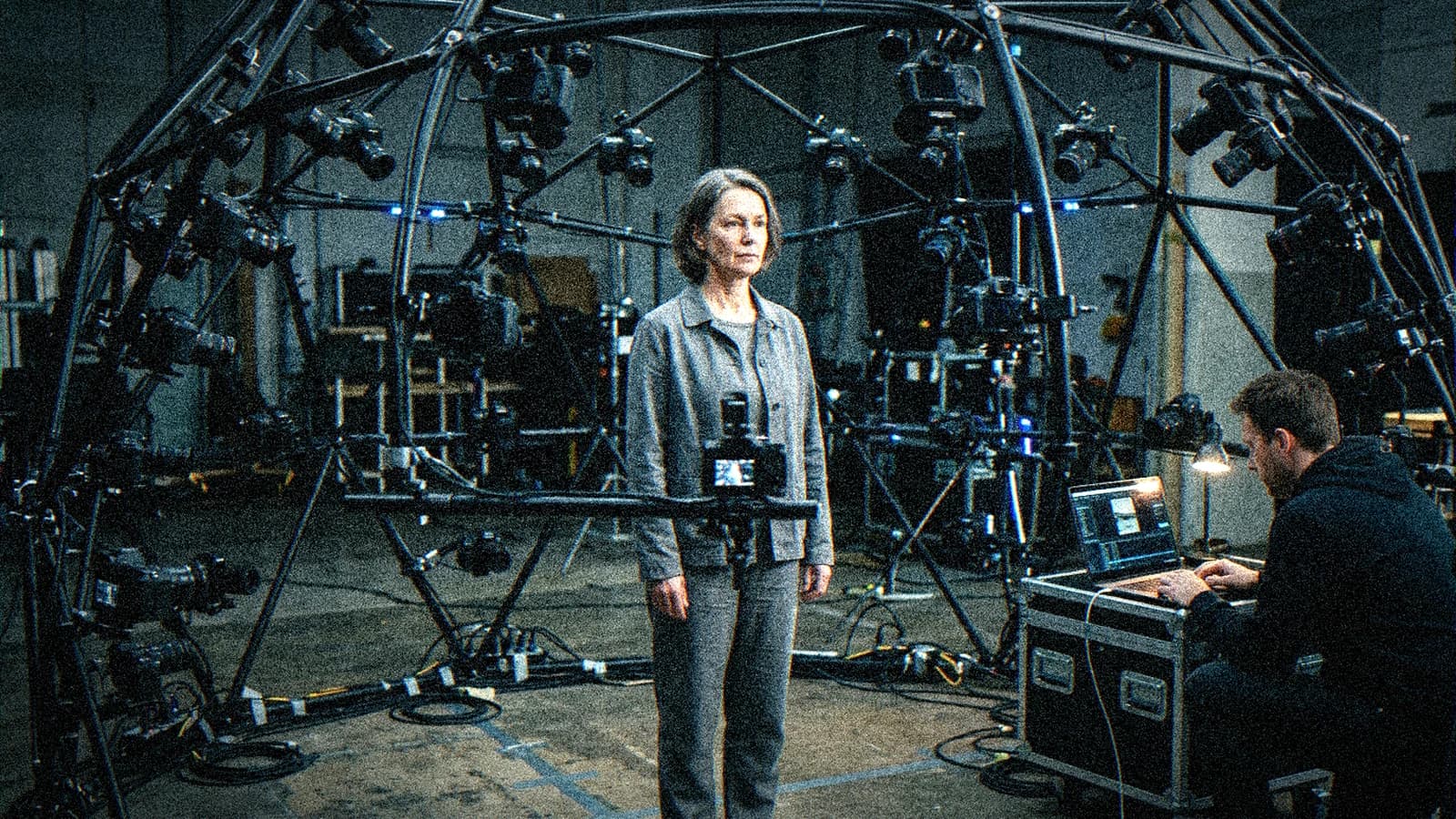
A three-page contract, one line buried in paragraph 7, and the words "digital replica" slipped between two sentences about distribution rights. That is how the question reaches most actors. A signature due Friday, on a document nobody around the table has really read.
Then there is the other side. Us, the people who build films with AI and need a face, a voice, a body that holds from one shot to the next. We spend our days chasing character consistency and skip the dumb question: who owns that head.
Both sides sit in the same file. French law protects more than most people think since summer 2026, American contracts already push their rules onto productions shot in Europe, and there is a real market where performers license a voice instead of having it taken. Start with the vocabulary, because that is where negotiations go sideways.
Three things people call a digital clone
When someone says "AI clone", they could mean three objects with different legal status and very different money attached. Until the conversation names which one is on the table, nobody is negotiating the same deal.
A replica built during employment. You get hired on a film, the production scans you, records neutral lines, and assembles a usable double. The source material comes from your work on that project, with you in the room. This is the most regulated case and the most common one on big shoots.
A replica built outside any job. Someone takes existing footage, interviews, episodes already broadcast, and assembles a double you never took part in. You were not there, you approved nothing, you find out afterwards. SAG-AFTRA treats this category more strictly, for an obvious reason: nobody could ask you at the moment it mattered.
A fully synthetic performer. No real person behind it. A face and a voice assembled from a model trained on the work of thousands of performers. On 30 September 2025, SAG-AFTRA published a statement about "Tilly Norwood", an AI-generated figure reported to be looking for representation. The union's answer was blunt: the thing is "a character generated by a computer program that was trained on the work of countless professional performers, without permission or compensation". The same statement reminded signatory producers that they may not use synthetic performers without meeting their contractual duty to give notice and bargain.
| Replica built in employment | Replica built outside employment | Synthetic performer | |
|---|---|---|---|
| Source material | Your scan, your takes on the project | Archives, footage, public content | A model trained on a corpus |
| Were you there | Yes | No | No |
| Written consent | Required, use by use | Required, with stricter terms | No person to ask |
| Who gets paid | You, on top of the fee | You, if you authorised it | Nobody |
| Legal angle in France | Contract plus article L212-3 of the IP code | Article 9 of the civil code, article 226-8 of the criminal code | Rights in the training corpus, unfair competition |
That third column is the one that worries people, and fairly so. But in the daily life of contracts, the first two will decide what performers gain or lose over the next five years.
In France, your voice has been protected like your face since June 2026
For years the honest answer to a worried voice actor was awkward. You patched something together out of image rights and hoped the judge followed. That fog has lifted.
On 24 June 2026, the first civil chamber of the Cour de cassation ruled in a decision published in the bulletin (appeal no. 25-20.483). The wording is short and worth reading as written: "Like their image, a person's voice is one of the principal attributes of their personality. It must therefore be protected as such and under the same conditions as the person's image." The decision rests on articles 8 and 10 of the European Convention on Human Rights together with article 9 of the French civil code, and it results in a partial cassation. The full decision is on Légifrance, it runs a few pages.
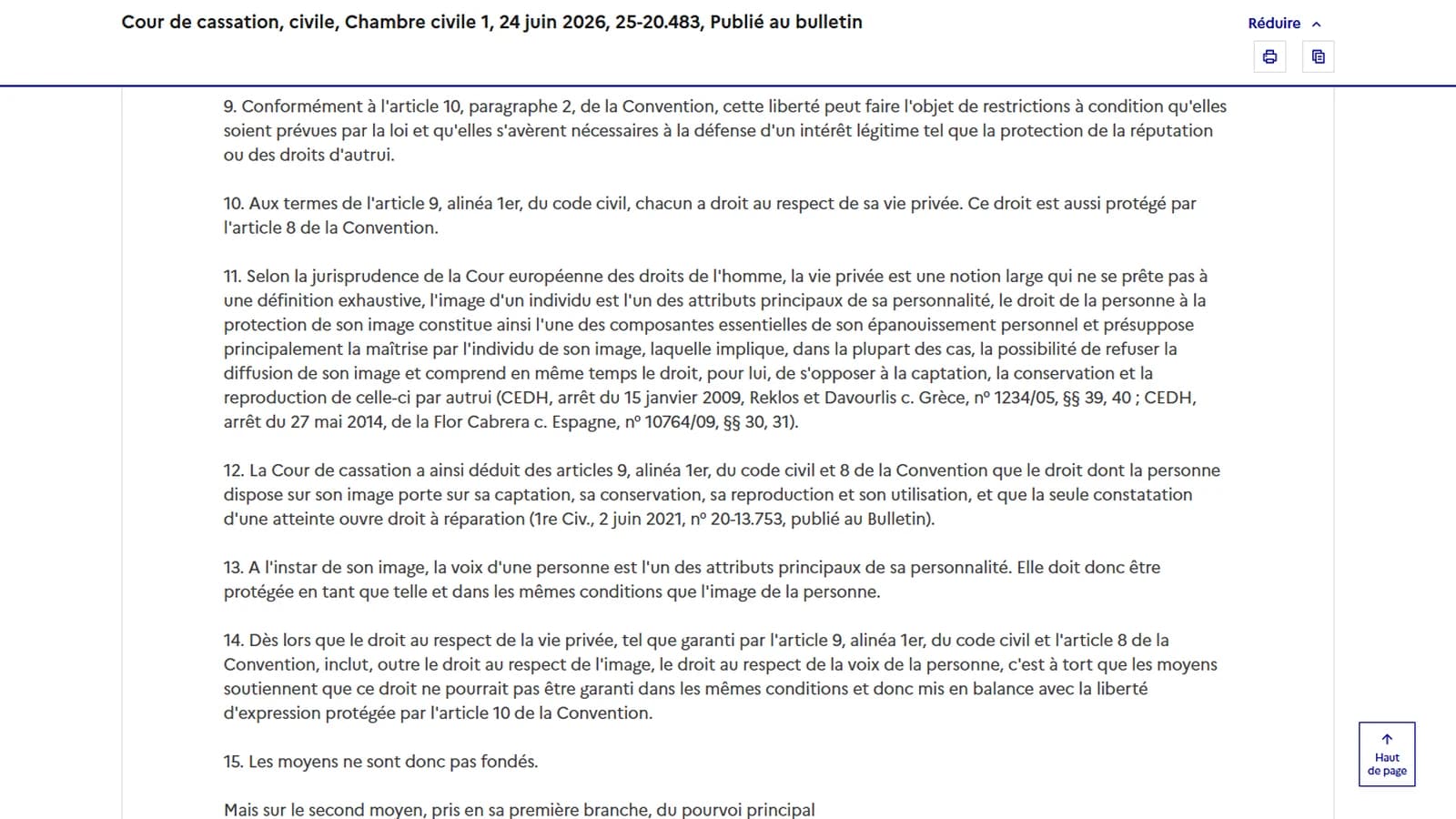
Captured from legifrance.gouv.fr on 1 October 2026, decision no. 25-20.483, paragraphs 9 to 15.
Careful with the reading. The same decision says this right gets balanced against freedom of expression, using the method already applied to image rights. A voice used in a work that feeds a debate of public interest can survive. A voice cloned to sell a subscription, much less so.
Around that ruling, the toolkit already exists:
- Article 9 of the civil code. A judge can order sequestration, seizure and any measure that stops the infringement, including through emergency proceedings. This is the fast takedown route.
- Article L212-3 of the intellectual property code. Written authorisation from the performer is required to fix, reproduce and communicate their performance to the public. A verbal agreement counts for nothing here.
- Article 226-8 of the criminal code, amended by the SREN law of 21 May 2024. It now explicitly covers content generated by algorithmic processing that represents a person's image or words without consent, where the generated nature is neither obvious nor expressly stated. One year in prison and a 15,000 euro fine, rising to two years and 45,000 euros when the content goes out online.
- Article 226-8-1, created by the same law, for sexual content. Two years and 60,000 euros, three years and 75,000 euros online.
- The GDPR. The French data protection authority counts a voice among the elements that identify a person. Anyone storing your samples falls inside the rules.
The weak spot sits elsewhere, and it is structural. In February 2026, franceinfo described an opt-out regime where the burden of proof lands on the victim: the performer has to prove they never agreed. Jonathan Elkaim, the lawyer representing eight voice actors in an action against the platforms Fish Audio and Voicedub, argues for a switch to opt-in that would push that burden onto the platforms. The same report covered voice actor Emmanuel Curtil calling on the Minister of Culture during the 2026 César ceremony, and cases of cloned voices including Philippe Peythieu, the French voice of Homer Simpson.
The sector did not just wait around. The #TouchePasMaVF campaign, launched by a video on 21 May 2024 featuring voices like Brigitte Lecordier, Donald Reignoux and Philippe Peythieu, carried a petition for national regulation.
💡 Frank's cut: the protection exists, the problem is speed. A voice deepfake has its best week in the first 72 hours. If you perform for a living, build your evidence file before you need it: timestamped captures, URLs, account names, an archive of the page. Emergency proceedings only move fast when the claimant walks in with a file already assembled.
What hardened in the US lands on European shoots
You could tell yourself American contracts have nothing to do with you. They do, the moment an American broadcaster finances, co-produces or buys. The clauses travel down the chain.
On 4 June 2026, SAG-AFTRA members ratified the new TV/Theatrical agreement with the AMPTP by 91.42% to 8.58%, with a 19.25% return rate. The contract took effect on 1 July 2026 and runs to 30 June 2030. On AI, the union announced terms that "further restrict use of synthetics". Chief negotiator Duncan Crabtree-Ireland described strict rules meant to keep synthetics "the exception in our industry instead of the rule".
California stacked up its own texts alongside:
- AB 2602, in force since 1 January 2025, voids contract terms allowing the creation or use of a digital replica unless the agreement includes a reasonably specific description of the intended uses and the performer is represented by counsel or a union during the negotiation.
- AB 1836 requires consent from the estate before using the digital replica of a deceased performer, with liability of at least 10,000 dollars or actual damages if higher.
- SB 1050, signed by Gavin Newsom in September 2026 at SAG-AFTRA headquarters, requires a clear disclaimer when an advertisement uses a synthetic performer instead of a human, and bars continued use of an advert found to break the rule. SAG-AFTRA's own announcement covers the text and the union's part in drafting it.
California is the second state to require that disclosure in advertising. New York got there first, with a law signed on 11 December 2025 that took effect in June 2026.
On the European side, article 50 of the AI Act has applied since 2 August 2026, with the deadline for machine-readable marking of systems already on the market pushed to 2 December 2026. Clearly artistic work gets a lighter regime: the disclosure has to exist without spoiling the experience of the work. And no retroactive labelling is required for content generated before 2 August 2026. I walked through those mechanics in the guide to copyright on AI-generated images, which covers the ownership side.
| France | California and New York | European Union | |
|---|---|---|---|
| Basis for voice rights | Article 9 civil code, ruling of 24 June 2026 | State personality rights, AB 2602 | No harmonised voice right |
| Replica of a deceased performer | Moral rights and estate agreements | AB 1836, 10,000 dollar floor | Nothing specific |
| Criminal penalty for deepfakes | Articles 226-8 and 226-8-1 | Mostly civil | Outside the AI Act |
| Mandatory transparency | Through AI Act article 50 | SB 1050 and the New York ad law | Article 50, in force since 2 August 2026 |
| Burden of proof | On the victim, opt-out regime | On the producer, inside the contract | On the system provider |
Where an actor can actually license a voice or a face
While the public debate circles around replacement, licensing routes have opened with written payment rules. They stay largely unknown in France, and they deserve a close look.
Narrativ. In August 2024, SAG-AFTRA signed an agreement with this marketplace letting members offer their voice replica for audio advertising. The performer sets their own rate, as long as it meets or beats the union commercials minimum. They state which kinds of ads they accept, and approve or refuse every offer that comes in. Each use triggers its own consent, and every ad generated with a SAG-AFTRA voice feeds contributions into the union health and retirement plans.
Ethovox. In October 2024, SAG-AFTRA signed a deal for the construction of a fully authenticated foundational voice model. Performers get a session fee plus revenue sharing for the life of the model, calculated as a percentage of gross revenue from licensing or use, split proportionally to each performer's recorded hours. The model is not user-facing and the voices inside it are not identifiable in anything it generates. That is neighbouring-rights logic applied to training data, and it strikes me as the most interesting experiment of the bunch.
ElevenLabs and its iconic voice marketplace. The company signed agreements with CMG Worldwide covering the estates of Judy Garland, James Dean, Burt Reynolds and Laurence Olivier. Uses are defined upfront, and those voices do not get folded into the general pool used to create new ones.
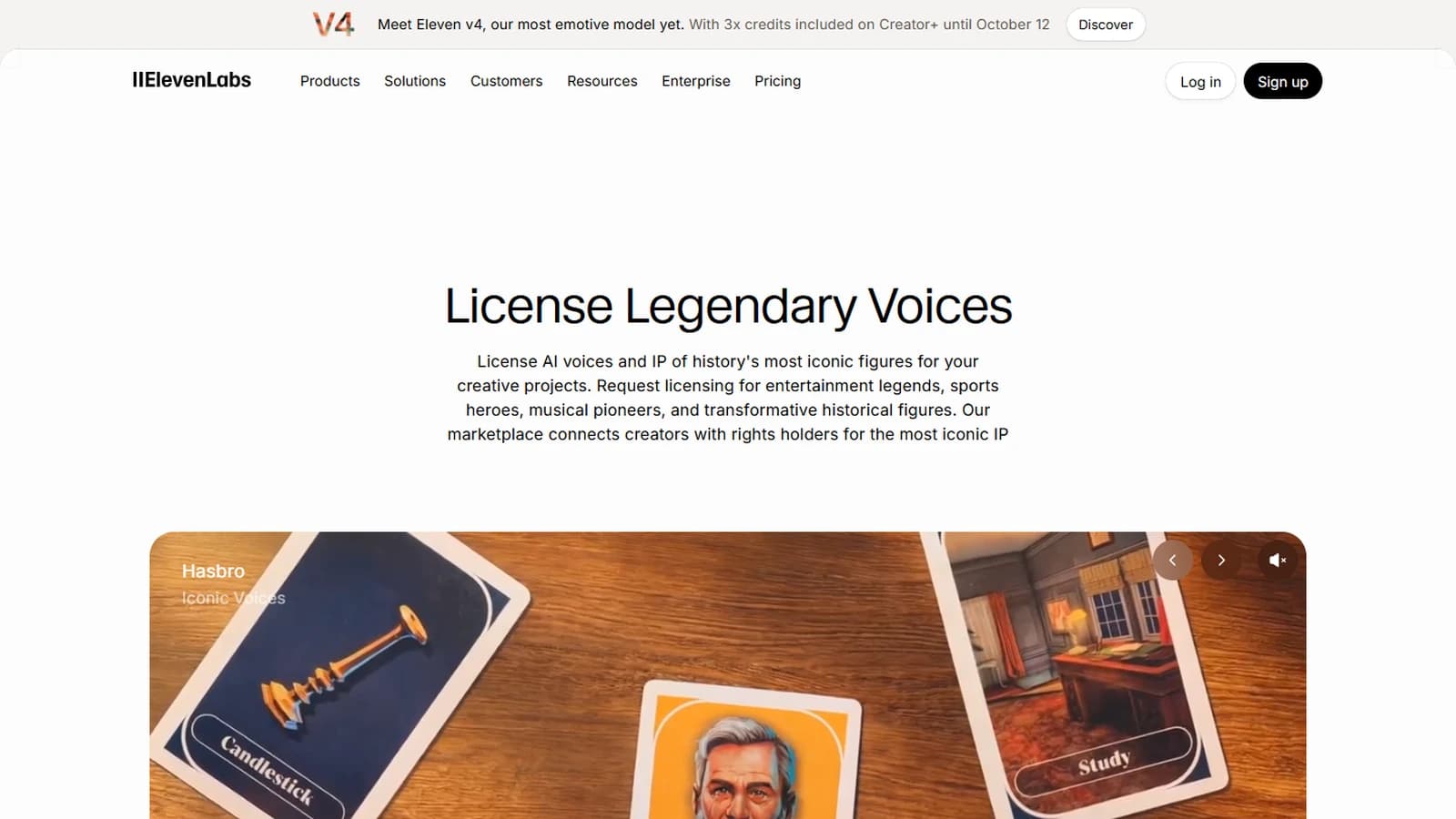
Captured from elevenlabs.io/iconic-marketplace on 1 October 2026. The page describes a match between creators and rights holders.
The Cameo coalition. On 26 August 2026, SAG-AFTRA, Cameo, CAA, UTA, WME and the Music Artist Coalition published a joint statement: talent keep full ownership of the videos they submit, Cameo policies prohibit any account from using AI to generate a deepfake of talent without explicit authorisation, and the platform does not use talent videos to create or train digital replicas without permission.
Narrativ and Ethovox run through SAG-AFTRA membership, so a French performer cannot walk straight in. Those deals still set a contract shape and a payment principle. When a producer offers you a replica clause with no money on top of the fee, you now have something to put on the table.
The clauses I reread before signing anything
The same grid works from both sides of the table, and it holds for a dubbing contract, an actor deal on an AI film, or an image release given to a brand.
- The list of uses, named one by one. Not "all media". Not "media now known or hereafter devised". A list: French TV spot, YouTube preroll, long cut on the brand's site. If a use is not written down, it is not authorised.
- Term and territory. A digital replica does not expire on its own. With no end date, it stays exploitable ten years later. Put a date on it.
- An explicit ban on training. "Files delivered may not be used to train, fine-tune or enrich any model, including for internal use." I have almost never read that line in a contract someone sent me, and it is the one line that closes the door on silent reuse.
- Payment separate from the fee. The fee pays for the performance. The replica is a second object with its own price, ideally per use rather than a lifetime flat rate.
- A right of refusal per project. The Narrativ model gets this right: a blanket consent signed once protects nothing. Consent per use does.
- A survival clause. What happens to the replica if you die, if the company is sold, if the film changes distributor. California answered with AB 1836, French law leans on moral rights and heirs. Write it down anyway.
- Traceability and deletion. Who stores the files, where, and how fast they get destroyed on request. That is the GDPR side, and it is enforceable.
If you sit on the production side, read that list backwards: every one of those points is a question a well-advised performer will ask you in 2027. Anticipating them costs an hour of drafting. Discovering them mid-edit costs a lot more.
For AI directors: using a face without putting yourself at risk
I make films with these tools, so I speak from that chair too. Here are the habits that kept me out of trouble.
I never start from a celebrity face as a reference. Not internally, not for a test, not "just to see". A prompt with an actor's name leaves a trace in the history, and the output is still an identifiable representation of a real person. After the 24 June 2026 ruling, the same reasoning covers a reference voice pulled off a trailer.
When I need a real human, I pay and I get a signature. A paid model, a written release listing the uses, a term. The cost is tiny next to the risk, and the result changes completely when you start from a real person under direction rather than a floating composite. It is also what keeps a character stable across forty shots, something I dig into in my guide to directing an AI character like an actor.
When I build a synthetic face, I check for accidental resemblance. A model trained on millions of photos sometimes spits out someone who exists. Reverse image search on three or four renders of the character before locking the sheet. If it lands on a real person, I shift the features and start again. The build method for a stable character is in my article on consistent characters across multiple images, and the voice side in the guide to cloning and directing voices.
For voice the rule is the same, only stricter, because the proof is easier to make. A spectrogram talks. If you need a precise timbre, hire the person who owns it, or take a library voice whose licence explicitly covers your commercial use.
On ScreenWeaver the question keeps coming up in reverse: by the time you finish writing, you have already decided how many real faces your film needs. Casting settled at the script stage costs less than casting discovered at the storyboard.
What I see break in practice
The most common scenario starts with blanket consent. A performer signs "I authorise the creation and exploitation of my digital replica", with no list of uses, because the sentence sits inside an otherwise normal contract. Two years later their voice is selling insurance. The legal argument gets ugly, since the signed text is broad. AB 2602 bans exactly that drafting in California since January 2025, and French law leans on strict interpretation of neighbouring-rights assignments, but you would rather not have to litigate.
Next comes parody, waved around as a universal shield. The Cour de cassation said in June 2026 that voice rights get balanced against freedom of expression. Balanced, not waived. A work that feeds a debate of public interest has a chance in front of a judge. A promotional video dressed up as parody has none.
The silliest miss is the generated-content disclosure. Article 226-8 of the criminal code targets generated content whose artificial nature is neither obvious nor expressly stated. Writing the disclosure changes the legal qualification, and it costs nothing.
Another classic is the reference voice pulled off YouTube. The file is public, so people assume it is fair game. Public broadcast transfers no rights, and article L212-3 of the IP code requires written authorisation from the performer.
Then there are estates, treated as public domain. A dead actor stays protected. AB 1836 says so in California, and in France the heirs are still across the table from you.
Last, festival declarations. Rules increasingly ask you to state which AI tools you used and whether human performers appear or were replaced. An omission found after selection costs the selection, sometimes more. For the underlying trend in the profession, I went through the numbers in my analysis of audiovisual jobs facing AI.
Foire aux questions
Réponses rapides aux questions les plus fréquentes sur cet article.
Is my voice protected against AI cloning in France?
Yes, and it is now explicit. In a decision of 24 June 2026 published in the bulletin, the first civil chamber of the Cour de cassation held that a person's voice is one of the principal attributes of their personality, protected as such and under the same conditions as their image, on the basis of article 9 of the civil code. In practice you have the emergency proceedings of article 9 to stop the infringement, article L212-3 of the intellectual property code if you are a performer, and the criminal route of articles 226-8 and 226-8-1. The protection has limits: a judge balances it against freedom of expression.
What is the difference between a digital replica and a synthetic performer?
A digital replica reproduces an identifiable real person, either from their work on a project or from existing material. A synthetic performer matches no real person: it is a face and a voice assembled from a model trained on a large corpus. The distinction matters because a replica creates an individual right, held by the person copied, with consent and payment attached. A synthetic performer leaves nobody to ask, which moves the argument onto training-data rights and onto the duty to tell the audience what they are watching.
How much can an actor earn by licensing a voice to AI?
No public rate card applies in France, so treat any figure quoted without a source with suspicion. What is documented is the mechanics. On Narrativ, the August 2024 SAG-AFTRA agreement lets the performer set their own rate with the union commercials minimum as a floor, and every use generates health and retirement contributions. With Ethovox, in October 2024, the model combines a session fee with revenue sharing across the life of the foundational model, split in proportion to each performer's recorded hours. Those are structural references, not rates you can lift straight into a French contract.
Does an advert using an AI-generated actor have to say so?
In the United States, yes in two states. New York has required it since June 2026, and California since SB 1050 was signed in September 2026, which demands a clear disclaimer when an advert uses a synthetic performer and bars continued use of a non-compliant advert. In the European Union, article 50 of the AI Act has required disclosure of the artificial nature of content since 2 August 2026, with the deadline for machine-readable marking of systems already on the market pushed to 2 December 2026. In France, a missing disclosure can also fall under article 226-8 of the criminal code.
Can I use a deceased actor's face in an AI film?
Not without the estate's agreement. In California, AB 1836 requires consent from the estate before using the digital replica of a deceased performer, with liability of at least 10,000 dollars or actual damages if higher. In France you run into moral rights, which are perpetual and transmissible, and into whatever agreements the family or rights holder has already signed. Licensing routes exist: ElevenLabs signed with CMG Worldwide for the estates of Judy Garland, James Dean, Burt Reynolds and Laurence Olivier, with uses defined in advance.
What wording blocks a model from training on my takes?
One explicit sentence, placed inside the exploitation clause rather than an annex: files delivered may not be used to train, fine-tune or enrich any artificial intelligence model, including for internal use and including a model that is never exposed to end users. Add a deletion deadline for the source files on request, and a named contact for that request. It is the clause most often missing from contracts I see going around, and it is the only one that stops reuse outside the negotiated scope. The rest of the contract can be perfect; without it, a door stays open.
Do SAG-AFTRA rules apply to a French producer?
Not directly, since it is an American collective agreement binding signatory producers. But the clauses travel down the financing chain. The moment an American broadcaster or studio co-produces, pre-buys or distributes, its contractual duties land on the local contracts. The TV/Theatrical agreement ratified on 4 June 2026 by 91.42% of voters, running from 1 July 2026 to 30 June 2030, tightens the use of synthetics further and requires notice and bargaining beforehand. Worth drafting your French contracts to that standard now.
Can a festival reject my AI film over a generated face?
Not on principle, since most festivals have opened dedicated sections. The risk sits in the declaration. Rules increasingly ask which tools were used, and whether human performers appear or were replaced. An incomplete or false declaration, found after selection, ends in withdrawal. Put together a production document listing the tools, the versions, the signed releases from anyone filmed or referenced, and the music rights. That document also serves you in front of a distributor, who will ask exactly the same questions.
The lag is in the contracts
The law moved faster than the contracts going around, which is rare enough to be worth saying. In France, the voice has been protected like the image since June 2026, criminal law explicitly covers generated content since the SREN act, and performers' rights require written authorisation. In the United States, advertising transparency is becoming mandatory state by state, and the actors' collective agreement frames synthetics until 2030.
What remains is the burden of proof, still sitting on the person who got copied. That is the point the voice actors' lawyers are trying to flip, and that is where the next round plays out.
If you perform, a market has opened next to the risk, with contract shapes worth borrowing even without an American union card. If you build films, pay the faces you use, write down exactly what you do with them, and keep the paper trail. One hour of drafting at the start of a project. A lot cheaper than a festival withdrawal or an injunction.
Related articles
 Guides
Adapting a book into an AI film: rights and method
How to check whether a book is free to use, how to get adaptation rights when it is not, and how to cut three hundred pages down to ten minutes.
 Analyses
Artificial Intelligence and the Creative Industry: Opportunities or Dangers?
A reading grid for brands, studios and independents: where AI creates value, where it weakens trust, and how to decide without getting trapped by the marketing.
 Tutoriels
Copyright and AI Music for a Film Soundtrack
What the tool licenses cover, client clauses, and hybrid composer + AI alternatives.