Case Study: How I Co-Wrote My Film Using Artificial Intelligence
A field report on an AI-assisted film co-writing: what worked, what failed, and the final method.

I am going to tell you a real production slap. At first, I thought co-writing a film with AI was going to save me a crazy amount of time. I had a strong concept, a clear atmosphere, and the impression of having finally found a tireless narrative assistant. In two days, I had dozens of pages. Problem: it was fluid, but empty. The text sounded right on the surface and false in depth.
The first table read was brutal. The scenes chained with no dramatic necessity, the characters changed emotional logic too fast, and the dialogues were "pretty" but not embodied. The tool produced sentences. Not cinema. That moment forced me to review my whole method.
This case study is here for that. To save you the weeks I lost believing that writing speed was enough. You are going to see what broke, what unblocked, then the concrete method that let me transform an artificial script into a shootable screenplay.
Core concepts: what co-writing with AI really means
Co-writing with AI does not mean delegating the author. It means outsourcing part of the iteration. The AI proposes, tests, reformulates, accelerates. The author chooses, decides, structures, and owns. As soon as you reverse this relationship, you get a text that looks like a film without being one.
The first key concept is the dramatic matrix. With no objective, obstacle, conflict, and emotional shift scene by scene, the AI fabricates convincing but narratively hollow paragraphs. It fills the void with verbal fluidity. It is pleasant to read. It is weak to play.
The second concept is the work granularity. When you ask "write me a feature", you get a statistical average of stories seen everywhere. When you ask "solve the conflict of this scene while keeping this stake", the quality rises. The scale of the request radically changes the value of the answer.
The third concept is orality. A dialogue that works on screen is not a literary dialogue. The AI loves complete and balanced sentences. The actors, on the other hand, need breaks, subtext, breath, the unsaid. With no reading aloud, you miss this essential test.
The fourth concept is narrative versioning. Each decision must be traced: why this version is retained, what problem it solves, what risk it creates. With no log, you can easily come back to a weaker script believing you are "improving".
To keep a visual and narrative consistency between writing and the future shoot, our complete workflow from idea to realistic AI film stays an excellent transversal frame.
| AI co-writing approach | Typical result | Real advantage | Major risk | Corrective method |
|---|---|---|---|---|
| Full script in one prompt | fast long text | initial speed | dramatic inconsistency | cut scene by scene |
| Infinite global rewriting | many variations | diversity of formulations | loss of author direction | fixed selection criteria |
| Iteration by narrative problem | targeted progression | measurable improvement | demands more rigor | decisional changelog |
| Table read integrated into the process | embodied text | real playability test | more time short-term | enormous gain at the shoot |
The trench workflow: the method that finally worked
After the failure of the first version, I restarted the project from scratch with a simple rule. Never again a "macro" generation with no precise question. Each work session had to solve a concrete narrative problem: clarify an objective, reinforce a conflict, simplify an exposition, or make a dialogue playable.
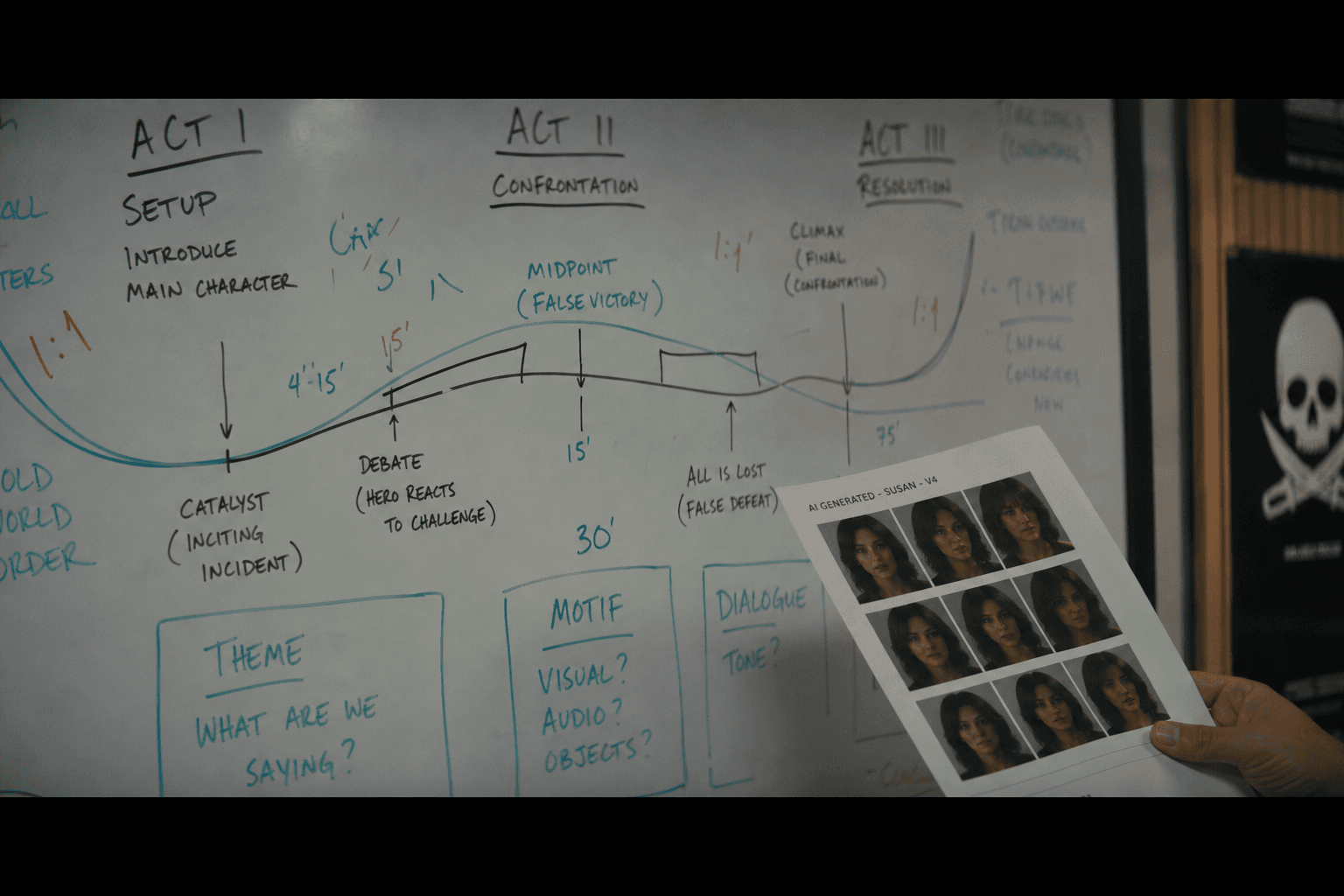
I then built a sheet per scene with four non-negotiable points: character objective, main obstacle, visible decision, emotional consequence. As long as a draft did not validate these four points, it was rejected, even if the style was seductive.
Third decision, I integrated reading aloud as a systematic step. Not at the end of the process. During the process. A scene that sounded "smart" on the text could collapse in 20 seconds of reading. This step saved me from building a false brilliant script.
Finally, I kept an ultra-simple changelog: version, modification, reason, expected effect, verdict after reading. This document became my compass. It is what stabilized the writing when the tool proposed a thousand alternatives.
What failed at the start and why
Initial mistake number one, I asked for a complete script too early. The AI delivered me a fuzzy narrative architecture with interchangeable scenes. At first, I confused volume and progression. I had a lot of pages, but little dramatic necessity.
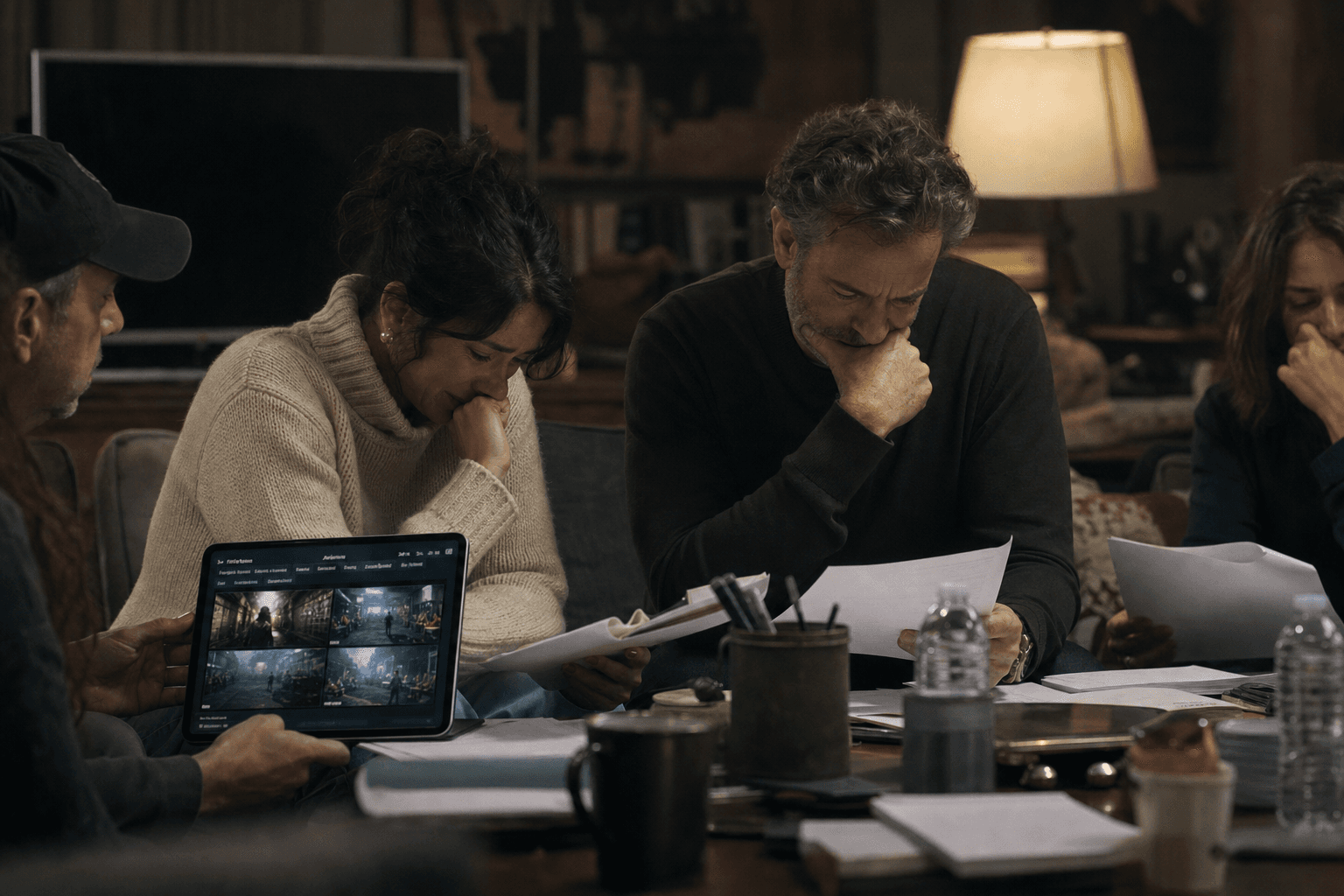
Mistake number two, I accepted "well-written" dialogues with no oral test. In silent reading, it seemed clean. In a table read, it was frozen, explanatory, sometimes artificial. The characters talked "about" themselves instead of acting through speech.
Mistake number three, I changed several variables at once. Tone, stake, temporality, character relation. Impossible afterward to understand what really improved the scene. The process was fast, but blind.
Mistake number four, I had no clear rejection criterion. Result, I kept "not-bad" versions. The screenplay became an accumulation of compromises rather than a sharp vision.
The pivot that changed everything: writing scene by scene with constraints
The real turning point came when I stopped "asking for text" to "ask for solutions". Example: "give three versions of this scene where the character gets the info without exposing their past". There, the AI became useful, because it answered a real dramatic constraint.
I limited each iteration to 2 or 3 short variants. Not ten. This constraint forced me to choose. Projects often die from an excess of options, not from a lack of options.
Then, I froze the voice of the characters in a mini bible. Vocabulary, sentence rhythm, level of restraint, avoided subjects, way of lying. On rereading, I could immediately detect if a line went out of character.
This frame let me recover the author direction without giving up the AI speed. The tool no longer steered the story. It fed a directed process.
💡 Frank's Cut: if a version is brilliant but does not serve the central conflict, delete it. Local quality never compensates for a structural weakness.
The key field lessons after several versions
First lesson, the precision of the dramaturgical prompts is worth more than the length of the prompts. A brief and clear request on a scene problem often gives a better answer than a long fuzzy brief.
Second lesson, the characters stabilize when you write their limits, not only their intentions. What they refuse to say, what they hide, what they cannot do. These limits produce more living dialogues.
Third lesson, the reading aloud must include real silences. Many AI dialogues are too "continuous". By putting pauses and interruptions, you immediately see what is playable.
Fourth lesson, always keep a "safe" version of each validated scene. It is essential when a late rewrite breaks a balance that worked.
Operational conclusion: AI accelerates, the author decides
After several cycles, the final screenplay was shorter, tenser, and more playable than the first "automatic" version. The real gain was not "writing more". The gain was "deciding better" faster.
The AI helped me explore options. It never replaced me on the choices of structure, tone, and emotional truth. It is exactly the posture I recommend to beginners: use the tool as an iteration workshop, not as a substitute for vision.
If you want to link this writing logic to the concrete making of the scenes and the final rhythm, our AI-assisted video editing guide is a natural extension.
And if your project includes a lot of dialogue or narration, think of validating the vocal dimension early. Our AI voice-over and dubbing method can save you heavy retouches in post-production.
Troubleshooting: what beginners break in AI co-writing
Mistake number one, writing with no precise dramatic question. The AI answers with generic text. Correction: formulate a concrete narrative problem before each generation.
Mistake number two, keeping too many "mediocre" versions. The screenplay loses its spine. Correction: strict rejection criteria and sharp decisions.
Mistake number three, neglecting the oral reading. The dialogues seem elegant but sound false. Correction: systematic table read at each major iteration.
Mistake number four, doing permanent global rewrites. You destabilize the whole script at each pass. Correction: local rewrite, scene by scene, with measured impact.
Mistake number five, forgetting the character consistency. The voices mix and the dramatic identity fades. Correction: a concise character bible and regular checks.
Mistake number six, no decision log. You get lost in the history and you reopen debates already decided. Correction: a simple, living, shared changelog.
To go deeper into your screenwriting and structural bases, you can consult the resources of John August, the principles of The Writer's Journey and the pedagogical content of Sundance Collab. These references complement a modern AI workflow well.
💡 Frank's Cut: when you hesitate between two scenes, keep the one that creates a decision in the character. Not the one that best explains the universe.
FAQ: the real questions about co-writing a film with AI
-
Can you really co-write a good film with artificial intelligence?
Yes, but not in autopilot mode. The AI can help you generate variants, explore trajectories, reformulate scenes and accelerate the test cycles. What it does not do in your place is the hierarchy of stakes, the emotional consistency, and the author direction. A good film is born from strong human decisions. The best approach consists of using the AI as an iteration engine framed by a strict method. With no frame, you get a fluid but fragile text. With a frame, you gain a powerful accelerator. -
What is the most frequent mistake when starting AI co-writing?
The most frequent is asking for a complete script too early, then trying to correct after the fact. This approach creates an unstable base hard to straighten. Better to build scene by scene with clear dramatic constraints. You validate each block before moving to the next. This progression seems slower at the start, but it is much more effective in the medium term. It saves you the endless global rewrites and strongly improves the final quality of the screenplay. -
How to formulate good prompts for the screenplay?
Pose a precise problem, give a short context, set limits, and ask for few targeted variants. Example: "Propose three short versions of a scene where X gets the info with no frontal exposition, tense tone, natural dialogue, ending on a decision." This type of request produces usable answers. The too-vast prompts often give generic results. The clarity of your question is directly proportional to the narrative value of the answer. In a screenplay, precision beats quantity. -
How to know if an AI dialogue is really good?
The main test is oral. Read aloud, ideally with several people. Listen to the rhythm, the breaks, the silences, and the truth of the intentions. A dialogue can seem elegant in silent reading and completely collapse in performance. Also check whether each character keeps a distinct voice. If all the lines could be said by anyone, the dialogue lacks identity. Finally, make sure the speech advances an action or a conflict, not only information. -
Should you keep all the variants generated by the AI?
No, and it is even dangerous. Too many unsorted variants create noise and slow the decision. Keep only the options that answer a precise criterion: reinforce conflict, clarify objective, improve orality, tighten rhythm. Archive the rest cleanly. Film writing is a process of choice, not of accumulation. The selection discipline is as important as the generation itself. With no this discipline, you confuse exploration and progression. -
How to avoid the screenplay losing my author voice?
Define an author charter before the iterations: priority themes, tonality, limits, type of ending, level of realism, way of treating the characters. Then, check each scene against this charter. The AI can easily drift toward conventional solutions if you do not maintain this frame. Your voice does not disappear because of the tool. It disappears when you stop actively filtering the proposals. The author filter is the key. -
What work rhythm to adopt to progress fast?
A 90-minute sprint works very well. 20 minutes of problem framing, 40 minutes of targeted iterations on one or two scenes, 20 minutes of reading aloud, 10 minutes of decisions and changelog. This format is short enough to keep energy and long enough to produce concrete results. Repeated several times a week, it creates a fast and measurable progression without drowning you in a rewrite marathon. -
How to link AI co-writing and shoot preparation?
As soon as a scene is validated, add feasibility notes: number of places, dialogue complexity, sound constraints, visual needs, continuity risks. This bridge avoids delivering a "beautiful" but impractical script. The earlier you integrate the production constraints, the more your screenplay becomes shootable without betraying your vision. AI co-writing is really powerful when it stays connected to the reality of the set.
What failed at the start
Generating a complete script with no clear dramatic matrix. Result: fluid but inconsistent text.
The pivot that changed everything
Switching to problem-solving scene by scene: conflict, objective, obstacle, emotional shift.
Key lessons
- Short variants, not infinite rewrites
- Oral dialogue, not literary
- Validation by reading aloud
- Decision changelog at each version
Operational conclusion
AI serves the development speed. The author keeps the consistency, the tone, and the artistic responsibility.
Detailed operational method
To transform a good concept into a really usable result, work with a simple and repeatable protocol. Start by defining a single objective for each production session: improve the conversion, reinforce the emotion, stabilize the continuity, accelerate the retakes, or finalize the technical quality. As long as this objective is not explicit, you risk multiplying the tests without learning what works.
Then, impose a short loop in four steps: preparation, execution, control, decision. In preparation, lock the non-negotiable parameters (scene intention, level of realism, distribution format, deadline constraints). In execution, produce several targeted variants rather than a single ambitious version. In control, compare the renders in their real context: complete timeline, global rhythm, readability on mobile and big screen, sound/image consistency. Finally, take a binary decision: keep, correct, or delete.
Most creators waste time because they evaluate the renders in an isolated full screen. Yet a shot can be superb alone and degrade the whole scene once edited. To avoid this trap, define validation criteria before launching the generations: message clarity, visual continuity, movement credibility, audio intelligibility, and narrative impact. If two key criteria fail, do not retouch indefinitely: restart on a simpler version.
Quality checklist before publication
Before the final export, systematically go through this checklist:
- consistency of the style from one shot to the next;
- stability of the sensitive elements (face, hands, lips, text, logo);
- audio balance (understandable voice, non-invasive music, controlled noise);
- rhythm adapted to the distribution channel;
- call to action, message, or creative intention readable from the first seconds.
This check takes little time and avoids the technically "impressive" but ineffective-in-real-use deliverables.
Frequent mistakes to avoid
The first mistake is wanting to optimize everything at the same time. When you simultaneously modify the framing, the light, the style, the sound and the speed, you no longer know which variable really improves the result. The second mistake is ignoring the versioning: with no clear history, impossible to come back to a good base. The third is over-treating the finish, which creates an artificial or tiring render.
Keep a progression logic: first the comprehension of the scene, then the visual quality, then the aesthetic details. This hierarchy protects the narration and saves time.
Concrete action plan
If you want to apply this method starting today, set yourself a 90-minute sprint: 20 minutes of preparation, 40 minutes of production in short variants, 20 minutes of in-context evaluation, 10 minutes of decisions and documentation. At the end of the sprint, keep a "safe" version ready to publish and an "ambitious" version to test. This discipline creates a reliable pipeline, lets you deliver more regularly, and improves the project quality project after project.
Related articles
 Tutoriels
Creating a Striking Video Ad With Artificial Intelligence
A complete guide to creating a striking video ad with artificial intelligence, from the idea to the conversion-oriented final edit.
 Tutoriels
Creating 3D Textures With Artificial Intelligence for Your Projects
Seamless tile, UV, plausible PBR, and Blender or game-engine integration: a clean pipeline between AI and 3D.
 Analyses
Luc Julia and the French Vision of Artificial Intelligence
Career path, strong ideas and what a creator can take from them: between sovereignty, engineering and industrial pragmatism, with no naivety or catastrophism.