How to Write a Short Film Script from A to Z with AI
A complete masterclass to write a short film with AI, from the raw idea to a shootable script, with no artificial dialogue or shaky structure.
You open your AI tool, you type an idea that is close to your heart, and in 20 seconds you receive a "clean" text. You read it. It sounds fake. The characters talk like polite robots. The conflict arrives too late. The ending explains everything instead of hitting emotionally. I know that pain by heart. I lost weeks like that, confusing generation speed with writing quality.
Here is the central point: AI does not write badly by nature. It simply amplifies your level of direction. If your framework is vague, it manufactures generic. If your framework is precise, it becomes a formidable co-author. This guide is built for complete beginners who want to write a real short film script with AI, with a set method, concrete parameters, robustness tests, and shootable decisions. You do not need to be a writer. You need to be a director, not a perfectionist at the start, but demanding at the end, with no exception.
The concepts that change everything before writing a scene
A short film does not forgive approximation. You do not have 90 minutes to correct the trajectory. You have between 7 and 12 minutes to set up a world, create a tension, and leave an emotional trace. So the first decision is brutal: you have to choose a simple, readable, but loaded conflict. If you try to tell three arcs at the same time, AI will give you a text "rich" on the surface and empty in impact.
The second concept is the final emotional promise. You have to write a sentence that starts with: "At the last image, the viewer must feel…" This sentence becomes your magnetic north. When a scene is technically correct but emotionally off track, you cut it. It is as simple as that.
The third concept is the production constraint integrated into the writing. But that is where everything breaks: most beginners write an "ideal" script, then try to make it feasible afterward. Bad approach. You have to integrate the shooting reality from the prompt: 2 locations, 2 to 3 characters, 2 production days, few fragile effects. Your script becomes stronger, not poorer.
The fourth concept is visual action as the main language. A good AI script is not a wordy PDF. It is an implicit staging plan. If your scene does not work with no dialogue, it is fragile. To reinforce this visual logic, lean on our Flux and SDXL comparison guide for realistic images, our method to create a consistent visual world with AI, and our complete idea-to-realistic-AI-film workflow. To move from text to previsualization images, our AI storyboarding guide helps lock shots before writing in a vacuum.
The fifth concept is the management of subtext as a primary skill. AI tends to name the emotions instead of showing them. Your job consists in imposing unsaid constraints: a ban on explaining the fear, an obligation to translate it into a gesture, a gaze, a delay in the answer. This gap produces playable scenes. The sixth concept is rewriting as a sport: a good session is not the one that produces thirty pages, it is the one that transforms three critical beats with a clear decision each time.
Trench workflow to write an AI script from A to Z
Step 1: lock the dramatic base before any dialogue
Start by writing yourself an ultra-short sheet in 8 lines: protagonist, intimate flaw, immediate desire, main obstacle, risk of loss, central shift, final image, tonality. No need to be literary. You write functional text. This sheet avoids the "write along with the AI's inspiration" trap.
Then, ask the AI for three possible structures while imposing firm limits. Example of a command: "Propose 3 realistic short film structures, 8-10 minutes, 2 locations max, 2 main characters, an emotionally open ending." The goal is not to choose "the coolest", but the most playable and the most readable.
Then ask for a comparative self-critique: tension, originality, visual clarity, feasibility. This step is underused and yet powerful. AI is often better at criticizing its options than at producing a perfect first draft.
Finally, impose an anti-cliché pass. Say explicitly: "List the narrative clichés of this structure and replace them with alternatives anchored in the real." Watch what happens when you do that: the level rises immediately.
Step 2: build a truly cinematic beat sheet
Your beat sheet is the backbone of the film. Aim for 10 to 14 beats, no more. Each beat must contain a goal, conflict, shift, visual proof. If a beat has no visual proof, it belongs to a novel, not a short film.
Then break down the time. For example: active exposition (0:00-1:30), pressure rise (1:30-5:00), crisis (5:00-7:00), resolution (7:00-9:00). You are not obliged to follow this model to the second, but you have to give a measurable rhythm to the AI.
Add a "indispensable dialogue?" column for each beat. If the answer is "no", it is a good sign. If the answer is "yes" everywhere, your film explains too much.
Here is a simple and robust grid:
| Beat | Target minute | Goal | Conflict | Shift | Visual proof |
|---|---|---|---|---|---|
| 1 | 0:00-0:40 | Set up the flaw | Internal denial | Unease | Hands trembling over an unsent text |
| 2 | 0:40-1:20 | Trigger the action | External refusal | Forced decision | A door closed in slow motion |
| 3 | 1:20-2:30 | First test | Concrete failure | Shame | An avoided gaze in a mirror |
| 4 | 2:30-4:00 | Escalation | A lie that costs | Guilt | A broken object off-frame, a dry sound |
| 5 | 4:00-6:00 | Crisis | An impossible truth | Rupture | A prolonged silence + camera pullback |
Step 3: write scene by scene with dialogue parameters
Never ask for the complete script in a single generation. You work scene by scene. You generate scene 1, you read it aloud, you adjust, then you move to the next one. This cycle avoids the "beautiful overall text impossible to act" effect.
For the dialogues, impose a density rule: 60 to 70% of the lines under 12 words in the tension scenes. It forces precision. The characters stop explaining their psychology as in a lecture.
Then ask for 3 subtext variants for each weak line. Example: "Rewrite this line in a defensive version, an ironic version, a silent version with an action." You get back acting, not just words.
Then add sensory micro-indications in the actions: the sound of a neon, a held breath, a fabric rubbing, the noise of a key. These details immediately give cinematic material.
💡 Frank's Cut: when a dialogue sounds fake, first replace it with an action. If the scene holds without the sentence, delete the sentence for good.
Step 4: real scenarios to train your level fast
Case 1, intimate drama. A girl empties her deceased father's apartment. Weak version: an explanatory monologue about their relationship. Strong version: she discovers an unlabeled tape, hesitates, puts it down, leaves, comes back. The conflict is in the gesture, not in the text.
Case 2, single-location thriller. Weak version: twists every 30 seconds. Strong version: a single threat, that rises in 4 clear stages. AI loves escalation. Your job is to slow down to reinforce.
Case 3, melancholic comedy. Weak version: verbal jokes in rapid fire. Strong version: social unease, timing, micro-humiliation, tenderness on exit. You have to explicitly ask for "visual situational humor".
These three cases show you a universal rule: AI quickly generates surface solutions. You dig the truth of behavior. That is where the film is born.
Step 5: lock the author voice and an anti-generic bible
Before writing lines, create a voice bible in five lines per character: sentence rhythm, favorite lexicon, defense mechanism under stress, taboo subject, and the lie they tell themselves. This document is not literary. It is operational. You paste it at the head of each AI session like a contract. When a line sounds too polite, it is not an accident: it is because the model optimizes politeness by default. You have to reinject the flaw.
Also add a short list of forbidden phrases: explanatory formulations like I feel that, deep down I think that, you know how it is. These are interior leaks that kill cinema. Replace them with actions or silences. Then impose a two-pass rewriting rule: pass A for the meaning, pass B only for the subtext and the harshness. Most beginners mix the two and get a soft text.
Finally, document a viewer promise in one line: at the end, I want the audience to wonder whether X will dare to do Y. If a scene does not feed this question, it is a candidate for the cut, even if it is beautiful. This discipline seems cold. It is in reality what protects your emotion.
Step 6: move from the beat sheet to a minimal technical breakdown
When your beat sheet stands up, make a light breakdown: number of scenes, locations, fictional time slots, and transitions. You do not write the shot-by-shot yet. You check if your story is filmable with no gymnastics. If you have to change city three times in eight minutes, you do not have an AI problem. You have a production framing problem.
Then ask the AI for a list of risks: which beats are the hardest to act, to frame, or to edit. Use this list to adjust before writing whole pages. It is a step rarely taught to beginners, because it is not glamorous. Yet it avoids the scripts magnificent on paper and impossible on set.
Troubleshooting: what beginners break and how to repair it
Problem 1: interchangeable characters. If you can swap the lines without changing the scene, it is broken. Fix: create a voice sheet per character, with a favorite lexicon, a sentence rhythm, a defense mechanism, a dominant unsaid.
Problem 2: soft middle. Many AI scripts have a good start then stagnate. Fix: add a rule "each scene must increase the emotional cost". If the scene costs the character nothing, it deflates the film.
Problem 3: explanatory ending. AI often concludes with a verbal moral. Fix: generate 5 endings with no dialogue and choose the one that opens an emotional question rather than closing the interpretation.
Problem 4: unshootable script. Too many locations, too many extras, too many fragile actions. Fix: a "production mode" pass with an explicit constraint and keep the arc. You can ask: "Optimize for 2 locations, 2 days, 3 characters, without losing the tension."
Problem 5: a "clean but dead" render. Fix: reinject human imperfection into the writing. Contradictory characters, silences, incomplete decisions, failed actions. The real is not smooth.
Problem 6: over-explaining the stakes in the first five minutes. Fix: move the information toward visual proofs and gestures. Keep one orientation sentence maximum at the start, then impose the action.
Problem 7: uniform tone between all the characters. Fix: rewrite each scene with a different voice constraint (talkative vs dry, ironic vs literal) and have it read aloud changing the reader.
Problem 8: dependence on AI for the structure with no human validation. Fix: impose a twelve-hour break between the AI version and the re-read. Your brain spots the generic better when you come back fresh.
External references to use intelligently
Read little, apply a lot. I recommend three solid sources: Syd Field for the dramatic structure, BBC Academy for the fundamentals of audiovisual writing, and the OpenAI documentation for the prompt iteration loops.
The goal is not to collect frameworks. The goal is to produce a shootable, readable, emotionally precise script. If you do only one thing after reading: write your final promise on a sticky note and refuse any scene that does not feed it.
Foire aux questions
Réponses rapides aux questions les plus fréquentes sur cet article.
How do I avoid AI writing dialogues that are too explanatory?
The best antidote is to define the hidden intention before generating the lines. For each line, ask yourself what the character wants to obtain in the moment, and what they refuse to admit. Then, force a rewrite in subtext with a length constraint, for example under 12 words for the tense lines. Systematically read aloud. This test immediately reveals the "literary" sentences. Finally, replace 20 to 30% of the weak lines with concrete actions. The dialogue must push a relationship, not explain the plot to the viewer.
What ideal length should I aim for a first short film written with AI?
For a first project, a target of 7 to 10 minutes is the most pedagogical zone. You have enough space to set up a conflict, build a tension and conclude emotionally without blowing up the production complexity. Below 5 minutes, you risk a conceptual film that is too dry. Above 12 minutes, the rhythm and consistency problems become harder to master for a beginner. AI helps speed up the writing, but the narrative hold still depends on your control. The shorter the format, the faster and more measurable your learning.
Should I write alone first or directly with the AI?
The most effective is a hybrid model in two steps. First, you write alone the intention note, the emotional promise and the production constraints. This step protects your author voice. Then, you use the AI to generate structure variants, alternative beats, and dialogue options. If you do the reverse, the AI imposes its generic texture. If you refuse the AI, you lose an enormous speed on the iterations. The right balance is a human author for the direction, an AI assistant for the exploration and the test.
How do I check that an AI script is really ready to shoot?
Use a four-pass validation. Pass 1, a complete read aloud with timing. Pass 2, a visual test: each scene must be understandable with no dialogue. Pass 3, a production audit: locations, time, cast, logistics, complexity level per shot. Pass 4, an external emotional test: have it read by a person who does not know the project and ask what they feel at the end. If the answers are clear and consistent with your initial promise, your script is ready. Otherwise, you correct before the storyboard to avoid a costly domino effect.
What prompts should I use to improve a weak scene?
The best prompts are specific and problem-oriented. Example 1: "Rewrite this scene keeping the goal, but with no direct verbal exposition." Example 2: "Propose 3 versions of a more concrete conflict with the same duration." Example 3: "Reduce the dialogue by 30% and replace it with observable actions." Avoid vague prompts like "make it more cinematic". They produce adjectives, not decisions. Structure your prompt around a single lever per pass. One pass for the rhythm, one for the subtext, one for the feasibility.
How do I keep my personal voice while using AI intensively?
Your voice comes from your choices, not from your keyboard. You protect it by locking three non-negotiable elements: your theme, your emotional viewpoint, and your level of behavioral realism. AI can propose options, but you have to refuse what does not belong to your world. Concretely, keep an "author bible" document with forbidden phrases, rejected clichés, and character-truth criteria. Re-read each scene against this bible before validation. Speed must never replace identity. AI speeds up the production, not the authenticity.
Can you sell a script co-written with AI in a pro context?
Yes, if the text is solid and you master the transparency of the process. The pro market judges the dramaturgical quality, the feasibility and the singularity of the proposal. The use of AI becomes problematic when it produces a standardized script or vague legal zones. Document your writing method, keep the history of the passes, and clarify the tools used. Above all, present a living, playable, and consistent script. Nobody finances a prompt. People finance an executable vision that holds up against the production constraints.
Related articles
 Tutoriels
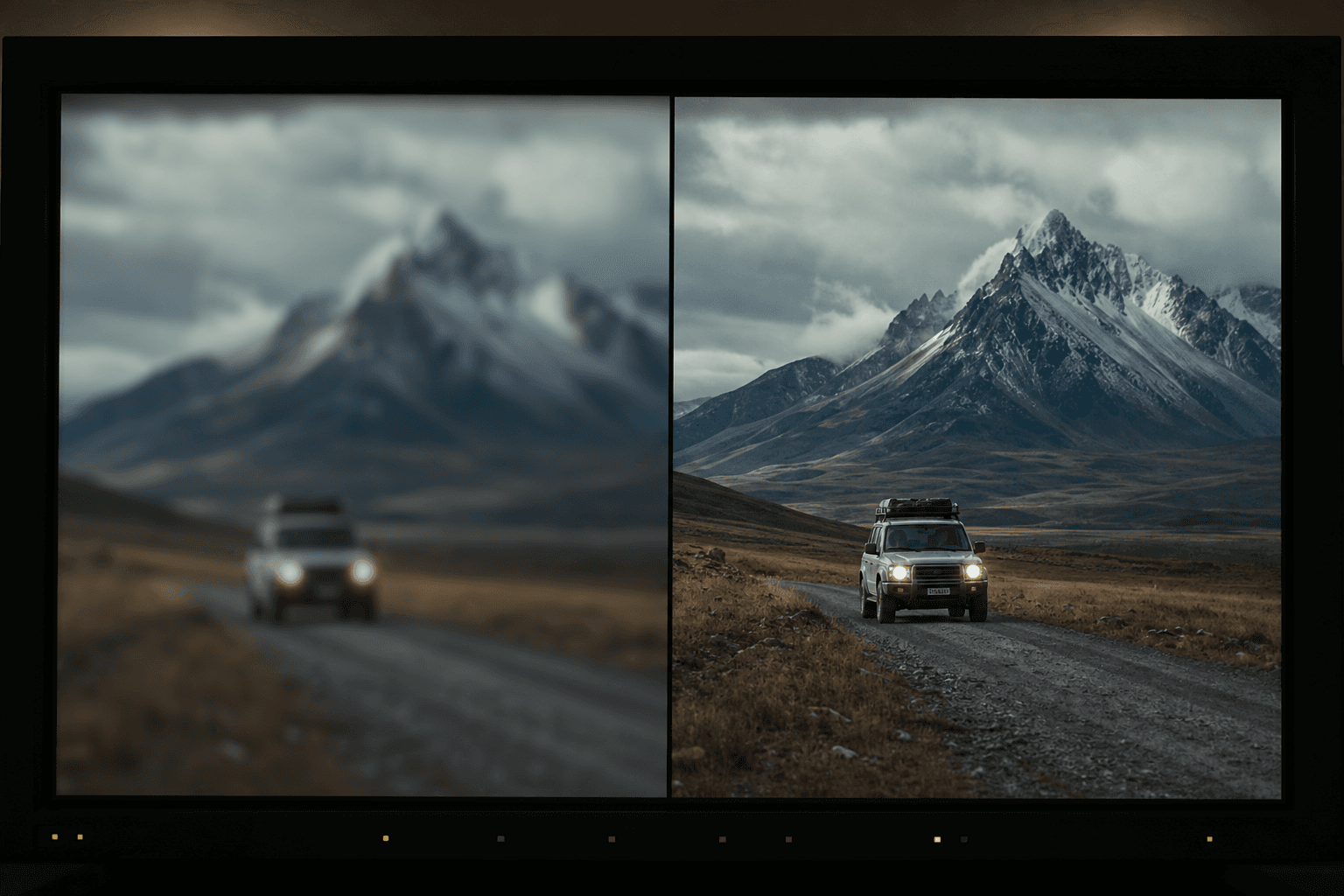
Video upscaling: bring your old short film to 4K with AI
Field method to upscale an old short film to 4K with AI, preserve the cinema texture and avoid the artifacts that betray an amateur render.
 Tutoriels
Creating a 100% AI Short Film With No Camera or Actors
Narrative structure, character consistency, honest limitations, and finishing to hold up at an online festival.
 Tutoriels
Managing Sonic Depth for an AI Short Film
A practical sound design method to give volume, distance and emotion to a generated scene.