Creative career change with AI: from business to film
Why I left online business content for AI filmmaking, what came with me, what I had to drop, and a method to plan your own creative career change.
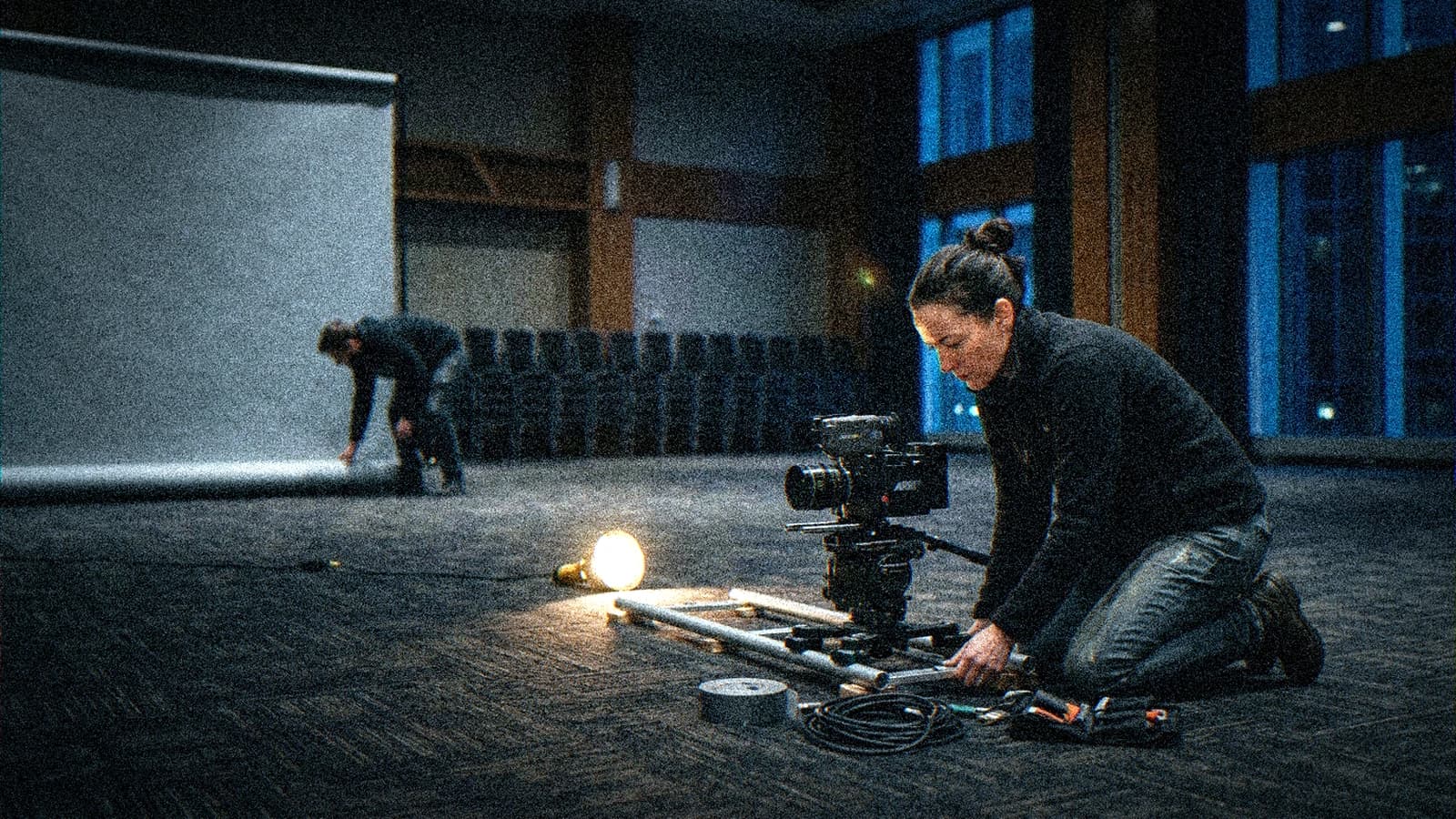
You have a job that more or less works. It pays the bills, you know how to do it, nobody is asking you to change. And yet for a few months now your evenings disappear into video generations, scribbled storyboards, shots you redo ten times because the light doesn't say what you want it to say. You keep wondering if this is a phase or the start of something.
I've lived that exact question. I spent years talking about entrepreneurship on Business Dynamite, a French channel about building things online. Today most of my time goes into AI films, a training program for creators and writing tools. The switch cost me an audience and a few certainties. I kept almost everything else. And if I had to do it again from where you're standing, I'd go about it very differently.
What actually changed, and what I kept
The word "pivot" suggests a clean turn. One day you do A, the next you do B. In practice it feels more like a slow shift in your center of gravity, uncomfortable, with a long stretch where you do both and feel like you're doing both badly.
The background matters here, so quickly. I started with guitar, taught it for years, then founded MyMusicTeacher in 2014, an online music learning platform that won a gold medal at the Concours Lépine (a French inventors' competition) and raised 200,000 euros before a much bigger competitor took over that market. Then came Business Dynamite. This article is about the last switch: going from a topic (entrepreneurship online) to a practice (making images and films with AI).
What changed is the object of my work. On Business Dynamite I talked about projects. My videos explained how other people could build something. With AI filmmaking I make the thing myself. Ronces, my first short film generated entirely with AI. Then VOIDBORN, an AI anime. Then Lost Garden, a series whose episodes come out on YouTube. These days, I ship.
The underlying mechanic held. Spot where people get stuck, build what gets them unstuck, pass it on. I did it with guitar chords, then with online launch strategies, and now with framing, lighting and generation workflows. AI Studios, the training program I built for creators, is a direct continuation of that reflex.
That's why I get suspicious when someone says "I'm starting from zero." Nobody starts from zero. You leave with a bag of skills, and part of it will help while another part will weigh you down. Most of the work in a career change is sorting that bag.
💡 Frank's Cut: before you talk about changing careers, write down what you can do without mentioning your job title. "I can explain a hard topic in ten minutes." "I can run a schedule across three contractors." That list comes with you. The title stays behind.
Why AI filmmaking and not another online business
People have asked me this in a few forms. Why not just add AI as one more topic on a business channel? Why go into film, where nobody was waiting for me and where value doesn't show up as a number on a dashboard?
The first reason is almost silly. Since the guitar days, what I wanted was to create and teach through something artistic. The company was always the vehicle. When image and video generation tools got solid enough to produce shots that hold up visually, a door opened onto territory that had been closed to me: making films with no studio, no crew and no traditional production budget.
The second reason was what I saw around me. A lot of generative AI use looked like people pressing a button and hoping for a miracle. No staging, no intent, pretty empty images. I knew what to do with that gap, because it's a method problem, and method has always been my ground.
The third reason is more personal. Talking about business for years wears down one specific thing: the feeling of making. A film, even a short one, even a flawed one, puts you in front of a result you can't dress up with a speech. The shot works or it doesn't. I needed that verdict.
Then came the outside validation, which mattered more than I like to admit. VOIDBORN won awards at the Seoul International AI Film Festival, the Hollywood Indie Festival and the Australian AI Festival, and took first place (Silver) at the Mondial Chroma Awards. On technique, those festivals taught me nothing. What they did was clear out the doubt that was still hanging around: I was right to change ground.
The skills that crossed over, and the ones I left behind
I wish I'd read this before I started. A good share of what I'd built in online business came with me. Another share turned out to be useless, or worse.
The table below is what I noticed in myself. It's subjective, it comes from my own practice and not from a study. But I see almost the same pattern in creators I work with who come from marketing, training or content jobs.
| Skill from online business | What it becomes in AI filmmaking | Transfer |
|---|---|---|
| Writing a teaching video script | Writing a screenplay, a shot list, a breakdown | Strong, once you learn film grammar |
| Keeping a publishing cadence | Keeping a production calendar over several weeks | Strong |
| Explaining a technical topic simply | Teaching, documenting workflows, writing behind-the-scenes | Strong |
| Building an audience on a topic | Rebuilding an audience on a different topic | Weak, the audience doesn't follow |
| Titles and thumbnails with a number promise | Titles and visuals for a film or series | None, often counterproductive |
| Reading conversion stats | Judging a shot, a light, a match cut | None, it's a different eye to train |
| Negotiating with contractors | Handling rights, contracts, festival submissions | Partial |
The row that hurt most was the audience. I go into it in my experience running an AI film YouTube channel: people who followed me for entrepreneurship did not show up in numbers for the art direction of an animated short. A few did. Each topic rebuilds its audience almost from nothing, even when the author stays the same.
Communication recipes trapped me longer. On entrepreneurship, a number in a title works. On film, the same promise sounds fake and pulls in people who leave right away. I had to unlearn habits that took me years to build.
Then there's the eye, which almost everyone underestimates. Reading a conversion table teaches you nothing about a blown backlight or an eyeline that doesn't match. That eye comes from watching films closely, redoing shots, comparing. No shortcut.
💡 Frank's Cut: if you come from marketing, your biggest asset is production discipline and your biggest handicap is the habit of selling before showing. Early on, show. A finished ninety-second film beats a sales page for a film that doesn't exist.
What the research says about rising skills
I don't trust big predictions about work. But one source is useful because it asks employers directly: the World Economic Forum's Future of Jobs Report 2025, built from the answers of more than 1,000 large employers.
The report estimates that on average 39% of workers' existing skill sets will be transformed or become outdated over the 2025-2030 period. It also lists creative thinking among the skills expected to keep rising in importance, next to AI and big data, technology literacy, resilience and curiosity.
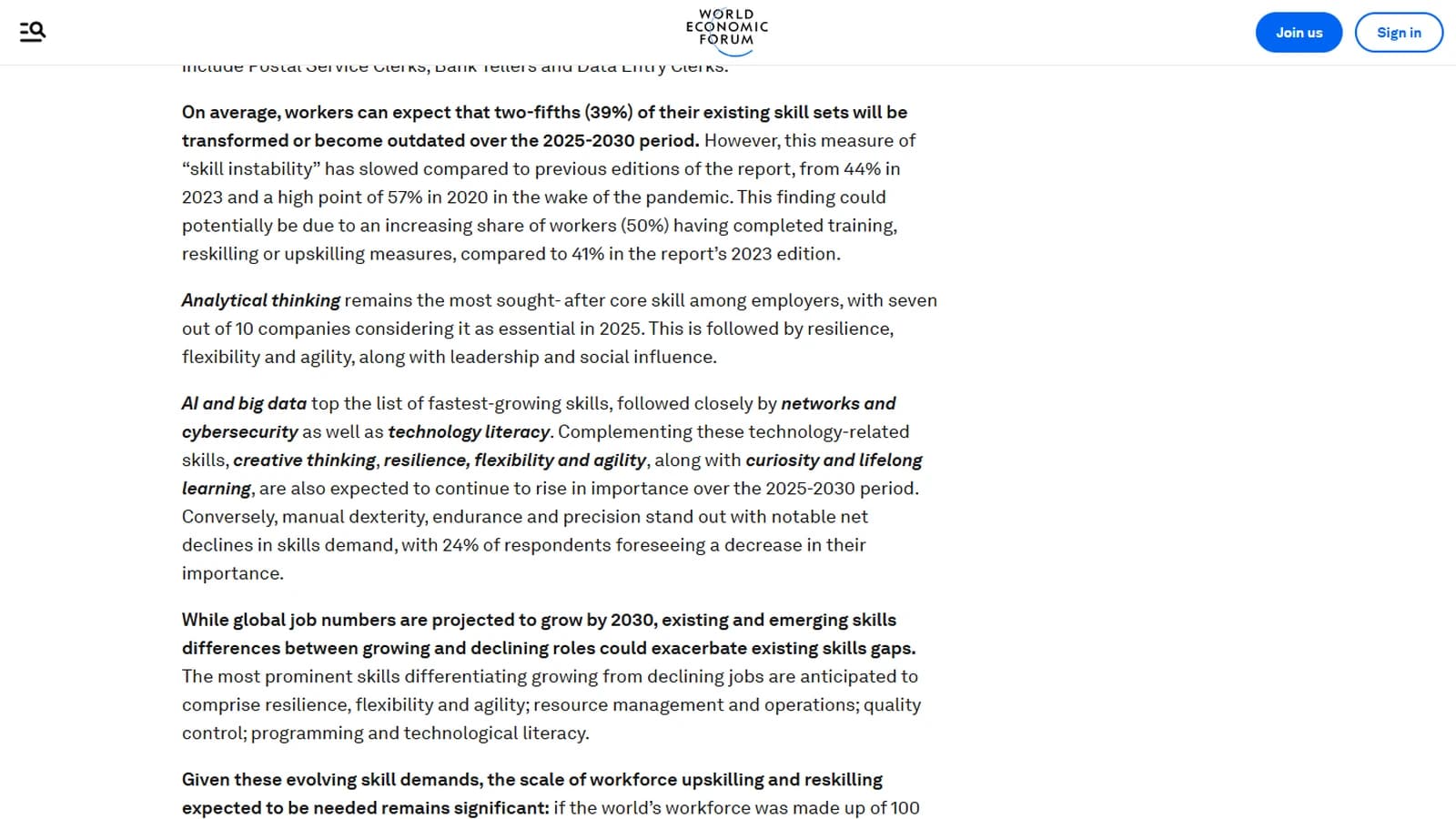
Screenshot of the Future of Jobs Report 2025 digest, weforum.org, captured October 7, 2026.
I don't read those numbers as a reason to drop everything and make films. I read something narrower: AI technical literacy plus creative thinking is exactly the mix AI filmmaking asks for. Someone who masters the tools but can't tell a story produces noise. Someone who can tell a story but can't drive the tools stays stuck at intent. Both together is a rare profile.
What the report doesn't say, and what I see on the ground, is that image jobs don't vanish in one block. They get reshaped. I cover that in my take on which film and video jobs AI threatens or transforms. A good creative career change often means stepping into one of those reshaped roles, instead of dreaming of an "AI director" position that doesn't exist yet in most org charts.
Planning your creative career change: my method in four stages
If I had to walk the path again from a salaried job or a business that's running, I'd go in this order. Nothing magic about it. It just avoids the two mistakes I see most: quitting too early, or never finishing anything.
Stage 1: the inventory, two weeks max
Take that sheet from earlier. List what you can do, then rate each line using the table above: strong, partial or no transfer. Be harsh with the "none" column.
Then look at what's missing. For AI filmmaking the usual gaps are always the same: shot breakdown, lighting, editing, sound, and visual consistency from shot to shot. You don't need to master all of it. You need to know which of those gaps will block your first film.
Stage 2: the overlap, three to six months
I started Business Dynamite while MyMusicTeacher was still running, and I started AI filmmaking while Business Dynamite was running. Both times the overlap was uncomfortable. Both times it saved me from starting at zero at the exact moment I was absorbing a loss.
In practice, overlap means a fixed slot every week, protected like a client meeting. Not "when I have time." One evening, one weekend morning, whatever, but always the same one. The career changes I've seen fail almost always die the same way: a calendar that eats the slot, week after week.
Stage 3: one finished public proof
Before you change anything about your work situation, finish a film. Short, ninety seconds or three minutes, but finished: edited, mixed, graded, exported, published. A folder of fifty gorgeous generations proves nothing to anyone, you included.
That first film will be flawed. Mine was. But it gives you three things no course gives you: the real time a finished minute takes you, the exact list of your technical gaps, and something to show. If you then want to turn that proof into a portfolio, I laid out the process in how to build a credible AI portfolio.
Stage 4: the money frame
This is where situations differ most, and where I see the most decisions made on impulse. The table compares the three paths I run into most often. The schemes named are French, so check what your own country offers if you live elsewhere.
| Path | Who it fits | What keeps you safe | What gets in the way |
|---|---|---|---|
| Projet de transition professionnelle (PTP, France) | Employees on permanent, fixed-term or temp contracts, and entertainment freelancers | Training paid for, employment contract and salary kept | Minimum seniority, certified training only, file approved by a committee |
| Gradual move to freelance | People who already freelance or can go part-time | Existing income keeps coming while you skill up | Fatigue, and the risk of never fully switching |
| Personal project, no status change | People who don't want to leave their job | No financial risk | No pressure to finish, so lots of unfinished projects |
If you're a salaried employee in France, the PTP is worth a look because few people know it. According to the official Transitions Pro page, it lets you change careers with funded training and your salary maintained, provided you meet eligibility rules, including minimum professional seniority and choosing a certified training program. Funding is granted if a joint committee finds the project relevant against three regulatory criteria and if it fits funding priorities.
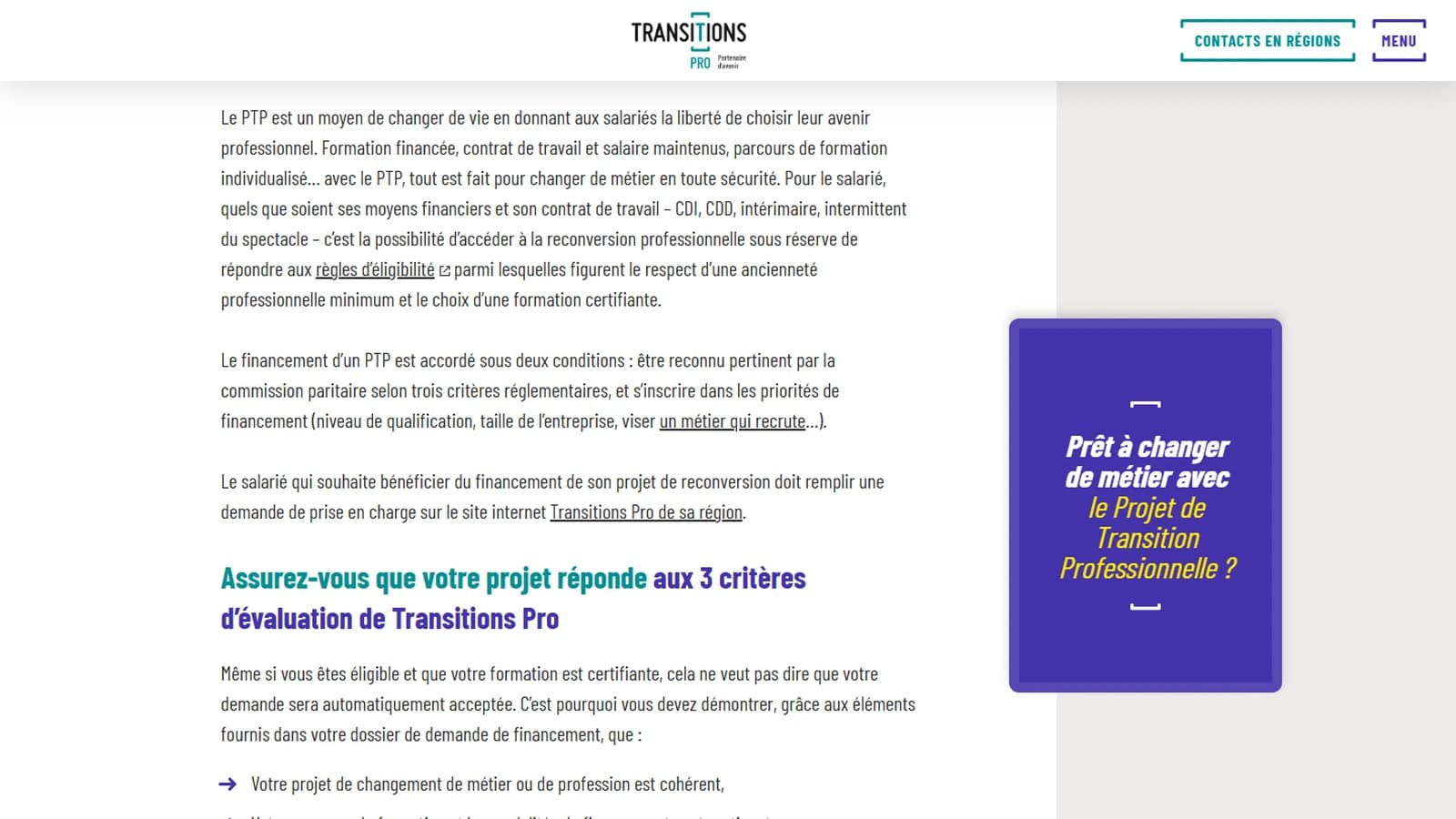
Screenshot of the "Projet de transition professionnelle" page on transitionspro.fr, captured October 7, 2026.
The training has to be certified, which rules out a lot of online AI courses, good ones included. And the page stresses that you have to show the project is coherent and that there are job prospects. A finished first film is a strong argument in that file.
💡 Frank's Cut: whichever path you pick, work out your cost per delivered minute on your first film before you set any income target. If one minute takes you forty hours, no financial plan will hold until that number comes down.
The mistakes I see in people moving into creative AI
In AI Studios I meet creators in the middle of this switch, and some mistakes come up often. I made half of them myself.
Collecting tools instead of finishing a project. Mistake number one. A new model ships every week, and every week you tell yourself you need to test it before you really start. Six months later you know every interface by heart and you have zero films. Pick one tool chain and stick with it until your first project is done.
The second trap is quieter: selling before you can deliver. People from online business, me included, have the reflex of building an offer before having the skill. In AI filmmaking that costs you. One client disappointed by a weak first film talks louder than ten happy ones.
Then there are the people who underrate sound. Weeks on the image, then a royalty-free track dropped on at the end. A film with average images and careful sound holds up better than one with stunning images and sloppy audio. I repeat this in training until everyone's tired of hearing it.
Another classic: waiting for your old audience to follow. I did it. They don't, or barely. Assume you're rebuilding from scratch and the first uploads won't crush you.
Last one: confusing a career change with a clean break. Nobody makes you burn your old job. My years in online business gave me production discipline, teaching skills, the ability to hold a calendar. Throwing that away would have been stupid. The sturdiest career changes recycle the most.
What about the money?
It's the question I get most, so let me be straight: this article isn't the place to answer it in depth, and this site isn't where I talk about online business in general.
What I can share is what I've seen. Making a living from AI film rarely runs on one income source. Client work, teaching, prize contests, selling files, vertical series, each has its own pace and demands. I broke those models down, with the cost per minute math, in my guide to making a living from AI video in 2026, and how to package a skill into an offer in monetizing your AI creative skills.
Everything about entrepreneurship online, customer acquisition and launching a solo business, I cover in French on Business Dynamite. That topic lives there, and that's fine. Here, we make films.
Foire aux questions
Réponses rapides aux questions les plus fréquentes sur cet article.
What is a creative career change with AI?
It's moving from an existing job into work where you create images, video, sound or films with the help of artificial intelligence. It can take several forms: becoming a director or editor focused on AI video, joining a content agency, going freelance, or adding AI production to a nearby job like marketing or training. What these have in common is that you don't just use the tools, you put them at the service of a narrative or visual intent. The technical side takes a few months to learn. The eye, the staging and the consistency take longer and need real practice on real projects.
Should I quit my job to move into AI filmmaking?
No, and I'd advise against it at the start. The overlap period, where you keep your current work and produce in a fixed weekly slot, lets you measure your real pace and your technical gaps without financial pressure. It also gives you time to finish a first film, which is the only proof that counts. If you're a salaried employee in France, the PTP scheme can fund certified training while keeping your salary, subject to seniority rules and committee approval. Quitting becomes a reasonable option once you have recurring income tied to the new work, not before.
Which skills from marketing or content jobs help in AI filmmaking?
Production and writing skills cross over well: writing a script, keeping a cadence, running a project over several weeks, explaining a technical topic simply. They turn into screenwriting, production scheduling and workflow documentation. What doesn't cross over is the number-driven communication playbook, which sounds fake on a film, and reading stats, which teaches you nothing about framing or light. Your audience also transfers badly, since each topic rebuilds its own following. Count on your discipline, not on your online contact list.
How long does a career change into AI video creation take?
I don't have a universal number, and I'm wary of anyone who gives one. From what I've seen, the first months go into learning the tools and finishing a short first film. The following months go into cutting the time each finished minute takes and building a portfolio of a few consistent pieces. The real milestone is the moment your cost per delivered minute fits a price someone will actually pay. Until you hit that point, keep your main income and protect your weekly slot like it's a client booking.
Can I fund AI film training through France's PTP scheme?
It's possible if the training you choose is certified, which Transitions Pro sets as a condition for the career transition project. Many online AI courses, even serious ones, aren't certified, so check that first. You also need minimum professional seniority and you must convince a joint committee that the project is coherent, the training relevant and that job prospects exist in your region. The official page recommends filing the request well before the training starts and working with a free career development advisor to prepare the file.
Why did Frank Houbre switch from online business to AI filmmaking?
Because since the guitar years, what I wanted was to create and teach through something artistic, and companies were only ever the vehicle. When generation tools became able to produce shots that hold up visually, they opened up the possibility of making films without a studio or crew. I also saw a method gap in most AI use, and method is my ground. Business Dynamite still exists for entrepreneurship topics, in French. Here I make films, train creators through AI Studios and build tools like ScreenWeaver.
Will my current audience follow me if I change topics?
Very few will, in my experience. When I started publishing about AI filmmaking, a handful of people who followed me for entrepreneurship came along, but not the bulk. People subscribe to a topic at least as much as to a person. What you carry over are work habits: opening a video without making people wait, cutting what doesn't serve, writing before you shoot. Assume you're rebuilding an audience, set up a separate space for the new topic if you can, and don't judge your first uploads against your old numbers.
Your first step this week
You don't need to decide today whether you're changing your life. You need two things: the inventory sheet and a fixed slot in your calendar. The rest gets decided with a finished film in your hands, which is a far better place to decide from than any late night of doubt.
If my path speaks to you and you want to see the projects I'm working on right now, the About page lists them.
Related articles
 Business
AI film YouTube channel: what I learned the hard way
A real account of running an AI film YouTube channel: which format survives, which YouTube rules to read first, and what breaks before anything else.
 Business
AI video for small business: 5 uses that pay off
AI video for small businesses: five uses that pay for themselves without an in-house studio, what each one really takes, and what to leave to people.
 Business
Training a team on AI: my 30 day protocol
The day by day calendar, the three numbers to record before you start, the real cost in hours, and the go / no-go call on day 30.