Living off AI video in 2026: the models that hold up
Client work, platform payouts, vertical series, assets, tools, contests: what each business model actually pays when you make AI video.

Your last video did numbers. Real numbers. A few hundred thousand views, comments asking which model you used, two or three excited DMs. And at the end of the month your bank statement looks exactly like it did the month before.
That gap is the most common thing I see in the messages I get. People know how to produce. They have no idea where the money comes from. Those are two separate skills, and nobody says that plainly enough.
Six business models exist right now for someone who makes video with AI. They do not share buyers, payment timelines, or entry conditions, and a couple of them were shut by rule changes in the last year. Everything below rests on platform terms I pulled on 26 September 2026, on sourced market numbers, and on what I see running my own products.
Six income streams, not one
That is where the confusion starts. "Living off AI video" sounds like a single job when there are six separate economies behind it, each with its own buyers, delays and failure modes.
| Model | What you sell | First euro | Realistic ceiling | What kills it |
|---|---|---|---|---|
| Client work | A validated decision, a defensible deliverable | 2 to 6 weeks | High, capped by your hours | One big client walking away |
| Platform payouts | Attention resold to advertisers | 6 to 18 months | Medium, very volatile | A policy change |
| Vertical series | Episodes for a catalogue with a budget | 1 to 3 months | High if you keep the pace | The cadence, not the quality |
| Asset sales | Reusable files | Immediate, tiny | Low on your own | The volume required |
| Teaching and tools | A method or a piece of software | 6 to 24 months | Very high | The wait before traction |
| Funded contests | A film that wins | Random | One-off | Whoever is on the jury |
The people I see making it work almost always run two or three at once. One income that pays rent now, one that grows slowly, and sometimes a lucky break that buys gear. The ones who crash bet everything on a single model, usually platform payouts, which happens to be the slowest and most fragile of the six.
💡 Le cut de Frank : before you pick a model, look at your bank balance and count how many months you can go with nothing coming in. Under four months of runway there is no choice to make. You do client work, and you build the rest at night.
Client work pays in the first month
A company that has to ship a campaign already has an approved budget, a date, and someone whose review depends on the result. That triangle is why client work pays fast. You do not have to create the demand, you have to be findable and credible.
The trap is selling "AI video". Nobody buys that. What a marketing director buys is a campaign that clears legal, a delivery date they can commit to in a meeting, and someone who picks up the phone when the exported file does not fit the ad network's spec. I laid out the full frame in how to monetize your AI creation skills, and the pricing side in how much to charge for a professional AI video.
This model has two weaknesses worth staring at. Your income is capped by your hours, and any client worth more than 40 % of your revenue puts you at risk the day their budget gets cut. The usual exit runs through building an agency, with all the staffing headaches that brings.
The blind spot for beginners is acquisition. Producing is not enough. Buyers have to know you exist, and that gets built with a method rather than with luck. The topic deserves its own piece: how to find clients with AI video.
Platform payouts: read the terms before you count on them
Plenty of people build a revenue plan on YouTube and TikTok without reading a single line of the conditions. The thresholds are public, and they sit higher than most advice admits.
On YouTube, ad revenue requires 1,000 subscribers plus either 4,000 valid watch hours over the last 365 days or 10 million valid Shorts views over 90 days. Channel memberships open earlier, at 500 subscribers, three public uploads in 90 days, and either 3,000 watch hours or 3 million Shorts views. Those numbers come from the YouTube Partner Program eligibility page.
The real filter sits elsewhere. Since July 2025, what YouTube used to call "repetitious content" is called "inauthentic content". The channel monetization policies require the work to be your original creation and rule out anything mass-produced, generic, repetitive or manipulative. They add one category aimed squarely at a very common practice: AI personas handing out health, legal, financial or political advice.
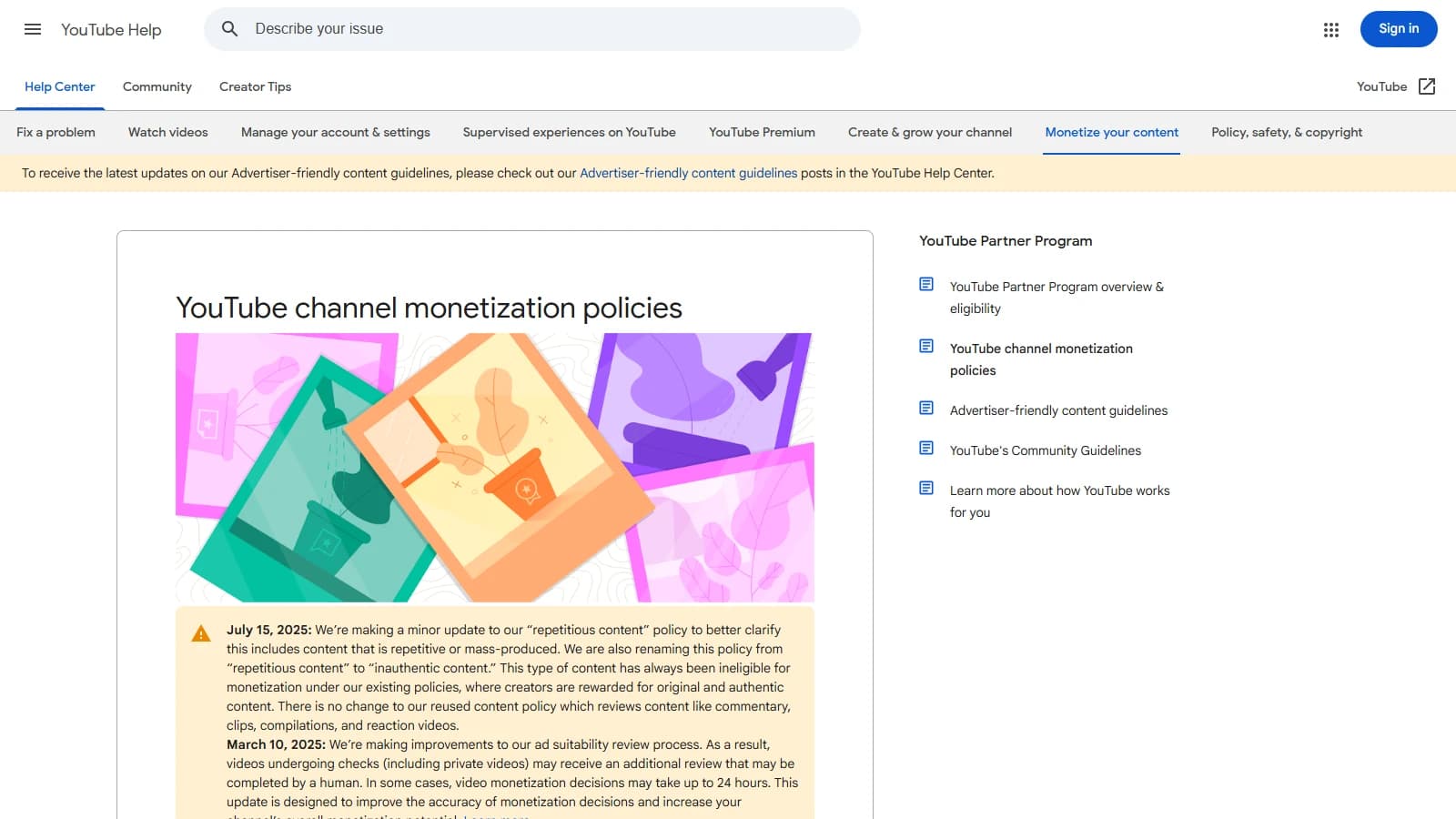
The banner dated 15 July 2025 announces the rename and notes this kind of content was never eligible in the first place. Screenshot of support.google.com/youtube/answer/1311392, taken on 26 September 2026.
A channel stacking videos on the same template with a synthetic voice and batch-generated images lands straight inside that definition. It is outside the terms, not in a grey zone. The fact that some of them still run changes nothing about the risk, and when demonetization hits, it hits the whole back catalogue.
Over on TikTok, the Creator Rewards Program is open in France, which surprises a lot of people. It covers eight countries: the United States, the United Kingdom, Germany, Japan, South Korea, France, Mexico and Brazil. You need to be 18, on a personal account, with 10,000 followers and 100,000 video views in the last 30 days.
The conditions on the videos themselves matter more than the account thresholds. Only original videos over one minute count, they have to pull at least 1,000 views on the For You feed, they cannot be a Duet or a Stitch, cannot use Photo Mode, cannot be sponsored, and have to be 1080p or higher. All of it is spelled out in the program documentation.
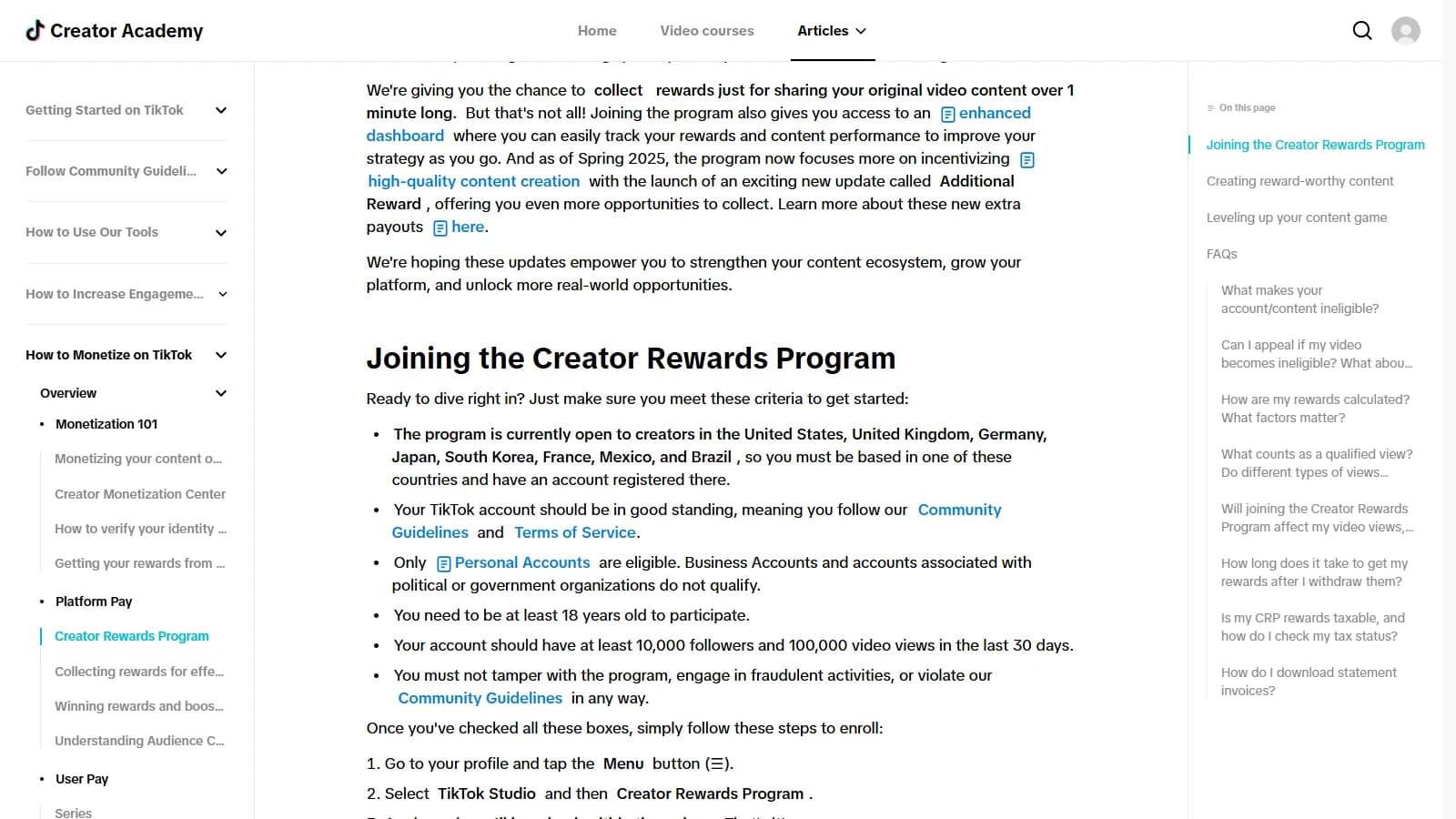
The country list includes France, and the line above it sets the rule about original content over one minute. Screenshot of the TikTok Creator Academy Creator Rewards Program page, taken on 26 September 2026.
That one-minute rule has a side effect few AI creators have absorbed. The fifteen-second clip, the format AI video produces most easily, earns nothing in this program. If you want TikTok to pay you, you need to hold a story for sixty to a hundred and twenty seconds, with everything that demands in character consistency and continuity.
Budget six to eighteen months before the first meaningful payout, and assume a policy revision can wipe out half your income overnight. Treat it as an asset you build, not as a salary.
Vertical series is where the money actually is
Buyers are actively hunting for people who can deliver a lot of episodes fast. Only one sector is in that position today, and it is also the only one whose revenue gets measured in public: short drama, those vertical series of 60 to 120 second episodes you binge inside a dedicated app.
Sensor Tower's numbers for the first quarter of 2026 give the scale: over 850 million downloads in the quarter, up 140 % year on year, and roughly 750 million dollars in in-app purchases, up 20 %. DramaBox and ReelShort remain the top two apps in the category, each close to 140 million dollars in that quarter alone. Average daily time spent hit 25 minutes in April 2026, up 85 % from January 2025. The full report is public: State of Short Drama Apps 2026.
What those numbers describe is a content famine. Catalogues that have to fill 25 minutes of daily viewing per user need a volume that conventional shooting does not produce at that price.
The trade-off is brutal. This market buys cadence. A 90 second episode a day for six weeks, same faces, same sets, same grade. What gets you selected is holding continuity across sixty episodes, and the beauty of any single shot comes a distant second. If you already struggle to keep a character stable across three shots, this model will eat you.
It also rewards vertical craft more than anything else, which I covered on the production side in producing vertical variants for Reels and Shorts.
💡 Le cut de Frank : before you pitch a short drama platform, produce three complete episodes and put them side by side. If your lead's jawline changed between episode 1 and episode 3, you are not ready, and no buyer is going to break it to you gently.
Selling files instead of videos
The asset model means building once and selling many times: stock image and video libraries, trained LoRAs, preset packs, sound collections. On paper it is the passive income dream.
In practice the payout per unit is tiny and the volume required puts nearly everyone off. One file sold earns cents. To reach income that matters you need a catalogue of several thousand pieces, which means an industrial production line, which is exactly the kind of work nobody pictures when they say "passive".
The second obstacle is legal. Marketplaces are strict about what they accept, and the rules differ from one to the next. Before you spend weeks building a catalogue, check what you are allowed to sell and under what terms, platform by platform, reading their own contributor pages rather than secondhand summaries. I laid the groundwork in selling AI-generated images and the legal question.
My take: this works as a side stream, when you sell the by-products of work you were doing anyway. It does not hold up as a main activity for one person.
Teaching, writing, building tools: slow, and solid
This is the model I spend most of my time on, and I am going to be honest about its economics because it is the one people romanticize hardest.
A tool takes years. ScreenWeaver, which I co-founded with Thibaut Dumont under Outerframe Studio, currently runs three tiers: the Screenwriter script editor at 0 dollars with unlimited projects and pages plus PDF and Final Draft export, a Storyboard Beta tier at 9.99 dollars a month, and a Filmmaker tier listed as coming soon, targeting 30 September 2026, with pricing not yet announced. Those are the figures shown on screenweaver.ai on 26 September 2026.
On the generation side, Imaginode bills in credits: 13 euros excluding tax for 900 credits a month, 42 euros for 3,100, 145 euros for 10,500, plus a one-off 5 euro top-up for 300 credits. Subscription credits expire at renewal, top-ups do not, and a failed generation gives the credits back.
What both products taught me is that revenue arrives after credibility, never before. Nobody bought a subscription because the product existed. People bought because they had seen films come out of the pipeline: VOIDBORN took a 1st Place Silver at the Mondial Chroma Awards, a 2nd Place Dreamina in the same competition, and an award at the Seoul International AI Film Festival. Les Fils du Vinnana picked up an honorable mention at the Top Quark Film Festival. Lost Garden is a finalist at the AI London Festival.
I cite those results because they are the only reason a stranger agrees to try a screenwriting tool signed by someone they have never heard of.
Count six months before the first sale and two years before it resembles an income. Without another source of money during that stretch, this model will put you out before it pays you. If you would rather build a team than a product, the structural questions are different, and I went through them in how to build an AI video agency.
What funded contests are actually worth
Prize money at AI festivals is real and sometimes large. Runway's festival lists, for its 2026 edition, a Grand Prix of 50,000 dollars plus a million Runway credits, a Gold at 15,000 dollars, a Silver at 10,000 dollars, two Honoree awards at 1,000 dollars and five Merit awards at 500 dollars, for an announced total above 135,000 dollars across all tracks. Categories cover Film, New Media, Gaming, Design, Advertising and Fashion, with events in New York, Los Angeles and Tokyo. It is all listed on aif.runwayml.com.
A prize like that changes a year. It does not make a revenue plan, for a simple arithmetic reason: you do not control the outcome. What you do control is the visibility a selection gives you, and that is where the real value sits. A line in a recognized list of winners opens commercial conversations that three months of cold outreach will not.
So treat contests as an acquisition tool wearing a lottery costume. You submit the film you were making anyway, you build nothing specially for a jury, and if it lands, you use the result in your pitch for two years.
The number that decides everything: your cost per delivered minute
When someone tells me they cannot make a living at this, I ask for their cost per delivered minute. Almost nobody has worked it out. That figure is what tells you whether a rate is viable or whether you are working at a loss while feeling clever about it.
Take Imaginode's pricing as a base, since its equivalences are published: 900 credits at 13 euros excluding tax buys roughly 173 seconds of video. That puts a generated second around 7.5 cents, so about 4.50 euros per minute of raw footage.
That number still means nothing on its own, because you do not deliver rushes. The figure that counts is your keep rate: how many generated seconds end up in the master.
| Keep rate | Seconds to generate per delivered minute | Generation cost per delivered minute |
|---|---|---|
| 1 shot kept in 3 | 180 | about 13.50 € |
| 1 shot kept in 6 | 360 | about 27 € |
| 1 shot kept in 12 | 720 | about 54 € |
Beginners often sit near one in twelve without knowing it. A tight workflow gets down to one in three or four. Across an eight minute commission, the gap between those two is over 300 euros of generation cost, and three times the hours spent sorting through takes.
The skill that moves that ratio sits before generation, in choosing the frame, the lens and the moment of the action. A shot decided on paper costs several times less than a shot hunted by relaunching.
💡 Le cut de Frank : for two weeks, log how many generations you launch and how many shots you keep. That ratio will tell you more about your profitability than any rate card.
What no longer holds in 2026
Three practices were still circulating in early 2026 in the make-money-with-AI corner of the internet. They are dead ends now.
The faceless channel on autopilot goes first. A synthetic voice, generated images, one template repeated a hundred times. YouTube's monetization policies explicitly name mass-produced, generic and repetitive content as ineligible, and the AI-personas-on-sensitive-topics category closes the niche that paid best, the health and finance advice corner.
Then there is the agency reselling a subscription. Charging 800 euros for a video a client could make themselves in twenty minutes with a 20 euro tool works right up until the client finds out. They always find out, and they leave feeling conned.
That leaves raw volume on short formats. Since TikTok reserves its rewards for videos over one minute that clear 1,000 views on the For You feed, posting forty fifteen-second clips a month produces plenty of activity and zero income.
All three swap volume for judgment. Judgment happens to be the part AI does worst and buyers pay most for.
What I would do if I started over tomorrow
Here is the order I would take, with rent to pay.
First three weeks, build proof rather than an audience. A two minute film with a character who holds from shot to shot, properly graded, properly mixed. One of them, finished. Not ten attempts.
First month, go after three local clients in a tight niche, with a clear quote and a price range you stand behind. A regional production company, a brand launching a product, a training organization. Three real conversations beat three hundred followers.
Months two to four, keep client work as the base and start documenting the work in public, using the long format the reward programs require rather than the reflex clip. The audience builds in the background, without the income depending on it.
From month six, and only if client work is steady, look at short drama or a product. Not before. Both models demand a cash cushion that client work alone can fund.
This plan is slow. It is the only one I see working for people who actually live off this today, and I would rather write it honestly than sell a thirty day method.
Foire aux questions
Réponses rapides aux questions les plus fréquentes sur cet article.
Can you really live off AI video in 2026?
Yes, though rarely on a single model and almost never on audience monetization alone. The people I watch doing it combine client work that pays the running bills with a second stream that grows slowly, whether that is vertical series, teaching or a product. The realistic gap between knowing how to produce a clean video and having the activity feed you runs six to eighteen months, depending on how good you get at finding buyers. Technical skill is the entry ticket, not the edge: plenty of people can generate a nice image, very few can deliver a project on deadline with decent traceability.
Which model pays fastest?
Client work, by a wide margin. An approved budget, a fixed date and someone accountable for the result make the friendliest context that exists for getting paid quickly. Two to six weeks between the first conversation and the transfer is common when you target companies already used to buying production. Every other model needs an accumulation phase: an audience to build, a catalogue to fill, a product to make known. If your runway is under four months, the choice more or less makes itself.
Do you have to disclose that a video was AI-generated?
The obligations depend on the distribution platform, the country and sometimes the advertiser's sector, and they move fast. The sane position is to document what was generated and how, from production onward, rather than reconstructing it six months later when a legal team asks. That traceability costs ten minutes per project when you keep it as you go and costs days when you rebuild it after the fact. It has also turned into a selling point with large accounts, whose internal requirements are often stricter than the regulation itself.
What does a delivered minute of AI video cost?
Raw generation cost is easy to compute: about 4.50 euros per minute of footage on a credit-based offer like Imaginode. The figure that actually decides things is your keep rate. At one shot kept in three, a delivered minute runs around 13 euros of generation. At one in twelve, still common among beginners, you climb toward 54 euros. On top of that sits your sorting time, the edit, the sound and the grade, which usually weigh far more than generation in the final cost.
Is short drama realistic for a European creator?
The market is mostly driven by Asian and American apps, but they buy content in several languages and they are hungry for volume. The barrier is industrial before it is geographic: you have to prove you can hold an episode cadence without losing visual continuity. A credible pitch starts with three complete, consistent episodes, not with a reel of pretty shots. Sensor Tower's figures show demand growing faster than the supply of content, which keeps the door open, as long as you accept an industrial production rhythm.
Why does an automated YouTube channel no longer work?
Because the rules now name the practice outright. The inauthentic content policy, renamed that way in July 2025, requires original creation and rules out mass-produced, generic, repetitive or manipulative work. A further category targets AI personas covering health, law, finance or politics, which is precisely where ad revenue ran highest. Some channels still slip through, which does nothing to change the risk calculation: building an activity on a practice the terms exclude by name is renting premises without a lease.
Do you need an audience before you can sell?
No, and believing otherwise costs a lot of people a year. A professional buyer checks three things: does the work shown resemble what they need, are the timelines credible, and will the person opposite take responsibility if it goes wrong. Follower count fits none of those. A portfolio page with three finished projects converts better than fifteen thousand followers on an account that posts tests. An audience helps discovery, it does not replace proof.
How long before a product or a course pays?
Six months to a first sale, two years before it resembles an income, with enormous variance. What decides it is the credibility the person publishing already holds, far more than the quality of the product itself. My own tools only started finding users after films from the pipeline were selected and awarded at festivals you can name. Without that signal, unknown software signed by an unknown does not survive the sign-up step. Which is why this model comes second, funded by something else.
Related articles
 Tutoriels
Multilingual Voiceover Localization: AI Workflow and Lip-Sync
Adapted scripts, voices, rhythm and QA for FR / EN / ES versions without losing the intention of the edit.
 Tutoriels
Managing the Voice-Over for AI Documentary Narration
A voice-over pipeline from script to mix to keep clarity, emotion and credibility on a documentary format.
 Actualité
Google cuts Imagen and the Gemini image preview models: migrate before June 24
Google is removing its Imagen 3 models and the Gemini image previews on June 24-25, 2026. If your image workflow goes through the Gemini API, you have less than a week to migrate. Here is what to do.