Managing the Voice-Over for AI Documentary Narration
A voice-over pipeline from script to mix to keep clarity, emotion and credibility on a documentary format.
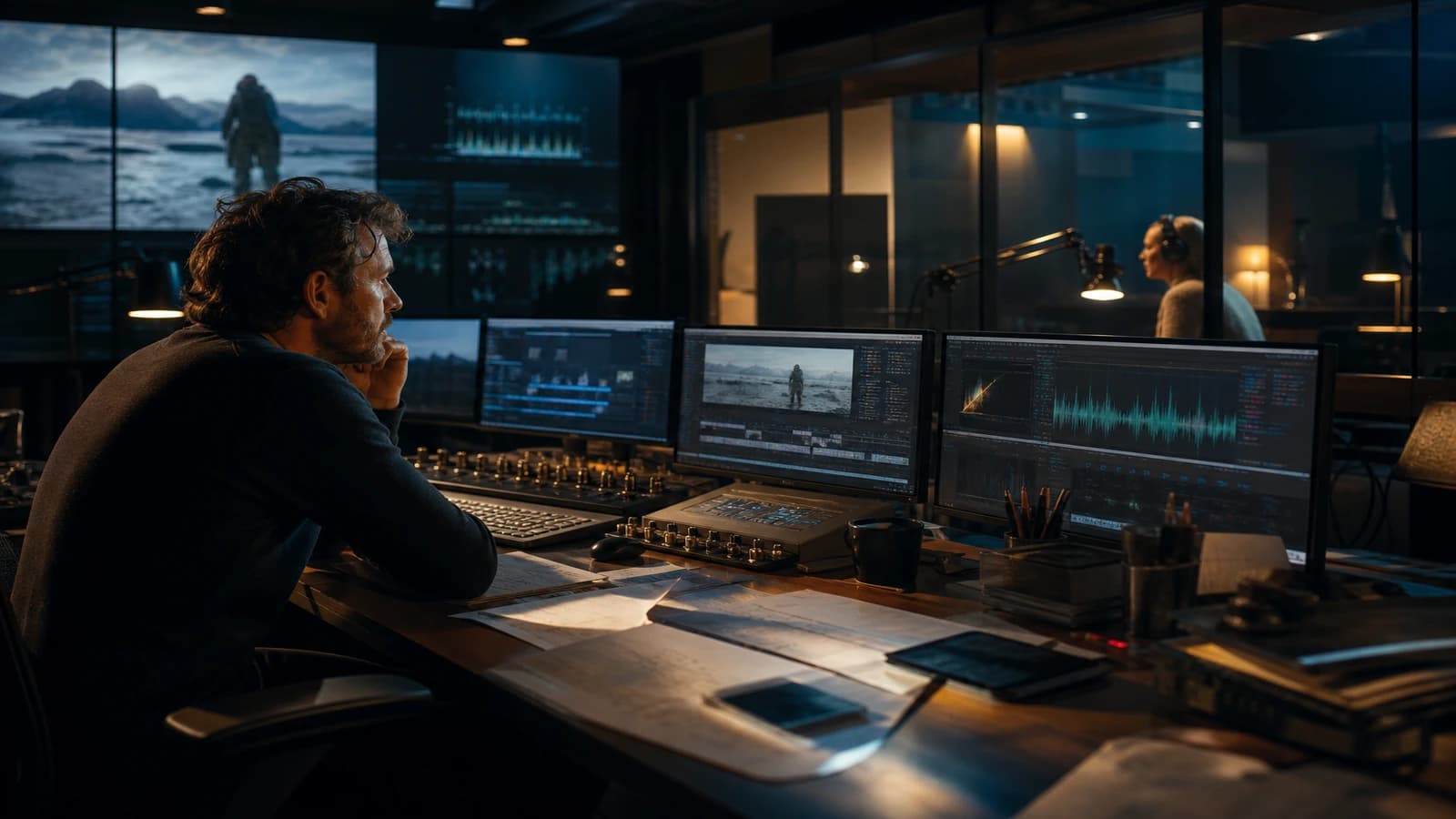
You have twelve gorgeous shots, a music that holds up, and a voice-over that sounds like an insurance ad read by an enthusiastic robot. The client says "it is not credible". You regenerate three times, you change voice, you raise the volume, and the problem stays: the text was written for the eye, not for the ear, and you mixed the narration afterward like a patch.
Managing the voice-over for AI documentary narration does not start in ElevenLabs or HeyGen. It starts in the oral script, continues in the breakdown by narrative blocks, and ends in a mix where the VO guides the viewer without crushing the image. This guide lays the pipeline I use on formats of three to twelve minutes: VO writing, generation by segments, rhythm control, documentary mix, mobile QA.
Why the documentary VO breaks before the image
In documentary, the voice-over carries the structure. It says what the image does not show, it orients the interpretation, it creates the link between the shots. When it sounds false, the whole film tips into a corporate clip, even if the visuals are clean.
The first trap is the pasted written text. Long sentences, subordinates, comma lists: aloud, it suffocates. The TTS model reads word for word. You get a PowerPoint reading rhythm, not a narration that breathes.
The second trap is the generation in a single block. An eight-minute documentary in one VO take is the retake hell. A pronunciation error on a proper noun at minute six, you start everything over or you do audible cobbling.
The third trap is the VO / edit mismatch. You edit the image on a music, then you lay the voice. Result: the important sentence falls on a transition shot, the vocal climax arrives when the image has already moved elsewhere. The narration must be laid early in the timeline, even in a temporary version.
For the narrative and sound base, read how to write an effective script for an AI-generated video and managing the depth of sounds and ambiences on an AI short film. The documentary VO leans on the same breakdown as the image script.
💡 Frank's Cut: record a draft reading of yourself on the phone before any AI generation. If you run out of breath or stumble, the text must be rewritten. Not the model.
The four layers of a credible documentary narration
A pro documentary VO rests on four distinct layers that you mix separately before the master.
The narration layer: main voice, clear, slightly intimate, never shouted except for a dramatic intention. The ambience layer: room tone, street, nature, office, what anchors the place even when the image changes. The music layer: emotional support, never in direct competition on the consonants of the VO. The sound design layer: transitions, discreet impacts, owned silences.
In AI documentary, the image can be generated shot by shot. The sound, on the other hand, must give the illusion of the same acoustic world. A VO laid on an absolute silence between two exterior shots breaks the magic faster than a visual artifact.
The documentary tone is not the ad tone. Less artificial enthusiasm, more poised curiosity. Think of the voice of someone who discovers with you, not a voice that sells you a mobile plan. This nuance plays out in the voice choice, the speed, and above all the pauses.
Comparative table of documentary VO tools
| Criterion | ElevenLabs | HeyGen (integrated VO) | Human voice + AI cleanup |
|---|---|---|---|
| Fine emotion control | Excellent with tags and settings | Medium, avatar-oriented | Total if a pro actor |
| Block breakdown | Native, recommended | Per avatar scene | Per studio take |
| Proper nouns / figures | SSML or manual phonetics | Variable | Direct |
| Long-format consistency | Stable with the same voice ID | Depends on the workflow | Maximal |
| Cost 10 min doc | Moderate, character credits | Variable by pack | Higher, better render |
For a detailed comparison of the engines, see HeyGen vs ElevenLabs for creators.
Field workflow: from script to mix in seven phases
Phase 1: oral rewrite of the script
Take the written script and transform it into VO text. Simple rules: short sentences, one idea per sentence, active verbs, figures rounded for the ear ("nearly three million" rather than "2,847,392"). Mark the pauses with periods or line breaks, not with parentheses.
Read each paragraph aloud. Time it. A documentary narrative block often holds between fifteen and forty-five seconds aloud. Beyond that, cut.
Phase 2: breakdown into VO blocks
Number your blocks: VO-01-intro, VO-02-context, etc. Each block corresponds to a narrative unit of the edit (intro, act 1, pivot, conclusion). Keep a "linked shot(s)" column in your production table.
This discipline avoids regenerating eight minutes to correct one word. You replace VO-05 only.
Phase 3: locked voice sheet
Before generation, document: Voice ID, speed (e.g. 0.92), stability, style (neutral-warm documentary), language, pronunciation of the proper nouns in phonetics or SSML. A ten-line voice-bible.md sheet is enough.
Do not change voice between the blocks except for a narrative intention (testimonial vs narrator). The timbre consistency does more than the phonetic perfection.
Phase 4: generation by short batch
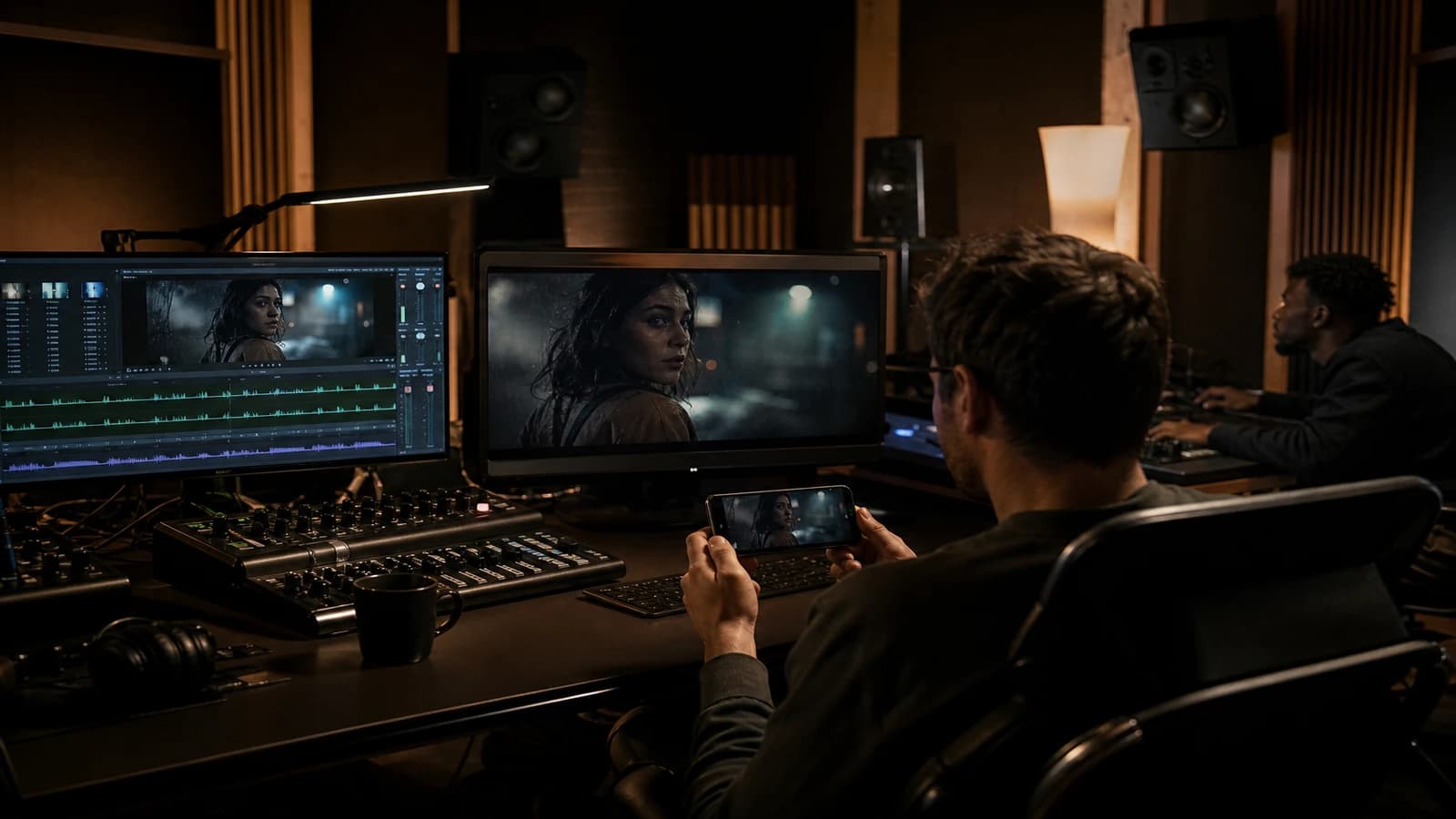
Generate block by block. Four to six takes max per block. Listen on closed headphones, then on the laptop speaker, then on the phone. The documentary is often watched in a domestic context, not in a Dolby room.
Archive: VO-03_take2_FINAL.wav. Note why take 1 is rejected (rising intonation, swallowed word, breath).
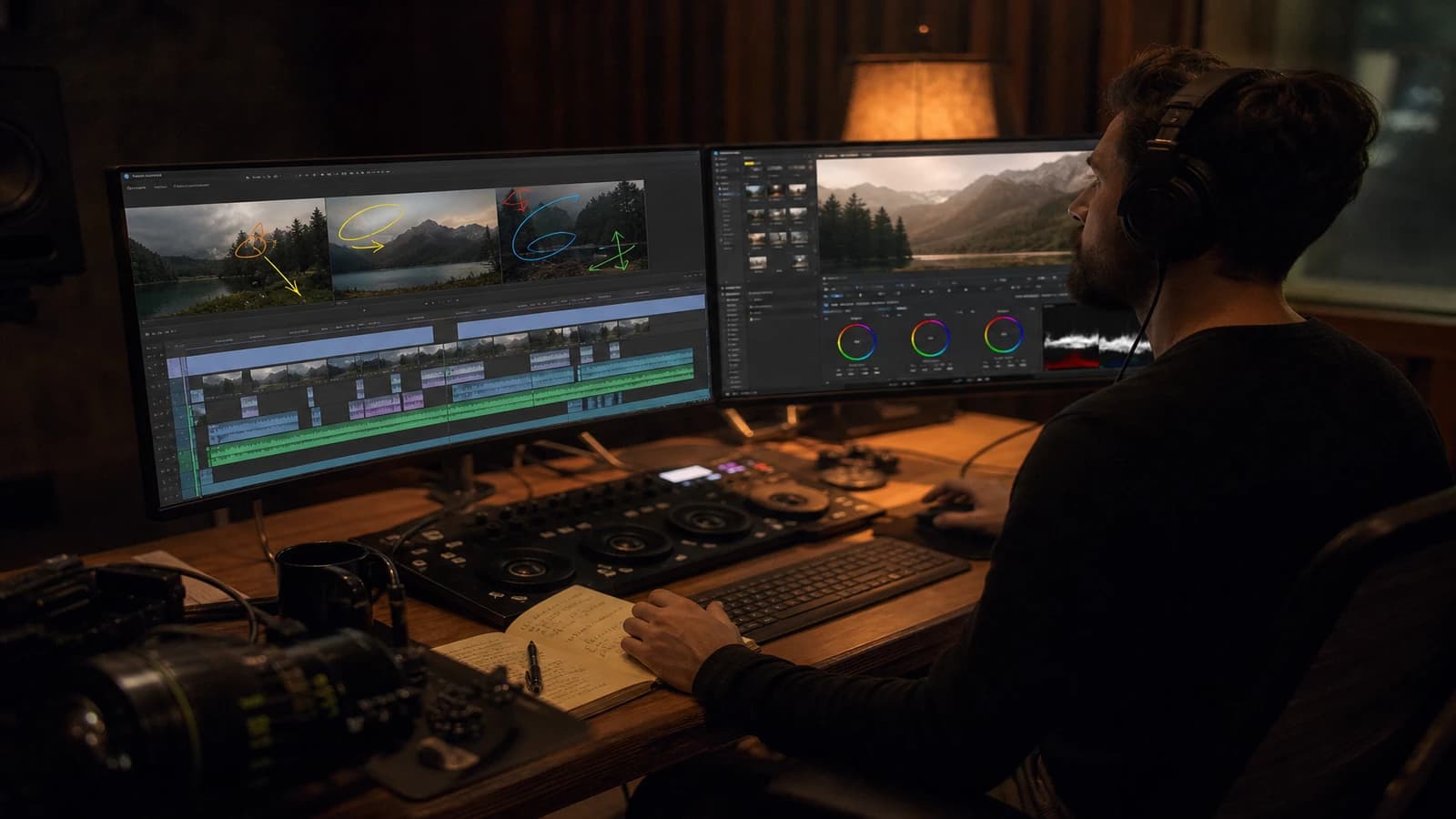
Phase 5: picture edit on temporary VO
Lay all the VO blocks on the timeline before finalizing the shots. Cut the image on the natural breaths. If a key sentence must fall on a precise shot, adjust the image, not the VO (except for a text error).
The documentary silences are a weapon. A half-second before a revelation is better than a cliché musical crescendo.
Phase 6: documentary mix
Recommended mix order: VO level first (target -16 to -14 LUFS integrated on the voice track alone depending on the platform), then ambience, then music ducked under the VO (-8 to -12 dB automatic or manual reduction on the strong consonants).
Avoid aggressive compression on the AI voice. It hardens the sibilants and reveals the artificiality. A light EQ: low cut under 80 Hz on the VO, soften 3-5 kHz if it grinds.
For the global image-sound link, read how to mix audio and image for a cinema render in AI video.
Phase 7: narration QA on three devices
Desktop, headphones, phone with no headphones. Check: intelligibility of the proper nouns, rhythm on the hook of the first three seconds, music that does not mask the sentence ends, volume consistency between blocks.
Real scenarios
5-min corporate documentary (internal training). Neutral-warm VO, 30s blocks, no music on the simulated testimonials, only room tone. Internal tool names in SSML phonetics. Delivery: VO stems + mix master.
8-min YouTube mini-doc (solo creator). VO hook in the first 4 seconds laid on a strong shot. Music between the sections only. VO blocks regenerated one by one until ear validation. Burn-in subtitles for muted mobile: see accessible burn-in subtitles.
Multilingual institutional doc. French VO master validated first. Oral script translation per language, not a literal translation of the PDF. Pipeline described in multilingual AI voice-over localization.
12-min artist portrait. Slower VO, long pauses, minimal music. The AI image changes place; the sound ambience unifies via a single light room tone bed under the whole narration.
Frequent mistakes and fixes
Text too literary. Fix: rewrite aloud, read standing, cut the double adjectives.
A single 12-min VO track. Fix: numbered blocks, surgical replacement.
Music too loud. Fix: sidechain or manual automation on each sentence.
Default TTS speed. Fix: slow down by 5 to 10%, documentary ≠ radio ad.
No phonetics on the names. Fix: note IPA or a French approximation in the voice sheet.
VO laid after the final edit. Fix: VO timeline from the rough cut.
Same treatment on intro and conclusion. Fix: tighter intro (more EQ presence), more open conclusion (less compression).
Technical references: EBU loudness recommendations, YouTube audio loudness, BBC guide to documentary narration.
Foire aux questions
Réponses rapides aux questions les plus fréquentes sur cet article.
Should you use a human voice or an AI voice for a serious documentary?
It depends on the budget, the audience and the required level of intimacy. A human voice stays unbeatable on the emotional micro-variations and the complex proper nouns. A well-set AI voice is enough for internal corporate, educational formats and prototypes before a studio recording. The decisive criterion is not the tool but the oral writing and the mix. An actor on a bad text sounds false; an AI on a breathing script and a block breakdown can pass on mobile if you avoid the "announcer" effects.
How to handle the figures and the acronyms aloud?
Write them as you want to hear them, not as in the PDF report. "Fifteen percent" rather than "15%" if the model reads the symbol badly. For the acronyms, choose a rule: spell out or pronounce as a word. Note it in the voice sheet. Test an isolated take before launching the twelve blocks. In SSML or phonetics depending on the tool, you can force a pronunciation. One minute of test avoids one hour of retakes.
What is the ideal length for a VO block before breakdown?
Aim for fifteen to forty-five seconds of oral per block, that is about forty to one hundred and twenty words in English depending on the pace. Under ten seconds, you multiply the files with no gain. Over one minute, the retakes become painful and the intonation errors accumulate. Align each block on a narrative unit of the edit: a place, an idea, a pivot. The breakdown follows the story, not the API character limits.
How to avoid the music covering the voice?
Duck the music under the VO with automation or a sidechain compressor. Target an audible but not ridiculous reduction: the viewer must feel the music without searching for the words. Cut the low frequencies of the music that mask the voice (often 200-500 Hz in conflict). Leave air: in documentary, the silences between sentences are as important as the notes. Lower the whole music by 3 dB if you doubt; you can always bring it back up.
Should I deliver the VO stems to the client?
Yes for the pro and institutional projects. Deliver at minimum: mix master, voice track alone, music and ambience if you have them. The client sometimes reuses the VO for a short version or a translation. It also avoids the disputes about "who modified the mix". Name clearly: PROJECT_VO_stems_v1.zip. It is a sign of seriousness that justifies your rate.
How to sync the VO and the AI shots when the clip durations vary?
Generate shots slightly longer than necessary and cut the image on the VO, not the opposite (except for a text correction). Use cutaway shots (hands, detail, landscape) to fill the gaps. If a VO block is too short, add a breath at the end of the sentence rather than a rush of images. The ear accepts a half-beat more; it does not accept a sentence cut in the middle.
Should the voice-over arrive in the first second?
Not systematically, but web documentary often rewards a vocal or sound hook before three seconds. You can open on a strong image then lay the VO at second 2 or 3 if the image hooks. Avoid thirty seconds of music alone with no information: the viewer scrolls. Test both versions if the subject allows it. The YouTube data will tell you; your ear will tell you first whether the start drags.
How to spot that an AI VO will never pass the client test?
If after three settings (speed, stability, phonetics) you still hear a metallic pattern on the sentence ends, change voice or move to human on the critical blocks. If the client compares it to an Arte documentary, a generic AI VO loses. Show a validated sound reference at the kickoff. If the gap is too big, own the studio recording on at least the intro and the conclusion. Better ten minutes of studio than ten hours of fighting against an unsuitable timbre.
Related articles
 Tutoriels
Dubbing and Voice-Over: Cloning and Directing a Voice for Your Film
A complete method of dubbing and voice-over with AI to clone, direct and mix a credible voice, with no robotic render or audio artifacts.
 Tutoriels
Managing the versions of your AI video projects: a concrete method
Without a versioning system, AI video projects quickly become uncontrollable. Lost prompts, deleted iterations, deliveries that start from scratch. Here is the method I use to stay in control.
 Tutoriels
Managing Sonic Depth for an AI Short Film
A practical sound design method to give volume, distance and emotion to a generated scene.