AI director visual style: building your signature
Ten good images do not add up to a style. How to find the choices you keep repeating, write them down, wire them into your tools, and hold them.
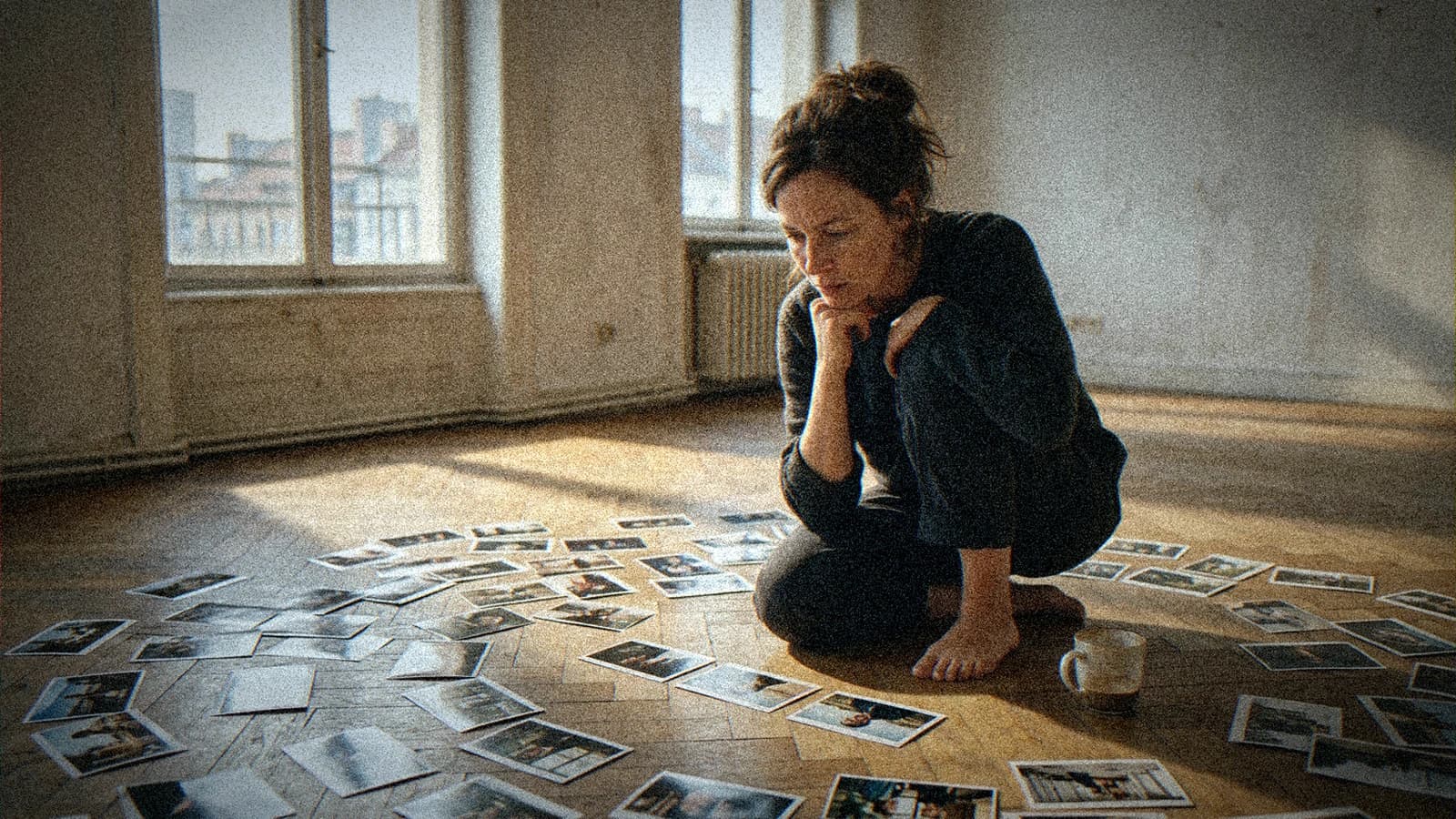
You post an image and it lands. You post twenty more and they land too. Six months later somebody scrolls your feed next to three other accounts and could not tell you which one is yours. The images are clean. The work is serious. And it is interchangeable.
That is the wall almost everyone hits once the technical phase is done. Faces stay consistent now, prompts behave, nobody ships six-fingered hands anymore. And one dumb question is still sitting there unanswered: what makes an image recognisably yours?
I took that one in the face looking at my own 2024 images. They mostly looked like everyone else's 2024 images. What follows is the method I put together to get out of it, and the one I have been running with the people I train ever since.
Project consistency and author signature are two different jobs
Two things hide behind the word "style", and mixing them up costs months.
The first is internal consistency inside one project. Thirty shots from the same short film with the same light, the same palette, the same character. That is a production problem and it gets solved with references, a bible and discipline. I covered that part in how to create a consistent visual world with AI, and the purely technical side of steering style in how to control visual style in an AI generation.
The second is whatever survives when you change projects. You go from a horror short to a coffee brand spot, the subject has nothing in common, and someone who knows your work still recognises your hand. A bible will not get you there, because a bible dies with the project.
| Project consistency | Author signature | |
|---|---|---|
| Scope | One film, one campaign, one series | Everything you make |
| Lifespan | As long as the project | Years |
| Lives in | Production bible, refs, LUT | One page of rules you know by heart |
| Who notices | The client, the crew | People who follow you, people who hire you |
| What breaks it | One badly copied prompt | A new model, a pushy client, boredom |
| How you check it | The shots hold together side by side | A stranger picks your image out without your name |
They feed each other. A clear signature makes project bibles much faster to write, because half the decisions are already made before you open the folder.
Why everybody produces the same image
An image model has a slope. Decide nothing and it hands you its centre of gravity: golden side light, shallow depth of field, centred composition, symmetrical faces, haze in the background. Nobody chose that. It is the average of what the model was trained on, plus whatever people click on most.
On top of that, we all learned the same vocabulary. The same ten words show up in everybody's prompts: cinematic, volumetric lighting, shallow depth of field, 8k, moody. Each one pushes a little harder toward the centre. Ask for cinema, get the average of cinema.
Then there are the style codes going around. Whole sites list --sref values to copy and paste, with previews that make you want to try them. The result looks good immediately, which is exactly the trap: the same code runs in thousands of accounts the same month. You did not find a style, you joined a queue. Those references have a serious use, mostly as a starting point rather than an identity, and the moodboard version of that work is in creating an actionable moodboard for AI production.
So your signature starts as a subtraction. What do you refuse to do even though the model offers it for free? That line of thinking runs through the limits of AI in art direction too, because the places where a tool stops are often where a personal eye can move in.
The seven places where your signature gets decided
A signature lives in a series of repeated decisions rather than a general mood. These are the ones that carry most weight, ordered by how fast a viewer picks them up.
| Variable | The call to make | What it changes on screen | A decided answer, as an example |
|---|---|---|---|
| Distance to subject | Do you move in or step back? | Where the viewer stands in the scene | Never tighter than a waist shot |
| Camera height | Eye level, lower, higher? | The power relationship with the subject | Always slightly below the eye |
| Light source | Where is it from, and is it motivated? | Whether the space feels real | One visible source in frame, no more |
| Palette | How many colour families, and which? | What people remember of the series | Three tones, one warm saturated accent |
| Frame density | Mostly empty or packed with objects? | The reading rhythm | One third of the frame empty, always |
| Moment of action | Before, during or after the event? | Narrative tension | Always after, you see the consequences |
| Faces and bodies | Who do you cast, at what age, with what flaws? | How human the whole thing feels | People who look tired |
That right-hand column is an example of what a decided answer looks like, not advice. Flip all seven and you could have a signature just as strong. What counts is that your answer stays the same from project to project and that you can say it out loud.
Three or four decided variables are plenty. Past five you are building yourself a prison and you will be bored in six months. For the thinking that happens before you ever write a prompt, how to think like a director with AI sets the frame.
💡 Frank's cut: the most underrated variable is the moment of action. Everyone generates the spectacular instant, the explosion, the jump, the look to camera. Pick the second after it every single time and your work becomes recognisable within three images, without touching a single colour setting.
The thirty-image audit
Nobody decides their style on a blank page. You find it in what you have already made, then you harden it.
Pull your last thirty images or shots. Not your best ones, your last ones. The best ones lie, they were picked precisely because they stand out. Print them small if you can, otherwise lay them out as a contact sheet on one screen, with no captions and no project context.
Now sort every recurring thing you spot into three columns.
What comes back because you chose it. You remember making the call, you could defend it to a client. That is the core of your signature, however timid it still looks.
What comes back because you decided nothing. The default focal length, the light the model serves when you say nothing, the framing your tool prefers. This pile is the biggest one for almost everybody. Call it what it is: the model's style, passing straight through you without stopping.
What comes back because you copied it. A borrowed sref, a reference sitting a bit too close to the surface, a seasonal trend. Keep it only if you can say what you do differently with it.
The sort takes two hours and it is unpleasant. The middle column is always fatter than you expected, and that is the useful part: every item you move from the middle column into the first one, by consciously deciding to keep it or kill it, is a piece of style that becomes yours.
If you want to push the same exercise up to the level of choosing which pieces to show, the grid I use before sending a portfolio out is in the AI portfolio quality audit before the demo reel.
💡 Frank's cut: run the audit with someone who does not know your work. Ask them one question: what keeps coming back? They will see things in ten minutes that you cannot see anymore, because you carry the backstory of every image and they only have the images.
The one-page charter
After the audit, you write. One page, not forty. If you cannot recite it from memory while walking, it is too long and you will not apply it under pressure.
The format that holds up best in workshops has three blocks: Always, Never, If in doubt.
In the Always block you put four positive rules, written so they can be checked. "Warm light" is worth nothing, nobody can rule on that in front of an image. "One light source, visible or motivated in frame" takes two seconds to verify. The Never block does the heaviest lifting, because it stops you sliding back down the model's slope when you are tired or late, and late is always when it happens. The If in doubt block holds two default calls for the two in the morning decisions, the ones where you have no opinion left. Step back. Desaturate. You pick yours once, cold, and then you apply them without reopening the debate.
Here is what it looks like filled in, on an urban fiction project I followed last year:
Always: one motivated light source in frame; subject off-centre on a third; at least a third of the image empty; faces that have lived. Never: golden backlight; look to camera; atmospheric haze; anything tighter than a chest shot. If in doubt: step back, desaturate, pick the less spectacular take.
Twelve lines. They beat any forty-page bible, because they are in your head at the moment you write the prompt instead of sitting in a file you will never reopen.
Wiring the charter into your tools
Once the rules are written they need to travel down into production. Otherwise they stay theory and the model takes over by the third prompt.
On the Midjourney side, personalization exists for exactly this. The --p parameter applies a personalization profile built from the images you select. You can create several profiles, each with an ID that generates a code when you run the prompt, and reuse it later with --p code. The official documentation adds two useful details: you have to unlock your global profile before --p works at all, and --stylize, which runs from 0 to 1000 with 100 as the default, controls how much personalization gets applied.
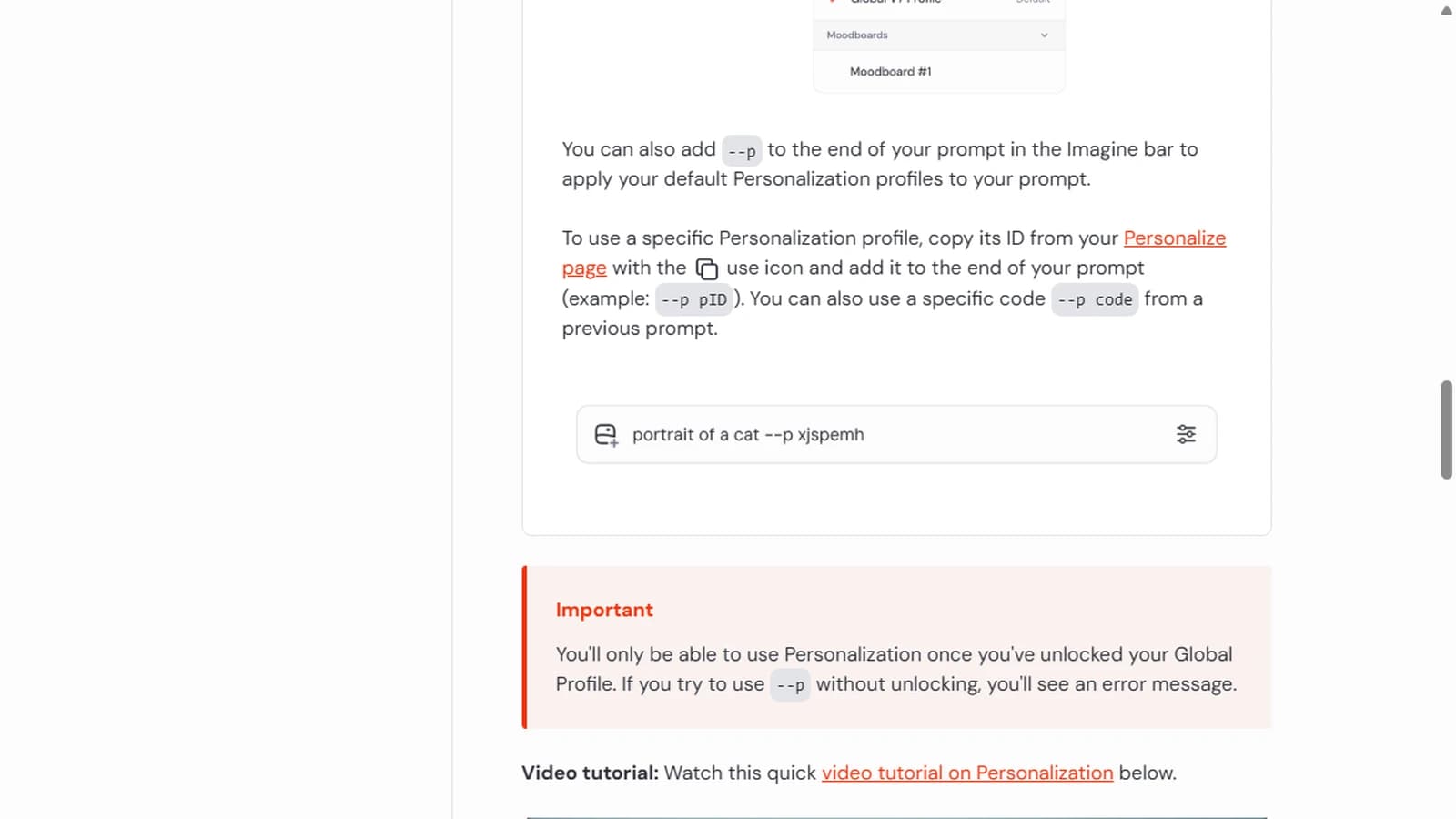
Captured from docs.midjourney.com on 2 October 2026, Personalization page.
Moodboards run on the same parameter with a different logic: you pick the images yourself instead of letting the system learn from your clicks. The docs describe them as broader than style references, and flag that they work with neither --sv nor --sw. Worth knowing before you spend an hour wondering why a prompt refuses to run.
Before you bet everything on this: a personalization code is a snapshot in time. The profile keeps evolving as you select more images, and it generates new codes as it goes. Write down the exact code used on every delivered project, or you will not find that look again in six months. In Discord, /list_personalize_codes brings the old ones back.
Deleting a profile leaves its existing codes working, which is good news for archiving and bad news if you were planning a clean-up.
Above all, a code does not replace a written rule. It encodes a mood, never a staging decision. No profile will stop you framing too tight or picking the spectacular instant. The charter sits above the tool, and it survives the next model release.
The same principle applies down the rest of the chain: a house LUT applied at the end of every edit, a template for format and grain, a base prompt library with your four rules already written in. Every bit of automation removes one chance to slide back down the slope out of tiredness.
The test that tells you whether your signature exists
One evening of work, and you will know where you stand better than six months of friendly feedback would tell you.
Start with the blind test. Mix five of your images into fifteen from other creators working in the same register, send the sheet with no captions to five people who know your work a little, and ask them to find yours. If nobody beats chance, your signature does not exist yet. If three out of five find four out of five, you have something. Then ask them what gave it away. Their answer is usually sharper than your own charter, and slightly annoying.
Follow with the three words. Have someone describe your work in three words, with "cinematic", "aesthetic" and "realistic" banned. Those three apply to everything and say nothing. If nobody can come up with three others, the image carries no identifiable point of view.
Then the refusal test, the uncomfortable one. Take a plausible, well-paid client brief that would make you break two of your rules. Could you say no, or negotiate something else? A style you drop at the first purchase order stays a preference. You are not being asked to turn down work here, only to know where you bend and where you do not.
You run the whole thing again in six months. The first time, the results are humbling. That is normal and that is the point.
No copyright protects your signature
Most people find this out at the worst possible moment, which is when they stumble on images that look far too much like theirs.
France's INPI puts it plainly on its copyright page: copyright does not protect ideas or concepts, only their concrete expression. What is protected is your works, one by one, as long as they are original, meaning they reflect your personality and come from free creative choices of yours. And that protection is automatic from the moment of creation, with no filing and no formality.
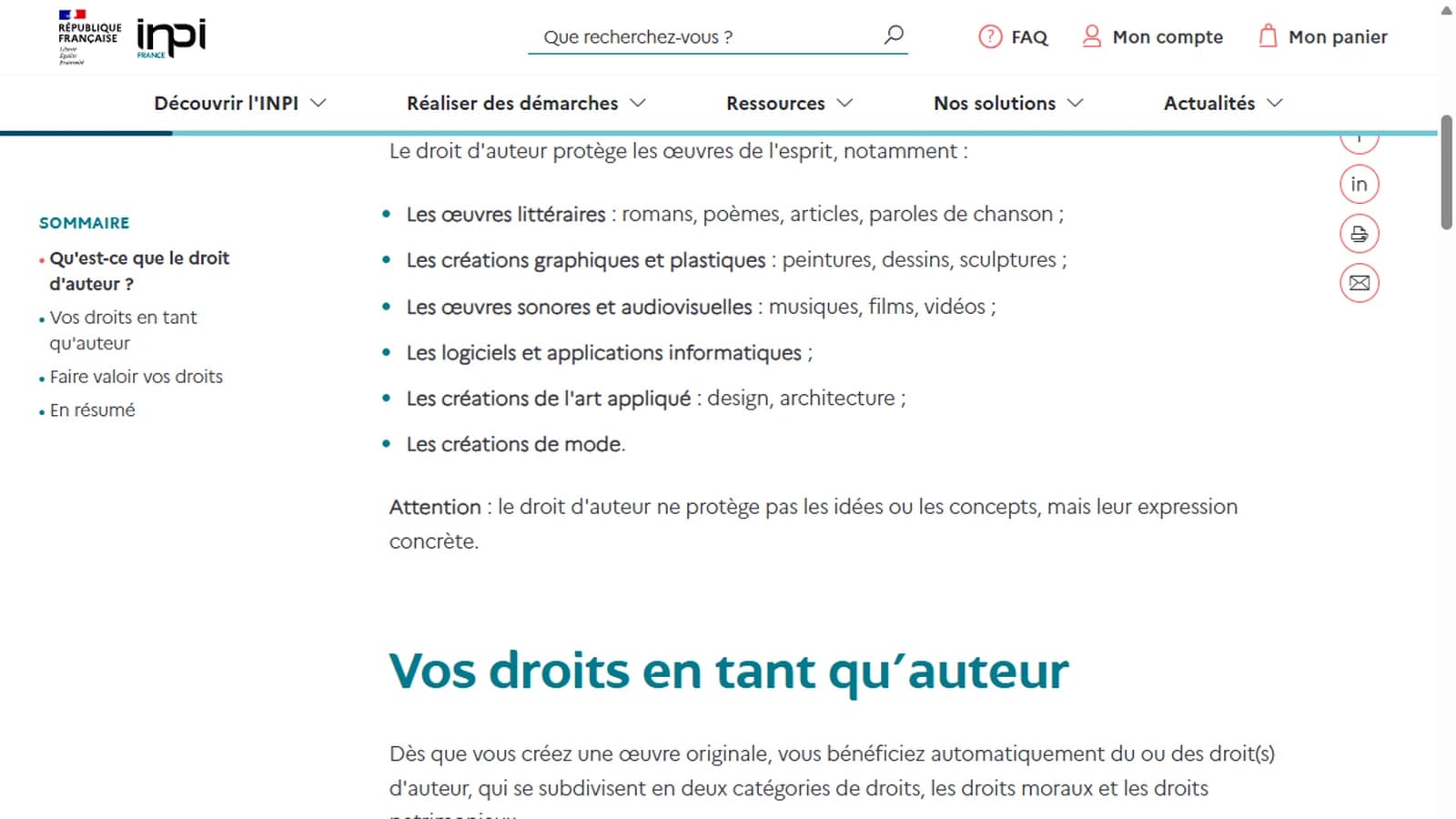
Captured from inpi.fr on 2 October 2026, section "Qu'est-ce que le droit d'auteur ?".
The US position matches, and it was restated recently in a context tied directly to AI. In its Copyright and Artificial Intelligence, Part 1: Digital Replicas report, published in July 2024, the Copyright Office writes that copyright "does not protect artistic style as a separate element of a work". The Office had received plenty of requests from creators asking for protection against "in the style of" generations. It acknowledges the problem is real, and still concludes that it does not recommend including style in the scope of new legislation at this stage.
Which means someone can study your work, take inspiration from it, build a moodboard out of your images and ship visuals that look like yours, without breaking anything, as long as they do not reproduce one of your actual images.
What does hold up legally is narrower. Your works themselves, each protected from creation, which gives you a remedy if someone lifts a specific image. Your name and commercial identity, which fall under trademark and unfair competition if somebody implies you worked on a project. And your contracts, the one place where you can write that delivered files will not be used to train a model or feed a moodboard for the next campaign.
The other protection is less legal and more effective: speed. A style that moves every year is harder to catch than a frozen one. People who copy are always copying the previous version.
What breaks a signature, and how to fix it
The client who asks for "something like X". Classic, and not malicious: existing references are the only vocabulary they have. Practical answer, take the reference for general tone, refuse it on two of your variables, and show a quick test. Nine times out of ten what they actually wanted was the emotion, not the look.
The new model. Every release resets the board, because the new model has its own slope and it differs from the last one. Protocol: regenerate five reference images from your past work with the new tool, compare, and note what moved. You will know immediately which settings need catching up.
The borrowed sref. A style that comes from a code you did not build will disappear the day everyone uses it, or the day it stops being supported. Keep it as a starter, build your own profile alongside.
Mannerism. The reverse problem. Hold the rules hard enough and you end up making the same image under different subjects, and people get bored before you do. Warning sign: you recognise your own image before you even register the subject. Cure: change one variable out of seven, deliberately, for a whole project.
Silent drift. You apply your rules a little less every month without noticing, especially when work piles up. The only counter-measure that works is redoing the thirty-image audit every six months. Two hours, twice a year.
The mosaic portfolio. Your signature can exist and stay invisible because you present thirty isolated images. Three series of ten shots show an author, thirty scattered shots show a contractor. Building that shop window properly is covered in how to build a credible AI portfolio.
Foire aux questions
Réponses rapides aux questions les plus fréquentes sur cet article.
How long does it take to get a recognisable style with AI?
Count three to six months of steady output after the audit, not before. What moves the needle is the number of decisions you have actually made and held, not the hours spent generating. Someone producing two images a week while applying four strict rules will have a sharper signature after four months than someone producing fifty a week with no rules at all. The main accelerator is running the thirty-image audit again partway through, because it shows you which of your rules you genuinely apply and which ones you wrote down and forgot by week two.
Can you have a signature using the same tools as everyone else?
Yes, and that is the normal situation. Photographers all shoot Canon, Sony or Nikon bodies and nobody confuses their pictures. What sets you apart happens before the tool: who you shoot, from how far, at what moment, with what light, and above all what you refuse to show. The tool only comes in afterwards. In practice, two people with the same Midjourney subscription and two different charters will ship images nobody mixes up, while two people with no charter will ship the same image from two different subscriptions.
Should you have one style or several?
Several works, as long as they are separated and named. Plenty of directors run one voice for fiction and another for commercial work. What fails is the unacknowledged blend where every project drifts with whoever is paying. Write one charter per register, one personalization profile per register, and keep a distinct space to present each. If you cannot explain in one sentence why a project belongs to one rather than the other, you have one register too many.
Is a Midjourney style code enough to define a signature?
No, and this is the most common confusion. A code encodes a mood: palette, texture, grain, how light gets treated. It encodes no staging decision whatsoever. It will never stop you framing too tight, picking the spectacular instant instead of its consequences, or casting the same smooth faces as everybody else. The code is a useful shortcut for holding a tone across a series, nothing more. Framing, distance and moment stay handwritten rules, and those are what people recognise first.
Is my style protected if someone imitates it with AI?
Not as a style. The INPI points out that copyright covers concrete expression and not ideas or concepts, and the US Copyright Office wrote in July 2024 that it does not protect artistic style as a separate element of a work, adding that it does not recommend writing style into new legislation. What stays protected is your works, one by one, from creation and with no formality. So you have a remedy if someone lifts a specific image, none if someone ships visuals that merely resemble yours. The levers left are contractual and commercial: your name, your clauses on model training, and staying one step ahead.
How do you keep your signature when a client imposes their references?
By negotiating variable by variable instead of globally. Accept the reference on what belongs to their brand world, product colour, emotional register, casting type, and hold the line on two or three calls that are yours, usually framing and choice of moment. Show a quick side-by-side test, their reference on one side, your version on the other. The conversation turns concrete and stops being a power struggle. And put a visual research line in the quote, which makes it legitimate to propose something other than the copy you were asked for.
Should you show your style or keep it to yourself?
Show it, and explain it. A secret style earns you nothing, nobody calls about something they do not know exists. Publishing your charter and saying why you refuse golden backlight or looks to camera does two jobs at once: it proves your images come from decisions rather than a run of lucky draws, and it filters your inbound. The people who call afterwards are calling for that specifically. Copying is a risk, sure, but a charter copied without being built produces applied, dead images, and that shows immediately.
The real cost is two hours every six months
The gap between a good technician and an author comes down to repeating a handful of decisions you can state out loud. Image quality, at this level, everybody has.
So this week: pull your last thirty images, sort them into three columns, write twelve lines. You will have a charter before the evening is out. It will be imperfect and it will change in six months, which is exactly what you want from it.
Then you push it down into your tools, test it blind, and put the next audit in the calendar. That is the whole protocol. Two hours, twice a year, and almost nobody takes them. Which explains fairly well why so many successful images look alike.
Related articles
 Tutoriels
How to Fix a Bad Visual Composition
Horizon, lines of force, subject hierarchy, and frame breathing: fixing before regenerating endlessly.
 Tutoriels
Creating a Visual Directing Intention Note With Tome AI
A complete method to turn a visual intuition into a clear, cinematic and presentable intention note with Tome AI.
 Tutoriels
How to Create Visual Storytelling with No Dialogue
Telling a clear story with the image, the frame, the light and the rhythm, without depending on dialogue.