The Limits of AI in Art Direction (and What the Human Must Keep)
Taste, consistency, responsibility, set relationships: why AI speeds up variants but does not replace an art direction that owns risky choices.
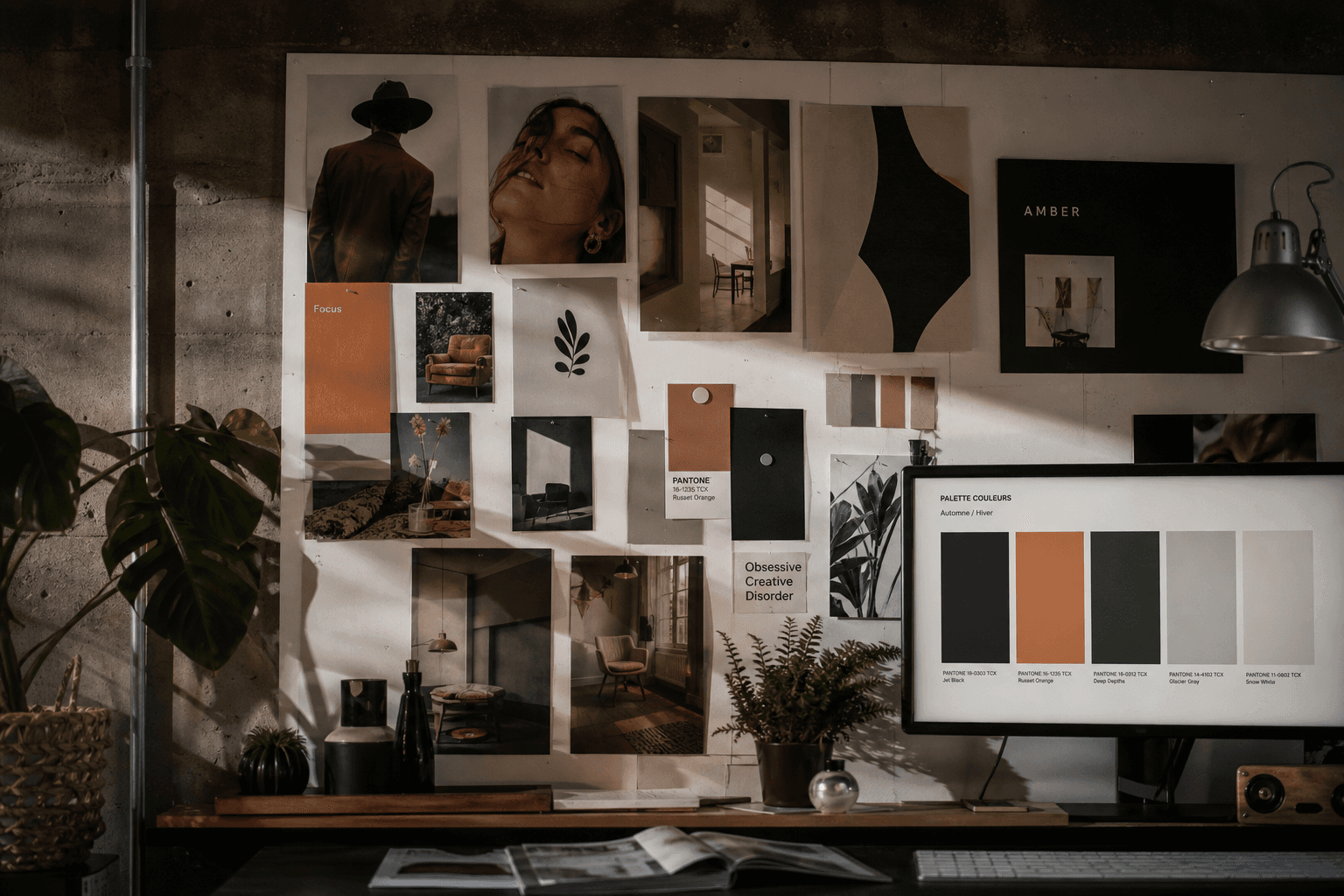
AI generates moodboards at the speed of a scroll. It proposes palettes, lights, "cinema" framings. And yet, on a real project, art direction stays a job of decision under uncertainty: budget, ego, internal politics, technical constraints, the producer's taste at three in the morning. A machine can give you ten credible options: it cannot carry the responsibility of the choice that costs a hundred thousand euros.
This text lists real limits, not moral ones. I am not going to tell you that "the soul" is inaccessible to algorithms: I am going to tell you where the algorithm goes structurally wrong relative to the role of an art director on a film, a series, an ad, or an image campaign.
What art direction really does
An art director does not only choose a color. They frame a universe: material, light, typography, costume, architecture, shot consistency, emotional continuity. They negotiate with the production, explain to the director why an idea is beautiful but unmanageable, turn a constraint into a style. The art director is a translator of constraints into a sensory language.
AI, for its part, often optimizes a statistical average of what "looks like" cinema. It is powerful for exploring. It is toxic if you confuse average and signature.
To structure a video with a narrative requirement, see how to structure an AI video like a real film. For the thinking behind the frame, how to think like a director with AI complements this subject well.
Limit 1: AI does not know your shoot tomorrow
The generators do not know that your set burned down, that your actor has an allergy to green makeup, that the brand banned red after a social incident. Real art direction is contextual. AI is generic until you inject context, and even then: it does not have the pressure of the set.
You can simulate context in a prompt, but reality answers you with unmodelable surprises: weather, sonic neighborhood, involuntary lens flare that becomes a signature. The set is a creative adversary: AI is not afraid of the sun.
Limit 2: taste is not an optimization
Taste, in a company, is a function of power and reputation. An art director must sometimes defend a deliberate ugliness, a dryness, an offset. AI tends to bring you closer to a "pleasant" aesthetic by default: clean contrasts, smooth faces, flattering light.
It is exactly what our guide on photorealistic AI images with no plastic effect fights: the smooth is not a direction, it is an absence of direction.
Limit 3: long-duration consistency
Over thirty shots, art direction imposes a continuity: grain, curve, costumes, recurring details. The image models generate variations locally beautiful and globally unstable. The tools progress, but the governance stays human: bible, locked references, quality control.
For classic continuity mistakes in AI video, read AI film: continuity mistakes and visual inconsistencies to avoid.
Limit 4: the human relationship
An art director must convince. They sometimes have to say no without destroying the motivation. They must translate a fuzzy client anxiety into actionable constraints. AI does not handle the non-verbal of a pitch room. You do not prompt an awkward silence.
Limit 5: ethics and the image of bodies
Faces, doubles, sexualization, stereotypes: art direction carries a societal responsibility that a tool cannot assume in your place. The institutional frameworks exist to reason about these subjects beyond the "pretty". UNESCO and artificial intelligence offers broad ethical markers. The European Commission on AI also frames transparency expectations.
Table: AD task vs AI contribution vs risk
| Task | AI useful | Risk |
|---|---|---|
| fast moodboard | yes | homogenization |
| exploratory palette | yes | "generic cinema" |
| written bible | partial | false details |
| budget arbitration | no | numeric hallucinations |
| client negotiation | no | absence of tactical empathy |
| aesthetic signature | no | statistical average |
Limit 6: legal responsibility and unconscious copy
A generator can reproduce motifs too close to existing works. The human art director must understand the uncertainty of the training data and the outputs. The WIPO: AI and IP primer helps set the vocabulary. This is not a legal line: it is a line of caution.
💡 Frank's Cut: if you cannot explain why this look serves the story in three sentences with no technical jargon, it is not art direction: it is set dressing.
14-day program: getting your eye back when AI harms you
Days 1 to 4: ban on "cinema look"
You generate images but you ban the words "cinematic, teal and orange, volumetric". You observe what remains when the cliché is removed. If nothing remains, your eye was rented from a preset.
Note each day a forbidden adjective and a mandatory adjective. After four days, you have a mini tone guide that looks like no one else's. You can reuse it as a preamble to each prompt: it is a cheap way to force a personality with no technical jargon.
Days 5 to 8: physical references
You print or project three human references (photo, painting, architecture). You set an AI image against them and you note the gap on five axes: grain, light transition, material, hand, gaze.
Days 9 to 11: series consistency
You impose a recurring object (watch, secondary color) and you check its stability over ten images. You document the failures.
Days 12 to 14: human pitch
You present two directions to a peer without saying which is AI. If you do not know how to defend the intention, you do not sell the art direction.
Add a constraint: two minutes with no showing the screen. If you cannot make the world be imagined, your images will not save the pitch. The images are a proof, not an escape from speech.
Practical case: fashion campaign with a brand constraint
The client bans pure black and wants an "artisanal" texture. AI proposes deep black and too-clean textures. The human art director chooses a warm gray, adds real photographic noise, imposes a side light that creates dirty shadows. The constraint becomes style: AI alone would have smoothed the client's fear.
Troubleshooting: symptoms of an art direction delegated to AI
Everything is beautiful and nothing is memorable
Fix: an owned risky visual motif, a simple repeated rule, a controlled ugliness.
The characters change identity between shots
Fix: photo bible, locked references, segmentation of the generative tasks. See also our articles on character consistency.
The client loves the previews and hates the master
Fix: previews calibrated on the same screen as the final validation. Mobile kills more art direction than AI.
You can no longer explain your choices
Fix: write an intention sentence per scene before generating. If the sentence is empty, the image will be too.
AD vs production designer vs concept designer: who does what with AI
On big projects, the roles separate. The concept designer explores worlds; the production designer materializes; the AD arbitrates the whole against the story. AI sometimes blurs these borders because it makes exploration accessible to everyone. The organizational bug: everyone "does art direction" on Slack at midnight.
When everyone generates, no one holds the list of prohibitions: competitor brand colors, sensitive symbols, cultural codes. The human art director then becomes again a guardian of constraints, not a magician of filters. It is less glamorous, but it is indispensable as soon as the image goes out on a poster.
Light, material, and the limit of the "plausible"
The engines know how to imitate a "pretty" light. They struggle more when the light is a character: dirty neon, fluorescent void, backlight that creates a precise emotion. Art direction often chooses a light that harms the readability of the face but serves the scene. AI, by default, brings you back to a comfortable readability. Comfort is not a universal artistic value.
The material undergoes the same bias: metal too clean, wood too regular, fabric with no gravity. You correct with real photographic references, scans, captured textures, and with a simple rule: one owned imperfection per shot.
Project memory: what a model does not have
A series lives for months. A campaign goes through revisions that depend on an email from March. AI in a chat does not have the institutional memory of your studio: it was not in the room when the producer said "never green" for an absurd but definitive reason.
Art direction must therefore externalize the memory: bible, screenshots of the validations, style sheet of the "yes / no". With no memory, you are not making art: you are making coherent noise for two weeks.
Table: AD decision vs what AI proposes by default
| Decision | Typical human intention | Frequent AI drift |
|---|---|---|
| contrast | contained anger | aggressive HDR |
| skin | noble fatigue | beauty smoothing |
| architecture | oppression | cliché symmetry |
| color | melancholy | teal/orange |
| typography | friction | "tech" fonts |
Workshop: five questions before showing an AI image to the client
- What feeling should we feel after the image, not during?
- What narrative information becomes clearer?
- What is forbidden in this project and visible here?
- What proof shows that it is not generic stock?
- What happens if the client says yes too fast? Sometimes it is a signal that it is too smooth.
Practical case (continued): short series and recurring identity
You have to hold a symbolic object (a lighter, a scar, a secondary color on a coat). Over ten AI keyframes, six lose the object. The human art director does not "correct": they redefine the rule: the object must appear in the first third of the frame, every time, even if it is less pretty. Narrative consistency beats instagrammable composition.
You document the failed shots: they become a human dataset of what the model does not know how to do for your show. It is more precious than a hundred prompts copied from Discord.
Then, you align the sound and the visual: the lighter must not only be visible, it must sound like the same metal on each insert. When the image and the sound diverge, the viewer's brain classifies the scene as "fake" even if each layer is beautiful in isolation. Art direction is sometimes a discipline of sensory synchronization, not only of moodboard.
Where AI stays an honest ally
Exploration, translation of references into words, packaging variation, fast mockups, internal communication. The winning alloy is: AI for the volume, human for the meaning and the responsibility.
When you use AI, set yourself a golden rule: each session ends with a written decision, even a small one: dominant color, prohibition, name of the look. Otherwise you accumulate variations with no direction, which is the exact opposite of the job.
Foire aux questions
Réponses rapides aux questions les plus fréquentes sur cet article.
Is AI going to replace art directors?
No for the social and decisional role. Yes for a part of the execution and variation work. The job moves toward curator, arbiter, constraint designer.
The studios that "save" an art director too early often discover a hidden cost: late rework, marketing inconsistency, images that have to be redone because they do not hold the distance of a campaign. Replacing an art director with a prompt is sometimes replacing a decision with an average.
How to defend a "less pretty" direction?
With the story: tension, character, target audience, technical constraint. Negotiated beauty beats average beauty.
Prepare three images: the "pretty" version, the "accurate" version, and a "risky" version. Explain in one sentence what each one sacrifices. Clients understand the sacrifice better than the jargon.
Which skill to level up first?
The communication of the choices and the visual proof (tests, comparisons, primary references).
Add the ability to write an intention note in five lines. It is often this document that saves a project when the visual is attacked by stakeholders who do not have the same screen.
Does AI help juniors?
Yes to learn fast, no if it replaces the observation of the real. A junior must spend time in front of real light, not only in front of probabilistic outputs.
Simple program: one output per day annotated by hand: "what is false here?". Manual annotation creates an internal vocabulary: with no that, you speak the language of prompts but not that of fabrication.
Should you refuse certain tools?
Refuse those that remove the traceability of the sources and the rights on the client assets.
Also refuse the workflows where the validation is done on files with no metadata: you will not be able to prove what was generated, retouched, or captured.
How to avoid aesthetic plagiarism?
A mix of improbable references, project-specific constraints, real shooting, captured textures.
When you copy an iconic composition "for homage", own the legal and ethical frame. Homage is not a button.
Does AI art direction work in advertising?
For fast concepts yes, for the compliance and the final signature, the human stays central.
Advertising has brand, medical, child, diversity-representation guardrails: these are subjects where a "cool" image can become a reputational problem in a few hours.
Can you do 100% generative art direction?
You can produce images, not a complete responsibility. Someone has to sign.
And someone has to assume the backlash if the image hurts a community. AI does not do crisis management: it proposes variants to you while your phone is ringing.
Art direction does not stop at the image: sound, rhythm, animated typography
A modern art direction often includes the typography in motion, the rhythm of the title cards, the sound / image relationship. Image AI does not see the sound. Audio AI does not see the tension of a gaze. The art director is sometimes the only role that holds the extremities of the pipeline in the same mental hand.
When you work with separate generators, the risk is a sum of beauties: each module is clean, the whole is inconsistent. The countermeasure is a "cross-cutting rules" sheet: fade durations, sound family, three tone adjectives, two camera-movement prohibitions.
Budget and visual "false richness"
AI images can give the illusion of a blockbuster on a sandwich budget. It is an opportunity and a trap: the client believes that everything is possible, then demands ten additional shots "since it is fast". The human art director must re-anchor the real cost: retouching, compliance, machine time, human iterations, legal validation. Visual richness with no control budget is a debt.
Conclusion
AI raises the technical floor. It also lowers the tolerance for approximation if you are not careful. Art direction, in the strong sense, is what remains when the tool has finished proposing: the choice, the risk, and the capacity to say no. That is where a human is irreplaceable.
If you want a last work sentence: the art director is not the one who owns the software, it is the one who owns the consequence of the frame.
Related articles
 Tutoriels
Underwater Shots: Caustics, Limits and AI Workarounds
What the engines hold underwater, when to prefer hybrid compositing, and a validation workflow.
 Comparatifs
The 10 Artificial Intelligence Sites Every Creator Must Know (2026)
A map of the platforms really useful in production: image, video, sound, writing, research and workflow, with selection criteria so you do not dilute your budget.
 Analyses
How Generative AI Transforms Creative Writing in Audiovisual
How generative AI changes the development of ideas, scenes, characters, pitches and audiovisual writing workflows.