Label the original, not the AI: what Adobe's CTO says
For Adobe's Ely Greenfield, the "made with AI" label will soon mean nothing. He wants to mark what was not generated. What that changes for you.
Contents · 6 sections
When you take a photo with your phone, AI is already involved: several exposures merged, automatic processing before the image even appears. Should it carry an "AI" label? For Ely Greenfield, CTO of Adobe's Digital Media business, the answer is no. And that is the whole problem with today's labels.
He said so to Digital Trends, in an exclusive interview at Adobe MAX published on November 15, 2026. His clearest line: "The goal of C2PA is not to label things that were made with AI, which doesn't help you; it's to label things that weren't." I read Varun Mirchandani's article and the C2PA coalition's site on November 17.
What Ely Greenfield says
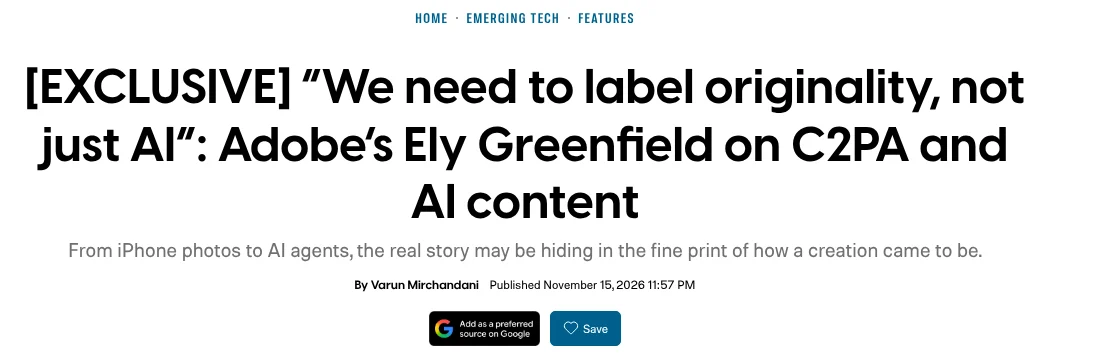
Source: Digital Trends, captured on November 17, 2026.
His starting point is creators. When you mention an AI label, he says, their reaction is: "Oh my god, like, I don't want my stuff labeled." And he expects the label to become so common it says nothing: "It'll be like saying somebody used Photoshop to edit this. Like, that doesn't tell you anything."
Hence his idea: flip the question. Instead of marking everything AI touched, make it possible to prove what comes from a real capture, with a verifiable history.
That is the job of C2PA (the Coalition for Content Provenance and Authenticity), an open standard Adobe helped establish. It attaches a signed record of a file's origin and edits, called Content Credentials. According to Digital Trends, Leica, Nikon and Canon have adopted it in some products, and Qualcomm has worked with Truepic to bring it to Snapdragon chips.
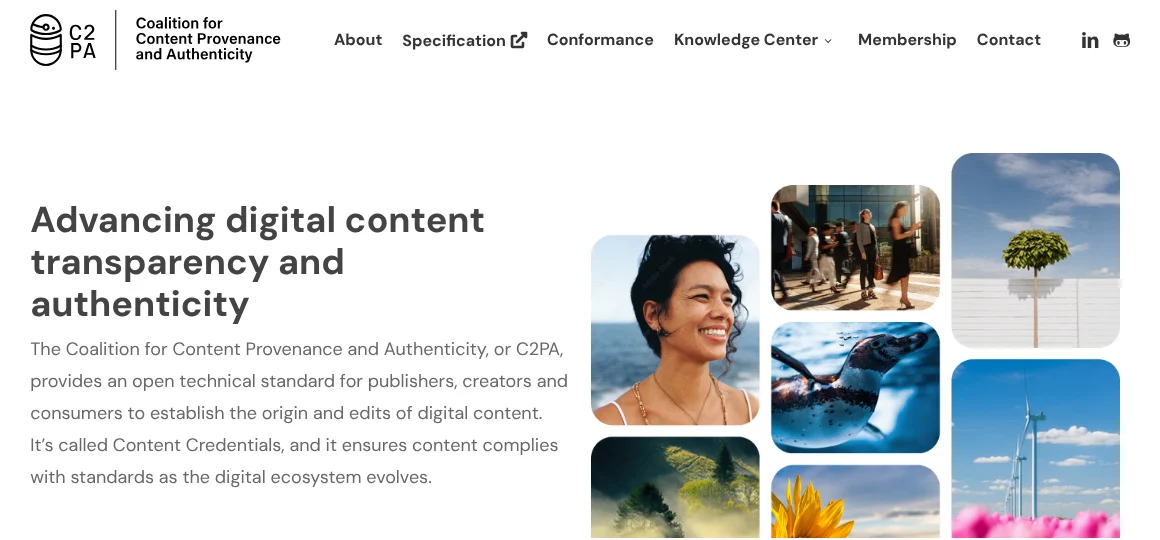
Source: C2PA website, captured on November 17, 2026.
What a Content Credential proves, and what it doesn't
Greenfield is not selling a magic detector. He says it himself: "I know this could be manipulated, because everything could be manipulated, but I can see and trust who is telling me something about this, and then I can decide if I trust that person."
The Digital Trends piece is clear about the limits:
- A credential shows the history, not the truth. It says who recorded what and which edits were made. It doesn't prove the scene is real.
- It doesn't measure the human share. It can say a tool was used, not how much judgment went into the work.
- A file without a credential isn't necessarily fake. It may simply have no history attached.
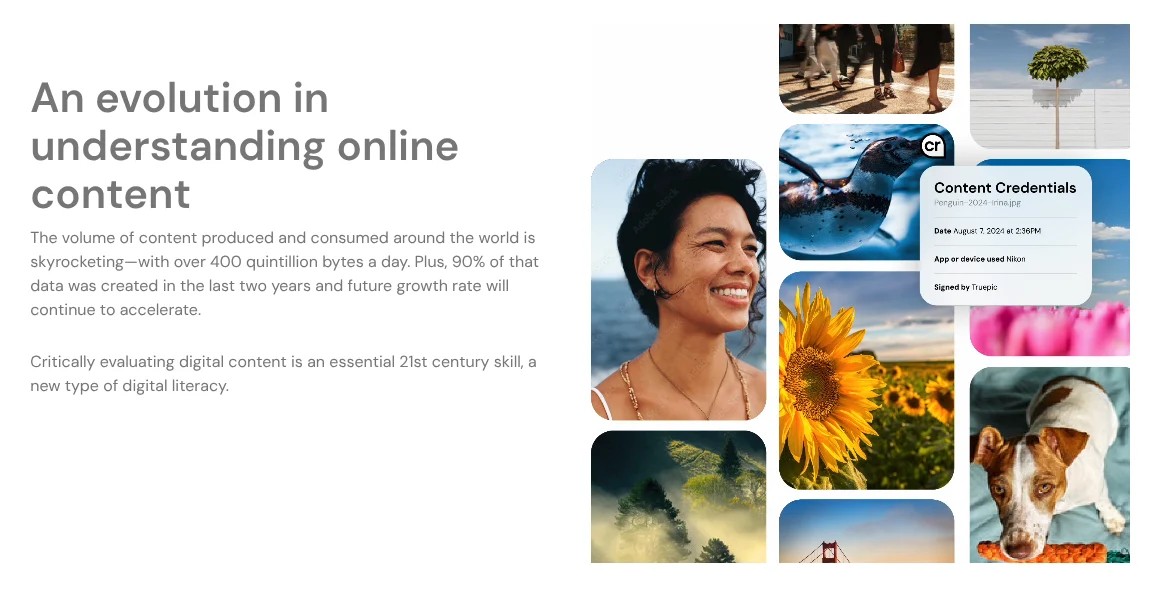
Source: Content Credentials website, captured on November 17, 2026.
Why this matters to me
I make images and films with AI, and I also retouch photos by hand. There is a whole gradient between the two, and the word "AI" flattens it. The article sums it up with three words we mix up: processed, assisted, generated.
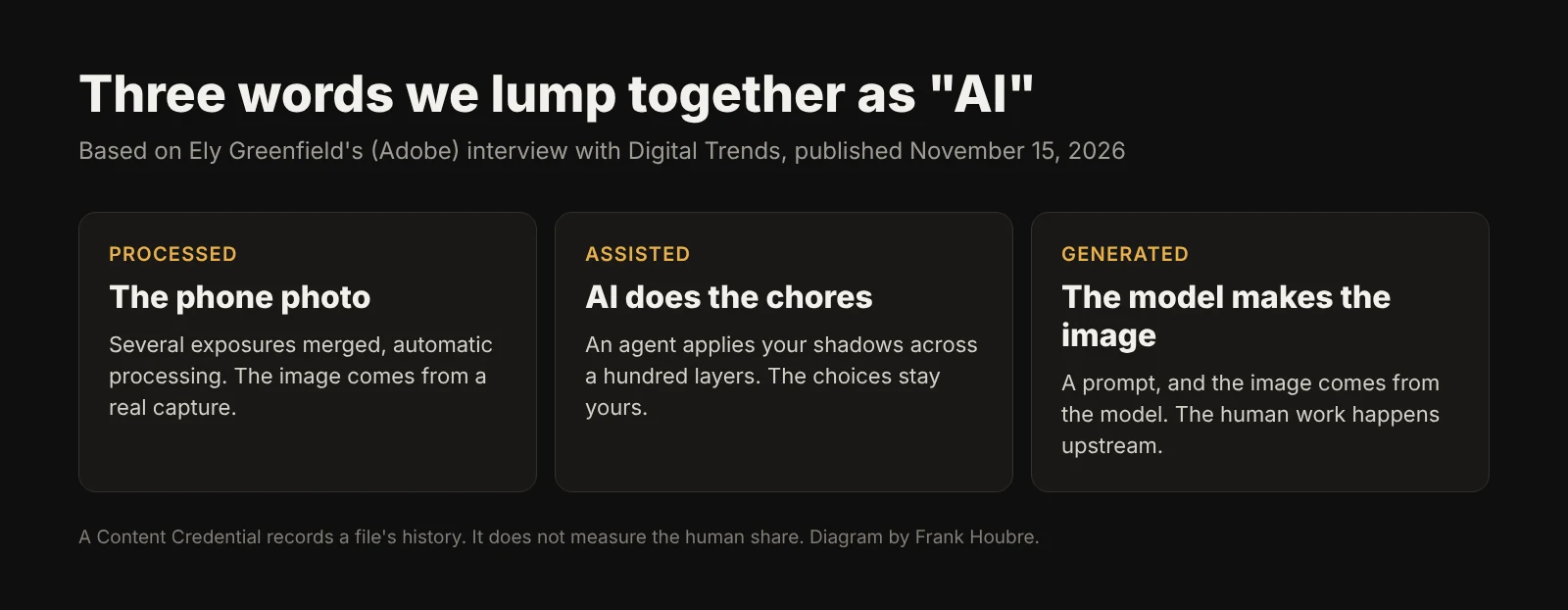
An illustrator who asks an agent to apply their shadows across a hundred layers has not done the same thing as someone typing a prompt. Both should be transparent. They don't deserve the same label. It is the same debate as copyright on AI-generated images: what matters is the share of human decision, and no badge measures it yet.
I also note the context. Greenfield speaks as Adobe puts AI everywhere, from Premiere to Photoshop. Adobe has an interest in "using Adobe's AI" not being seen as a stain on your work. His argument still holds, but keep that in mind.
What I would do in your place
- Keep your source files. Original photos, working files, intermediate versions. They are your best proof of process, credential or not.
- Turn on Content Credentials where your tools offer them, especially for field photos. The day someone asks "is this real?", you'll have an answer.
- Be precise when you disclose AI. Instead of a plain "made with AI", say what the tool did: retouch, set extension, generated image. Clients and audiences will understand better.
- Don't rely on a missing badge to judge someone else's image. A credential is a clue, not a verdict.
What we don't know
- What Adobe will actually change. The interview describes a vision, not a new label format or a date.
- Adoption by social networks. The article names no platform that shows these credentials systematically.
- How to mark "the original" without penalizing photos taken on devices that don't support it, which is most of them.
Frequently asked questions
Quick answers to the questions readers ask most about this article.
What is C2PA?
The Coalition for Content Provenance and Authenticity. It publishes an open standard that attaches a signed record of a file's origin and edits, called Content Credentials.
What did Ely Greenfield say about AI labels?
That the "made with AI" label will become as unhelpful as "edited in Photoshop", and that C2PA's goal is rather to label what was not made with AI. He told Digital Trends in an interview published November 15, 2026.
Does a Content Credential prove a photo is real?
No. It shows who recorded the file's history and which edits were made. It doesn't prove the scene is real, and it can be manipulated, as Greenfield acknowledges.
Is an image without a Content Credential fake?
Not necessarily. It may simply have no history attached, which is the case for most images today.
Which cameras use C2PA?
According to Digital Trends, Leica, Nikon and Canon have adopted it in some products, and Qualcomm has worked with Truepic to bring it to Snapdragon chips.
How should I disclose AI use in my images?
Be precise: say what the tool did (retouch, extension, full generation) rather than a plain "AI". And keep your source files as proof of your process.
Related articles
 Actualité
Writing with AI: a study says keep the idea for yourself
A study in PNAS Nexus compares three ways of writing with AI. Letting AI do everything gives the weakest stories. What it means for your screenplay.
 Actualité
Adobe Project Live Set: editing a video while it plays
At the Adobe MAX Sneaks, Project Live Set changed the subject, set or camera of a video mid-playback. What it promises for an AI film, and its limits.
 Actualité
Adobe MAX 2026: what changes in Premiere for cutting a film
Color Mode grading, generation in the timeline, object removal, AI agents: what Adobe shipped for Premiere at MAX, and what is still in beta.