Writing with AI: a study says keep the idea for yourself
A study in PNAS Nexus compares three ways of writing with AI. Letting AI do everything gives the weakest stories. What it means for your screenplay.
Contents · 6 sections
When you write a screenplay with AI, the question is not only "do I use it?". It is when. A study published on November 10, 2026 in the scientific journal PNAS Nexus shows it fairly clearly: the same AI produces very different stories depending on how much of the work you hand over.
The study is by Kartik Hosanagar, a professor at the University of Pennsylvania, and Daehwan Ahn. I read it through the PNAS Nexus press release and CNET's article (Julian Dossett) of November 12, both read on November 13. The full paper on the journal's site could not be opened from my browser.
What the study tested
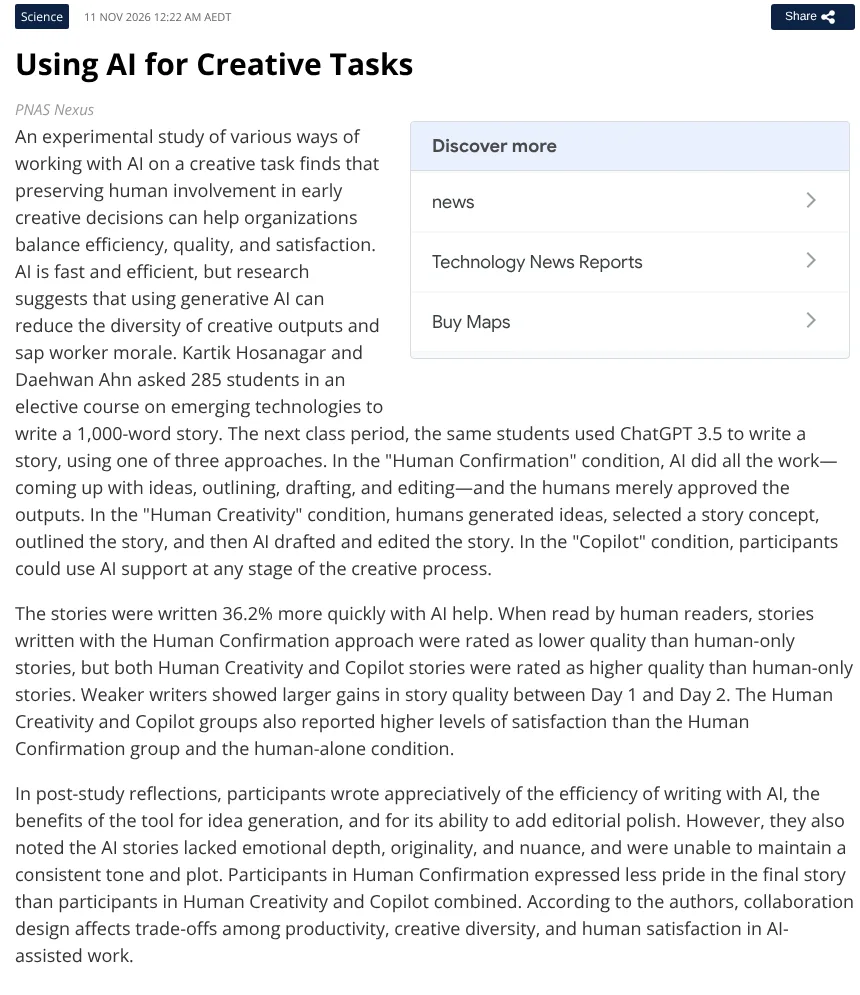
Source: PNAS Nexus press release, via Mirage News, captured on November 13, 2026.
The setup is simple. 285 students first write a 1,000-word story on their own. In the next class, they write another one with ChatGPT 3.5, using one of three methods:
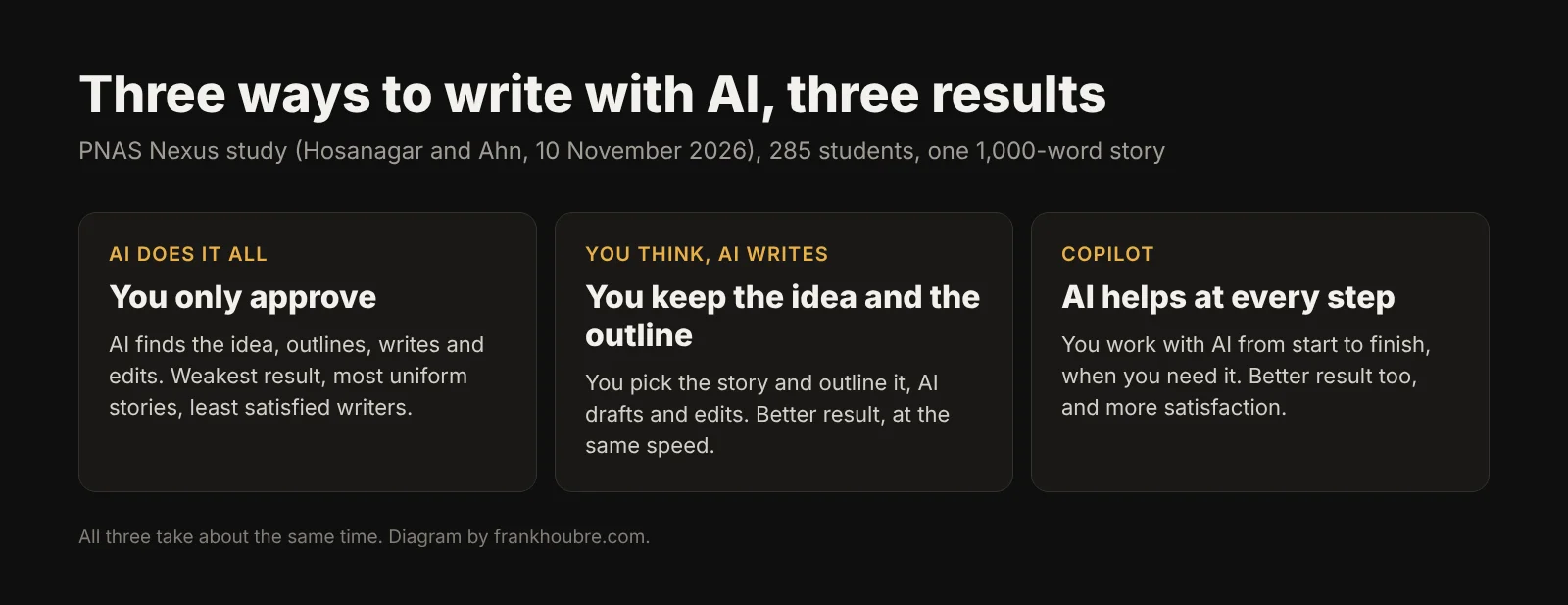
- AI does it all ("Human Confirmation"): it finds the idea, outlines, writes and edits. The student only approves.
- You think, AI writes ("Human Creativity"): the student comes up with ideas, picks the story and outlines it. AI drafts and edits.
- Copilot: the student can ask AI for help at any stage.
What it found
According to the press release and CNET:
- With AI, stories were written 36.2% faster. And the three methods took about the same time.
- When AI does it all, the stories are the weakest and the most uniform, and their writers are the least proud of them.
- When the student keeps the idea and the outline, or works as a copilot, the stories are better, at the same speed, and the writers more satisfied.
- The weakest writers at the start improved the most between day one and day two.
- In their comments, students found that the AI's writing lacked emotional depth, originality and nuance, and struggled to keep tone and plot consistent.
Source: CNET, captured on November 13, 2026.
One point to read with care: the two sources disagree on the comparison with writing without AI. The press release reports better stories with two of the methods, while CNET writes that AI did not improve quality in any group. What is certain is the gap between "AI does it all" and the other two.
What it means for your screenplay
People often think the gain from AI is time. The study says something else: handing over the idea does not save more time, but it costs quality and variety. The moment you decide what the story is about is exactly where the AI sounds most like every other AI.
Kartik Hosanagar sums it up to CNET: the goal is not to eliminate human effort but to direct it to the parts where human judgment and creativity matter most. He adds that people get satisfaction from a meaningful creative role, not just from a good final output.
💡 Frank's take: This is exactly what I see in the AI films people show me. The ones that all look alike are the ones where AI picked the story. My order of work does not change: idea, character and structure on paper first, then AI for dialogue, variations and proofreading.
To unblock a scene without handing over the idea, my piece on AI and the blank page gives a step-by-step method. For a full short film, from idea to shot list, follow my guide to writing a short film with AI. And a concrete example of splitting the roles is in my case study of a film co-written with AI.
What I would do this week
- Write your pitch and outline by hand, without AI, even in ten lines. That is the part the study suggests you keep.
- Give that outline to AI for a first version of the scenes, not the other way round.
- Reread looking for what is missing: emotion, nuance, consistent tone. Those are the participants' complaints about the AI's writing.
- Compare one scene written both ways. Once where AI suggests the idea, once where you give it the idea. You will quickly see which one sounds like you.
What we don't know
- Whether it holds for professionals. The participants are students, on a single story.
- Whether it holds with current models. The study used ChatGPT 3.5, an old model.
- Whether it holds for a screenplay. The task is a 1,000-word story, not a 90-page script.
- The detail of the quality ratings. I could not access the full paper, and the summaries disagree on the comparison with writing without AI.
Frequently asked questions
Quick answers to the questions readers ask most about this article.
What does the PNAS Nexus study say about writing with AI?
It compares three ways of writing a story with ChatGPT 3.5. When AI does everything and the human only approves, the stories are the weakest, the most uniform and the least satisfying for their writers. When the human keeps the idea and the outline, or works as a copilot, the result is better at the same speed.
Who ran the study?
Kartik Hosanagar, a professor at the University of Pennsylvania, and Daehwan Ahn. It was published on November 10, 2026 in PNAS Nexus.
Does AI save time when writing?
Yes, stories were written 36.2% faster with AI, according to the press release. But the three methods tested took about the same time: letting AI do it all is not faster than keeping the idea yourself.
Should AI come up with the idea for a screenplay?
The study suggests not. That method produced the most uniform stories. Keeping the idea and the outline, then handing drafting or variations to AI, gave better results.
Do these results apply to a professional screenwriter?
We don't know. The study covers students, with ChatGPT 3.5, on a single 1,000-word story. It is an indication, not a rule for a feature film.
How should you organize your writing with AI?
Write the pitch, the characters and the outline yourself. Then use AI to suggest versions of scenes, dialogue or a proofread, and reread looking for emotion and a consistent tone.
Related articles
 Analyses
How Generative AI Transforms Creative Writing in Audiovisual
How generative AI changes the development of ideas, scenes, characters, pitches and audiovisual writing workflows.
 Actualité
Apple now charges for AI in its creative apps past a quota
Apple sells a $49.99 AI usage pack in Logic Pro, France included. Final Cut Pro is expected next. How it works, and how not to get caught short mid-project.
 Guides
Keep the same character across shots in AI video
A director's method to keep the same character from shot to shot in AI video: references, Kling Elements, Seedance, Google Flow, Runway, shot planning.