Becoming an Audiovisual Prompt Engineer: Skills, Outlets and Method (2026)
Beyond the magic-word lists: how to structure prompts like cinema briefs, deliver as a team, and build a career around AI video and image without getting replaced by the next model.
"Prompt engineer" has become a LinkedIn title as vague as "consultant". In audiovisual, the useful job is not writing mystical sentences: it is to translate a directing intention into constraints usable by a model, then to verify the result as you verify a rush. If you do not know what a wide shot is, your prompt will not save your film.
This guide lays a realistic path: minimal technical skills, indispensable cinema skills, deliverables expected in a studio, tooling, frequent mistakes, and a strategy to stay employable when the models change every quarter.
The audiovisual prompt engineer is not a "text magician"
In the field, you will be asked for:
- variants for the same scene (light, focal length, tempo),
- consistency between shots,
- exports usable by the edit or the 3D,
- traceability (which model version, which prompt, which seed if applicable).
Your employer does not pay for the prompt: they pay for the reduction of uncertainty. A good prompt is a short brief. A bad prompt is a prayer.
For the bases "why it fails", read why your prompt does not work (and how to fix it). To avoid the market's intellectual shortcuts, also see whatever you do, do not buy a ready-made AI prompt.
The three pillars: cinema language, technical chain, communication
Cinema language
You must name: framing, "felt" focal length, light direction, contrast, depth of field, camera movement, implicit edit rhythm. It is not snobbery: it is signal to reduce the space of solutions.
Technical chain
Resolution, cadence, compression, color profiles, output formats, denoise, upscaling. You are not obliged to be an engineer, but you must know where your image dies in the pipeline.
Communication
You reformulate the director's fuzzy brief, you say no to impossible requests, you document. Studios hire humans for the conflicts, not for the dashes.
For an overview of the tools, our comparison of the best AI video tools helps choose where to invest your time. For the narration, structuring an AI video like a real film stays a compass.
Table: "amateur" prompt vs "studio" prompt
| Criterion | Amateur | Studio |
|---|---|---|
| intention | adjectives | measurable constraints |
| light | "beautiful" | direction + quality + ratio |
| character | long description | bible + references |
| output | one image | test plan + OK/KO criteria |
| traceability | none | versioned log |
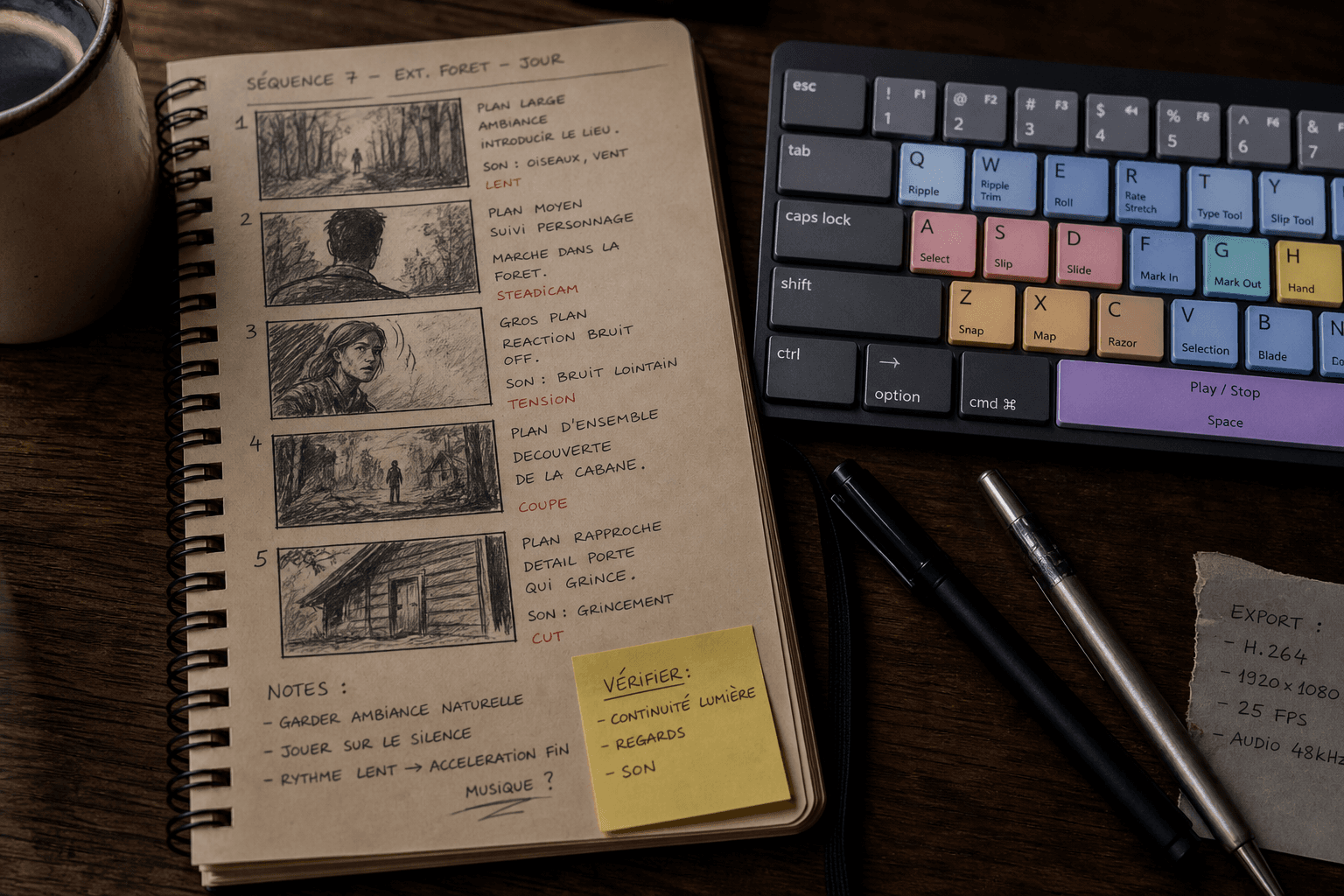
The deliverable: what is expected of you on Monday morning
"Exploration" pack
Ten images or ten short clips, classified, with one intention sentence each. No excuses: if it is unreadable, it is useless.
Name the folders like an editor: 01_light, 02_focal, 03_grain, not render3_final. Exploration with no classification is a dump.
"Locking" pack
Two viable directions, with advantages / risks / machine cost. The studio wants to choose, not guess.
For each direction, add a "what we sacrifice" paragraph: time budget, retouch complexity, hand risk, voice-over need. A locking with no sacrifice is a commercial lie.
"Compliance" pack
A rights / faces / logos / temp music checklist. You are not a lawyer, but you must alert.
Add a "resemblance" box: if a generated face recalls a real person, you escalate. Compliance starts with the right reflex, not with the diploma.
Method: the brief in five blocks
- Scene: who, where, tension.
- Camera: shot, movement, focal length.
- Light: source, hardness, contrast.
- Material: skin, fabric, grain.
- Prohibitions: cartoon, beauty, fisheye, etc.
If a block is missing, the model fills it with the internet average. The internet average is your enemy.
Variant by project type
Documentary: priority to the real textures, to the "acceptable" noise, to the non-smoothed faces. Fiction: priority to the costume / set consistency, to the readable silhouettes. Ad: priority to the logo readability and to the single message. The same engine must not receive the same prompt if the genre changes: otherwise you get the same look.
Quality control in three fast passes
- composition, 2) light, 3) hands and eyes. If you start with the eyes, you often forget the global geometry.
💡 Frank's Cut: always write a "truth test" in one sentence: "we will know it is a success if…". If you cannot measure it, your prompt is hot air.
Outlets: where it concretely leads
- Previsualization and concept motion.
- Industrial social: variations, hooks, formats.
- Post: clean up, extensions, assisted rotoscoping.
- Internal training: templates, guidelines, QA.
The "prompt engineer" title can be a springboard, but the people who last often carry a more classic title: technical artist, motion designer, post supervisor, with a prompt skill.
On the freelance market, the "AI video" calls for tenders explode but the demanded quality rises too: those who know how to brief + QA + deliver eat the majority of the budget. The rest fight over per-prompt prices, and it is a dead end.
The team around you: who consumes your prompts
The editor wants clean masters and readable file names. The colorist wants headroom in the highlights. The sound designer wants your images not to lie about the rhythm of the mouths if you prepare lip sync. A prompt engineer who does not read the timeline ends up producing unusable beauties.
Learn the minimal vocabulary of each interlocutor: handles, mattes, premultiply, audio handles, head sync. You do not need to master everything: you must avoid proposing outputs that break the pipeline.
Templates: from free text to specification
When a project repeats, move from "artistic" prompts to templates with mandatory fields: subject distance, camera height, light source type, palette in three adjectives, three prohibitions. A template is not a prison: it is a quality insurance.
You can version these templates like code: v1.2 when you change a focal length flaw after a client return. Studios like that because it looks like an industrialization rather than magic.
Table: skills to display on a CV (prioritized)
| Skill | Why a recruiter pays | Portfolio signal |
|---|---|---|
| cinema brief | fewer iterations | annotated storyboard |
| visual QA | less rework | typical-error grid |
| color awareness | consistency | before / after light grade |
| minimal sound | credibility | aligned waveform |
| doc / traceability | compliance | prompt log capture |
30-day program: ramping up with no bullshit
Week 1: vocabulary
One concept a day: PPS, shutter, rolling shutter, compression generation loss, macroblocking. You write a definition in your own words, then you compare to an official doc.
Add a mini test each day: an image or a ten-second clip that illustrates the concept. Otherwise you think you understand because you read.
Week 2: reproduction
You take a film image you love, you try to approach it without copying the work: you look for the light structure, not the plagiarism.
You note what is missing: geometry, grain, optics, costume. The list of gaps becomes your training program.
Week 3: consistency
Same character, three angles. You document the failures. You learn to cut: what holds in the face vs what holds in the set.
You add a business constraint: same subject in 16:9 and 9:16 without breaking the face geometry. Social is not an option: it is a production constraint.
Week 4: delivery
You produce a fictional mini client package: brief, tests, choice, exports, risk note. If you do not own the form of the deliverable, you are not ready.
You finish with a "nightmare" review: someone who is not in the trade must understand where to click and what to validate. If only the initiated understand your folder, you do not scale.
Practical case: 20-second teaser, three calendar days
Brief: city at night, tension, no graphic violence. You first propose three light directions: wet sodium, clean neon, bluish black. You film or you generate short test shots. You align the grain between the sources. You deliver an animatic with temp music listed for replacement. The client hears the music as a promise: warn that it is not cleared.
Client data and confidentiality
Do not put full scripts in public tools with no frame. Anonymize the names, cut the addresses, remove the unauthorized logos. A prompt leak is rare: a client PDF leak is frequent.
Ethics and responsibility: the silent differentiator
The public frames help to talk cleanly about the risks. UNESCO on AI gives a broad ethical language. For useful content and the perceived quality on the search side (useful if you also produce web around your demos), see Google Search Central: helpful content. For the technical rigor on the models, cross-reference with publications on arXiv.
Troubleshooting: career mistakes
A frequent trap: you become "the AI person" with no time budget, because "it is fast". Fix: a dedicated weekly slot, otherwise you disappear from the rest of the production and you lose the cinema credibility.
You accumulate prompts with no client results
Fix: a portfolio in cases: problem, method, proof, time-saved figure. Add a line on what you refused to promise.
You depend on a single tool
Fix: separate "brief language" and "vendor syntax". The brief survives the vendor.
You promise hyperrealism with no retouch budget
Fix: honest scopes: what is automatic, what is human.
You ignore the sound
Fix: integrate an audio layer early. A perfect image with a cheap voice stays amateur.
You sell "secret prompts"
Fix: sell reproducible systems. Secret prompts age badly and scare off the serious studios.
Negotiation: how to talk money without devaluing yourself
A junior sells time. An intermediate sells cycles. A senior sells bounded results: "pack A delivered with two cycles, rush option billed". If you do not write the scope, the client will write the scope for you, for free, at three in the morning.
When you are asked for "just a test", ask for a measurable constraint: duration, ratio, number of characters, rights. Otherwise you enter a spiral where "a test" becomes a disguised production.
Remote collaboration: asynchronous proof
Remote teams hate mysteries. Use Loom, short PDFs, numbered captures. Show two bad options and one good: it accelerates the human decision. A single beautiful image with no context looks like luck.
Trainings and "certs": how not to get scammed
The market sells prompt trainings that are word lists. Evaluate a training with three questions: does it make you fail publicly and learn? does it include a visual QA? does it talk delivery? If the answer is no everywhere, keep your money for hardware and practice time.
A good training gives you a diagnosis frame: why this image is plastic, why this shot does not match, why this voice sounds metallic. The magic words with no diagnosis are a casino.
Satellite tools that make your work credible
A spreadsheet, a capture manager, a batch renaming tool, a video player that displays the metadata, a vectorscope to check that you did not push the saturation into the red without realizing it. The credible prompt engineer looks like a post: they have instruments.
Foire aux questions
Réponses rapides aux questions les plus fréquentes sur cet article.
Do you need to know how to code?
Not necessarily to start. Useful to automate, batch, integrate APIs. Code accelerates, taste decides.
Python or Bash is often enough to rename, move, extract frames, generate prompts from a CSV. You do not need to be a developer: you must avoid the manual tasks that steal your cinema attention. Start with a script that logs your prompts in a dated file: it is code at the service of traceability.
What portfolio convinces?
Before / afters, versioned prompts, constraint explanations, documented failures.
Add a "what I do not do" page: it filters the bad clients and positions you as someone who knows their limits. Also show times: how many minutes for an exploration pack, how many for a locking. The portfolio is a cadence promise.
Will the job disappear?
The title may dilute. The "translate intention into constraints" skill stays. It changes form: less text, more graphs, more controllers, more data.
The interfaces become more visual, but someone must still write the objective function: what you maximize, what you minimize, what you forbid. That someone is your future self, with another software.
Prompt in English or in French?
Often English for the models, but your client brief stays in the language of the project. Translate cleanly: a fuzzy word upstream becomes a fuzzy image downstream.
Keep an internal bilingual glossary: "key light" becomes an operational definition for your French-speaking team. Otherwise you mix terms and you get inconsistent lights between two sessions.
How to get paid?
A flat rate per deliverable, not per prompt. Add bounded revision cycles.
Add a "raw material" line: API credits, cloud rendering, temporary storage. If you absorb everything, you become an involuntary sponsor of the client.
Is it compatible with classic directing?
Yes, and it is often the best profile: someone who has shot or edited understands what breaks.
You can start internally: a team asks you for variants for a precise scene. You do not need a flamboyant LinkedIn title: you need a documented case.
Which soft skills?
Negotiation, pedagogy, humility in the face of the model's errors.
Add the ability to say "I do not know yet" without panicking the room. The models change: the methodological honesty reassures more than a technical bluff.
Where to start today?
A mini project: 60 seconds, one intention, three shots, a color consistency, a risk note.
Then post the result with only three prompts, not thirty: the discipline of the few proves that you know how to choose.
Reading the release notes like an adult
The models change their behavior without warning you personally. The release notes are your official journal: what improves, what breaks, what is deprecated. Get into the habit of redoing an internal benchmark of five reference prompts at each major update. Otherwise you explain regressions by black magic.
Conclusion
Becoming an audiovisual prompt engineer is not collecting formulas. It is becoming the person who reduces the gap between what the director wants to say and what the machine can do without lying. The models will change: the human brief, however, stays central.
If you remember only one thing: learn to write prompts that someone else can pick up tomorrow. Traceability and common vocabulary are worth more than ten private tricks that expire at the next interface.
Related articles
 Analyses
How Generative AI Transforms Creative Writing in Audiovisual
How generative AI changes the development of ideas, scenes, characters, pitches and audiovisual writing workflows.
 Analyses
Audiovisual Jobs Threatened or Transformed by AI: My Take
An honest reading of the jobs that resist, those that recompose, and the skills that become rare when everyone generates 'correct' images.
 Business
How to Monetize Your AI Creation Skills (Freelance, Agency)
Offers, packaging, proof, pricing and risks: a frame to sell AI creation without getting crushed by the two-euro prompt market.