Forest and Mist: Depth of Field in AI Exteriors
Forest shots, volumetric mist, focal length and post to separate planes with no mud or sky HDR.
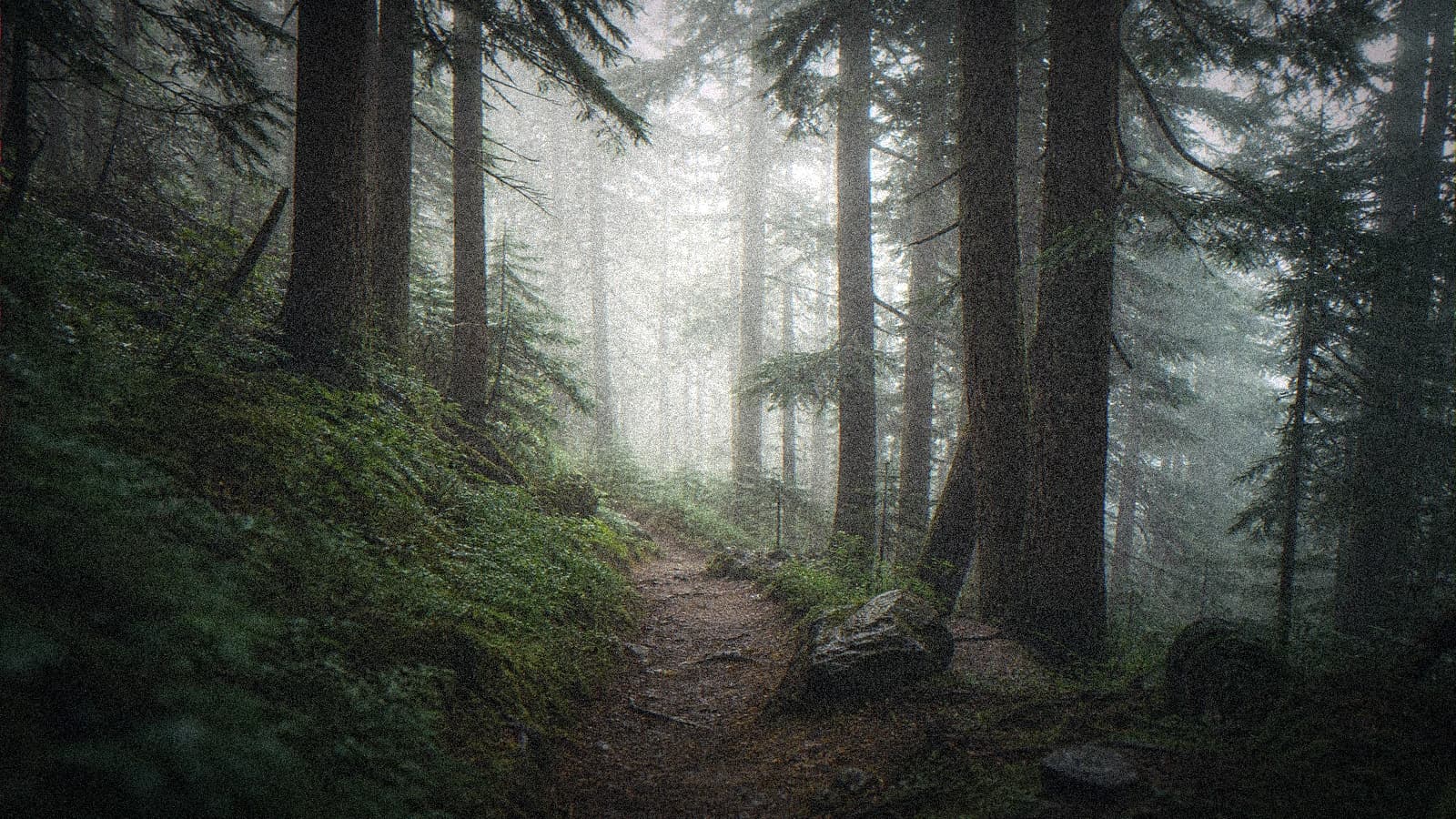
The forest in AI video can be sublime, or become a visual mud in a few seconds. The main cause is almost always the same: badly managed depth. Trunks that merge, uniform mist, overexposed sky, subject drowned in a green with no hierarchy.
In a forest exterior, the difficulty is not generating trees. The difficulty is separating the planes. Foreground, mid-ground, background, aerial perspective: each layer must stay readable, otherwise your shot seems synthetic.
This guide gives you a field method to create credible forest shots, with mastered mist and usable depth at the edit.
Why AI forest becomes illegible fast
The engines love texture. The forest is an explosion of textures. With no clear direction, they saturate everything.
Failure signals:
- uniform mist over the whole frame;
- micro details everywhere with no breathing;
- HDR sky disconnected from the ground;
- subject lost in the set;
- camera movement that accentuates the chaos.
The solution: create a simple visual architecture before looking for the effect.
Credible mist: localized, not generalized
In a real forest, the mist has a logic:
- it follows the topography;
- it accumulates in hollows;
- it varies in density.
In the prompt, prefer:
subtle ground mist between mid and background trees, clear foreground subject, soft morning humidity
Avoid the "fog everywhere" type formulations.
Depth of field: your best ally
Depth of field creates order in the forest chaos.
Useful reflexes:
- sharp subject;
- foreground slightly softened;
- softer background;
- decreasing contrasts with the distance.
You do not need an extreme blur. You need a coherent separation.
Pre-production: a mini 8-point scene plan
- forest type (dense, pines, wet, mountain);
- time (dawn, morning, noon, end of day);
- weather;
- main narrative point;
- movement axis;
- mist density;
- dominant light source;
- perceived focal length.
This base saves you hours of useless corrections.
Robust framings in AI forest
Solid
- a trail in soft perspective;
- off-center subject;
- mid-ground shot with readable layers.
Fragile
- ultra wide angle on dense vegetation;
- fast pan on tight trunks;
- long shot with no focal point.
In a forest, camera modesty is a strength.
Recommended workflow in 5 phases
Phase 1: fixed pilot
Validate:
- readable depth;
- controlled sky;
- identifiable subject.
Phase 2: short animation
3 to 5 seconds with light movement.
Phase 3: quality sorting
Reject the shots where:
- the trunks ripple;
- the mist invades everything;
- the subject disappears.
Phase 4: local correction
- sky mask;
- mist adjustment;
- local contrast on the subject.
Phase 5: sequence continuity
Align all the shots around the same light mood.
Forest + mist QA table
| Criterion | Check | Status |
|---|---|---|
| Plane separation | Foreground/mid/background distinct? | OK/Reject |
| Mist | Logical and localized density? | OK/Reject |
| Sky | Mastered highlights? | OK/Reject |
| Subject | Readable immediately? | OK/Reject |
| Movement | No trunk deformation? | OK/Reject |
| Consistency | Color match between shots? | OK/Reject |
Practical case 1: morning adventure teaser
Goal: feeling of fresh air, mystery.
Initial failure:
- mist too dense;
- burned sky;
- drowned subject.
Correction:
- mist reduced to the mid-ground;
- compressed sky exposure;
- reinforced subject contrast.
Result: depth recovered, credible atmosphere.
Practical case 2: narrative clip in a wet forest
Goal: soft tension, slow movement.
Approach:
- near-fixed camera;
- low mist;
- desaturated green palette;
- natural forest sound.
The credibility comes from the restraint.
Practical case 3: vertical social content
Risk: loss of reading with too many details.
Fix:
- subject centered slightly low;
- simplified background;
- discreet lateral mist;
- very short duration.
The vertical format demands even more clarity.
Forest exterior sound design
A real forest is not silent:
- light wind;
- distant birds;
- discreet cracks;
- steps on wet ground.
The sound builds the depth as much as the image.
Forest grading with no chromatic mud
Traps:
- greens too saturated;
- blocked-up blacks;
- excessive micro contrast.
Method:
- balance the luminance;
- moderate the green saturation;
- separate the planes by contrast;
- protect the highlights;
- add discreet grain.
The goal is readability, not the postcard effect.
Client management: realistic expectations
A client can ask for "more mist" when the shot is already borderline. Answer with visual proof:
- balanced version A;
- denser version B;
- mobile comparison.
Version A often wins in real projection.
Final checklist before export
- subject readable in 1 second;
- clear depth;
- logical mist;
- non-aggressive sky;
- palette continuity;
- natural sound in place;
- mobile test validated.
Foire aux questions
Réponses rapides aux questions les plus fréquentes sur cet article.
Why does my mist look painted on the image?
Because it is uniform and independent of the relief. Localize it and vary its density according to the depth.
How to avoid the HDR sky in a forest?
Protect the highlights early and avoid extreme contrasts in post.
Which focal length works well?
35mm or 50mm perceived in general. The ultra wide angles are riskier.
Should the green be saturated to seem alive?
Not necessarily. A slightly desaturated green often seems more cinematographic and credible.
How many seconds to iterate?
Three to five seconds. You then edit for the feeling of duration.
Can you save an illegible forest in post?
Partially. If the layers are not separated from the generation, the post will only limit the damage.
A successful forest shot breathes. You feel the air, the distance, the material of the place. If everything is at the same visual level, the illusion breaks.
Advanced workshop: conifer vs deciduous forests
The conifers create repetitive vertical structures that can ripple in movement. To limit that:
- reduce the camera speed;
- avoid long lateral tracking shots;
- keep a sharp anchor point in the frame.
The deciduous forests pose another problem: shimmering of the fine foliage. Here, a slight softening of the background and a calmer movement strongly improve the stability.
Mist according to time and weather
The morning mist is not the same as the evening mist.
- Fresh morning: low, diffuse, luminous mist.
- Wet evening: more visible density, more marked contrasts.
- After rain: localized mist, with ground reflections.
Adapting this logic makes your shots immediately more credible.
Multi-shot narrative pipeline
For a forest mini sequence:
- wide establishing shot;
- mid-ground subject shot;
- texture insert, ground, hand, branch;
- exit shot.
Each shot has a role. You avoid asking the same shot to tell everything.
Complementary FAQ
How to avoid the visual mud on mobile?
Slightly reinforce the subject/background separation and lower the background micro details.
Should you add rain for more realism?
Only if narratively useful. Adding rain + mist + movement increases the instability risk.
What is the number-one rejection signal?
The subject that disappears into the set after two seconds.
How to keep consistency between shots from different days?
Set a color reference and align each shot on it before stylization.
Building depth by contrast layers
In a forest, the visual depth is built layer by layer:
- foreground: stronger contrast, controlled details;
- mid-ground: medium contrast, light mist;
- background: softer contrast, reduced saturation.
If the three layers have the same contrast, your image becomes flat. If you push the gap too much, it becomes artificial. Look for the balance.
Choice of focal length according to narrative intention
35mm perceived
Good for:
- showing environment + subject;
- readable trajectory;
- exploration narration.
Risk:
- detail overload if the set is very dense.
50mm perceived
Good for:
- isolating a subject;
- keeping the background present but soft;
- a more intimate atmosphere.
Risk:
- losing the context if too tight.
85mm perceived simulated
Good for:
- portraits in the forest;
- mist in the background;
- aesthetic plane compression.
Risk:
- a less immersive feeling.
Sky control in a forest exterior
The sky is a realism killer if badly managed.
Problems:
- burned highlights;
- halo around the branches;
- intensity variation between shots.
Solutions:
- expose for the subject then recover the sky;
- limit the pure white zones;
- keep a natural gradient.
A sober sky is often more credible than a spectacular sky.
Forest ground and subject contact
The ground tells the weight of the subject.
To check:
- contact shadow;
- consistent ground texture;
- plausible feet/terrain interaction.
A subject that "floats" immediately destroys the illusion.
Mist and wind: a logical relationship
If you add wind, the mist must react. Otherwise, inconsistency.
Approach:
- weak wind: nearly stable mist;
- moderate wind: soft movement;
- strong wind: fragmented mist.
The viewer does not name this rule, but they feel it.
Forest sequence: an effective breakdown protocol
For a short narrative scene:
- environment opening shot;
- subject shot in movement;
- nature detail shot, hand, branch, tracks;
- reaction shot;
- exit shot.
This breakdown gives rhythm without forcing a too-long shot.
Sound direction by weather
The sound depends on the perceived weather:
- dry morning: birds, light foliage;
- wet: drops, muffled sounds;
- windy: dominant blow, fewer fine details.
Aligning sound and image strongly increases the credibility.
Managing the green color
Green is tricky:
- too saturated: video game look;
- too desaturated: dead image.
Technique:
- moderate the global saturation;
- preserve a few key greens;
- control the leaf luminance.
The goal is a natural richness, not a filter.
Advanced case: night forest with a lamp
A very risky scene:
- strong local source;
- very dark background;
- possible particles.
To hold:
- one clear main source;
- calm camera movements;
- short shots;
- controlled visual noise.
The lamp must guide the gaze, not burn the frame.
Advanced case: fine rain in a forest
Adding rain + mist + foliage is complex.
Robust option:
- light rain in compositing;
- moderate mist in generation;
- shorter shots;
- rain sound to reinforce the perception.
You lighten the engine load while keeping the effect.
Local corrections workflow
When a shot is almost good:
- correct the sky;
- correct the subject/background separation;
- correct the mist density;
- check the color continuity.
Avoid the brutal global corrections. They quickly break the hierarchy.
Multi-condition QA
Test the scene:
- full screen;
- small screen;
- strong brightness;
- weak brightness.
The forest can seem perfect in the studio and illegible on a mobile outdoors.
Client management: avoiding the "more mist"
When the client wants more atmosphere, propose:
- balanced version A;
- mist-reinforced version B;
- contrast-reinforced version C with no more mist.
Very often, version C is preferred. The client wanted depth, not necessarily more fog.
Complementary FAQ 2
How to make a dense forest readable?
Create a hierarchy in layers, simplify some zones and give a clear focal point.
Should you always add mist?
No. The mist is useful, but a forest can be credible with no it if the light is well managed.
Why do my trunks vibrate in movement?
Camera too mobile and repetitive textures. Reduce the speed and simplify the background.
How to succeed at a simulated drone shot in a forest?
Stay cautious. Prefer a slow movement and a moderate altitude to avoid the deformations.
Does grain help in exteriors?
Yes, light. It unifies the texture, especially after social compression.
What is the main rejection signal?
Subject drowned in the set with no clear separation.
Final workshop: a team review guide
Do a review with three roles:
- DP: depth and exposure;
- editor: rhythm and matches;
- sound designer: atmosphere consistency.
Each role flags a maximum of one blocking point. You correct these points before any cosmetic retouch.
This discipline maintains the quality under deadline constraint.
A successful AI forest is not the one that shows the most trees. It is the one where each shot has air, distance, and a clear visual direction.
Extension: forest scenes with a walking character
Walking in a forest quickly exposes the parallax limits. To keep the credibility:
- shorten the movements per shot;
- keep a stable axis;
- use cuts on gestures, not only on position.
A too-violent axis change between two shots destroys the feeling of continuous space.
Managing weather transitions in the same sequence
If your narration goes from dry to wet:
- introduce the variation progressively;
- adapt sound and color in parallel;
- avoid changing mist, rain and contrast simultaneously on a single cut.
The progressivity makes the transition credible.
Complementary FAQ 3
How to avoid a "painted" background in a forest?
Reduce the repetitive details, add contrast variation by layers, and keep a sharp focal point.
Do you always need a human subject to hold the depth?
No, but a strong focal point is necessary, a path, a rock, an isolated trunk, a silhouette.
How to handle backlights in the undergrowth?
Protect the highlights and lift the subject slightly. The backlight can be superb if the reading of the subject stays possible.
Can you create a stylized forest without losing realism?
Yes, if the depth and light logic stays coherent. The style must not crush the perceived physics.
Last QA sprint before export
Final pass:
- subject readable at 100%;
- depth readable on mobile;
- coherent mist;
- contained sky;
- natural sound;
- clean matches.
If a box fails, correct locally rather than redoing the whole grade.
Final block: a seasonal consistency protocol
Forest scenes change radically depending on the season. To stay credible over a series of shots:
- define a dominant season;
- lock the foliage density;
- adapt the ground color;
- adjust the light quality.
An autumn scene with saturated summer greens sounds false immediately.
Mini landmarks:
- spring: fresh greens, moderate contrasts, light humidity;
- summer: denser greens, more marked shadows;
- autumn: warm desaturated palette, more textured ground;
- winter: drier contrast, reduced colors.
Even in stylization, respecting this logic strongly improves the credibility.
Final validation on 3 screens
Before publication, validate on:
- main screen;
- standard laptop;
- smartphone.
If the depth holds on all three, you can deliver serenely. If it disappears on mobile, lighten the background and reinforce the subject separation.
This last check is often the point that transforms a "pretty" shot into a really broadcastable shot.
To secure the delivery even more, export a short 5-second excerpt with the most vegetation-dense passage. If this excerpt stays readable after compression, the rest of the sequence will almost always hold.
You can also keep a "safety" version with slightly reduced mist. In case of a last-minute client doubt, this backup version avoids relaunching the whole chain.
Think of noting the chosen weather parameters in a production file. This follow-up eases the retakes several days later and guarantees a solid visual continuity over a whole campaign.
In long projects, this weather log becomes a real quality insurance. It lets you quickly recreate the validated atmosphere without restarting from zero and without breaking the already-approved visual matches.
Also add a note on the mist density and the perceived contrast level. These two pieces of information are often the ones that drift the most between sessions, especially when several people work on the same project.
In practice, this note is often enough to maintain a clean forest continuity over a whole series.
It also lets you quickly identify the source of a drift and correct cleanly without breaking the already-validated shots.
You thus keep a strong continuity, even when the schedule imposes late retakes.
It is precisely this consistency that makes the difference between a beautiful test and a real deliverable production.
It also saves you from losing time in useless validation back-and-forths with the client.
In daily life, this method keeps the creation fluid and coherent.
It is a real operational gain.
Over time.
Related articles
 Tutoriels
How to Generate a Realistic Scene with Depth of Field
Plane separation, consistent bokeh, subject-set distance, and post to soften the transitions.
 Tutoriels
Managing Sonic Depth for an AI Short Film
A practical sound design method to give volume, distance and emotion to a generated scene.
 Tutoriels
Why Does My AI Render Lack Depth
Too-flat shots, contradictory focal length, stuck gray values, and absence of foreground / background separation: how to bring back relief.