AI video tenders: how to bid as a freelancer
Bidding on an AI video tender as a freelancer: find the right notices, read the file fast, price AI work honestly and write a proposal that holds.
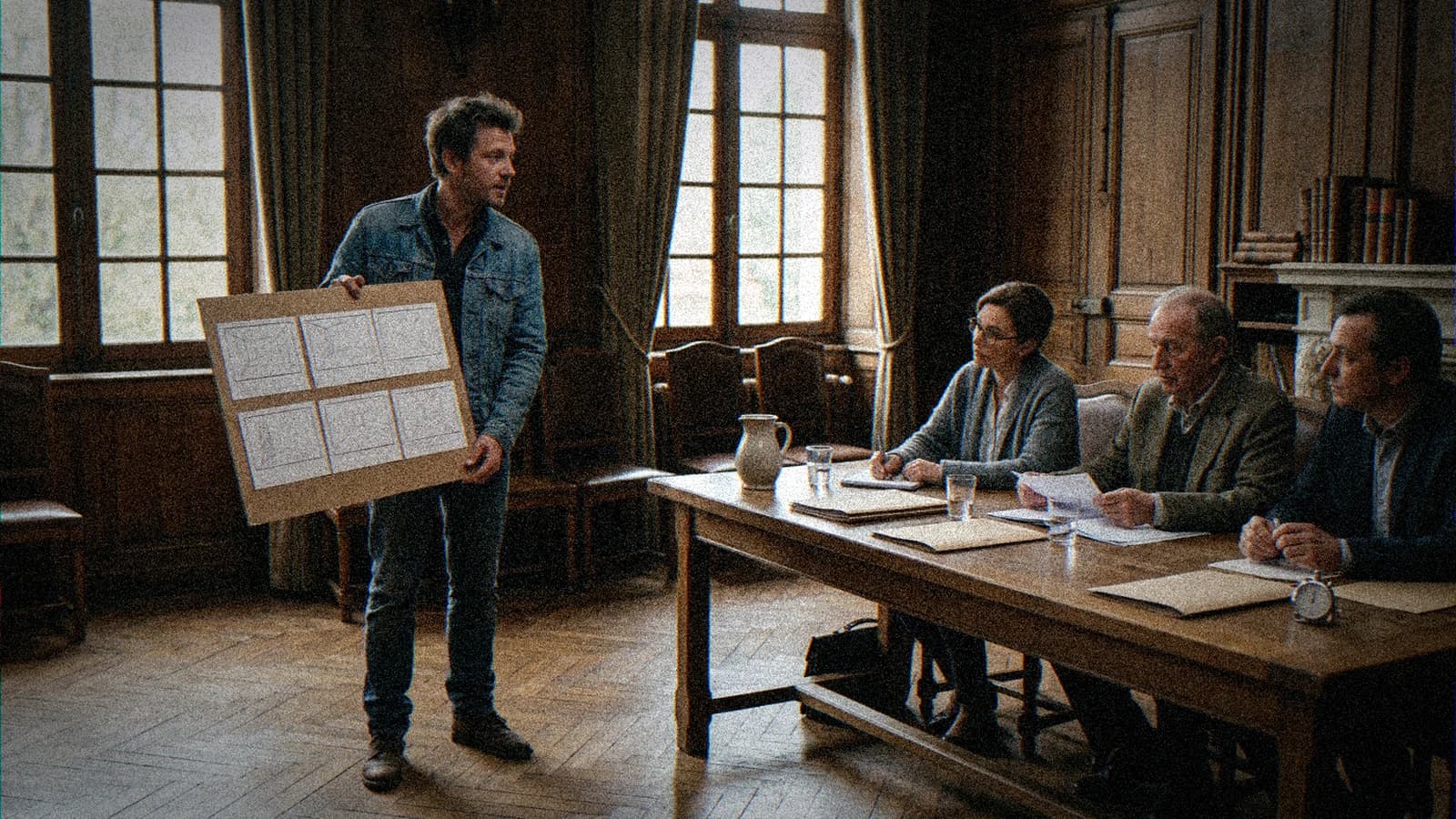
You find a notice. A town hall, a group of municipalities or a tourist board wants a provider for "the design and production of video content". You open the file: forty pages of rules, a technical specification, a price schedule to fill in, a contract form, a deadline nineteen days away. You close it and decide this is a game for agencies with a legal department.
I get that reflex. But a lot of these contracts are sized for one to five people, split into lots, and a public buyer often has no idea which freelancers work in their area. What you need is a method: read fast, decide fast whether it is worth it, then write a bid that reassures a buyer who has never watched an AI-generated video in their life. I'll use the French system as the worked example, since that is where I bid, with the 2026 thresholds, the paperwork to prepare once, and how to talk about AI in your bid without scaring anyone or promising the moon.
What a video tender actually means in 2026
People use the word "tender" for everything. In practice you will run into three situations, and you won't answer them the same way.
The most structured one is public procurement. A public buyer (central government, a local authority, a public body, a hospital, a university) has to follow the public procurement code. The rules are written down, the documents are standardised, and the final score comes from criteria announced in advance. It is the most predictable ground, and it is what most of this article covers.
Then there is the private consultation, where a brand, a small company or an agency puts three or four providers in competition. No imposed rules, everyone does it their own way. Sometimes you get a two-page brief, sometimes a twenty-minute call and a "send us a proposal".
Last comes the creative pitch, where you are asked to produce routes, or even a mock-up, before anything is signed. That one deserves real suspicion, and I come back to it below.
For an AI video freelancer, public procurement has an underrated advantage: the buyer has to explain how they will choose. You know in advance whether price counts for 40% or 60% of the score, and you know which documents they expect. In a private consultation, you guess.
The thresholds that set the procedure
The estimated value of the contract decides almost everything: whether advertising is mandatory, and how heavy the paperwork gets. For service contracts in France in 2026, it looks like this.
| Estimated value (excl. VAT) | What the buyer can or must do | What it means for you |
|---|---|---|
| Under €60,000 | Contract allowed with no advertising and no competition (since April 1, 2026) | No notice at all: the buyer has to know you before the need exists |
| €60,000 to €90,000 | Adapted procedure, advertising free and proportionate | Notices on the buyer's own portal or regional platforms, rarely on BOAMP |
| €90,000 to the EU threshold | Adapted procedure, advertised on BOAMP or in a legal notices journal | Most of the video notices you will see |
| Above €140,000 (central government) or €216,000 (local authorities) | Formal procedure, EU-wide advertising | Heavy, often multi-year contracts, reachable as a consortium |
The move to €60,000 for supplies and services comes from decree no. 2025-1386 of December 29, 2025, which amended article R2122-8 of the code. The EU thresholds were revised on January 1, 2026 and apply across the EU. The French site Code : Commande publique tracks each article, and the French government page on thresholds for public contracts has the official version.
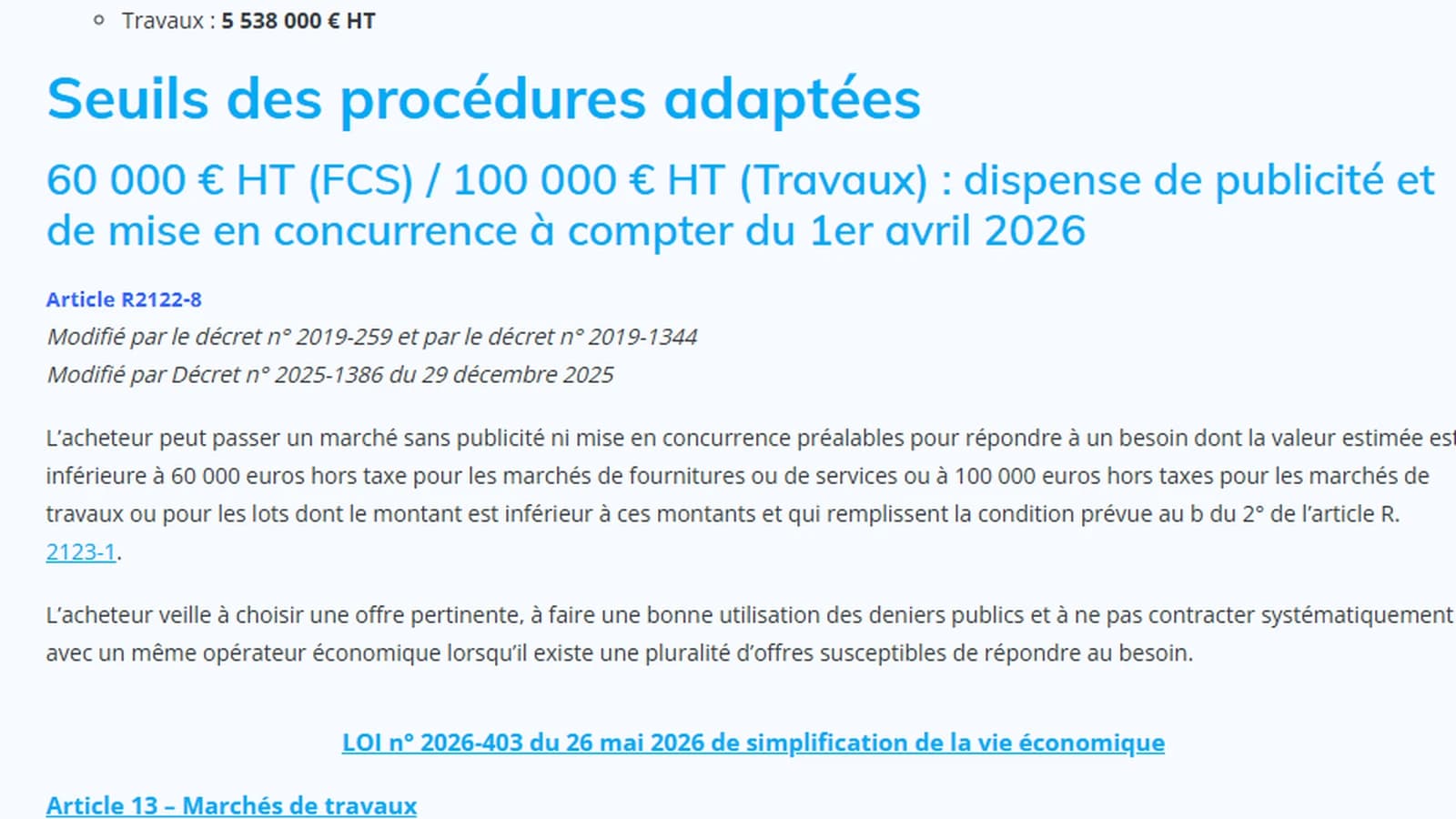
Screenshot of the procurement thresholds page on Code : Commande publique, taken on October 13, 2026.
Look at the second paragraph of the article in the screenshot. The buyer must take care "not to systematically contract with the same economic operator" when several offers could meet the need. In plain terms, under €60,000, a town hall that always hires the same agency is supposed to look elsewhere from time to time. That is your way in, as long as they know you exist.
💡 Frank's Cut: most small video contracts never go through a notice. Send a short presentation (three films, one page, indicative rates) to the communications teams of the local authorities around you, in September and January, while budgets are being prepared. You are not answering a tender. You are making sure your name is on the list when the buyer asks for three quotes.
Where to find video notices
In France, BOAMP is the free starting point. Keyword search works well enough if you combine "vidéo" with the Type de marché: Services filter and the Avis en cours (open notices) status.
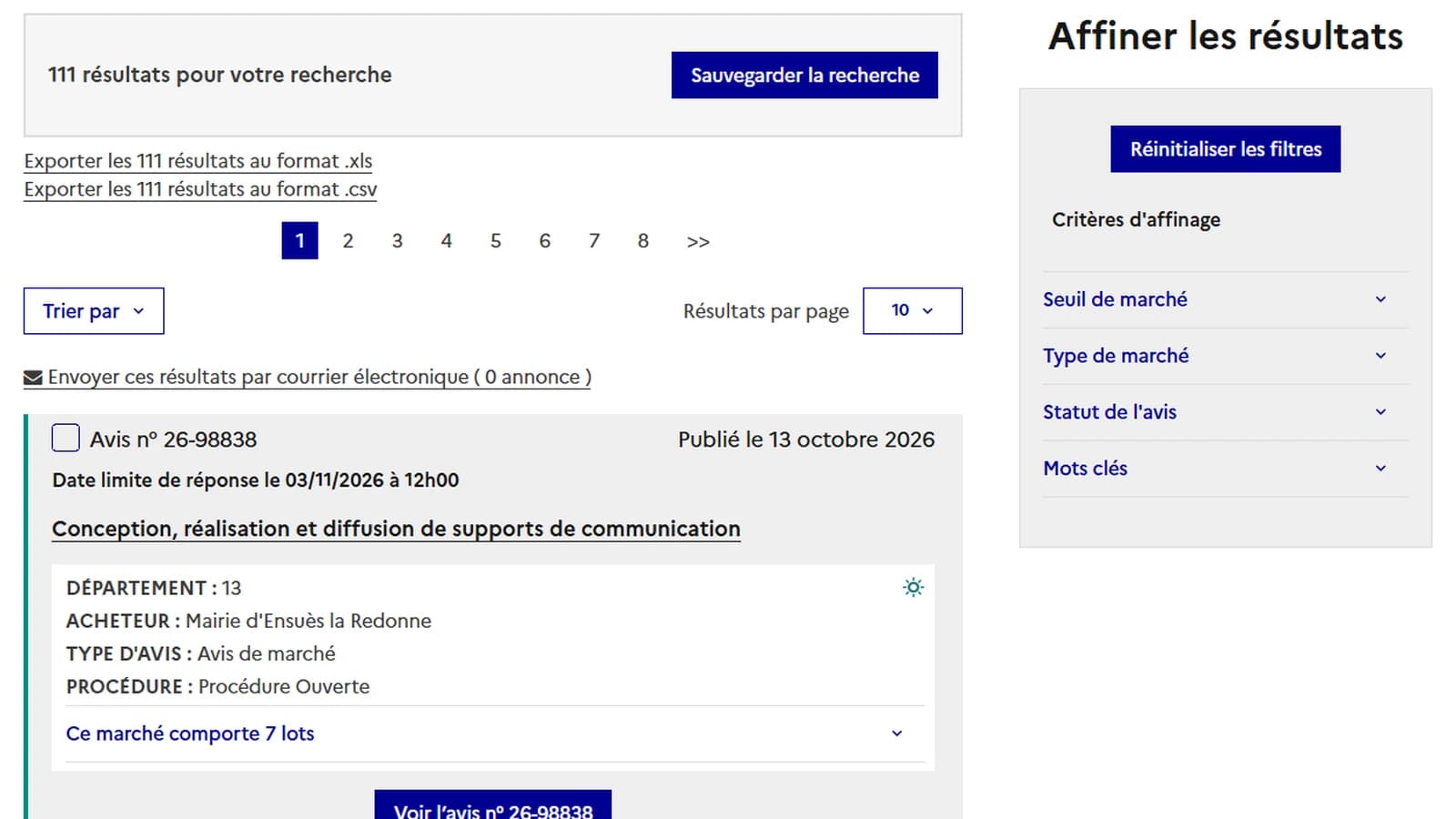
Screenshot of a "vidéo" search on boamp.fr, service contracts, open notices, taken on October 13, 2026.
That day the search returned 111 notices. The first one shows what you are up against: a town hall looking for a provider for "the design, production and distribution of communication materials", open procedure, split into seven lots. Video is often one lot among others, next to printing, the website or signage. You bid on the lot that fits you. Nobody makes you do printing.
Many notices under €90,000 never reach BOAMP. They live on the authority's own buyer portal or on shared regional platforms. If you target a specific area, find the platforms local buyers use and set an alert on each one. BOAMP also has a free keyword alert you configure once.
Don't stop at "video" as a keyword. Buyers write "audiovisual content", "motion design", "corporate film", "event filming", "social media", "communication campaign". None of them writes "AI video". The buyer describes the film they want to see, and the technique is your business.
Reading the file in thirty minutes
The tender file is intimidating by volume alone. You don't need to read all of it before deciding whether to bid. I read it in this order.
- The consultation rules (RC in France). The user manual. Deadline, required documents, lots, and above all the award criteria and their weighting. If price weighs 70% and the buyer is a large authority, you are up against agencies with volume margins. Think twice.
- The technical specification (CCTP). The real need. How many videos, which formats, what lengths, what delivery dates, how many review rounds. This is where you see whether the workload fits your calendar.
- The price schedule (BPU or DPGF). The grid you will fill in. It shows how the buyer thinks about cost: flat fee per video, day rate, per finished minute.
- The administrative terms (CCAP). Late penalties, rights assignment, payment terms. Read at least the intellectual property and penalty clauses.
Within thirty minutes you should be able to answer three questions. Does the need fit what you can deliver alone, or with a partner you already know? Can the schedule live alongside your other clients? Does the price weighting leave you a chance? If any answer is no, move to the next notice. There will be more next week.
If something is unclear, ask. The tender platforms let you send questions to the buyer before a date set in the rules, and the answer goes to every bidder. A precise question ("Are distribution rights requested for a limited or unlimited period?") already shows you are serious.
The admin pack to build once
The administrative part is the dullest one, and it is where freelancers get knocked out for silly reasons. One missing document can sink an excellent bid. Build it once, then keep it up to date.
Keep a ready folder with:
- the DC1 (application letter) and DC2 (bidder declaration), or the ESPD, the European Single Procurement Document that replaces them when the buyer accepts it;
- your company registration extract;
- your social contributions certificate (the French URSSAF one is requested again every six months) and your tax compliance certificate;
- your professional liability insurance certificate;
- a references sheet with three to five projects, each with client, date, format, length and a private viewing link.
That last item matters more than people think. A public buyer looks in your portfolio for projects comparable to theirs, delivered to comparable organisations. A presentation video for a local charity reassures them more than an experimental short film. If your portfolio is all personal pieces, read how to build a credible AI portfolio before your first bid.
💡 Frank's Cut: name your files the way the buyer will look for them: "01_DC1_YourCompany.pdf", "02_DC2_YourCompany.pdf", "05_Technical_proposal_Lot3.pdf". Whoever opens your bid has fifteen more to open that day. Save them three minutes and they remember it.
Pricing AI video work without shooting yourself in the foot
The classic trap for a freelancer using AI is to pass the whole productivity gain on to the price. "I'm twice as fast, so I can be half the price." In public procurement, that is how you file an abnormally low bid, which the buyer can ask you to justify and then reject if they are not convinced.
Price the real time instead, including the time AI doesn't shrink: the kickoff meeting, writing, picking usable shots out of the failed generations, editing, grading, mixing, review rounds, exports in every format requested. Add subscriptions and generation credits pro rata. If you need a starting structure for the commercial side, my guide to selling AI videos to professional clients covers packaging and the lines people forget.
In the price schedule, stick strictly to the buyer's grid, even if it doesn't match how you think. If they ask for a price per 60-second video, don't answer with a global flat fee. They compare lines across bidders. A line they can't compare is a line they score badly.
Think about payment terms too. In France, central government and local authorities have 30 days to pay, and the contract can include an advance. A public contract paid in 30 days is often easier on your cash flow than plenty of private clients, provided your invoice follows exactly what the administrative terms require (contract reference, purchase order number, upload to the Chorus Pro platform).
The technical proposal: where you win or lose
The technical value, scored on your written proposal, is almost always weighted next to price, and on creative work it weighs heavily. The exact figure is in the rules. The proposal is the document where you explain how you will do the job. It is also where most freelancers lose points, either by pasting their sales brochure or by drowning the buyer in technical vocabulary.
Build it on the sub-criteria in the rules, in the same order, with the same titles. If the rules say "methodology (20 points), human and technical resources (10 points), schedule (10 points)", your proposal has three parts with those titles. The person scoring you has a grid. Don't make them hunt.
Talking about AI without alarming the buyer
A public buyer has two fears about AI: footage that looks fake and gets residents talking, and legal risk. Address both, explicitly, in a dedicated part of your methodology.
On the look, explain at which stages you use AI and at which you don't. For example: illustrative shots and transitions, yes; the face of an elected official or an identifiable staff member, no without their written consent; the voice of a real person, never without permission. Show a reference video where AI is used that way.
On the legal side, describe your rights chain: tools used, commercial terms for each, no images of real people without consent, licensed music. The EU AI Act also brings transparency obligations for some generated content shown to the public. Say how you apply them on the deliverables, and offer to write the disclosure line that goes with each video together with the buyer.
For contract wording, my AI content clauses for client contracts give you a base. One caveat: in public procurement, the buyer's administrative terms override your own terms and conditions. You can flag a problem through the questions, rarely change the clauses.
What a good proposal actually contains
A dated schedule, week by week, with the buyer's sign-off points. A description of the review rounds and what happens beyond them. Your real technical resources, without padding the list. The names and roles of everyone involved, including your partners (editor, sound mixer, motion designer). And one or two storyboard pages on a subject close to the contract's, so the buyer can picture the result.
Skip the pages of generic text about "the importance of video in local communication". The buyer knows. They wrote the brief.
Bidding alone, as a consortium or with subcontractors
A contract too big for you alone can still work with others, in one of two forms.
In a temporary consortium, you bid with one or more partners and each one signs the contract. A lead member represents the group to the buyer. It suits cases where each member brings a distinct skill, for example you on AI production and a photographer or copywriter on other services in the same lot.
With declared subcontracting, you stay the sole contractor and declare your subcontractors to the buyer (the DC4 form in France). Handy for an occasional sound mixer or motion designer.
Either way, pick people you have already worked with. Discovering a partner mid-contract, with late penalties in the terms, is not something I'd recommend. My piece on monetising AI creative skills as a freelancer or agency compares both setups if you are thinking about a small team.
The pitches you should turn down
On the private side, some consultations ask for a full creative proposal before anything is signed: script, storyboard, sometimes an animated mock-up. With AI the temptation is strong, since a mock-up takes an evening.
Before saying yes, ask how many providers are being consulted. Beyond three, your odds get thin. Is the preparatory work paid? A fee, even a modest one, shows the client respects your time. What happens to your proposal if you lose? If nothing stops the client from reusing your idea, you are giving it away.
In French public procurement, when a buyer asks for significant work at the bid stage, they must provide a payment for bidders, with the amount stated in the tender documents. Read that part carefully. In the private sector nothing requires it, so negotiate it before you open your software.
💡 Frank's Cut: when someone asks me for a free mock-up, I offer three storyboard pages and a reference video I've already delivered that looks like the project. The client sees the direction, and I don't hand over the film before I'm paid. That is usually enough to start the conversation.
The mistakes that cost you the contract
Uploading at the last hour, first. Platforms can slow down on deadline day, and a heavy file takes a while to upload. A bid that arrives at 12:01 for a 12:00 deadline is inadmissible. Aim for the day before.
Then the missing document. The buyer can ask you to complete your application, but doesn't have to. Make a checklist from the rules and tick every line.
A badly filled price schedule also sinks bids: a global price where unit prices were expected, an empty line, a mismatch between the schedule and the proposal. Any of these can make the bid irregular.
A proposal that could be sent to any buyer gets an average score. Name the area, the audiences and the constraints mentioned in the specification.
Promising "unlimited videos" or "footage indistinguishable from a real shoot" makes the buyer uneasy and makes you liable for something you can't deliver. Promise what you know you can deliver, with examples.
And when you lose, ask why. A rejected bidder can obtain the reasons for rejection and the characteristics of the winning bid. It's free, and it shows you exactly where you dropped points.
The three kinds of tenders compared
| Criterion | Public contract under €90,000 | Public contract above €90,000 | Private consultation |
|---|---|---|---|
| Where to find it | Buyer portal, regional platforms, direct contact | BOAMP or legal notices journal, then the EU Official Journal above the EU threshold | Network, referrals, matchmaking platforms |
| Selection criteria | Announced, sometimes simplified | Announced and weighted in the rules | Rarely written |
| Admin paperwork | Lighter, depending on the buyer | DC1, DC2 or ESPD, certificates | Often none |
| Free work requested | Rare | Regulated, with payment for significant work | Common, negotiate it |
| Payment terms | 30 days | 30 days | Per contract, often longer |
| Feedback if you lose | Reasons on request | Reasons on request | Often none |
Foire aux questions
Réponses rapides aux questions les plus fréquentes sur cet article.
Can a sole trader bid on a public tender?
Yes, nothing prevents it. The buyer assesses the capacities set in the consultation rules: minimum turnover, references, insurance. The French code limits the first one: unless there is a specific justification, the minimum turnover required cannot exceed twice the estimated value of the contract or lot. Check that point in the rules before you start. If the turnover requirement is out of reach, a consortium with a more established partner can solve it, since a group's capacities are assessed as a whole. Many video lots are small enough that a well-organised freelancer qualifies without any partner at all.
Should I tell the buyer I use AI?
Yes, and as early as possible, in the technical proposal. A buyer who finds out about AI use after delivery may feel misled, and the contract may contain clauses about where content comes from. By raising it yourself, you control the story: at which stages you use it, what you refuse to do, how you handle rights. The EU AI Act also adds transparency obligations for some generated content shown to the public. It is far better to offer the buyer a clear disclosure line in your bid than to negotiate it in a rush on publication day, with the communications team waiting on you.
How do I know if my price is too low?
Compare it with your real cost: working days times your day rate, plus the subscriptions and generation credits you can attribute to the contract. If your price doesn't cover that total, it is too low, whatever time AI saves you. In public procurement, a price well below the other bids can trigger a request for justification. You then have to explain where the gap comes from, and "AI makes me very fast" doesn't always convince. The feedback from a lost contract also gives you a sense of the prices winning bidders charge, which is the most useful benchmark you will get.
How long does a bid take to prepare?
For a first contract, plan on several days spread over two weeks: reading the file, sending questions, writing the proposal, pricing, assembling the admin pack. After that, the whole admin pack and a good part of the proposal get reused, and the time drops a lot. That is why it pays to bid on similar contracts, for example only local authorities or only tourism. Each bid feeds the next. Track the time you spend on every bid: after a few, you will know which contracts are worth the effort and which ones you should skip without opening the file.
What happens if I win and can't deliver?
The administrative terms usually include late penalties, and the buyer can go as far as terminating the contract at the contractor's fault for a serious failure. That is a good reason to bid only on contracts that fit your workload. Before submitting, check that the schedule in the specification works with your other commitments, and line up a backup partner who could take over part of the production. If something goes wrong mid-contract, tell the buyer immediately and in writing. A buyer told early often finds a solution. A buyer faced with a done deal applies the contract.
Are copyright and usage rights a problem in public contracts?
They have to be settled, yes. The administrative terms state what the buyer wants: distribution rights, duration, territories, media, the right to edit the videos. With AI you also need to check that your tools allow commercial use and that you can actually grant what the buyer asks for. Read that part before pricing, because a broad, unlimited assignment has a value your price should reflect. If a clause looks impossible to meet with your toolchain, ask during the consultation instead of signing and hoping nobody checks. Buyers would rather adjust a clause before award than discover the problem later.
Where can I find video tenders besides BOAMP?
Contracts under €90,000 mostly live on local authorities' buyer portals and on shared regional platforms, each with its own alert system. Tourist boards, universities, hospitals and chambers of commerce also publish their own consultations. For contracts under €60,000, often awarded without advertising, the direct approach still works best: show your work to communications teams before a need appears. Finally, communication agencies that win large contracts sometimes look for specialist subcontractors, which can become your way into public projects without having to carry the whole bid yourself.
Where to start this week
Set up a BOAMP alert with five keywords: vidéo, audiovisuel, motion design, film institutionnel, réseaux sociaux. Put your DC1, DC2, certificates and references sheet in one folder. Then pick an open notice, even one you don't plan to bid on, and read its consultation rules to the end, noting the criteria and their weighting.
The first file takes time. The third goes much faster, because half the documents are already done. And the day a communications team calls you about a contract under €60,000 because your name was in their contacts, you'll realise your best answer to that tender went out six months before it was published.
Related articles
 Business
How to Monetize Your AI Creation Skills (Freelance, Agency)
Offers, packaging, proof, pricing and risks: a frame to sell AI creation without getting crushed by the two-euro prompt market.
 Business
AI video for small business: 5 uses that pay off
AI video for small businesses: five uses that pay for themselves without an in-house studio, what each one really takes, and what to leave to people.
 Business
Solo AI studio: a typical production day
A typical day in a solo AI studio: shot list in the morning, generation in blocks, editing before polishing, sound and backups at night. What holds, what breaks.