Nolan praises The Odyssey's anti-AI credits notice
The Odyssey's end credits forbid using the film to train AI. Nolan welcomes it. What such a notice is worth, and how to protect your own films.
Contents · 6 sections
Christopher Nolan, president of the Directors Guild of America, says he was "very pleased" with a line few viewers have read: at the end of The Odyssey, the credits state, for the first time at Universal, that the film cannot be used to train AI. He said it on the Hollywood Insiders podcast, reported on November 7, 2026 by Deadline and TheWrap.
If you make films, with or without AI, this matters more than it looks. It raises a simple question: how do you say "no" to training on your work, and to whom? Nolan gives his answer for Hollywood. In Europe, the law gives part of the answer for you.
What follows comes from Glenn Garner's piece for Deadline and Benjamin Lindsay's for TheWrap, read on November 8, and from the text of the EU copyright directive. I haven't seen the film's credits myself: the exact wording comes from TheWrap.
What Nolan said
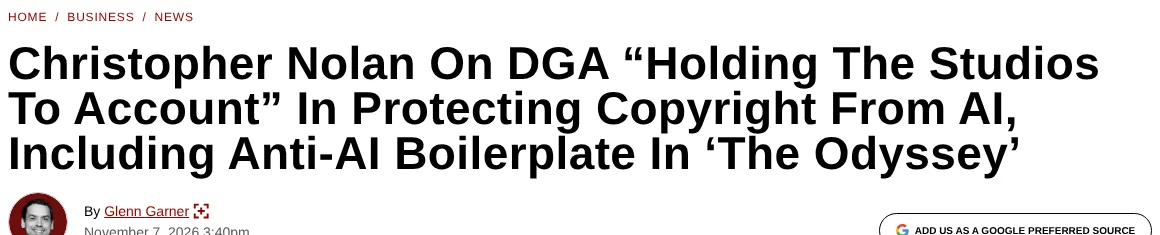
Source: Deadline, captured on November 9, 2026.
Three ideas stand out.
1. It's the studios' fight. The DGA negotiated AI guardrails with the producers, and Nolan calls them good. But he points out that directors almost never own the copyright in their films. "It's down to the studios to do that": they are the ones who can go after companies training models on their catalogues.
2. "AI" is too broad a word. In his view, companies use it to absolve themselves, as if the technology were a Frankenstein's monster nobody is accountable for. He thinks the fair use defence "won't hold up in court" in the long run. That's his opinion, not a ruling.
3. The Odyssey's credits set a precedent. According to TheWrap, Universal included for the first time language stating the film cannot be ingested, scraped or used as training data for generative AI models.
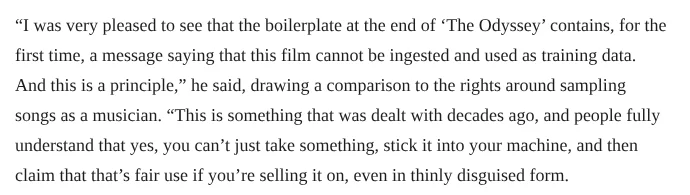
Source: TheWrap, captured on November 9, 2026.
He compares it to sampling in music: that was settled decades ago, you can't take a track and resell it thinly disguised. He expects AI to end up in the same place, through the courts, and it will take time.
What a line in the credits is worth
A credits notice is a clear message. It isn't enough.
Why? Because a bot scraping a video online doesn't watch the end of the film. In Europe, the rule that matters is Article 4 of Directive 2019/790 on copyright. It allows text and data mining (TDM, the process used to train models) on lawfully accessible works, unless the rightholder has reserved it "in an appropriate manner".
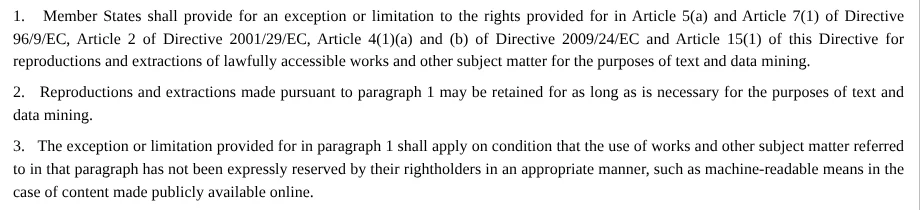
Source: EUR-Lex, Directive (EU) 2019/790, Article 4, captured on November 9, 2026.
For content made available online, the text adds: "such as machine-readable means". Recital 18 of the same directive names metadata and a website's terms and conditions as valid means. France transposed the rule in its Intellectual Property Code (Article L. 122-5-3).
Since August 2, 2025, the EU AI Act (Article 53) also requires providers of general-purpose AI models to identify and comply with these reservations of rights. So your reservation isn't wishful thinking: it's what these companies are supposed to look for.
Four places to say "no"
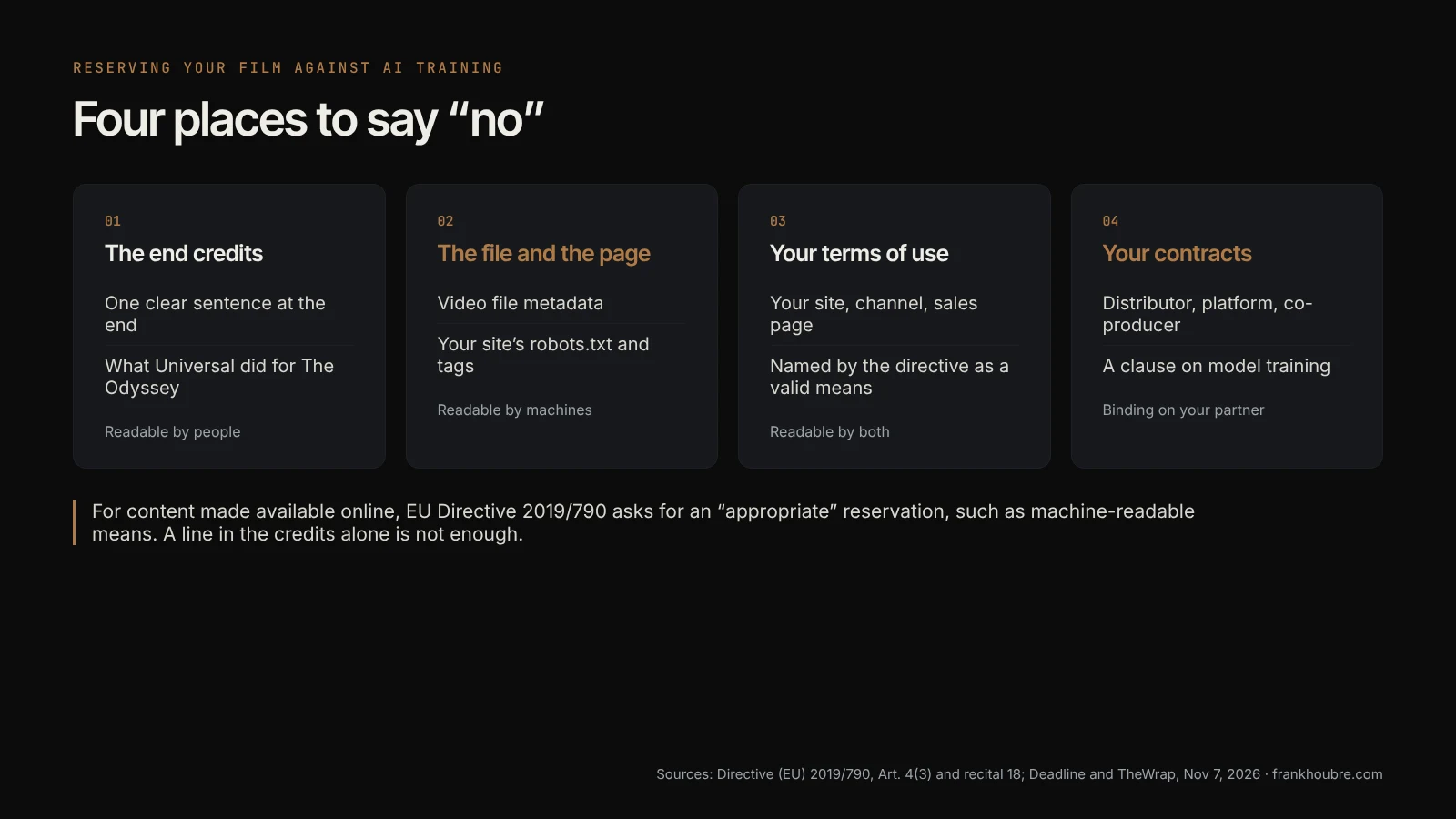
- The end credits. Do what Universal did: one clear sentence. It's the human signal, the one a judge or a distributor will read.
- The file and the page. Your video's metadata, and your site's robots.txt. Since October 30, Google, OpenAI, Microsoft and Anthropic have pledged to honor one shared robots.txt signal against training, which I cover in my piece on the common signal.
- Your terms of use. On your site, sales page or channel, one line reserving text and data mining.
- Your contracts. With your distributor, platform or co-producer: who can authorize training on the film, and who gets paid if it happens.
💡 Frank's cut: I make films with AI, and I still reserve mine against training. That's not a contradiction. Using a tool doesn't mean handing your work to the next model. What I like about The Odyssey's line is that it costs nothing and forces everyone to say "no" out loud instead of thinking it quietly.
One honest caveat: if you use models trained on other people's work, the question comes back at you. I look at it for music in my piece on AI soundtrack rights.
What I would do this week
- Add one line to your next end credits, such as: "All reproduction or extraction of this work for text and data mining, including the training of AI models, is expressly reserved (Article 4(3), Directive (EU) 2019/790)."
- Put the same sentence in the terms of use of your site and in your video descriptions.
- Open your robots.txt and add the shared anti-training signal.
- Reread your distribution contracts: look for "training" or "artificial intelligence". If it isn't there, ask before you sign the next one.
What we don't know
- The exact wording in the credits. I rely on TheWrap's description and Nolan's words, not a capture of the film.
- What these notices achieve. No court has yet said what a credits notice alone is worth, without machine-readable means.
- What other studios will do. Nolan asks them to act. Nothing so far shows the others will adopt Universal's notice.
Frequently asked questions
Quick answers to the questions readers ask most about this article.
What is in The Odyssey's end credits?
According to TheWrap and Deadline, reporting Christopher Nolan's comments on November 7, 2026, Universal included for the first time an end-credits notice forbidding anyone to ingest, scrape or use the film as training data for generative AI models. Nolan welcomed it on the Hollywood Insiders podcast, produced by the Motion Picture & Television Fund.
Why does Nolan say it's up to the studios?
Because DGA directors almost never own the copyright in the films they direct. The guild can negotiate guardrails on how AI is used in production, but only the rightholders, usually the studios, can sue a company that trains a model on their films.
Is a line in the credits enough to protect a film in Europe?
Not on its own. Article 4 of Directive 2019/790 allows text and data mining unless the rightholder makes an "appropriate" reservation, and for online content that reservation should use machine-readable means such as metadata, terms of use or robots.txt. The credits notice is still useful as evidence and as a signal, but it needs backing up.
How do I reserve my film against AI training?
Write a clear reservation in the credits, repeat it in your site's terms of use and your video descriptions, add the anti-training signal to your robots.txt, and include a clause on model training in your contracts with distributors and platforms. In France the legal basis is Article L. 122-5-3 of the Intellectual Property Code.
Do AI companies have to respect these reservations?
In Europe, in principle yes. Since August 2, 2025, Article 53 of the EU AI Act requires providers of general-purpose AI models to have a copyright compliance policy, and in particular to identify and comply with reservations of rights made under Article 4(3) of Directive 2019/790. Enforcement is still to be tested.
I make films with AI: is it consistent to reserve them?
Yes. Using generative tools to create doesn't oblige you to let your own work train the next models. The two decisions are separate. But if you use models trained on other people's work, find out how they were trained, especially for commercial use.
Related articles
 Actualité
AI training opt-out: OpenAI and Google back one robots.txt
On October 30, OpenAI, Google, Microsoft and Anthropic pledged to honor one robots.txt signal against AI training. What it changes for creators.
 Actualité
Chomet accused of AI over his Dior film: his answer
Sylvain Chomet denies any generative AI in his Dior short and admits some automated interpolation. What the row teaches anyone making films with AI.
 Actualité
Underdog Woof: a 32 MB AI voice that runs locally
Underdog released Woof, a 31.7 MB text-to-speech model that works offline. What it really does, its non-commercial licence, and where it fits in an AI film.