Chomet accused of AI over his Dior film: his answer
Sylvain Chomet denies any generative AI in his Dior short and admits some automated interpolation. What the row teaches anyone making films with AI.
Contents · 7 sections
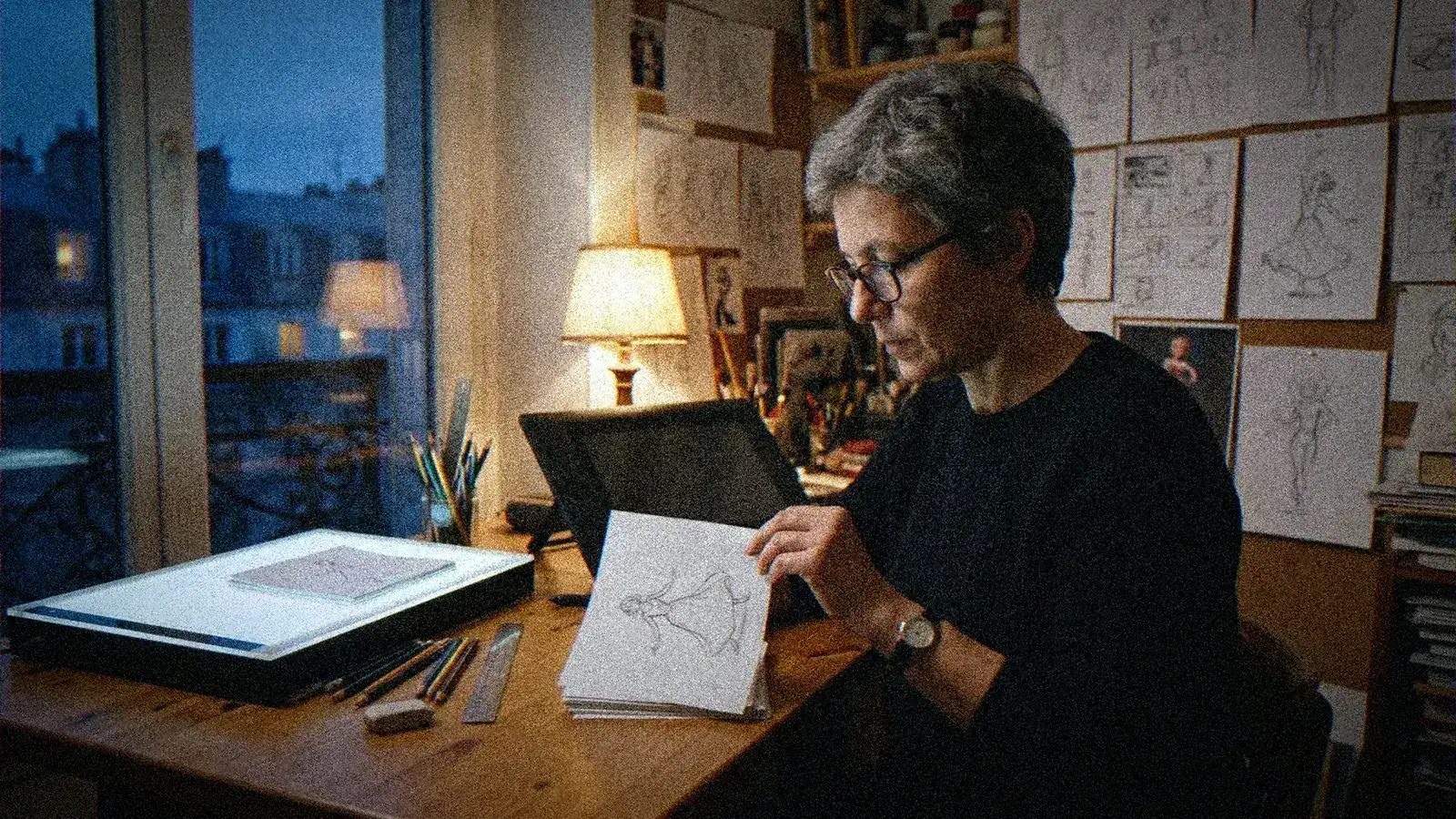
Sylvain Chomet, the director of The Triplets of Belleville and The Illusionist, is answering viewers who say his short film for Dior was made with generative AI. In an exclusive interview published by Variety on November 7, 2026, he and his producer Aton Soumache explain that everything was drawn by artists, and that an automated interpolation tool was used for "a very small part of the process". The Verge picked up the story the same day.
I find this case more useful than most AI rows. It isn't about "AI or no AI". It's about a line many people don't see: drawing, interpolating and generating are three different things. And when you don't say which one you used, the audience decides for you.
What follows comes from Variety's interview by Elsa Keslassy and The Verge's post by Terrence O'Brien, read on November 8. I haven't seen the production files: the production figures are the team's.
The film and the accusation
Christian Dior's Night in Color is a six-minute animated short, released in early November to open the house's holiday season. Robert Pattinson narrates, Louis Garrel voices Christian Dior and Camille Cottin plays Marlene Dietrich, with Rihanna, Josh O'Connor and LaKeith Stanfield also in the cast. The story: Dietrich is shooting in Hollywood, the director switches to colour, and Paris has to deliver a gown overnight.
Dior presented the film as a tribute to handwork, drawing a parallel between Chomet's drawing and its couture ateliers. That's where it went wrong. Viewers spotted visual glitches, including a character with six fingers, and concluded the animation came from an AI.
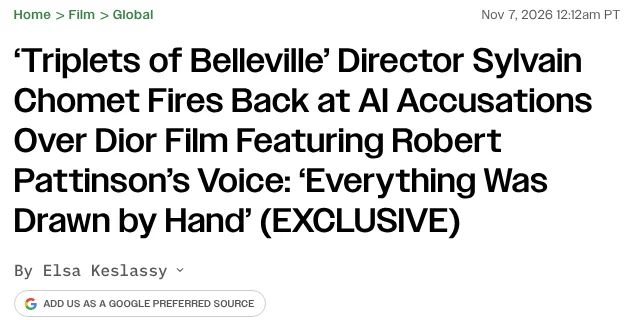
Source: Variety, captured on November 8, 2026.
What Chomet and his producer say
Their account, as Variety reports it:
| Point | What the team says |
|---|---|
| Production time | 7 months |
| Crew | About 20 people, including 6 animators, plus storyboard, backgrounds, compositing and editing |
| What is drawn | Characters, backgrounds, key poses, by artists, on graphics tablets |
| What is automated | Part of the in-betweens, the frames between two poses |
| Generative AI | Never used to create the artwork |
Aton Soumache answers the harshest rumour, a film made in two weeks without a single drawing: "This film took seven months to make and it was entirely drawn by artists." Chomet calls the interpolation tool "a way of automating the repetitive, mechanical part of animation, not the creative work".
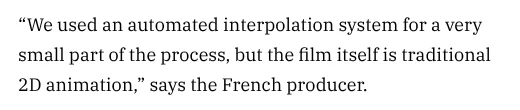
Source: Variety, captured on November 8, 2026.
On the six fingers, he gives a craft answer: when a hand fans open in a fast movement, you sometimes draw six or seven fingers to convey speed. And he points out he's seen far worse in traditional animation, like a nose changing shape over five frames as a character turns his head.
There's an irony he points out himself. In the Toy Story era, people announced the death of 2D. He kept drawing. "That's why I find it so strange that people are attacking me today." He adds that he will still use the tools technology offers.
Drawing, interpolating, generating: the difference
This is the heart of the story, and it's where many comments aim at the wrong target.
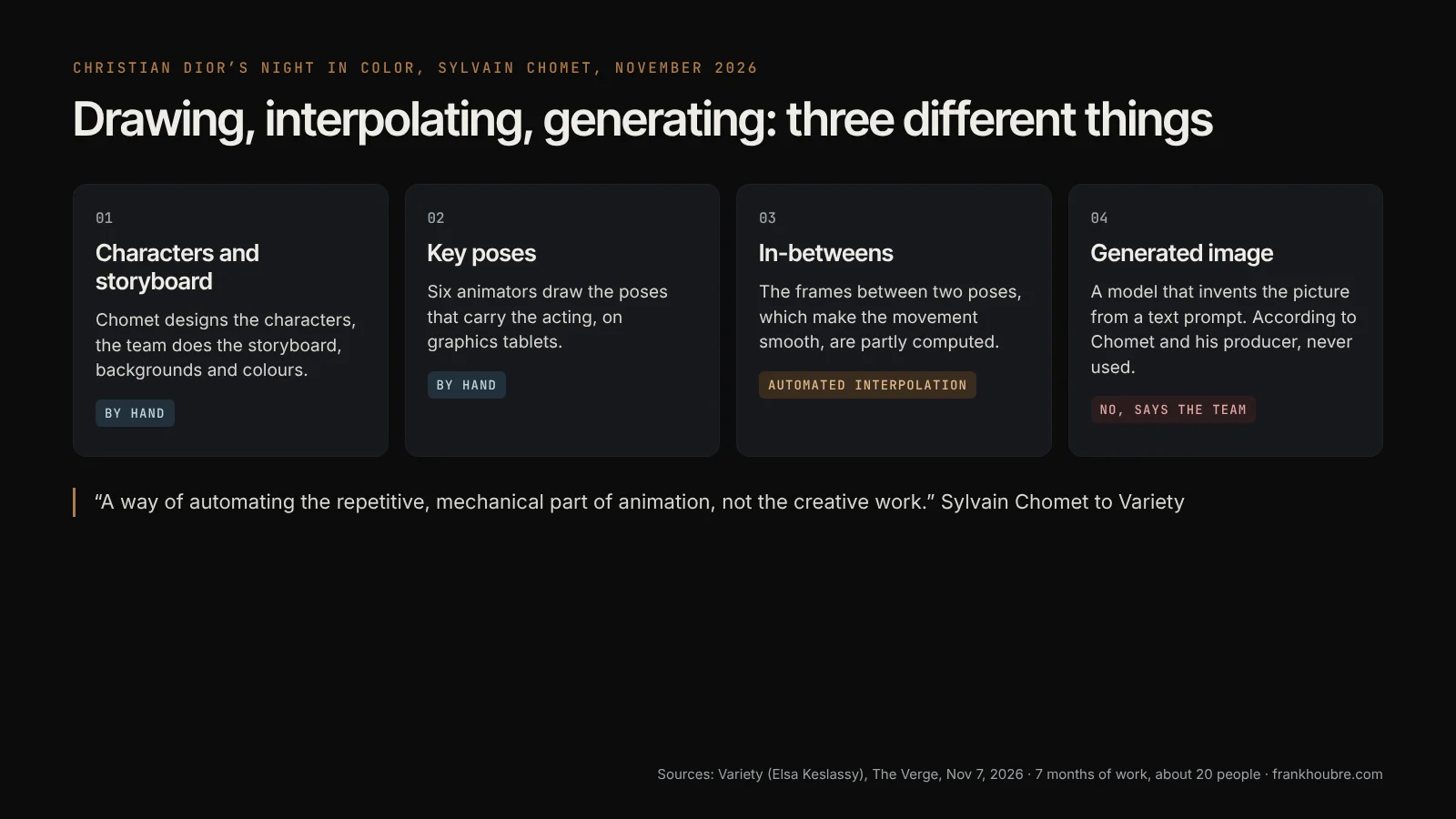
- Drawing means deciding the shape, the acting, the timing. Key poses carry the animator's intent.
- Interpolating means computing the frames between two poses that are already decided. The tool doesn't choose what the character does, it fills in the path. The same principle has long been used to slow down video or change its frame rate.
- Generating means asking a model to invent the image itself, from a text prompt or a reference.
When Chomet says "no generative AI", he means the third category. When a viewer sees a glitch and shouts AI, they often lump all three together. Both can be in good faith.
What no one can check from the outside is the exact share of computed in-betweens. "A very small part," the team says. I have nothing to say otherwise, and nothing to confirm it.
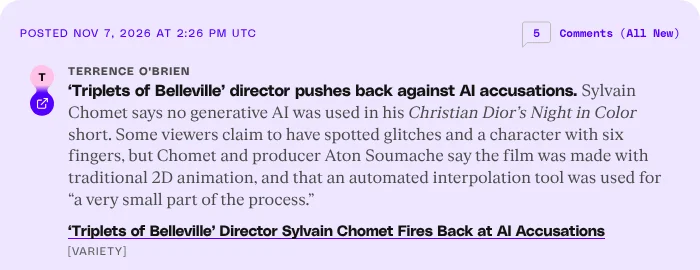
Source: The Verge, captured on November 8, 2026.
What it changes for you as a creator
Dior's problem isn't the tool. It's the gap between the message ("handmade") and what the audience thinks it sees. Once a film is sold on craft, the smallest glitch becomes evidence, and the explanation arrives after the rumour.
If you make films with AI, or films where AI steps in at one stage, the lesson is simple: say what you used, and at which stage, before anyone asks. Not a confession, a spec sheet. That's also the spirit of the EU transparency obligation on generated content (Article 50 of the AI Act), which applies since August 2, 2026. And it's the in-betweener's job that this kind of tool reshapes first, a shift I look at in my take on film and TV jobs facing AI.
And the other way round, if you make a fully generated film, the example of Gods Don't Give Gifts with Grimes shows you can own it out loud and make it a selling point.
💡 Frank's cut: I use interpolation every day to smooth a generated shot, and I've never felt it was cheating. What bothers me here isn't Chomet, it's the vague brand message. A credit line saying "hand-drawn, in-betweens partly assisted" would have killed the row before it started.
If you want to understand what interpolation really does to an image, and where it breaks, I cover it in my guide to making generated video smoother.
What I would do this week
- Write the spec sheet of your last film: for each stage (writing, images, animation, voice, music, edit), human, assisted tool or generation. One line per stage.
- Put it in the description or the credits. Before release, not after the first critic.
- Find your "six fingers" frames: images where fast motion creates an odd shape. If it's intended, keep it. If a tool caused it, fix it.
- Watch Dior's film with this diagram in mind and judge for yourself, not from the screenshots going around.
What we don't know
- The exact share of computed in-betweens. The team says a very small part, without a number.
- The tool used. Neither Variety nor The Verge names it.
- Dior's reaction. The statements come from Chomet and his producer, not from a statement by the house.
Frequently asked questions
Quick answers to the questions readers ask most about this article.
Was Sylvain Chomet's Dior film made with AI?
According to Sylvain Chomet and his producer Aton Soumache, interviewed by Variety on November 7, 2026, no generative AI was used to create the images of Christian Dior's Night in Color. Characters, backgrounds and key poses were drawn by artists over seven months. They do acknowledge an automated interpolation tool for part of the in-between frames. That is their account: no one outside the team has had access to the production files to check it.
What is the difference between interpolation and generative AI?
Interpolation computes the frames between two poses that are already drawn. It fills in the path of a movement the animator decided, without inventing what the character does. Generative AI creates the whole image from a text prompt or a reference. In the Dior film, the team says it used the first for a small share of in-betweens and never the second. The principle of interpolation has also long been used in video to slow a shot down or change its frame rate.
Why did viewers accuse the film?
Viewers spotted visual glitches, especially a character who seems to have six fingers, and saw them as the mark of generated animation. The context amplified the criticism: Dior had presented the film as a celebration of handwork, alongside its couture ateliers. Chomet explains that in a hand movement that fans out, you sometimes draw six or seven fingers to convey speed, a common practice in traditional animation.
Who worked on Christian Dior's Night in Color?
According to Variety, the film is directed by Sylvain Chomet and produced by Aton Soumache (The Little Prince), with about 20 people including six animators, storyboard artists, background artists, compositors and editors. The idea came from Jonathan Anderson, Dior's creative director, and Martin Latham co-wrote the script. Voices: Robert Pattinson narrates, Louis Garrel plays Christian Dior, Camille Cottin plays Marlene Dietrich, with Rihanna, Josh O'Connor and LaKeith Stanfield.
Should you disclose interpolation in a film?
Nothing requires you to list every tool, and interpolation isn't image generation. But this case shows the cost of silence: when a film is sold as handmade, the smallest glitch becomes evidence, and the explanation arrives after the rumour. One line in the credits or the description, stage by stage, costs little and protects a lot. For generated content, the EU transparency obligation in Article 50 of the AI Act applies since August 2, 2026.
What does this case change for an AI filmmaker?
It shows that audiences judge on visual clues, often without telling assisted drawing, interpolation and generation apart. If you work with AI, the best defence is clarity: an honest spec sheet, published before release. It also shows that an intentional quirk can be mistaken for a machine error. Know which ones you stand behind, and be able to explain them in one sentence.
Related articles
 Actualité
Grimes stars in Gods Don't Give Gifts, an AI film for theaters
Grimes lends her voice and likeness to the AI film Gods Don't Give Gifts, in US theaters on December 4. What is human, what is AI, and what it means for you.
 Actualité
The New York Times sues Brave over AI scraping
On November 2, the New York Times and three dailies sued Brave over a 30 billion page index sold to AI companies. What the complaints say.
 Actualité
iQIYI opens an AI film studio in Shanghai
iQIYI films real actors on a 110 m² stage in Shanghai, then AI rebuilds sets and light around their performance. What the November 1 release says.