Gods Don't Give Gifts ruled out of the animation Oscar
The Academy ruled the AI film Gods Don't Give Gifts ineligible for Best Animated Feature. The rule behind it, the planned appeal, and what it tells AI filmmakers.
Contents · 7 sections
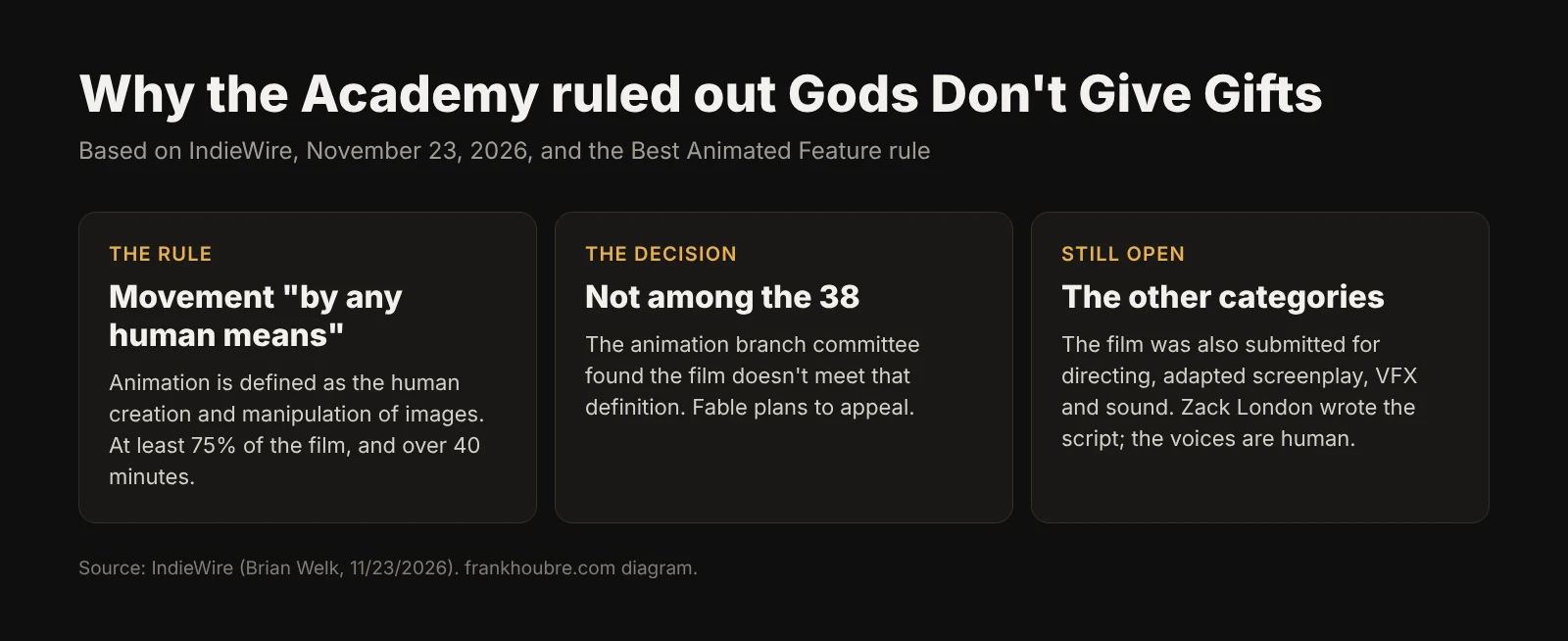
On Monday, November 23, 2026, the Academy published the list of 38 films eligible for the Best Animated Feature Oscar. Gods Don't Give Gifts, the fully AI-generated film by Zack London (aka Gossip Goblin), isn't on it. According to IndieWire, the animation branch committee found it doesn't meet the Academy's definition of an animated film.
I've followed this film since Grimes joined the cast, and this decision interests me more than the announcement did. It spells out where the Academy draws the line between animating and generating.
This piece is based on Brian Welk's article for IndieWire, published on November 23 and read on November 24, 2026. I haven't seen the Academy's written decision.
What the Academy decided

Source: IndieWire, captured on November 24, 2026.
The film had been submitted and planned "for your consideration" screenings alongside its theatrical release on December 4. It isn't among the 38 eligible animated films announced Monday. IndieWire says the animation branch's executive committee made the call under the rules for the 99th Awards.
For comparison, Coyote vs. Acme, a hybrid film with the Looney Tunes alongside live actors, did qualify.
The rule at issue
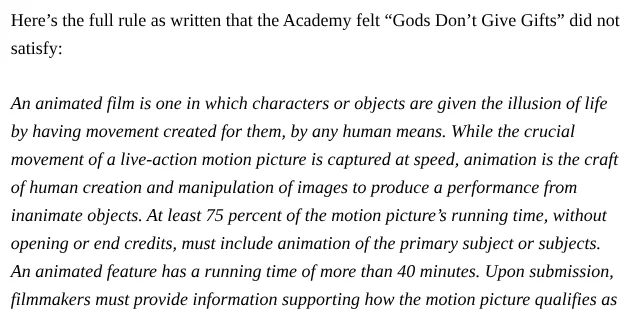
Source: IndieWire, captured on November 24, 2026.
It comes down to a few words. For the Academy, an animated film gives characters or objects "the illusion of life by having movement created for them, by any human means." Animation is "the craft of human creation and manipulation of images." At least 75 percent of the running time must be animated, and the film must run over 40 minutes.
The sticking point is "human." In a generated film, the movement comes out of the model, even when humans guided it.
What the filmmakers say
Edward Saatchi, a producer with Fable Studios, told IndieWire that he and Zack London will appeal. He points to Richard Linklater's rotoscoped Apollo 10½, first ruled ineligible, then admitted on appeal.
The film was also submitted in other categories: directing, adapted screenplay, VFX and sound. Saatchi put the question bluntly: "Is it time to consider a 'Best AI Movie?' Do these films fit best in the voice-actor led animation category? Is AI simply the new VFX?" He named Matthieu Kassovitz, Alex Proyas and Doug Liman as established directors also making heavily-AI films.
IndieWire lists what is human here: London wrote the script, real actors voice the characters, and a team of 30 to 35 people worked on it for years, with lookbooks and visual references. A behind-the-scenes documentary shows the composer, the foley artist and the voice actors. I broke down that split in my piece on Grimes joining the film.
What I make of it
The decision doesn't surprise me, and I don't find it unfair. The animation rule is about movement, and in a generative film, movement is exactly what the machine produces. You can call the definition dated, but it's consistent.
What matters more to me is the bigger picture. The Academy already requires human-authored screenplays and consenting human performers, and it asks for disclosure of AI use. It isn't shutting out films made with AI: it's looking at who did what. That's good news for people who work the way London does, with a real script, real voices and a real crew.
Saatchi's idea of a "Best AI Movie" category leaves me torn. A separate box is recognition, but it's also a ghetto. I'd rather a film be judged on what it says, with full transparency about how it was made.
What it means for you
- Document your process from day one. Who wrote, who performed, who edited, which tool did what. London's team had to release a behind-the-scenes documentary to prove it after the fact.
- Keep humans where it counts. Script, voices, performance, editing: that's what festivals and the Academy look at first.
- Read the rules before you submit. Every festival defines animation, AI and eligibility its own way. One category can shut the door, another can open it.
- Don't count on an "AI" category. For now it doesn't exist. Pick the category where your human work shows best.
For another way of mixing live shooting and AI, see my piece on Topview's hybrid film idea.
What we don't know
- The Academy's detailed reasoning: IndieWire summarizes the decision; the committee's text isn't public.
- The outcome of the appeal, or when it will be decided.
- How the film fares in the other categories (directing, adapted screenplay, VFX, sound), where nothing has been announced.
Frequently asked questions
Quick answers to the questions readers ask most about this article.
Why is Gods Don't Give Gifts ineligible for Best Animated Feature?
According to IndieWire, the animation branch committee found the film doesn't meet the Academy's definition of an animated film, which requires movement created "by any human means."
Will the film appeal?
Yes. Producer Edward Saatchi told IndieWire that he and director Zack London will appeal, citing Richard Linklater's Apollo 10½, admitted after a first rejection.
Can the film still compete at the Oscars?
It was submitted in other categories: directing, adapted screenplay, VFX and sound. IndieWire doesn't say whether it is eligible there.
What is human in Gods Don't Give Gifts?
The script, written by Zack London, the character voices, performed by real actors, the music and the foley. The images are AI-generated. A team of 30 to 35 people worked on the film.
When does the film come out?
December 4, 2026 in the US, first as a qualifying run, then wider from January 22 with international distributor AGC International.
What rules does the Academy apply to AI?
It requires disclosure of AI use in a film. Acting categories require consenting human performers, and screenplays must be human-authored.
Related articles
 Actualité01
Grimes stars in Gods Don't Give Gifts, an AI film for theaters
Grimes lends her voice and likeness to the AI film Gods Don't Give Gifts, in US theaters on December 4. What is human, what is AI, and what it means for you.
 Actualité02
Ozzy Fox on Disney+: what Animaj's AI actually does
Ozzy Fox, animated with tools from French startup Animaj, comes to Disney+ in December. Where AI enters the pipeline, and what it does not do.
 Actualité03
AI training opt-out: OpenAI and Google back one robots.txt
On October 30, OpenAI, Google, Microsoft and Anthropic pledged to honor one robots.txt signal against AI training. What it changes for creators.