How to Create a Cinematic Video with AI Step by Step
A complete method to go from a vague idea to a credible AI video, shot by shot, with no plastic render.
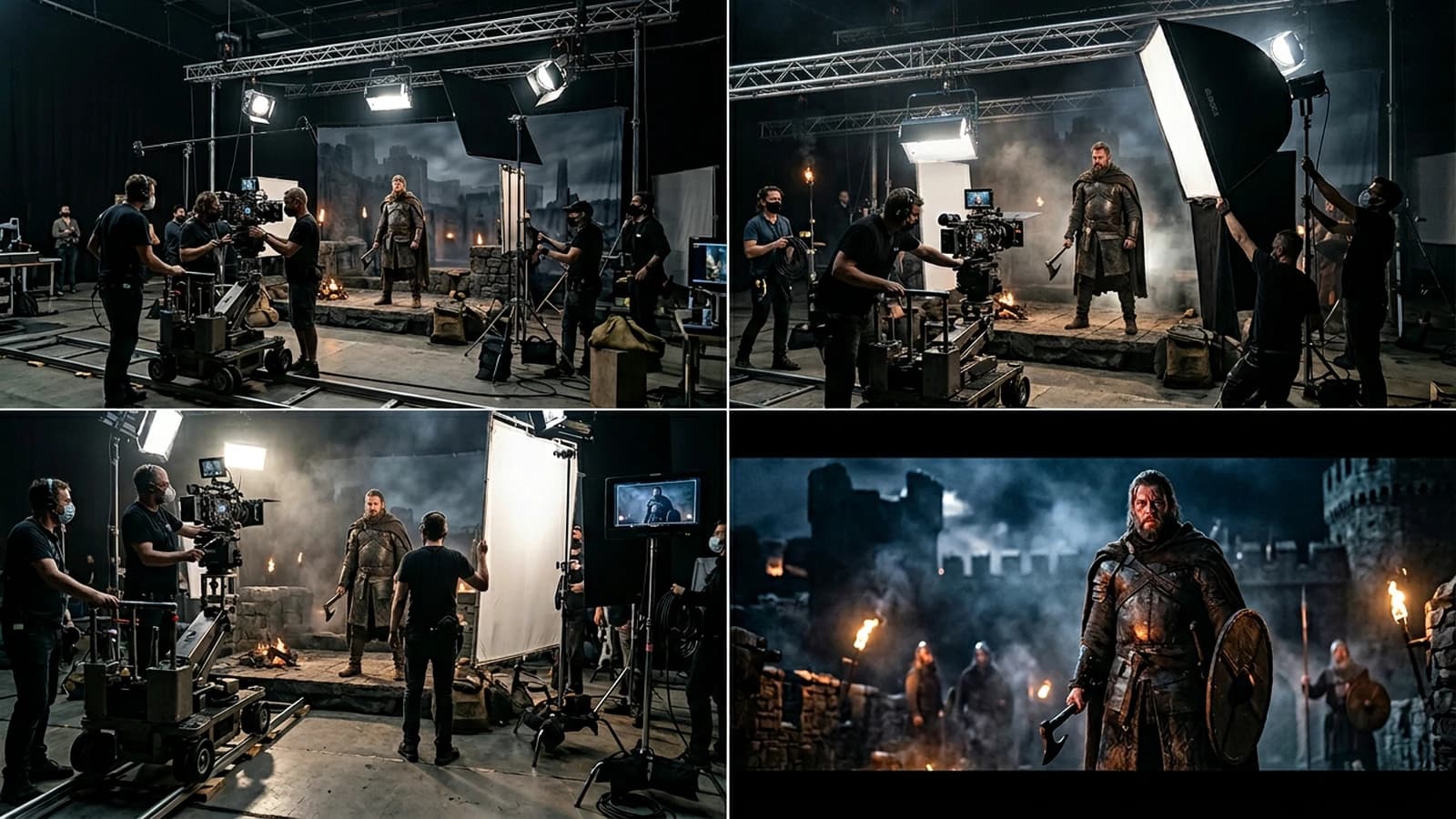
You open your generator. You type a prompt. You launch.
And there, the wall. The image moves, yes, but it does not live. Plastic skin, inconsistent light, floating movements, a "clean" set like a generic ad. You wanted a film shot. You got a technical test.
This guide is made to spare you that. No magic. No useless jargon. A set method, adapted to local AI, to produce a real, credible cinematic video.
The real starting point
Most beginners start with the tool. You have to start with the intention.
Before generating a single pixel, set these 5 answers:
- what the character feels
- what the viewer must understand
- where the dominant light source is
- which camera movement is plausible
- which visual detail carries the emotion
If these answers are vague, your render will be too.
Pro insight A cinematic shot is a visual decision, not an applied style.
To stabilize the narrative from the preparation, use the logic of how to structure an AI video like a real film.
3 beginner scenarios, field version
Scenario 1, "my fashion ad is beautiful but fake"
You have a premium look. Everything is sharp. Everything is dead.
What is missing:
- a justified camera movement
- natural skin
- a readable light source
What we fix:
- 3 to 4 second shots
- weak to moderate motion
- skin texture + subtle grain
Scenario 2, "my still images are strong, my video breaks"
The still is credible. The animation destroys the edges.
What is missing:
- temporal consistency
- control of the sensitive zones
- iteration parameter by parameter
What we fix:
- fixed seed
- minimal A/B test
- 200% zoom check on faces/hands
Scenario 3, "I want a dramatic short, I get a clip"
The shots are pretty but do not advance narratively.
What is missing:
- emotional progression
- editing rhythm
- a final consequence
What we fix:
- a short arc in 3 blocks
- cut on intention
- sound handled early
Mandatory prompt template
This template is not enough on its own.
The quality plays out in [SCENE DESCRIPTION].
Ultra-detailed workflow, step by step
Step 1, mini brief in 12 lines
Write:
- subject
- emotion
- place
- time
- weather
- shot type
- perceived focal length
- camera movement
- palette
- texture
- visual prohibition
- role of the shot
Step 2, fixed keyframes before video
You lock the image first.
Starting settings:
- resolution: 1536x864 or 1920x1080
- steps: 30 to 45
- CFG: 4.5 to 6.5
- sampler: DPM++ 2M Karras
- denoise img2img: 0.25 to 0.40
- seed: fixed per shot
Step 3, controlled local animation
Safety rules:
- duration: 3 to 5 seconds
- fps: 24
- motion strength: 0.35 to 0.55
- temporal consistency: high
- noise: low
Step 4, strict selection
You keep:
- 1 version A
- 1 version B maximum
You reject:
- unstable faces
- inconsistent hands
- contradictory lights
Step 5, narrative editing
Recommended structure:
- setup
- tension
- decision
- consequence
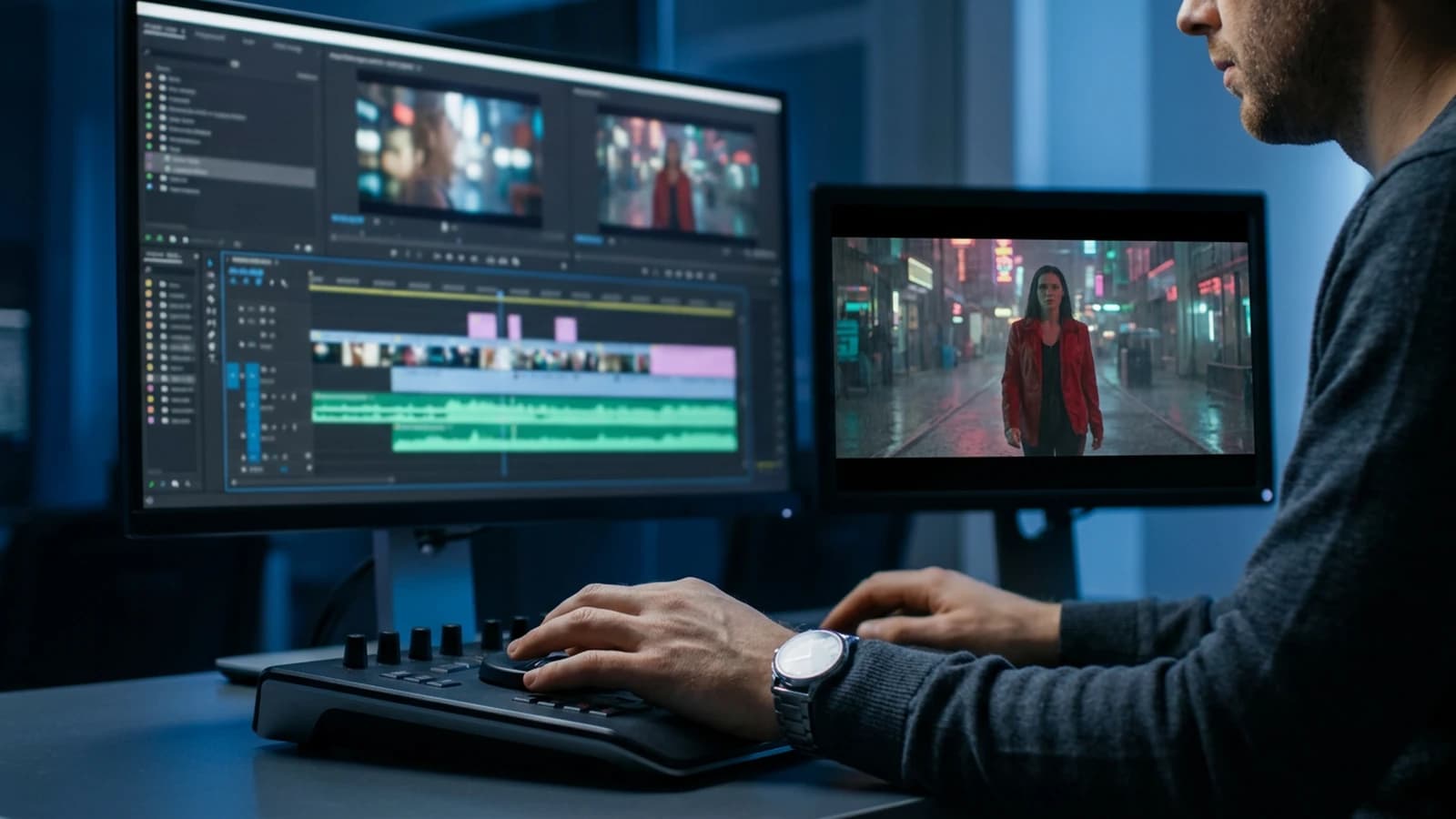
Step 6, realistic grade
Order:
- exposure
- soft contrast
- secondary skin
- harmonization
- fine grain
Step 7, sound from the rough cut
Base:
- ambience at -24 LUFS
- punctual effects at -18/-14
- music as support, not as camouflage
Starting settings table
| Parameter | Base value | Why |
|---|---|---|
| Clip duration | 3-5 s | AI stability |
| FPS | 24 | cinema rhythm |
| Motion strength | 0.35-0.55 | movement credibility |
| Seed | fixed | continuity |
| Denoise | 0.25-0.40 | controlled variation |
| Grain | light | organic texture |
What beginners miss, and how to fix it
1) Generating too long
Mistake: a 10 to 15 second shot at once. Fix: short segments then editing.
2) Too much movement
Mistake: a demonstrative camera. Fix: sober inertia, readable trajectory.
3) Too much sharpness
Mistake: a video-game render. Fix: reduce the sharpen, preserve the midtones.
4) LUT before light
Mistake: an artificial look. Fix: correct the lighting geometry before the style.
5) No stable seed
Mistake: a character that changes. Fix: fixed seed per shot.
6) Forgetting the edges of the frame
Mistake: artifacts visible at export. Fix: systematic 200% check.
7) Sound added at the last moment
Mistake: broken rhythm. Fix: lay the room tone from the rough cut.
8) Absent structure
Mistake: beautiful shots, empty film. Fix: each shot must have a mission.
9) Badly locked character
Mistake: face/costume inconsistency. Fix: a constant character sheet.
10) Testing everything at the same time
Mistake: impossible to diagnose. Fix: one variable per iteration.
To avoid the texture drifts that break the realism, complete it with how to generate photorealistic AI images without the plastic look.
Foire aux questions
Réponses rapides aux questions les plus fréquentes sur cet article.
What duration should I aim for at the start?
3 to 5 seconds per shot. This figure is a reliable starting point, but adjust it according to the type of movement, the frame density and the expected level of realism. The most reliable method is to test two close variants with the same conditions (seed, light, framing), then keep the one that stays readable after several reviews. If you hesitate, favor the overall consistency of the sequence and document your choice, because that is what gives a credible result over time.
Should I always work in 24 fps?
Yes as a base, it is the most stable for the cinema intention. The right answer mostly depends on the scene intention and the consistency between the shots, not on an absolute rule applied everywhere. The most reliable method is to test two close variants with the same conditions (seed, light, framing), then keep the one that stays readable after several reviews. If you hesitate, favor the overall consistency of the sequence and document your choice, because that is what gives a credible result over time.
Is the model enough to make the difference?
No, the method counts more than the brand of the model. In practice, treat this decision as a narrative parameter, not as a simple technical setting, otherwise the render quickly becomes inconsistent from one shot to another. The most reliable method is to test two close variants with the same conditions (seed, light, framing), then keep the one that stays readable after several reviews. If you hesitate, favor the overall consistency of the sequence and document your choice, because that is what gives a credible result over time.
Why do my faces change?
Unstable seed, denoise too high, character description too variable. The main reason is that the model fills the ambiguous zones with approximations, which creates visible inconsistencies when the scene becomes complex. The most reliable method is to test two close variants with the same conditions (seed, light, framing), then keep the one that stays readable after several reviews. If you hesitate, favor the overall consistency of the sequence and document your choice, because that is what gives a credible result over time.
Can you go pro with no team?
Yes, with a clean pipeline and short shots. In practice, treat this decision as a narrative parameter, not as a simple technical setting, otherwise the render quickly becomes inconsistent from one shot to another. The most reliable method is to test two close variants with the same conditions (seed, light, framing), then keep the one that stays readable after several reviews. If you hesitate, favor the overall consistency of the sequence and document your choice, because that is what gives a credible result over time.
How many versions should I keep per shot?
Two maximum, A and B. This figure is a reliable starting point, but adjust it according to the type of movement, the frame density and the expected level of realism. The most reliable method is to test two close variants with the same conditions (seed, light, framing), then keep the one that stays readable after several reviews. If you hesitate, favor the overall consistency of the sequence and document your choice, because that is what gives a credible result over time.
How do I know the shot is ready?
When it stays credible full screen, on mobile, and with no explanation. Start with a simple, stable version, then add a single constraint at a time to clearly see what improves or degrades the result. The most reliable method is to test two close variants with the same conditions (seed, light, framing), then keep the one that stays readable after several reviews. If you hesitate, favor the overall consistency of the sequence and document your choice, because that is what gives a credible result over time.
What is the number one mistake?
Confusing visual effect and narrative intention. In practice, treat this decision as a narrative parameter, not as a simple technical setting, otherwise the render quickly becomes inconsistent from one shot to another. The most reliable method is to test two close variants with the same conditions (seed, light, framing), then keep the one that stays readable after several reviews. If you hesitate, favor the overall consistency of the sequence and document your choice, because that is what gives a credible result over time.
Advanced block, complete pipeline in real conditions
When you move from solo tests to a real production, even a short one, the mistakes change. It is no longer only "is the shot pretty". It is "does the sequence hold from end to end, with continuity, rhythm, and credibility".
Compact pre-production, field version
You make a single 1-page document:
- logline
- emotional arc
- shot list
- lighting charter
- texture charter
- visual prohibitions
You must be able to explain it to someone in 90 seconds. If that is not possible, your project is still vague.
Recommended settings by shot type
| Shot type | Duration | Motion | Key risk | Action |
|---|---|---|---|---|
| Tight portrait | 3-4 s | 0.30-0.40 | face drift | almost fixed camera |
| Medium action shot | 4-5 s | 0.40-0.55 | hands/edges | simplify the gesture |
| Wide ambience shot | 3-5 s | 0.25-0.40 | set geometry | limit the tracking shot |
| Object detail shot | 2-4 s | 0.20-0.35 | "CGI" texture | explicit material |
Render pipeline
- validated source image
- low-intensity test animation
- targeted correction pass
- A/B selection
- timeline integration
- color harmonization
- minimal sound
- master export
- distribution export
If you skip steps 2 to 4, you repair in a panic at the end.
Pro insight The best quality gain does not come from a new model, it comes from a better selection discipline.
Extended trench warfare, "invisible" mistakes that kill the credibility
11) Shots validated in preview only
Mistake: everything seems clean in a 50% preview. Fix: full-screen + mobile validation mandatory.
12) Neglected color continuity
Mistake: one shot pulls cyan, the other magenta. Fix: neutralize first, look next.
13) Too many "intermediate" shots
Mistake: the narrative stretches, the impact dilutes. Fix: cut the shots that add neither information nor emotion.
14) Generic "library" sound
Mistake: the video looks stock. Fix: location ambience + contextualized micro foley.
15) No versioning
Mistake: impossible to reproduce a good output. Fix: strict naming and a settings log.
16) Character variations between shots
Mistake: perception of fake casting. Fix: character sheet + seed + constant wardrobe.
17) Inconsistent reflections
Mistake: glasses/windows betray the AI. Fix: simplified angle + controlled highlights.
18) Too many grading effects
Mistake: a "social preset" impression. Fix: sober primary correction, light final look.
19) Badly anticipated compression
Mistake: the upload destroys the fine textures. Fix: headroom on the highlights + subtle grain.
20) Absence of a rejection rule
Mistake: you "save" mediocre shots. Fix: if a major defect remains after 2 passes, reject.
Mini practical case, from brief to export in 45 minutes
- minute 0-5: logline + 4-shot shotlist
- minute 5-15: fixed keyframes
- minute 15-25: animation tests
- minute 25-35: selection + rough edit
- minute 35-42: color correction + sound
- minute 42-45: export + quick QA
This short format forces you to decide fast. And well.
Pro publication checklist
- 3 minimum consistent shots
- no major visible artifact
- natural skin texture
- stable motivated light
- contextualized sound
- clear narrative CTA if ad format
- validated mobile version
- archived source file
Complementary FAQ
Should I launch several seeds in parallel?
Yes to explore, but then lock one version. The right answer mostly depends on the scene intention and the consistency between the shots, not on an absolute rule applied everywhere. The most reliable method is to test two close variants with the same conditions (seed, light, framing), then keep the one that stays readable after several reviews. If you hesitate, favor the overall consistency of the sequence and document your choice, because that is what gives a credible result over time.
Can you do a sequence shot in AI?
Possible, rarely recommended at the start. In practice, treat this decision as a narrative parameter, not as a simple technical setting, otherwise the render quickly becomes inconsistent from one shot to another. The most reliable method is to test two close variants with the same conditions (seed, light, framing), then keep the one that stays readable after several reviews. If you hesitate, favor the overall consistency of the sequence and document your choice, because that is what gives a credible result over time.
How long for a 20-second pro clip?
Between 1 and 3 days depending on your level and your hardware. This figure is a reliable starting point, but adjust it according to the type of movement, the frame density and the expected level of realism. The most reliable method is to test two close variants with the same conditions (seed, light, framing), then keep the one that stays readable after several reviews. If you hesitate, favor the overall consistency of the sequence and document your choice, because that is what gives a credible result over time.
What is the best quality "hack"?
No hack, it is the overall consistency. In practice, treat this decision as a narrative parameter, not as a simple technical setting, otherwise the render quickly becomes inconsistent from one shot to another. The most reliable method is to test two close variants with the same conditions (seed, light, framing), then keep the one that stays readable after several reviews. If you hesitate, favor the overall consistency of the sequence and document your choice, because that is what gives a credible result over time.
How do I train a beginner fast?
Short exercises, same constraints, immediate feedback. Start with a simple, stable version, then add a single constraint at a time to clearly see what improves or degrades the result. The most reliable method is to test two close variants with the same conditions (seed, light, framing), then keep the one that stays readable after several reviews. If you hesitate, favor the overall consistency of the sequence and document your choice, because that is what gives a credible result over time.
Is music mandatory?
No, a good sound design is often enough. In practice, treat this decision as a narrative parameter, not as a simple technical setting, otherwise the render quickly becomes inconsistent from one shot to another. The most reliable method is to test two close variants with the same conditions (seed, light, framing), then keep the one that stays readable after several reviews. If you hesitate, favor the overall consistency of the sequence and document your choice, because that is what gives a credible result over time.
Is a smartphone for validation enough?
No, it complements, it does not replace the main screen. In practice, treat this decision as a narrative parameter, not as a simple technical setting, otherwise the render quickly becomes inconsistent from one shot to another. The most reliable method is to test two close variants with the same conditions (seed, light, framing), then keep the one that stays readable after several reviews. If you hesitate, favor the overall consistency of the sequence and document your choice, because that is what gives a credible result over time.
When do I know I have to start from scratch?
When the visual base contradicts the intention. In practice, treat this decision as a narrative parameter, not as a simple technical setting, otherwise the render quickly becomes inconsistent from one shot to another. The most reliable method is to test two close variants with the same conditions (seed, light, framing), then keep the one that stays readable after several reviews. If you hesitate, favor the overall consistency of the sequence and document your choice, because that is what gives a credible result over time.
How do I keep a consistent style across several videos?
A fixed visual charter + a standard QA process. Start with a simple, stable version, then add a single constraint at a time to clearly see what improves or degrades the result. The most reliable method is to test two close variants with the same conditions (seed, light, framing), then keep the one that stays readable after several reviews. If you hesitate, favor the overall consistency of the sequence and document your choice, because that is what gives a credible result over time.
What differentiates a "pro" video from an "AI" video?
The emotional readability, not the technology used. In practice, treat this decision as a narrative parameter, not as a simple technical setting, otherwise the render quickly becomes inconsistent from one shot to another. The most reliable method is to test two close variants with the same conditions (seed, light, framing), then keep the one that stays readable after several reviews. If you hesitate, favor the overall consistency of the sequence and document your choice, because that is what gives a credible result over time.
Deep dive, from the isolated shot to the pro mini sequence
When you move to a 20 to 40 second format, one detail becomes critical, the management of the transitions. An excellent shot can seem fake if the following cut breaks the axis or the texture density.
Visual transition rule
Between two consecutive shots, control:
- gaze axis
- light direction
- grain density
- contrast level
- apparent speed of the movement
If three elements change at the same time, the perception of fake increases.
"3 editing passes" method
Pass 1, understanding You check that the story is understood with no effect.
Pass 2, emotion You adjust the duration of the shots to create tension and release.
Pass 3, finishing You harmonize color, texture and sound.
Pro insight A convincing sequence is not a sum of perfect shots, it is a continuity of readable intentions.
Production scenario, local 30-second ad
Brief
- cosmetic product
- target 25-35
- fast confidence promise
- natural premium tone
Breakdown
- shot 1, product texture hook
- shot 2, real use
- shot 3, result
- shot 4, visual CTA
Specific quality control
- credible skin on all the shots
- consistent bottle reflections
- progressive rhythm
- message understandable with no voice
Complementary troubleshooting section
21) "It works in a still, not in a sequence"
Fix: harmonize the light match before the creative grade.
22) "The final shot is worse than the first"
Fix: selection fatigue, redo the QA cold.
23) "The mobile render looks cheap"
Fix: review the local contrast and the global sharpness.
24) "The CTA does not land"
Fix: reduce the visual noise in the last 3 seconds.
25) "The character loses their identity"
Fix: lock the descriptors and the clothing in each prompt.
26) "The background attracts more than the subject"
Fix: lower the set's luminance, raise the subject.
27) "The image looks too digital"
Fix: remove the sharpen, add a subtle homogeneous grain.
28) "The rhythm is monotonous"
Fix: alternate short shots and breathing shots.
29) "The scene lacks depth"
Fix: reinforce the foreground/background separation.
30) "Impossible to decide between 2 versions"
Fix: test on a cold audience with a simple question, "which one seems the most real".
Last pass, validation in real conditions
Before publication, do a "no indulgence" read.
- watch with visual fatigue, like a real viewer
- watch with low sound, then sound off
- watch on a small screen
If the emotion stays clear in these three conditions, your shot holds.
Add a last production note:
- what worked best
- what broke
- what you reuse next time
This discipline turns a good attempt into a durable method.
You can also set up a simple team review rule, even with two people:
- one person judges the narrative
- the other judges the visual credibility
If both validate, you publish. If one of the two hesitates, you do a short pass again. This routine avoids the "almost good" publications that make you lose the audience's trust over the long term.
It is simple. But powerful. And above all, reproducible project after project.
You make fewer mistakes, and you progress much faster.
Really, project after project.
And if you want to reinforce the consistency of the scenes, also use the shot-by-shot construction principles.
Related articles
 Tutoriels
How to Create a Dark, Cinematic Mood with AI
Real black, practicals, faces in shadow, grain and export with no mud or cheap HDR.
 Tutoriels
How to Create a Storyboard with AI Step by Step
To create an AI storyboard step by step with no plastic render or decorative gallery: script breakdown, visual bible, stable prompts, sequential QA and a production deliverable.
 Tutoriels
How to Create Natural Light in an AI Image
Window, time of day, weather, interior bounce, and what distinguishes a gray day from golden hour.