Creating a Striking Video Ad With Artificial Intelligence
A complete guide to creating a striking video ad with artificial intelligence, from the idea to the conversion-oriented final edit.

You have already seen that ad "made with AI" that looks spectacular for three seconds, then nothing. No clear message. No desire. No call to action. Visually it is clean, commercially it is dead. If you create a striking video ad with artificial intelligence, your stake is not to impress creatives. Your stake is to trigger a decision in a real person who scrolls fast, today.
I see the same mistake everywhere. Beginners treat AI as a "stylish shots" machine. They accumulate pretty sequences, then try to stick a CTA at the end. But an ad is not built backward. It is designed around a promise, a precise problem, a credible proof, and a persuasion rhythm.
In this guide, we are going to do exactly the opposite of generic content. You are going to learn to structure a conversion script, generate shots that prove, edit for retention, test the variants that count, and steer your creations with metrics. You are also going to see how to avoid the plastic "AI demo" aesthetic that destroys trust from the first seconds, especially on mobile in paid distribution.
Core concepts: what makes an AI ad really striking
A striking video ad with artificial intelligence rests on a simple truth. The tool accelerates the production, not the strategy. If the promise is fuzzy, AI will produce a faster fuzziness. If the promise is sharp, AI becomes a performance multiplier. That is why you always start with the value proposition before opening any generator.
Second point, conversion comes from the proof, not from the style. A gorgeous shot with no concrete demonstration is often less effective than a sober scene that shows a clear benefit. The brands that perform today no longer sell images, they sell a certainty: "it works for me now". Your storyboard must make this certainty visible.
Third point, the retention is decided in the first 3 seconds. It is brutal, but it is the real terrain. If your hook is abstract, your audience leaves before having understood the offer. In acquisition, you do not have the luxury of slowly installing a universe. You must capture, qualify, and orient quickly without falling into the advertising scream.
Fourth point, the visual consistency impacts the trust. An ad that jumps from one style to another with no logic looks like a collage of tests. The viewer feels the instability and unconsciously associates this instability with the product. If you want a solid pipeline on the image side, reread our guide to go from an idea to a realistic AI film. It is an effective base to stabilize your render.
Last principle, the iteration must be driven by clear hypotheses. "I change the hook to increase the retention at 3 seconds." "I change the CTA to increase the click rate." If you modify everything at once, you do not know what really moved the performance.
| AI ad format | Main goal | Recommended duration | Effective creative angle | Priority KPI | Typical mistake |
|---|---|---|---|---|---|
| Cinematic UGC | Trust + closeness | 15 to 30 s | Guided testimonial + visual proof | CTR | Too many "beautiful" shots with no proof |
| Product demonstration | Fast comprehension | 20 to 45 s | Before/after + real use | 50% view rate | Script too technical |
| Emotional story ad | Brand memorization | 30 to 60 s | Micro-story with tension then resolution | View-through rate | Slow intro |
| Performance offer ad | Direct conversion | 10 to 20 s | Immediate problem + quantified benefit + clear CTA | CPA | Fuzzy or late CTA |
The trench workflow: building an AI ad that performs from idea to export
The first step is strategic. You define a precise audience, a single pain, and a testable promise. Not "I target entrepreneurs". Too broad. You must go toward something like "video freelancers who lose prospects because their ads lack tangible proof". This precision lets you write a surgical hook.
Then, write your script in conversion blocks. Hook, tension, solution, proof, CTA. Each block must have a clear mission. The hook captures. The tension makes the problem recognized. The solution shows a simple mechanism. The proof gives credibility. The CTA transforms the attention into action. If a block serves nothing, you cut it.
I recommend writing two script versions from the start. Version A emotional, version B rational. Both can be excellent, but your market will choose. Beginners waste a crazy amount of time polishing a single version with no real feedback. The split test is not an option. It is the heart of performance marketing.
When the script is validated, you move to the visual generation keeping a strict bible: light, palette, texture, camera angle. If you want to avoid the "AI assembly" effect, set continuity rules from the start. For the framing, our guide on AI camera angles will help you reinforce the narrative impact shot by shot.
Step 1: writing a hook that stops the scroll in under 3 seconds
Your hook must combine recognition and promise. Recognition = "it is my problem". Promise = "there is a way out". Weak example: "Discover our innovative solution." Strong example: "If your ads are seen but do not sell, here is the plan that changes the result in 7 days." You see the difference. The second speaks to the real.
Visually, avoid the too-long "establishing shot" intro. In performance ads, each second of installation costs you useful impressions. You must open with an image that already carries the tension: a failed result, an analytics screen dropping, an authentic face reaction, an immediate before/after.
The hook text must be spoken and displayed, especially on silent mobile. A large part of users consume with no sound at first. If your message exists only in voice-over, you lose people even before they activate the audio.
Make at least three hooks per campaign. The first "pain". The second "result". The third "counter-intuitive". You let the market decide. In 80 percent of cases, the winning hook is not the one the team preferred in the room.
Step 2: generating shots that prove instead of shots that decorate
A striking ad does not only show a universe. It demonstrates a transformation. You must therefore design proof shots. Before/after, use capture, user reaction, readable metric, tangible result. With no proof, your audience files the video in the "pretty but marketing" category.
In the AI tools, stay concrete in your prompts. You describe the context, the action, the material, the light, and the commercial intention of the shot. Avoid the vague adjectives that push toward generic imagery. The more operational your prompt, the more usable your outputs in a conversion edit.
If you must generate characters, keep a strict consistency of look and posture to avoid the "actor who changes at every shot" effect. For that, our guide on consistent characters in AI is a useful resource to integrate into your ads workflow.
Also think about the readability of the product or the offer. Too much depth of field can make the proof unreadable. In advertising, the aesthetic must serve the clarity. If your product is blurred at the critical moment, the video can be beautiful and yet ineffective.
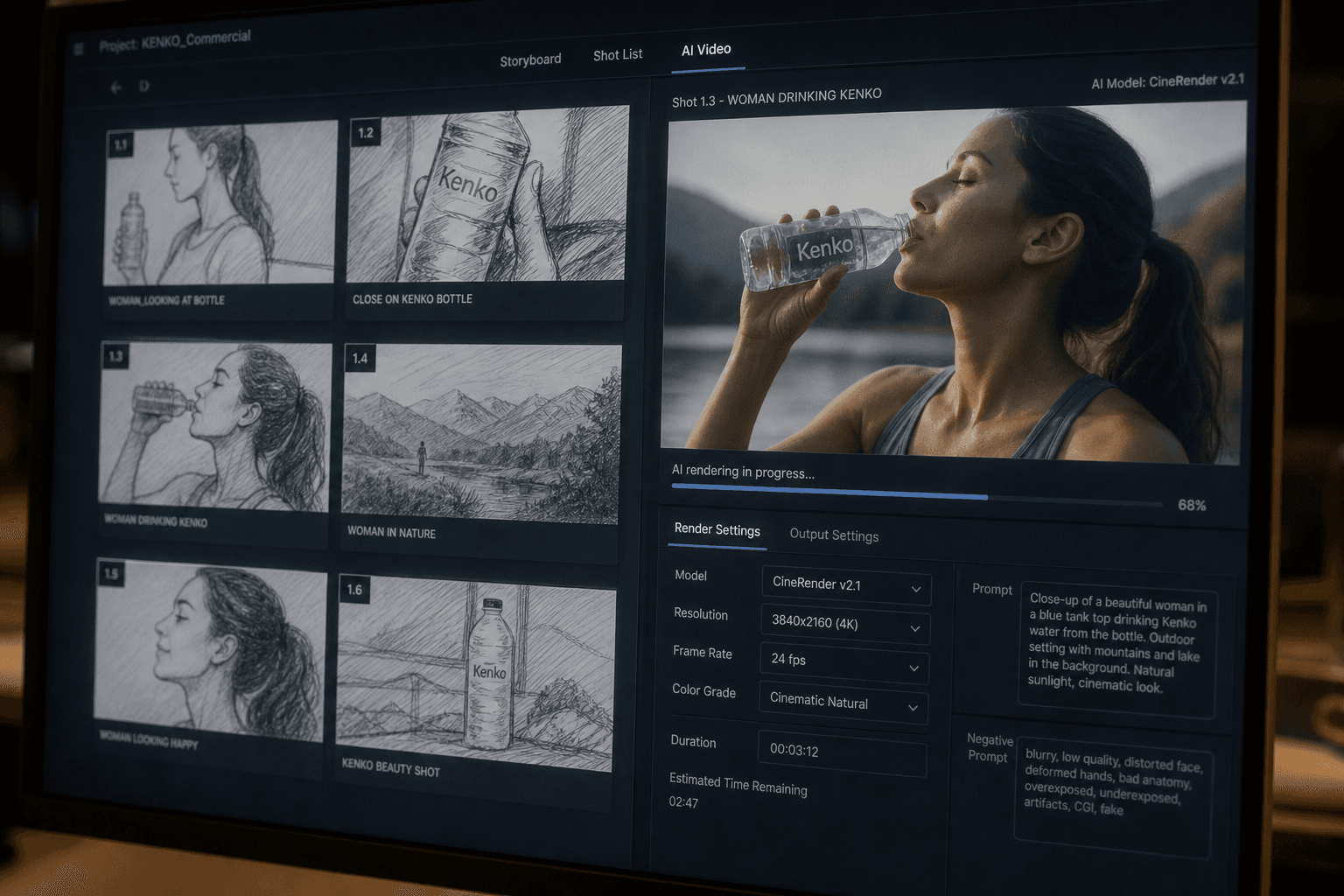
💡 Frank's Cut: when a shot is aesthetically strong but serves neither the proof nor the promise, delete it. In performance ads, the courage to cut is a competitive advantage.
Step 3: editing for retention and comprehension
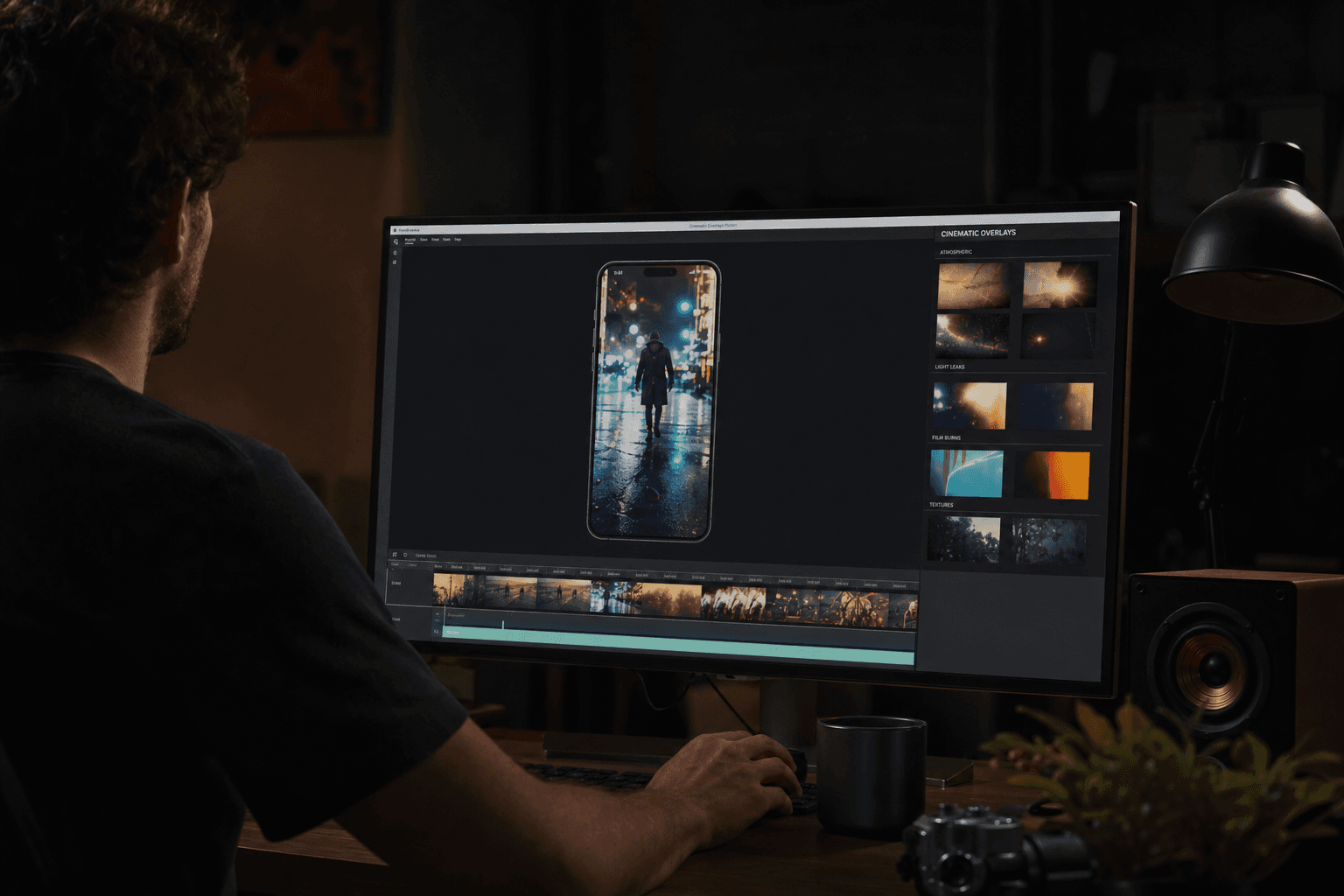
The edit of a striking AI ad follows the logic of minimal friction. You ease the comprehension scene after scene. You reduce the useless transitions, you clarify the text, you maintain a pace that respects the distribution format. The goal is to keep the attention without saturating.
Work in "units of meaning". One unit = one idea + one visual + one audio signal. When a unit ends, the next must extend the tension or bring a proof. If you stack ideas with no breathing, the video becomes noisy. If you slow down too much, it drops off.
Audio on the ad side: clear voice, supporting music, sober effects. The mix must never steal the comprehension of the message. Many AI ads lose here. They sound "trailer", but the value proposition becomes inaudible. To reinforce a clean voice-over, you can also review our AI dubbing and voice-over guide.
Systematically test your version on mobile before validation. The contrast, the text size, and the CTA readability are judged in a real situation. This simple test protects you from the "beautiful desktop video" that fails in distribution.
Step 4: testing the variants that move the KPIs
A performing campaign is built by iteration. You launch targeted variants, not complete remixes. Hook variant, offer variant, proof variant, CTA variant. One variable at a time. Otherwise you cannot attribute the gains or the performance drops.
Define a clear test protocol. Example: 3 hooks x 2 CTAs on the same video body. Same starting budget, same audience, identical reading window. You observe first the short retention, then the click, then the conversion. Each KPI answers a different question of the funnel.
Do not interpret too early. Leave a minimal volume of data before concluding. Many hasty decisions come from a too-weak sample. AI lets you produce fast, but the marketing decision must stay methodical.
Finally document each test in a simple sheet: hypothesis, variant, result, decision. After a few cycles, you build a system that improves continuously. It is this system that creates the advantage, not an isolated video.
Troubleshooting: the mistakes that sabotage an AI ad and how to fix them
Mistake number one, the abstract promise. You talk about innovation, quality, creativity, with no concrete benefit. Correction: reformulate into a measurable direct impact. "Gain 3 hours a week", "reduce the acquisition cost", "deliver faster". The precision immediately increases the perceived clarity.
Mistake number two, the style that takes over the proof. You have incredible shots, but the viewer does not understand what they gain. Correction: add use sequences, visual proofs, result markers, and simplify the edit around these truth points.
Mistake number three, the CTA drowned in the video end. Many place it too late, too small, or too ambiguous. Correction: visible CTA, formulated in an action verb, aligned with the hook promise. If the hook promises "method", the CTA must propose immediate access to that method.
Mistake number four, the visual inconsistency between shots. You change style, light, texture, and the trust drops. Correction: impose a visual bible and validate each new shot against this reference. In an ad, consistency reassures. Instability worries.
Mistake number five, the absence of a test protocol. With no test, you confuse internal taste and market truth. Correction: simple hypotheses, controlled variants, KPIs defined in advance. You thus transform the creation into a commercial learning engine.
To frame your choices with reliable references, lean on the resources of Google Ads Video best practices, the principles of Meta Ads Creative Guidance and the persuasion fundamentals documented by the Nielsen Norman Group. These frames help you stay user-oriented instead of getting lost in the trends.
💡 Frank's Cut: an ad that converts is often less "demonstrative cinema" and more "concise proof". Beauty attracts, clarity sells.
FAQ: what creators ask before launching an AI video ad
-
What duration to aim for a striking AI video ad?
The right duration depends on the goal and the channel, but for most acquisition campaigns, 10 to 30 seconds is a very effective zone. The most important is not the absolute duration, it is the useful density. A 20-second video can be too long if it installs slowly, and a 40-second video can perform if each segment brings a clear proof. I recommend producing several derived formats: short aggressive version, intermediate explanatory version, more narrative version. Then you let the metrics decide, not the internal preferences. -
How to write a good AI ad script when you start?
Use a simple structure: hook, problem, solution, proof, CTA. Write each block in one clear sentence before adding style. If your message does not fit in this skeleton, your video will be confused, even with great visuals. Then, read the script aloud to check the rhythm. A good ad script is understood immediately, with no jargon. Start concrete, then refine the emotion. Many beginners do the opposite and lose the clarity. The script is your conversion engine, not a pre-production formality. -
Should I favor a very aesthetic or a very demonstrative AI ad?
You must favor what helps the decision. In the majority of cases, a demonstrative ad with a mastered aesthetic converts better than an ultra-stylized ad with no proof. The ideal is to balance the two: enough aesthetic to capture the attention, proof clear enough to convince. If you must choose, choose the proof. The audience rarely pays for beauty alone. It pays for a transformation perceived as credible. Your video must therefore show the benefit tangibly, then dress this benefit with a coherent visual direction. -
Which KPIs to track to know if my AI video ad works?
Start with three indicators: short retention (3 seconds), click rate, cost per final result (lead, purchase, sign-up). The retention tells you if your hook holds, the click tells you if the promise makes people want to act, and the final cost tells you if the campaign is economically viable. Tracking only the views is insufficient. A video can be very watched and not very profitable. Set a goal per KPI before launch, then adjust one variable at a time. This discipline avoids hasty conclusions and random optimizations. -
How to avoid the "fake AI video" effect that lowers the trust?
The fake effect often comes from a mix of plastic textures, gratuitous transitions, and style inconsistencies. To avoid it, keep a stable visual bible, favor realistic use scenes, and limit the "wow" effects with no commercial function. On the audio side, a credible voice-over and a clean mix reinforce the perception of seriousness. Finally, test the video on mobile. Many artifacts show more on a small compressed screen. If your content stays readable and natural in these conditions, you strongly reduce the risk of instant rejection. -
How many variants do you need to test before concluding that an ad does not work?
There is no universal number, but I recommend at least 3 hooks and 2 CTAs before declaring a creative "losing", keeping the heart of the video stable. This lets you test the most impactful levers without restarting from scratch. If the performance stays weak, revisit the promise itself, not only the edit. Often, the problem is not the execution, it is the value angle. A good iteration loop combines fast creativity and analysis discipline. With no this double logic, you burn budget with no learning. -
Can you create performing AI ads with no complete team?
Yes, provided you have a clear process. A solo creator can produce solid campaigns if they structure their work: audience research, conversion script, coherent visual generation, proof-oriented edit, then iterative test. AI reduces the production cost, but it does not replace the marketing decisions. I advise documenting each test and creating a library of components that work: hooks, proof formats, CTAs, music, edit templates. With this base, you can progressively industrialize without sacrificing the commercial quality. -
What routine to apply this week to progress fast in AI video advertising?
Do a 90-minute sprint oriented toward conversion. 20 minutes to frame the audience and the promise, 25 minutes to write two short scripts, 25 minutes to generate and edit two variants, 20 minutes to prepare the test plan and the publication. Keep a "safe" version ready to distribute and a "bold" version to challenge it. Then, analyze the first returns with composure. The goal is not to put out a perfect work. The goal is to create a fast, measurable, and reproducible learning loop week after week.
Related articles
 Tutoriels
Creating 3D Textures With Artificial Intelligence for Your Projects
Seamless tile, UV, plausible PBR, and Blender or game-engine integration: a clean pipeline between AI and 3D.
 Tutoriels
Case Study: How I Co-Wrote My Film Using Artificial Intelligence
A field report on an AI-assisted film co-writing: what worked, what failed, and the final method.
 Tutoriels
Creating AI Advertising Product Packshots That Hold Up in Post
A debrief-to-export packshot workflow to produce clean, believable product shots with AI.