Fincher's AI on Cliff Booth: cleaned-up dialogue and fixed lips
Mr. David Fincher says he used AI to clean up Cliff Booth's dialogue and fix the actors' lip sync. What he actually did, and what you can take from it.
Contents · 7 sections
Mr. David Fincher has explained how he used AI on The Further Mis-Adventures of Cliff Booth, the film written by Mr. Quentin Tarantino and starring Mr. Brad Pitt, which opened in IMAX in the U.S. on 25 November. Not to make shots: to clean up dialogue and fix lip sync when the best line reading and the best picture didn't come from the same take.
It lands just as viewers accuse the film of visible generated images. And what he describes is far more concrete, and more useful to us, than the "for or against AI" debate.
This is based on Variety's article of 25 November 2026, which reports his appearance on The Ringer's The Big Picture podcast, World of Reel on 26 November for the theatrical release, and the film's official page on Netflix Tudum. I read them on 28 November. I didn't listen to the whole podcast: quotes are as Variety transcribed them.
What Fincher said
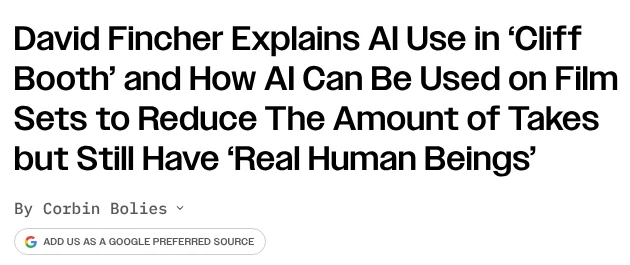
Source: Variety, captured on 28 November 2026.
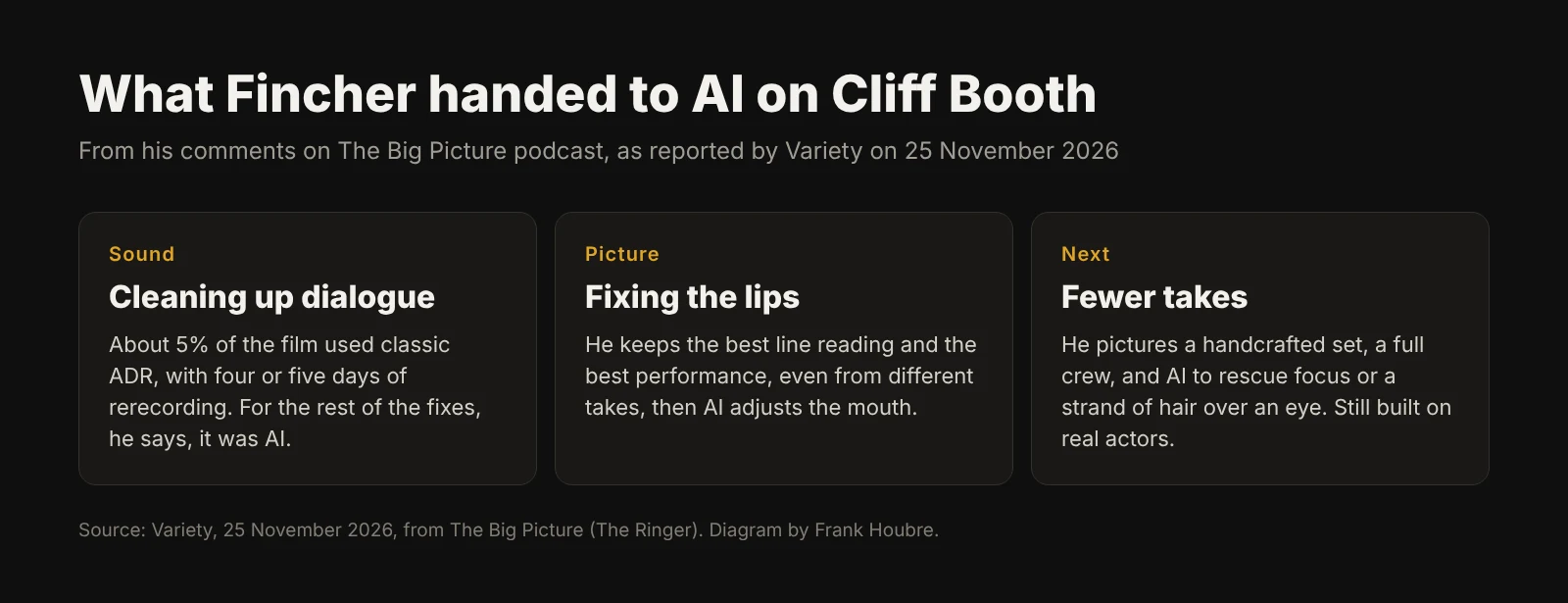
Talking to Mr. Sean Fennessey, Mr. Fincher explains that AI was used to pair the best reading of a line with the best performance take, when the two didn't line up on camera. According to Variety, only about 5% of the film went through classic ADR, with four or five days of rerecording. For the rest of the fixes, it was AI.
"We could use AI to re-lip that thing," he says. He compares the film to plasticine rather than marble: you pick what's best for the eye, then what's best for the ear, and figure out later how to bring them together. He admits a couple of shots don't quite work yet, and that they'll be reworked before the Netflix release.
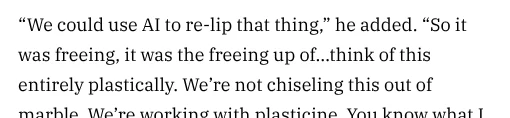
Source: Variety, captured on 28 November 2026.
His idea for what's next: fewer takes, not fewer people
Mr. Fincher is known for dozens of takes. He pictures a set that keeps the same handcrafted set and the same crew, but where AI rescues what forces a retake: missed focus, a strand of hair over an eye. "It'll still be based on real human beings," he says, on how they move, sit down, take their coat off. They'll just have to do it 15 times instead of more.
Variety notes the interview was recorded before the accusations from early screenings, where viewers spotted images that look generated, such as a horse carriage with two wagons in a flashback. Mr. Fincher and Netflix haven't commented on those examples. Also according to Variety, Netflix bought Mr. Ben Affleck's AI tool startup InterPositive in March, and says more than 300 programs in its catalog used generative AI this year.
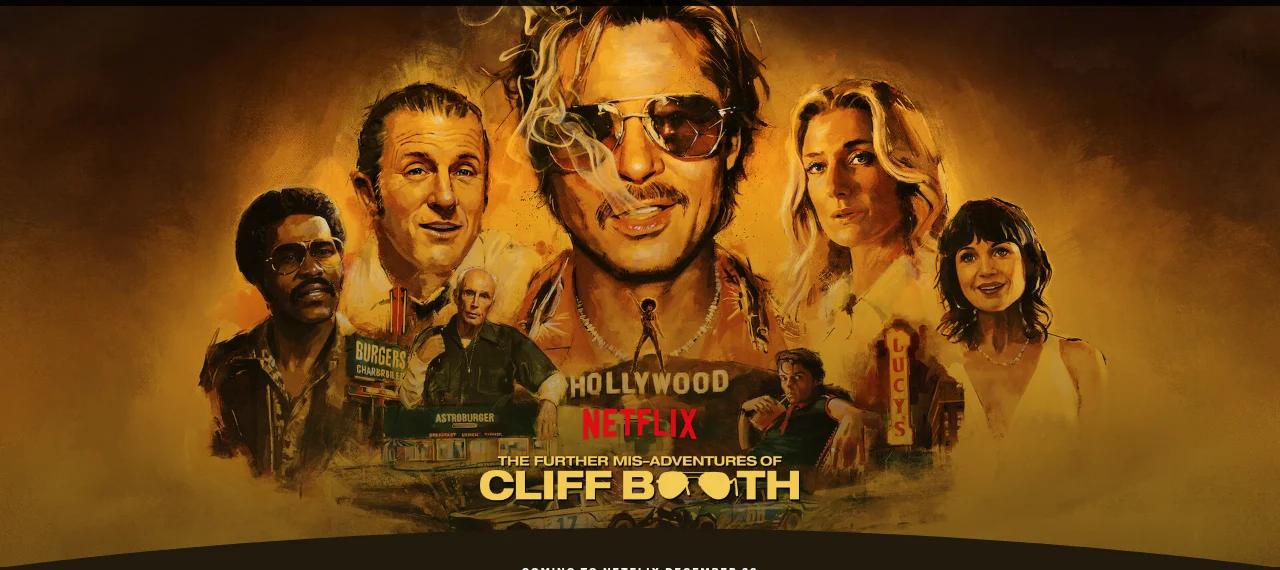
Source: Netflix Tudum, captured on 28 November 2026.
What I think
This is the use of AI I've defended from the start: serving a human performance, not replacing it. Keeping an actor's best line and the best picture of their take is an old editor's dream. You used to cut to a reverse shot to hide the mismatch. Now you can fix it.
But the Cliff Booth case also shows the limit. As soon as one shot misses, the audience can't tell a fixed mouth from a generated image. Everything becomes "AI". It's the same trap Mr. Arthur Harari fell into with the deepfake in L'Inconnu: transparency comes after the controversy instead of before it.
What it means for you
- Separate what's repaired from what's generated. Cleaning up sound or fixing a mouth isn't creating an image. Say so in your credits or description, before anyone asks.
- Pick takes on performance, not technique. If an actor's best moment has a picture or sound flaw, it's increasingly fixable. The reverse isn't.
- Check every fixed shot full screen. One bad shot is enough to make people doubt the whole film. Mr. Fincher himself says some aren't finished.
- Care for sound as much as picture. That's where AI did the most work here. My guide to adding sound design to an AI video starts from the same idea.
- Think about rights and consent. Fixing a mouth means changing a performance. I cover it in AI actors, clones and rights.
What we don't know
- Which tools were used to clean up the dialogue and fix the lips.
- Whether the images viewers flagged come from generative AI, and which ones. Mr. Fincher and Netflix haven't responded on those examples.
- What will be fixed before the film reaches Netflix.
Frequently asked questions
Quick answers to the questions readers ask most about this article.
How did David Fincher use AI on Cliff Booth?
According to Variety, to clean up dialogue and fix the actors' lip sync, so the best reading of a line could be paired with the best performance take when they came from different takes.
How much of the film was rerecorded?
About 5% of the film, with four or five days of rerecording, according to his comments reported by Variety. The rest of the dialogue fixes went through AI.
Does the film contain AI-generated images?
Viewers at early screenings think they spotted some, such as a carriage with two wagons. Neither Mr. Fincher nor Netflix has commented on those examples, and the interview was recorded before the accusations.
Where did Fincher talk about AI?
On The Ringer's The Big Picture podcast, with Mr. Sean Fennessey. Variety published excerpts on 25 November 2026.
When is The Further Mis-Adventures of Cliff Booth released?
In IMAX in the U.S. since 25 November 2026, then on Netflix, where the film's official page announces its arrival.
Is fixing lip sync with AI a deepfake?
Technically, you're altering the image of a real face. The difference lies in the actor's consent and transparency with the audience. That's why it's better to disclose it.
Sources
- Variety, "David Fincher Explains AI Use in 'Cliff Booth' and How AI Can Be Used on Film Sets to Reduce The Amount of Takes but Still Have 'Real Human Beings'", 25 November 2026.
- The Ringer, The Big Picture podcast, interview with Mr. David Fincher, cited by Variety, November 2026.
- World of Reel, "'Cliff Booth': $5M Holiday Weekend With a Whopping $20K Per-Screen-Average", 26 November 2026.
- Netflix Tudum, official page for The Further Mis-Adventures of Cliff Booth, accessed 28 November 2026.
Related articles
 Actualité01
Google patents a channel of AI videos made just for you
A Google patent describes My Channel, a TV channel of AI-generated videos built from your tastes, with you as the star. What it tells video creators.
 Actualité02
The New York Times tells photographers to avoid Photoshop 2027
The New York Times asks freelance photographers not to use Photoshop 2027, fearing an AI label in the metadata. What the decision teaches anyone who edits photos.
 Actualité03
Gods Don't Give Gifts ruled out of the animation Oscar
The Academy ruled the AI film Gods Don't Give Gifts ineligible for Best Animated Feature. The rule behind it, the planned appeal, and what it tells AI filmmakers.