The New York Times tells photographers to avoid Photoshop 2027
The New York Times asks freelance photographers not to use Photoshop 2027, fearing an AI label in the metadata. What the decision teaches anyone who edits photos.
Contents · 6 sections
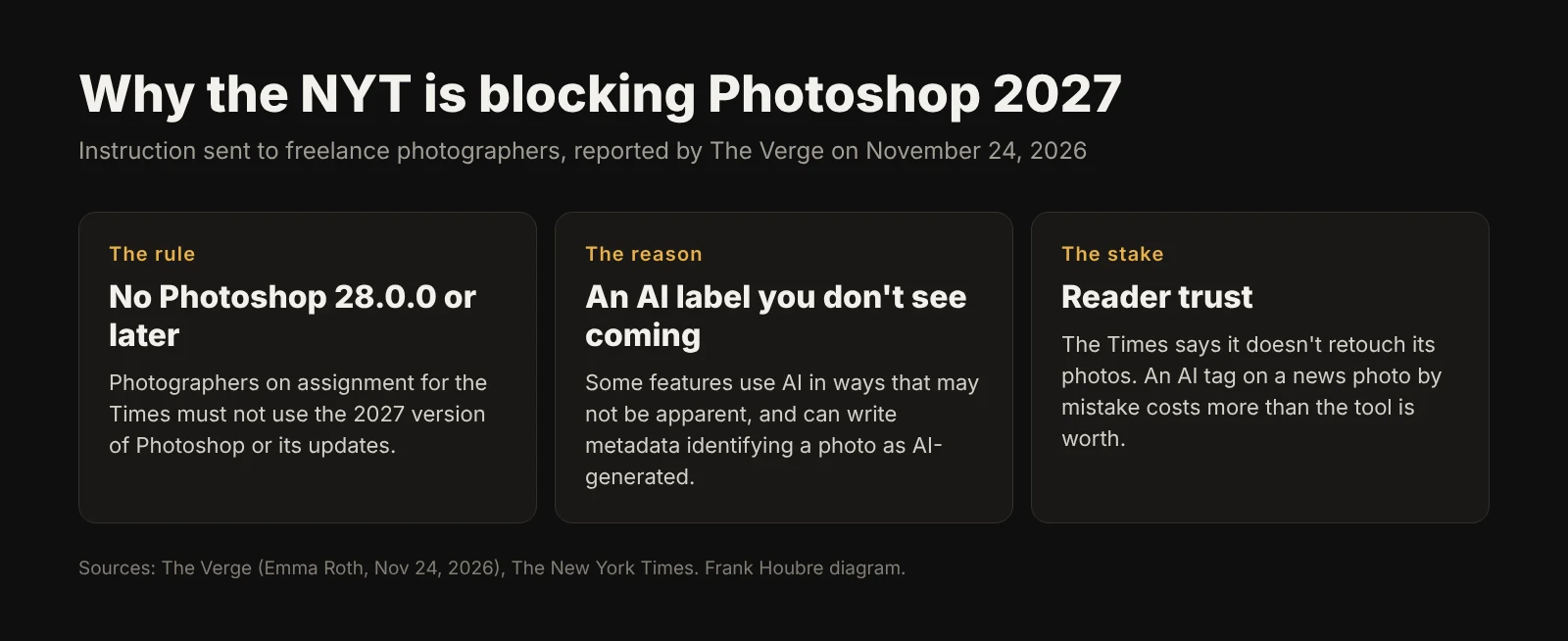
The New York Times is asking its freelance photographers not to use the latest version of Photoshop. The reason: some features in the 2027 release use AI "in ways that may not be apparent to users," and can leave metadata saying the photo is AI-generated.
It's the first time I've seen a major newsroom refuse an update over this. And the problem isn't what photographers do with AI. It's what the software writes into the file without them noticing.
This piece is based on Emma Roth's article for The Verge, published on November 24 and read on November 25, 2026. I haven't seen the full email, and Adobe's release notes page wouldn't open from my reading tool.
What the Times is asking
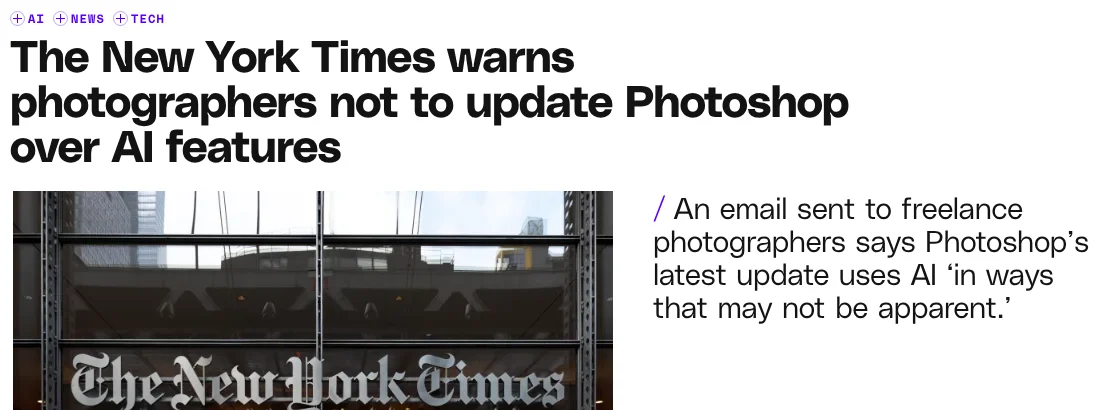
Source: The Verge, captured on November 25, 2026.
The email is signed by two of the Times' photography leaders, Meaghan Looram and Josh Haner. The Verge saw it, and it was also posted on Threads. It says using these features "can result in metadata identifying photographs as AI-generated."
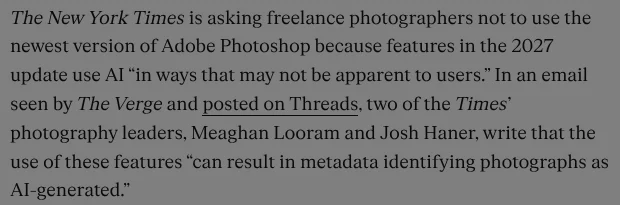
Source: The Verge, captured on November 25, 2026.
The instruction is specific: "At this time, we are requiring that all contributing photographers avoid using Adobe Photoshop 2027 (release 28.0.0 and subsequent updates) when working on assignment for The Times." Times spokesperson Graham James confirmed it to The Verge.
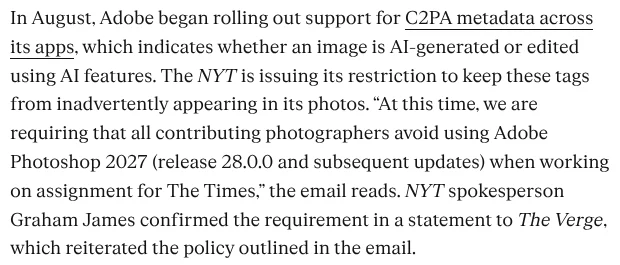
Source: The Verge, captured on November 25, 2026.
Where the problem comes from
Since August, Adobe has been adding C2PA metadata across its apps. It records whether an image was generated or edited with AI features. In principle, that's a good thing: I wrote about it when Adobe suggested labeling the original rather than the AI.
The catch is that it's no longer clear which tool counts as "AI." The Verge notes that even older options, like automated selection, may now be considered part of the AI suite. The November update also adds an AI Assisted Editor view that gathers every AI feature in one toolbar, a step-by-step editing assistant, prompt-based editing, new AI upscaling options and an AI tool that recomposes images for other canvas sizes.
So a photographer adjusting a selection can end up with a photo tagged as AI-edited. For the Times, which says it does not "retouch or digitally manipulate" photos beyond minimal color adjustments, that's a direct risk to reader trust.
The Verge says it's still unclear which specific features the Times means, and Adobe hadn't responded when the article was published.
What I make of it
The decision makes sense to me, and it should worry Adobe a little. It makes sense because an AI tag on a news photo, even a mistaken one, costs more than any time saved. It's worrying because labeling was meant to build trust, and now it's pushing away professionals who don't generate anything.
The real issue is clarity. A tool that marks your files should tell you plainly when and why it does it. Until it does, demanding clients will prefer to stay on an older version.
What it means for you
- Know what your tools write into your files. Check an export's metadata (with a C2PA verifier or an EXIF reader) before delivering to a sensitive client.
- Read your clients' rules. Newsrooms, institutions and photo contests will increasingly set rules on allowed versions and tools.
- Don't update mid-job. Keep a stable version for the length of a project and test the new one on the side.
- Separate your uses. For reportage, minimal editing and no generative features. For creative work, use AI openly and say so. I've laid out the line between retouching, inpainting and generation in photography.
What we don't know
- Which exact features trigger the AI label in Photoshop 2027.
- Adobe's response, which hadn't come when The Verge published.
- Whether other newsrooms will follow.
Frequently asked questions
Quick answers to the questions readers ask most about this article.
Why is The New York Times advising against Photoshop 2027?
Because some features use AI in ways that may not be apparent and can produce metadata identifying photos as AI-generated, according to the email sent to its freelance photographers.
Which Photoshop versions are affected?
Photoshop 2027, release 28.0.0, and all later updates, according to the email quoted by The Verge.
What is C2PA metadata?
Information embedded in a file that describes its origin and edits, including the use of AI. Adobe began rolling it out across its apps in August 2026.
What AI features does Photoshop 2027 add?
An AI Assisted Editor view that gathers the AI features, a step-by-step editing assistant, prompt-based editing, new AI upscaling options and an AI recompose tool for other canvas sizes, according to The Verge.
Did the Times confirm the rule?
Yes. Spokesperson Graham James confirmed it to The Verge.
How can I tell if my photos carry an AI label?
Inspect your exports' metadata with a C2PA verifier or an EXIF reader before delivering them, especially to a news client.
Related articles
 Actualité01
The New York Times sues Brave over AI scraping
On November 2, the New York Times and three dailies sued Brave over a 30 billion page index sold to AI companies. What the complaints say.
 Actualité02
ChatGPT Announces Image 2: The New OpenAI Image Generator, Decoded Like a Production Brief
What the new image generation changes in ChatGPT for cinema and advertising, how to integrate it without falling back into plastic, and the field workflow to go from prompt to a credible shot.
 Actualité03
Google patents a channel of AI videos made just for you
A Google patent describes My Channel, a TV channel of AI-generated videos built from your tastes, with you as the star. What it tells video creators.