Video Generation: What the New Tools Change for Directors
The concrete impact of the new AI video generation tools on pre-production, hybrid shooting and post-production.
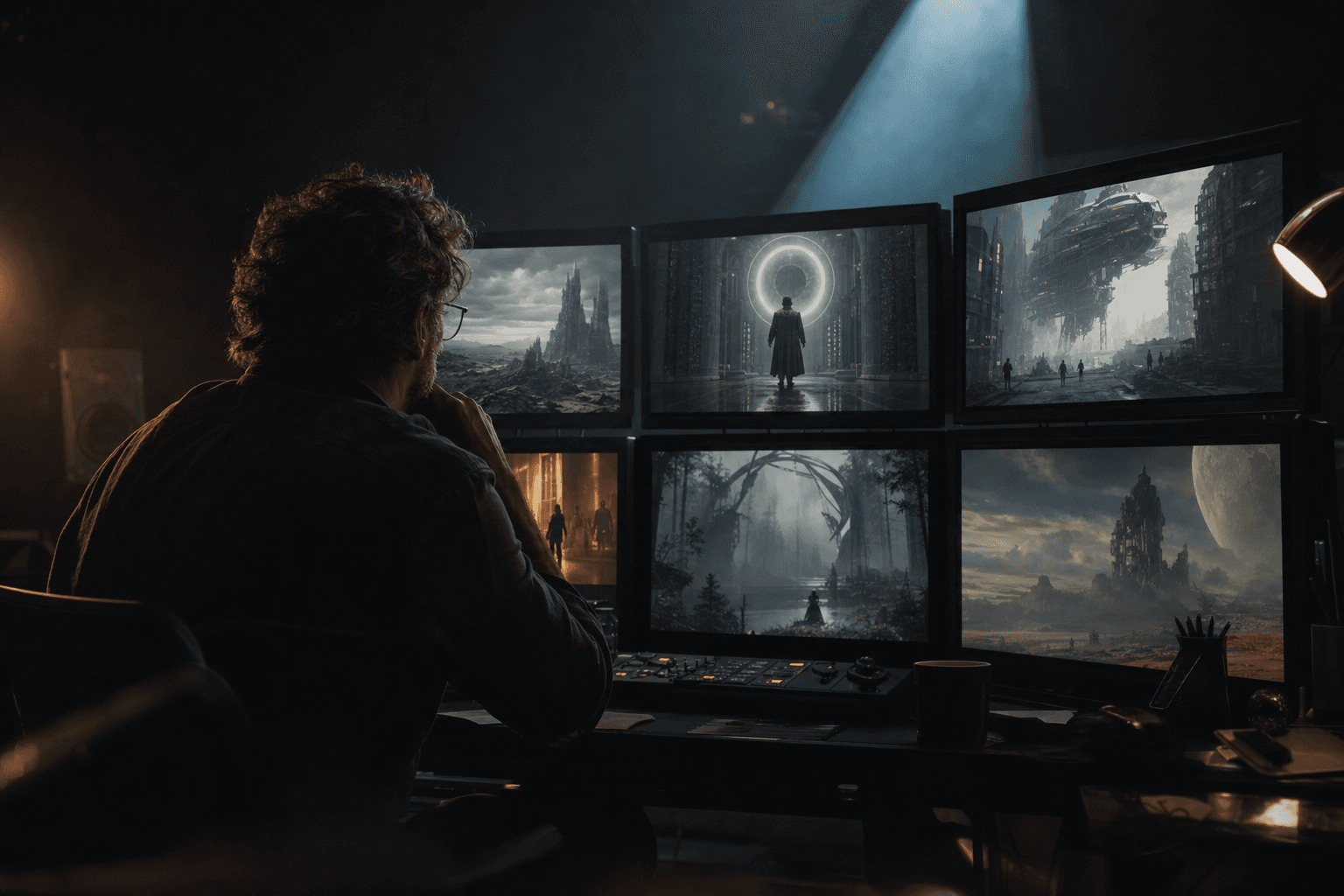
The most dangerous myth right now is this one: "with the new AI tools, the director becomes secondary". False. Radically false. What disappears is not the director's role. What disappears is the margin of improvisation with no method. The tools accelerate everything, including the mistakes.
I have seen teams produce in two days the visual equivalent of a week of pre-production. On paper, it is fantastic. In reality, some sequences were unusable because no decision had been made: fuzzy scene intention, unstable camera grammar, contradictory textures, absent acting direction. Enormous speed, weak clarity.
The real change is that the director becomes a workflow architect. You must know what you want to tell, in what order, with what consistency, then decide how to distribute the work between real, generated, and hybrid. The tools give you options. Your job is to eliminate the options that harm the film.
Core concepts: what the new tools really change
First concept, the abundance of variants creates a new risk of scatter. Before, the lack of means naturally limited the options. Today, you can test ten visual directions in a morning. With no selection frame, you replace the budget constraint with creative chaos.
Second concept, pre-production becomes a space of active simulation. You can previsualize camera axes, light atmospheres, set/character interactions before shooting. It is a massive advantage. But only if you link these tests to a clear narrative intention. Otherwise, you collect visuals with no strategy.
Third concept, hybrid shooting imposes a consistency discipline. The real and the generated can coexist superbly, but they must share a common grammar of focal length, contrast, movement dynamics, and texture. If this grammar is not defined early, the post-production becomes a repair worksite.
Fourth concept, post-production changes nature. It is no longer only a finish space. It becomes a convergence space, where you harmonize sources of different origins. On this point, our AI-assisted video editing guide is essential to hold the global consistency.
Fifth concept, the artistic responsibility increases. The more powerful the tools, the more the author's trade-offs count. The director must protect the meaning, not only the visual quality.
| Craft domain | Before recent tools | With video generation tools | Major opportunity | New risk |
|---|---|---|---|---|
| Pre-production | limited tests | fast multi-axis simulation | reduce blind spots | getting lost in variants |
| Shooting | main capture | capture + planned AI blocks | optimize set time | real/generated inconsistency |
| Editing | take selection | selection + hybrid source assembly | narrative flexibility | visual patchwork |
| Art direction | static visual bible | evolving bible tested early | early validation | continuous style drift |
The trench workflow: how a director keeps control
The first rule is to lock the intention before opening a tool. A scene must answer a question: what must the viewer feel here? If you cannot formulate it in one sentence, you are not ready to generate.
The second rule is to create explicit decision criteria. For example: emotional readability, light consistency, production feasibility, narrative impact. Each variant must be judged on these criteria, not on the "wow" effect alone.
The third rule is to work in short loops. Prepare, execute, control, decide. Do not get bogged down in generation sessions with no checkpoint. The projects that advance are those that decide fast what they keep and what they eliminate.
The fourth rule is to align the whole team on a common language. Director, DP, editing, sound, VFX. If everyone interprets the goals differently, the AI tools amplify the divergences.
Augmented pre-production: more tests, more edge
Pre-production has become an ultra-fast laboratory. You can test long takes, backlights, rainy atmospheres, set architectures in a few hours. It is a practical revolution for the independents.
But here is the trap. Testing is not deciding. Many beginner directors postpone the choices because they "can still explore". Result, they arrive at the shoot with no clear course. The freedom of the tools becomes a decision debt.
The good reflex is to do question-oriented tests. "Does this angle reinforce the character's vulnerability?" "Does this light support the scene tension?" A clear question protects you from aesthetic drift.
To reinforce this step, our guide on AI camera angles helps to transform the tests into staging decisions.
Hybrid shooting: the common grammar real + generated
Hybrid shooting works when you know in advance what will be captured, what will be generated, and what will be mixed. If this distribution is fuzzy, you improvise too late and the costs rise.
On set, keep stable technical references: dominant focal lengths, camera height, light temperature, desired texture, movement margin. These landmarks then let you integrate the generated blocks with no brutal break.
Acting direction stays central. The tools do not replace the truth of a gaze, a silence, a hesitation. If the performance is weak, no spectacular generation will compensate for that void.
When you plan well, hybrid shooting becomes a strength. You capture what must be alive on set and you leave to the AI tools what can be optimized without sacrificing the emotion.
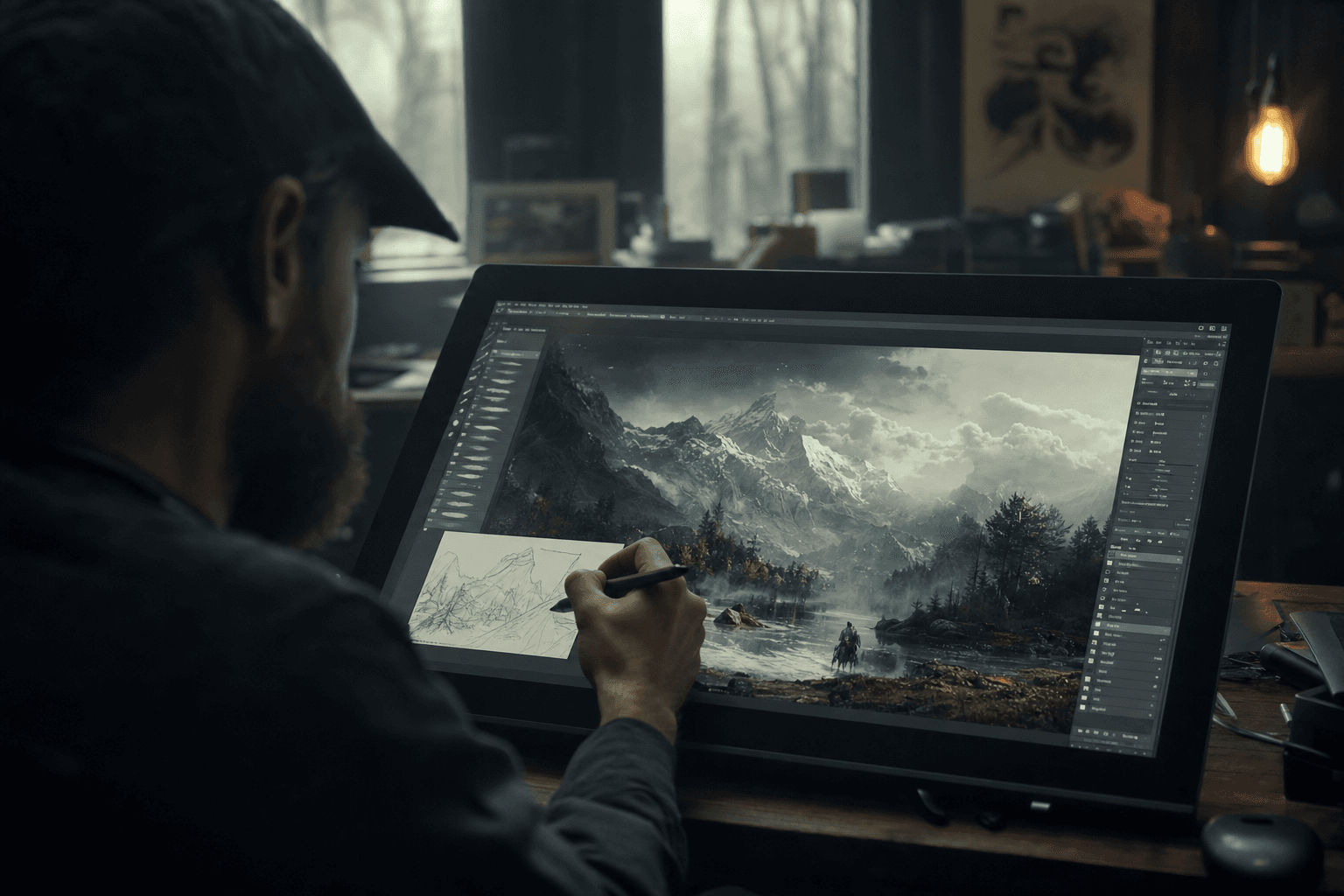
💡 Frank's Cut: the useful question is not "can we generate this shot?" The real question is "must we generate it to tell the story better?"
Strategic post-production: convergence instead of collage
In post-production, you must treat the consistency as an active mission. Texture, contrast, movement, color, sound, rhythm. A hybrid film that holds is a film where the viewer does not spend their time guessing what comes from the AI.
The edit becomes a place of permanent narrative arbitration. You choose the versions that serve the emotional progression, not those that display the best technical demo.
The sound plays a critical role here. A hybrid image can seem credible visually and collapse if the audio does not match. Ambiences, voices, dynamics, transitions. Everything must breathe in the same scene.
To consolidate this voice/performance axis in hybrid projects, our guide on AI dubbing and voice-over lets you avoid the inconsistencies that quickly betray the render.
The director's new role: decision, consistency, responsibility
The modern director does not only direct shots. They direct production systems. You must understand the limits and strengths of the tools to make the right decisions at the right moment.
You must also become a guardian of the consistency. When a test is impressive but off-story, it is up to you to say no. This "no" is often more important than ten brilliant ideas.
Then, you must protect the team's time. The tools can accelerate the creation, but they can also multiply the useless iterations. A good director sets exploration windows and decision deadlines.
Finally, you carry the final artistic responsibility. The AI does not own the film. You do.
Field cases: three situations where the tools really change the directing choices
Case 1, a tight-budget series teaser. The team had to deliver a teaser in ten days with only two days of real shooting. With no recent AI tools, the project would have been limited to interior dialogue scenes. With an augmented pre-production and planned generated blocks, we could add strong visual transitions between places, without blowing up the budget. The key point was not the generation itself. The key point was the clarity of the split between what had to stay alive on set and what could be stylized in post.
Case 2, a premium ad with a realism requirement. The first version looked like a tool demo, too shiny, too smooth. The director refocused the approach on the material truth: skins, reflections, imperfections, acting cadence. Visually "spectacular" options were removed. The final result seemed less demonstrative and much more credible. The client retained this version, precisely because it "felt real".
Case 3, a hybrid short film with a strong lead actor. The team wanted to test several visual universes around a single character. The tests were useful, but they quickly created a stylistic drift. The solution was to freeze a consistency bible after a first wave of exploration. Once this bible was locked, the tools became an accelerator again instead of a scatter factor.
These three cases show a constant. The new tools improve the execution power. The final quality always depends on the quality of the directing trade-offs.
Team protocol: how to avoid confusion in hybrid production
The success of an AI video project also plays out in the human organization. A workflow brilliant on paper fails fast if the roles are not clear. Who decides the final style? Who validates the variants? Who decides when image and narration are in conflict? These questions must be settled before the active production.
I recommend a short framing meeting with five points. One, the dominant narrative intention. Two, the non-negotiable visual rules. Three, the zones open to experimentation. Four, the validation criteria. Five, the decision calendar. This meeting avoids 80 percent of the contradictory returns later.
Then, set up an ultra-simple daily loop. In the morning, the day's goals. At the end of the day, a review of the variants, binary decisions, and an update of a production log. This log must be readable in 5 minutes. Too much detail kills the use.
Another critical point concerns the communication between directing and post-production. If the post receives elements with no narrative context, it optimizes the technique but can betray the intention. So you must transmit a scene intention note with each batch, even short. This practice aligns the whole chain.
Finally, protect the team against decision fatigue. The tools can give the illusion that you can "always try one more option". This logic exhausts the talents and dilutes the film. Set a limited experimentation frame, then impose final decisions.
Director steering checklist for an AI video project
Before launching the production, check whether your project answers a steering checklist. Film intention formulated in one clear sentence. Sequenced emotional arc. Validated visual bible. Basic sound rules defined. Active versioning method. If a point is missing, you already know where the workflow can break.
During the production, you must check the consistency continuously. Do the generated shots serve the story? Do the transitions stay readable? Do the human performances stay at the center? If the answer slides toward "we keep it because it is impressive", it is an alert signal.
In post, control the convergence rather than the isolated perfection. A perfect shot alone can harm the sequence. The director must protect the global rhythm, the emotional readability, and the world consistency. This overall vision is your real value.
After delivery, do a documented lessons-learned review. What really accelerated? What slowed down? Which rules to keep on the next project? With no this learning loop, each new film restarts from zero.
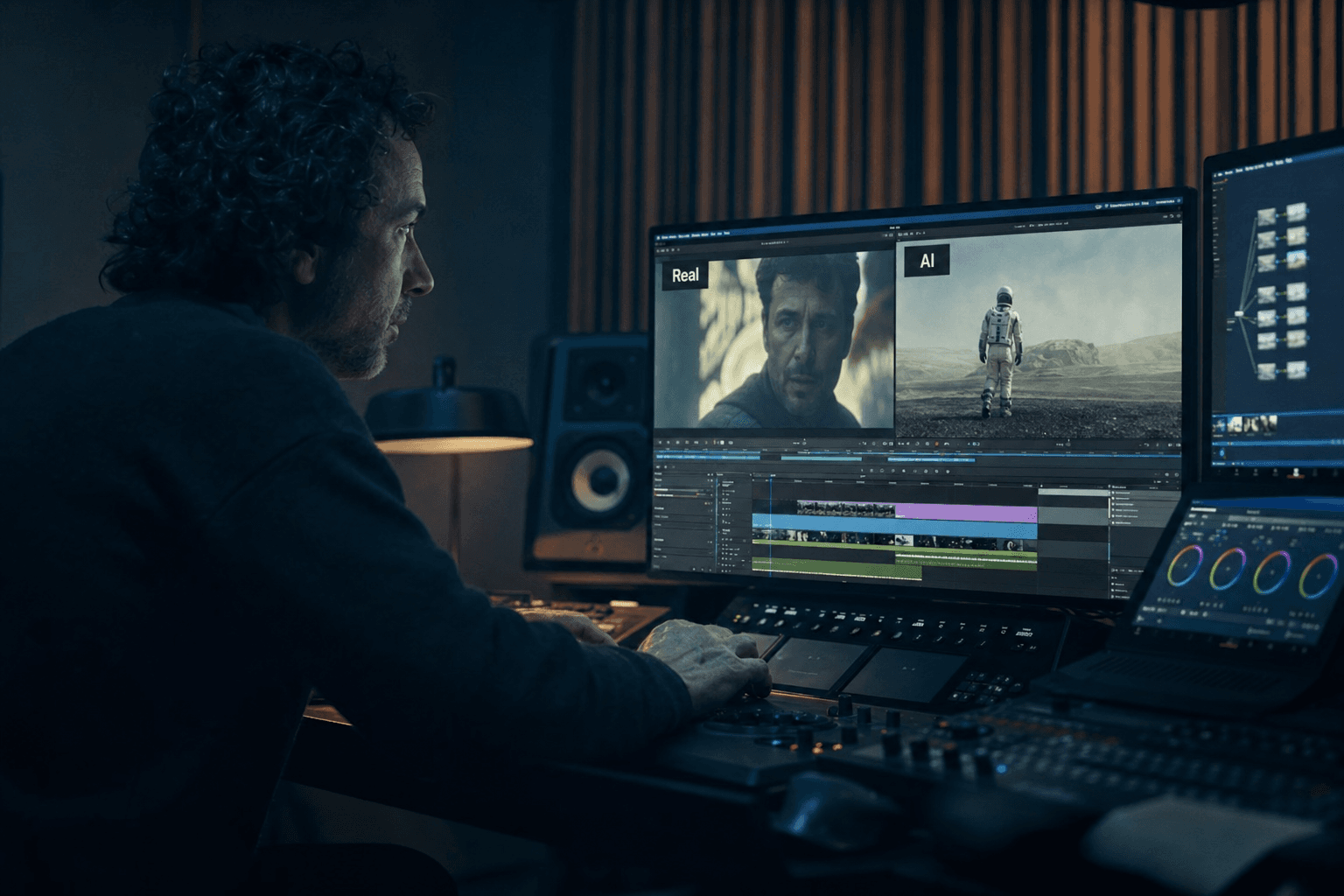
Troubleshooting: what directors break with the new tools
Mistake number one, confusing the quantity of tests and the quality of the decision. Too many options with no criteria. Correction: a fixed evaluation grid and regular trade-offs.
Mistake number two, changing style at each version. The film becomes a patchwork. Correction: a locked visual bible, exceptions justified narratively.
Mistake number three, treating the post as a simple "final filter". Correction: an image/sound convergence pipeline from the rough cut.
Mistake number four, underestimating the sound in hybrid content. Correction: integrate voices and ambiences early, not at the end of the chain.
Mistake number five, postponing the decisions on the pretext that you can still generate. Correction: limited exploration windows and dated decisions.
Mistake number six, forgetting the set feasibility. A generated idea is not automatically shootable. Correction: a cross validation director/DP/production before locking.
To go deeper, lean on robust resources like the American Society of Cinematographers, SMPTE and the Unreal Engine filmmaking documentation. These references help to structure credible workflows.
💡 Frank's Cut: a director is not paid to produce options. They are paid to make the right decisions under constraint.
FAQ: what directors ask about AI video generation
-
Do the new AI tools really threaten the director's role?
They transform it more than they threaten it. The director's role stays central, but it broadens. You must now steer a system where real capture, generation, and advanced post-production coexist. The tools accelerate the making of options, not the artistic responsibility. If you keep a clear frame of narration, style and decision, these tools reinforce your ability to deliver ambitious projects. With no frame, they increase the noise. The heart of the craft stays identical: choose what serves the film. -
How to avoid drowning in the generated variants?
Define selection criteria before generating. Three to five are enough: emotional impact, narrative readability, visual consistency, production feasibility, sound integration quality. Then, limit the number of variants per creative question. For example three options maximum per critical scene. The idea is to keep the decision cadence. If you explore with no limit, you postpone the trade-offs and you tire the team. The selection discipline is your best lever of real speed. -
What is the difference between classic pre-production and AI-augmented pre-production?
Classic pre-production anticipates with few tested visuals. AI-augmented pre-production lets you simulate many more configurations fast before the shoot. The advantage is enormous to identify the dead ends early. The risk is confusing simulation and final validation. So you must keep a field and technical validation protocol. The good model is hybrid: fast simulation to filter, real validation to confirm. Thus, you gain time without losing reliability. -
Does hybrid shooting cost less automatically?
Not automatically. It can cost less if the planning is solid and the responsibilities clear. Otherwise, it can cost more because of the retakes, the inconsistencies and the late corrections. The economic gain comes from a well-designed workflow: what is better captured is shot, what is better generated is delegated, what is critical is validated early. With no this logic, the hybrid becomes an addition of complexities. With this logic, it becomes a real value multiplier. -
How to maintain the consistency between real shots and generated shots?
You must lock a common visual grammar: focal lengths, light dynamics, target contrast, texture, camera behavior. Then, apply a consistency review scene by scene in the edit, then harmonize in post-production. The sound must also be treated as part of this consistency. Many perceived breaks come from non-aligned audio. The consistency is a process, not a preset. It is this process that makes the border between real and generated disappear. -
Should you train the whole team on AI video tools?
Not necessarily at an expert level, but yes at a shared operational level. Director, DP, editing, VFX, sound must understand the basic implications of the AI choices to avoid the pipeline misunderstandings. A minimal common understanding reduces the frictions and accelerates the decisions. You can keep specialists for the advanced execution, but the collective alignment on the method stays indispensable. The best hybrid projects are projects where the technical communication is simple and continuous. -
Which indicators show that a hybrid workflow works?
You can track concrete indicators: drop in late retakes, stability of the visual direction, reduction of the client validation time, better narrative readability at the first viewing, and a better-controlled post-production correction load. If these signals progress, your workflow is healthy. If on the contrary the versions accumulate with no convergence, it is because a decision frame is missing. Measuring the process is essential to avoid steering by impression. -
What practical routine to apply this week to evolve as a hybrid director?
Do a 90-minute sprint oriented toward decision. 20 minutes of narrative framing, 25 minutes of targeted simulations, 25 minutes of review with fixed criteria, 20 minutes of versioned decisions and an action plan. Repeat on two different scenes. The goal is not to produce more images. The goal is to decide better, faster, with consistency. It is exactly this skill that becomes decisive for directors in the era of the new AI video tools.
Related articles
 Tutoriels
How to Generate Special Effects (VFX) With AI Tools
A complete method to create credible AI VFX, from the shot diagnosis to the final compositing with no artificial render.
 Tutoriels
Creating Realistic Dialogues With the Help of Conversational Tools
A field method to use ChatGPT, Claude, Gemini or Mistral as improvisation partners and write truer dialogues.
 Tutoriels
Logo Creation With AI: Free Tools and Pro Tips
Vectorization, small-size readability, trademark filing, and the limits of generators: a pro workflow with no magic promise.