How Google's AI Is Revolutionizing Search and Content Creation
Gemini, enriched search and creative workflows: what changes for SEO, proof, audiovisual production, and how to avoid publishing 'plausible but false' content.
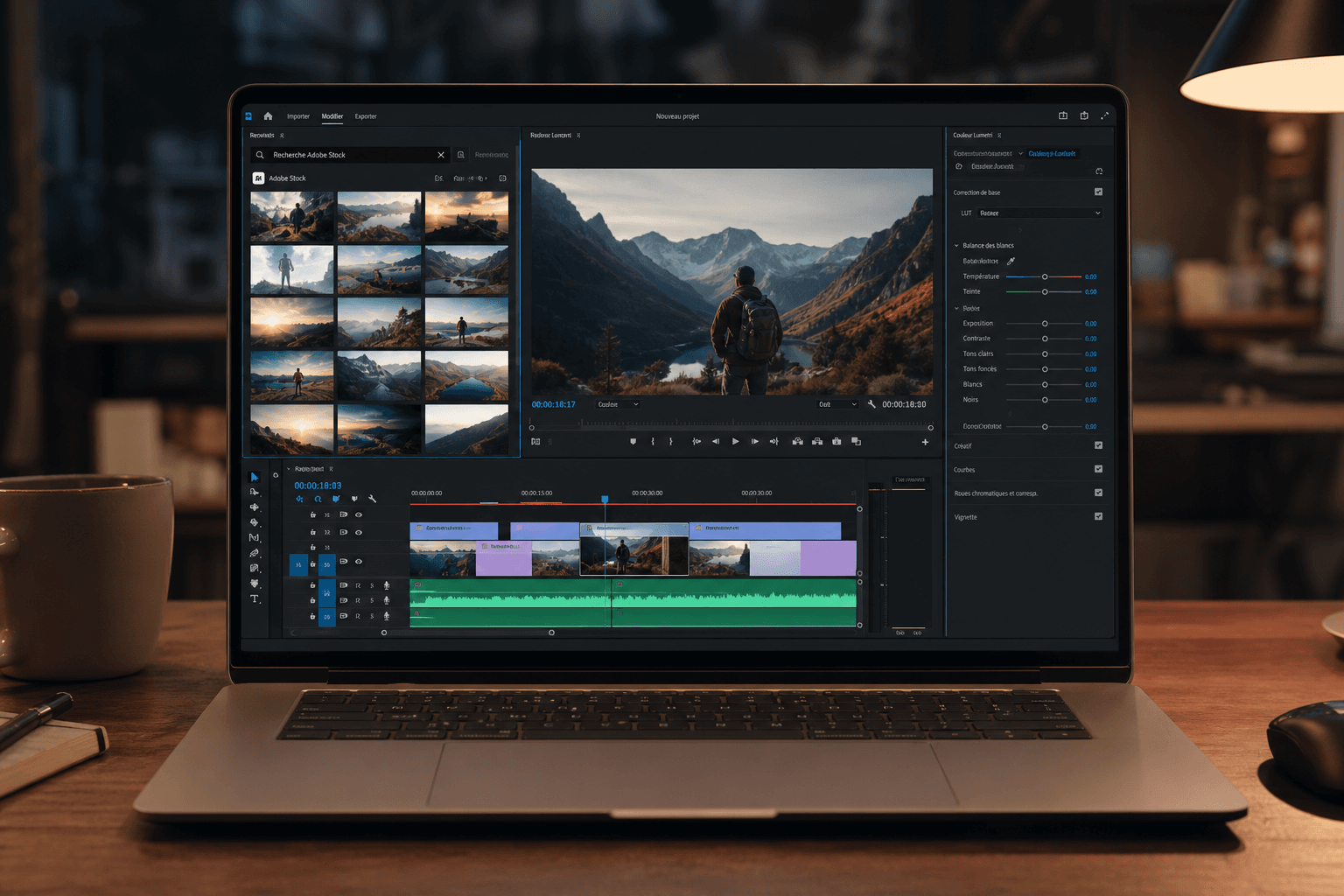
Search is no longer only a page of blue links. It becomes an interface where a model summarizes, reformulates, and sometimes invents with a confident voice. For a creator, it is not a gadget: it is a change of attention distribution, of answer format, and of proof bar. If you keep producing like in 2019, you will not be invisible: you will be misunderstood.
This text lays a simple frame: what Google transforms on the user side, what it imposes on the content side, and how to integrate Gemini (and the Workspace ecosystem) without turning your studio into a rumor factory. I talk as a practitioner: the useful revolution is not "the AI writes in your place", it is "the AI compresses the research and increases the cost of approximation".
What "Google's AI" means in 2026 (with no marketing)
When people say "Google's AI", they often mix three layers:
- Language models able to produce text, code, plans, syntheses.
- Products: Gemini in the browser, in Gmail, in Docs, in Android, in APIs.
- Discovery surfaces: Google search, YouTube, Google Discover, sometimes experiences that mix generated answers and sources.
The confusion is normal, but it is dangerous for your workflow. A model can be brilliant in a draft and catastrophic in a citation. A search surface can give you the illusion of a "truth" when it is a probabilistic aggregation. Trust is the bug.
For a transversal reading on the ecosystem of creative tools, see our panorama of the best AI video tools. For the narration and the structure of a video that holds up, link how to structure an AI video like a real film.
Compressed search: why your audience reads differently
Historically, Google sent you to pages. The user chose a link, then compared sources. Today, part of the traffic stays on the results page because the answer starts to be served: synthesis, steps, definitions, sometimes excerpts.
Consequence for a creator:
- The click can drop on certain "question / answer" subjects.
- The first sentence counts more: if your content does not anchor a clear intention fast, it is badly summarized.
- The proof becomes a competitive advantage: primary citations, data, demonstrations, captures, tests.
It is not "the end of SEO". It is the end of lazy SEO: long pages with no distinctive value, generic text, rewriting Wikipedia articles with extra adjectives. The algorithm does not need to punish you: it can simply bypass you.
Google insists on the idea of useful and user-centered content in its fundamentals published on Google Search Central: creating helpful content. It is not corporate poetry: it is a compass when you decide what you publish after a Gemini session.
Gemini in creation: where it really accelerates
Exploratory research
You must prepare a video on a technical subject. Gemini can help you map: definitions, angles, controversies, glossary. It is useful if you treat the output as a map, not as a source.
Structuring
You move from the chaos of notes to a plan: acts, transitions, objections, proofs to film. There, the AI shines because it forces you to name what you flee. The plan is not the truth: it is a contract with yourself.
Packaging variants
Titles, descriptions, hooks, YouTube chapters. For the platform-side SEO frame, our article AI and YouTube descriptions: SEO with no keyword stuffing stays a solid base.
Script draft
The risk is the uniformization. The remedy: tone constraints, stylistic prohibitions, examples of sentences you accept, and above all the shooting of segments that cannot be "guessed" by a model (field, demo, guest).

Table: old reflex vs "post synthesis" reflex
| Situation | 2019 reflex | 2026 reflex |
|---|---|---|
| You verify a fact | you click 3 sources | you demand a primary source |
| You write a tutorial | you fill keywords | you show a reproducible result |
| You make a thumbnail | you promise "incredible" | you align promise and proof in the first 2 seconds |
| You cite a study | you copy the title | you read the methodology |
| You produce fast | you publish | you document hypotheses and limits |
The impact on generative image and video
Search does not only push text. It also pushes intentions: people ask "how to do" and "which tool". The creators who win are those who show the workflow: settings, mistakes, comparisons, costs, time.
To avoid the "plastic" render when you generate support images, keep the principles of photorealistic AI images with no plastic effect. For the cinema thinking, the important is to separate tool and intention: otherwise you optimize prompts and you forget the gaze.
Hallucinations, citations and reputation: the red line
A model can produce a reference that sounds right: author, title, year. If you do not verify, you publish a fiction. The publication speed amplifies the dishonor speed.
Simple rules:
- Primary sources: official documentation, PDF, registry, dataset, original video.
- Role separation: the AI proposes, the human locks the facts.
- Prompt log: date, version, prompt, output, decision. Indispensable if you work as a team.
For a broad frame on AI and intellectual property when you mix research, sources and generation, the WIPO: AI and IP primer stays a useful reading. For the European transparency frame, see the approach described by the European Commission on AI.
💡 Frank's Cut: treat any AI synthesis as an investigation lead. If you cannot explain in two sentences why you believe a fact without the AI, you must not say it publicly.

Recommended workflow: from brief to video with no drift
Step A: user question
Write the query as if you were your viewer: "I want to know if…", "I compare A and B because…". If your question is fuzzy, the synthesis will be elegant and false.
Step B: AI mapping
You ask for a list of angles, risks, definitions. You forbid the unsourced quantified claims.
Step C: field proof
You film a demo, you show a file, you cite a doc. It is your differentiation.
Step D: publication
Aligned title, useful description, chapters, links to sources. You help the search and the viewer.
What you avoid (a short but expensive list)
- Publishing a "study" without reading the study.
- Transforming a hypothesis into a title.
- Using Gemini to "find sources" then not opening the URLs.
- Mixing opinion and fact without signaling the seam.
YouTube, Discover, and the "proof in one image"
On YouTube, the internal search and the recommendation push toward formats where the thumbnail and the first ten seconds become a visual synthesis. When Google aggregates textual answers elsewhere, YouTube stays a place where the demonstration beats the speech. A tutorial that does not show the screen is no longer a tutorial: it is a disguised podcast.
Discover often rewards the regularity and the readability of the subject. It is not an eternal truth: the signals change. But the stable lesson is that the "feed" surfaces negotiate with the attention as a synthesis negotiates with the curiosity. So you must produce content that survives a diagonal reading: honest title, readable image, promise kept fast.
Workspace: collaboration with no documentary chaos
When Gemini lives in Docs, the risk is not the AI: it is the single version that becomes "the truth" because it is convenient. I recommend a dumb but effective separation:
BRIEF.md: intentions, audience, prohibitions.RESEARCH/: raw notes, captures, PDF.SCRIPT_vXX: named iterations, never "final final".
On a shoot or a series, a structured bible avoids the "catch-all" document killing the vision. Build a clear index: characters, places, visual rules, narrative prohibitions, and above all a "decided decisions" page. Yes, it is human work: that is why it resists the automatic summaries.
21-day program: taming Google + AI with no slip
Week 1: source rereading
Each day, you take a claim seen online and you trace it back to a primary source. You note in three lines: what the source says, what you believed, what you can claim publicly. It is mental sport, but it immunizes you against the model's confident voice.
Week 2: assisted packaging
You write five titles with no AI, then five variants with AI, then you choose without looking at the author. If you cannot decide blind, your prompt is too weak or your angle too generic.
Week 3: hybrid production
You publish a short video with a "verifiable fact" segment (measurement, export, comparison) and a clearly announced "opinion" segment. You observe how people summarize your point in a comment. If the summary is false, your "fact / opinion" signal is illegible.
Practical case: a tool comparison with no phantom benchmark
You want to compare two software. Gemini puts out an impressive "specs" table for you. Stop: you open both apps, you film the same task, you time it, you note where it breaks. The result is not "more true" because it is filmed: it is more honest because it is reproducible. A benchmark with no screen recording is a premium fiction.
You can then use the AI to write the structure, but the "proof" column must contain timestamps, not adjectives.
Table: useful prompts vs dangerous prompts
| Prompt | Why it works | Why it breaks |
|---|---|---|
| "List 8 angles with no figures" | mapping | if you believe it is true |
| "Rewrite in a dry style, short sentences" | clarity | if you hide gaps |
| "Give questions to verify" | caution | if you do not answer |
| "Pretend to be an expert" | viral engagement | reputation |
Troubleshooting: frequent symptoms
You confuse speed and rigor
Fix: a publication checklist: figures, proper nouns, dates, links. If an item is missing, you do not publish. The checklist is boring: that is why it works.
Your videos are well summarized but little clicked
Fix: your title may promise too much "synthesis". Add a concrete constraint: "in 12 minutes", "with files", "mistakes included".
Your team uses Gemini as a truth engine
Fix: a mandatory "human researcher" role on the factual scripts. The AI becomes a draft assistant, never a signatory.
You lose track of the prompt versions
Fix: a minimal spreadsheet: date, model, prompt, output, published URL. For the scientific culture on the model limits, cross-reference with publications on arXiv when you touch serious technical subjects.
Distribution: search does not replace the network
If you want to understand how a video lives outside SEO, think channel by channel: newsletter, community, partnerships, and short formats that send back to a long proof. Search and the YouTube recommendations amplify what is already clear and verifiable.
Foire aux questions
Réponses rapides aux questions les plus fréquentes sur cet article.
Will Google's AI kill SEO?
No in the sense that the demand for information does not disappear. Yes in the sense that the "filler" formats lose. You must aim for pages and videos that bring a proof or an experience the synthesis does not replace.
SEO becomes closer to useful journalism: angle, method, sources, update. If your page can be replaced by three correct but empty sentences, it will be replaced. If your page contains a file, a measurement, a filmed comparison, a documented mistake, it becomes harder to summarize without citing you.
Does Gemini replace Google Search?
These are different uses. Search stays oriented toward discovery and navigation. Gemini is strong for structuring and reformulating. The trap is confusing comfort and accuracy.
In practice, you spend your day alternating: you search for an exact name (company, law, software version) via classic search, then you ask Gemini to reorganize what you have already read. If you reverse the order, you build a cathedral on sand.
How to cite correctly when an AI summarizes?
You cite the original source, not the chat. The chat is an intermediate step. If the source does not exist, you do not display the claim.
When you write for YouTube, put the links in the description, not only in the monologue. When you write for the web, use explicit anchors. The citation is not a decoration: it is a traceability promise.
Is it legally risky to publish AI-assisted content?
It depends on the domain, the claims, the people cited, and the rights on the input data. WIPO gives a useful vocabulary; a lawyer stays necessary for the serious cases. I do not play lawyer on the internet.
What is certain is that defamation and misleading advertising existed before AI. The AI only increases the volume of text publishable per minute. So your review system must move up a notch, especially if you touch identifiable people.
YouTube and Google: same logic?
Often yes on the intention: the user wants to understand fast. The difference is the format: retention, visual proof, personality. An optimized description does not save a soft video.
On YouTube, the "search" often includes an immediate emotional dimension: do I trust this voice, is the thumbnail honest. On Google web, the trust also plays out, but with other signals (site, history, reputation). Do not export your clickbait titles from the web to YouTube without adapting the proof in the video.
Should I announce the use of AI in my videos?
Transparency is a trust strategy. Announce especially when the AI touches faces, voices, or sensitive facts. Silence is not neutral: it is interpreted.
A useful announcement is factual: "assisted script, facts verified on sources X", not a litany of logos. The viewer wants to know where they should be skeptical.
How to train a team to this new rhythm?
Process: fact-checking, prompt log, export rules, human validation on any "quantified" or medical / legal claim. Quality is a system, not an inspiration.
Add a weekly ten-minute review: "what mistake we avoided", "what prompt produced a drift", "what source was missing". Teams learn fast when the shame is replaced by a routine.
Which indicator to track first?
The comment satisfaction on the factual segments. If the mistakes arrive in the comments, your research pipeline is broken.
Then, look at the response rate to the corrections: if you correct a note in the description and the audience keeps relaying the mistake, it means your correction was not visible early enough in the video.
Conclusion: being the creator the synthesis cites
You do not win by "beating" Google's AI. You win by becoming the reference that even a synthesis must mention because it cannot replace your demo. The scale changed: laziness costs more, but rigor is better rewarded than before.
Related articles
 Tutoriels
Adapting Brand Storytelling to AI Video Content
How to keep the brand voice when production speeds up with AI without losing identity or trust.
 Tutoriels
Measuring the Performance of AI Video Content After Publication
A simple dashboard to link AI production decisions to real distribution and conversion results.
 Tutoriels
Client Contract Clause for AI-Generated Content
Useful wording, transparency, liability and retouching scope to avoid disputes.