Arthur Harari: AI is "a slippery slope", except for one shot
In Marrakech, the Anatomy of a Fall co-writer said he won't use AI to write, then admitted a deepfake for a Léa Seydoux scene. Where he draws the line.
Contents · 6 sections
On Sunday, November 22, 2026, at the Marrakech International Film Festival, Arthur Harari took an audience question about AI. The co-writer of Anatomy of a Fall and director of The Unknown started by saying he had never used it. A few sentences later, he admitted his team had used a deepfake tool for a scene where Léa Seydoux kisses Léa Seydoux.
That isn't a shameful contradiction. It's the position many filmmakers will have to own: no to AI in the writing, yes to AI as an effects tool under human control. And the line he draws is more interesting than the admission.
This piece is based on Christopher Vourlias's article for Variety, published on November 22 and read on November 23, 2026. I haven't had access to a recording of the talk, so all quotes are as Variety reported them.
What he said in Marrakech
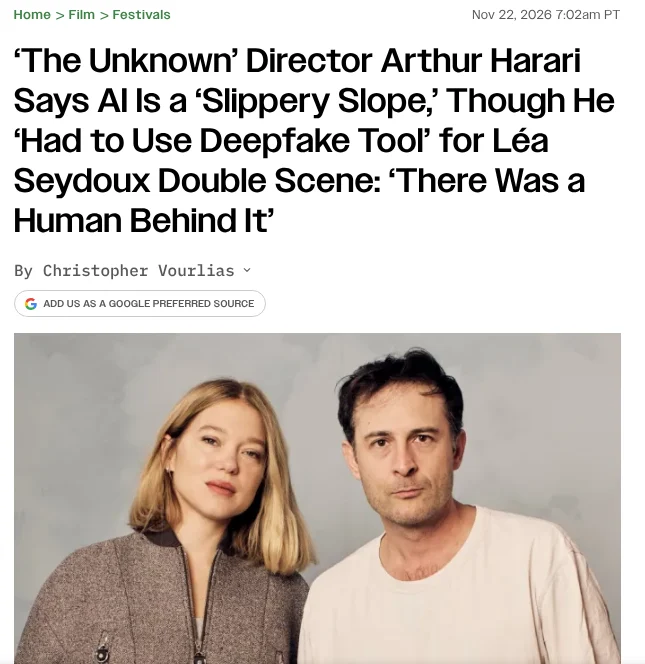
Source: Variety, captured on November 23, 2026.
Harari was a guest of the festival's Conversation series, alongside film critic and historian Charles Tesson. Asked about AI's place in his work, he first answered: "I'm in much the same position as everyone else: this shift toward using AI is suddenly upon us, and it's becoming not just a possibility, but something increasingly pervasive and tempting. Personally, I've never used it."
Then he added a detail. The Unknown, which premiered in competition at Cannes this year, is a body-swap story: a photographer, played by Niels Schneider, wakes up inside the body of an unknown woman played by Léa Seydoux. Hence a scene where the actress kisses herself.
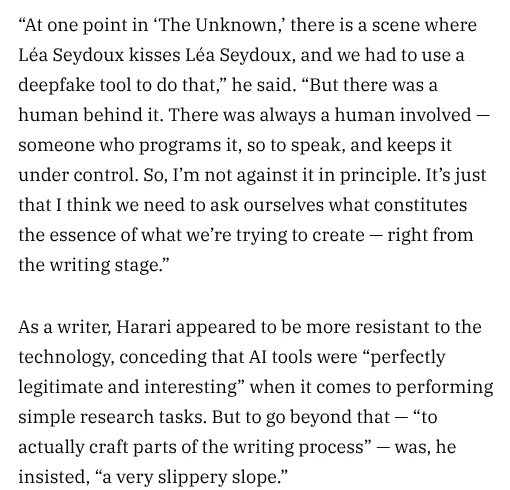
Source: Variety, captured on November 23, 2026.
"There was a human behind it. There was always a human involved, someone who programs it, so to speak, and keeps it under control. So, I'm not against it in principle," he said. "It's just that I think we need to ask ourselves what constitutes the essence of what we're trying to create, right from the writing stage."
The line he draws
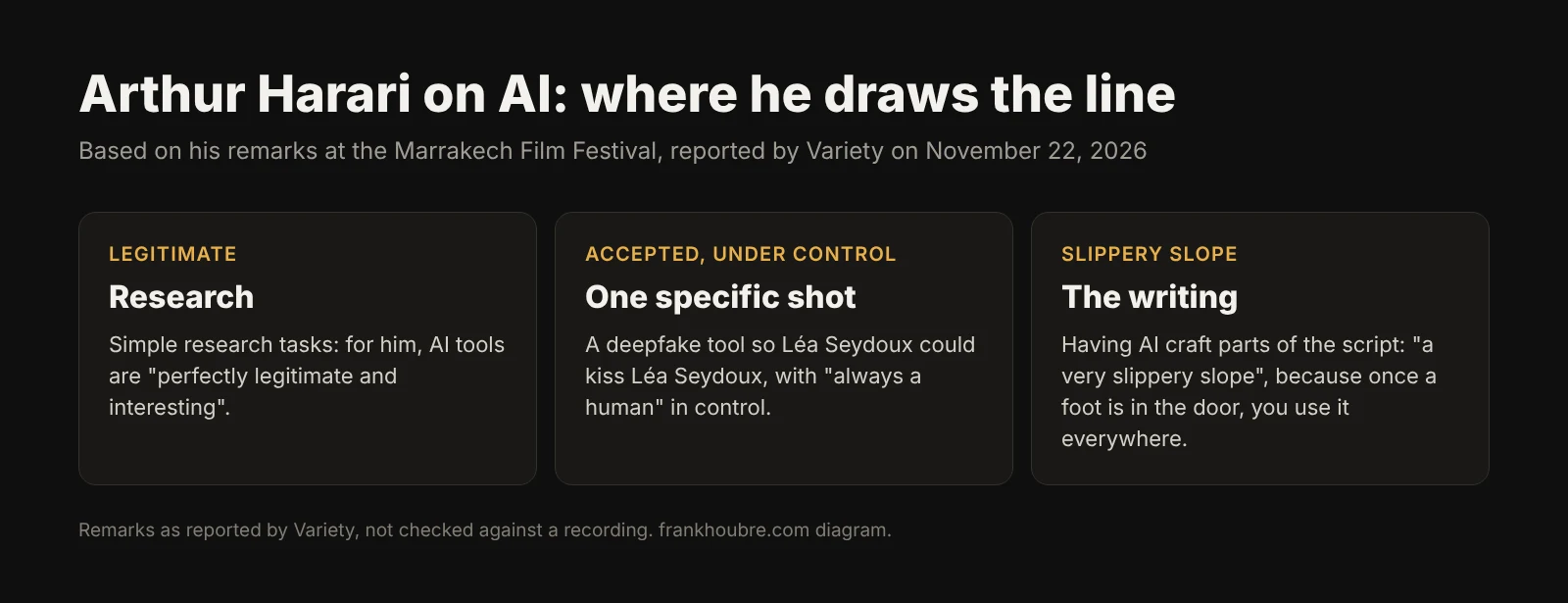
On writing, Harari is much firmer. For simple research tasks, he called AI tools "perfectly legitimate and interesting." But using them "to actually craft parts of the writing process" is, in his words, "a very slippery slope."
His reason isn't technical, it's human: "We are inherently prone to addiction. Look at our phones, for instance; we're constantly glued to them. Once you get a foot in the door, it becomes incredibly difficult not to use it at every turn."
What I make of it
I find this more honest than most statements on the subject. Harari doesn't pretend AI doesn't exist: he used it where it solved a real staging problem, a shot you can't film any other way with a single actress. And he keeps it away from the core of his craft, the writing.
It's the same line I argue for in my piece on writing with AI: the tool can research, check, suggest variations of form. The idea, the point of view, the choice of what you tell, stays with you. His addiction argument rings true to me: the risk isn't that AI writes badly, it's that you stop searching yourself.
On the deepfake, the nuance matters. A lead actress agreeing to a trick shot in her own film is not the same as a face used without consent. I covered that boundary in my guide to AI actor clones and, on the legal side, in the piece on the DEFIANCE Act against deepfakes.
What it means for you
- Decide where your line is before the project. Research, effects, writing: Harari has an answer for each stage. Write yours down, so you don't slide without noticing.
- Keep a human in charge of trick shots. Every altered shot needs a named person who chooses, corrects and signs off. That's what he describes.
- Get it in writing. If you alter a performer's face or body on screen, have them sign before the shoot.
- Watch out for convenience. If a tool saves you an hour of research, great. If it starts suggesting your scenes, ask yourself what's left for you.
What we don't know
- Which tool was used for the scene in The Unknown, or who handled it.
- Whether Léa Seydoux has commented on that shot. Variety only notes that she said earlier this year she doesn't feel threatened by AI.
- His exact words in French: the remarks were reported, and possibly translated, by Variety.
Frequently asked questions
Quick answers to the questions readers ask most about this article.
What did Arthur Harari say about AI?
According to Variety, he said at the Marrakech Film Festival that he didn't see a place for AI in his work, that it was legitimate for simple research tasks, but that having it craft parts of a script was "a very slippery slope."
Did he use AI in The Unknown?
Yes, for one specific scene. His team used a deepfake tool for a scene where Léa Seydoux kisses Léa Seydoux, with, he said, always a human programming and controlling the tool.
Why does he call it a slippery slope?
Because, in his view, we are prone to addiction, as with our phones, and once you start using AI to write, it becomes very hard not to use it everywhere.
What is The Unknown about?
A photographer, played by Niels Schneider, wakes up inside the body of an unknown woman, played by Léa Seydoux, after a night with her. The film premiered in competition at Cannes in 2026.
Where and when did he say this?
On November 22, 2026, in a talk with critic Charles Tesson as part of the Marrakech International Film Festival's Conversation series. The festival runs November 20 to 28.
Is a deepfake legal in a film?
When the performer agrees, yes. The legal problem arises when someone's likeness is used without consent, which several countries, including France, punish.
Related articles
 Tutoriels01
AI pipeline from A to Z: from idea to shot list in one day
How to chain AI tools to go from a raw idea to a complete shot list in a single workday. A concrete method, with the tools that actually slot together.
 Actualité02
AI training opt-out: OpenAI and Google back one robots.txt
On October 30, OpenAI, Google, Microsoft and Anthropic pledged to honor one robots.txt signal against AI training. What it changes for creators.
 Actualité03
MiniMax launches Hub: an all-in-one AI video platform unveiled at the Shanghai Festival
MiniMax unveiled Hub at the Shanghai International Film Festival on June 15, 2026. A single platform that combines image, video, voice, music and editing in an AI-agent-driven pipeline.