Sexual deepfakes: Paris Hilton pushes the DEFIANCE Act again
Paris Hilton and two lawmakers are asking the US House to vote on the DEFIANCE Act against sexual deepfakes. What the bill says, and what it changes for you.
Contents · 6 sections
On November 17, 2026, Paris Hilton went back to the steps of the Capitol in Washington with a simple request: that the House of Representatives finally vote on the DEFIANCE Act. The bill would let victims of sexual deepfakes sue the people who make and share them. The Senate passed it unanimously in January. The House has never put it to a vote.
If you create images or videos with AI, this concerns you even if you've never made a deepfake: it draws the line between what a tool allows and what the law tolerates.
What follows comes from Ana-Maria Stanciuc's article for The Next Web and Stetson Miller's report for Gray DC, published on November 18 and read on November 21, and from the CNIL's page on deepfakes for French law.
What happened in Washington
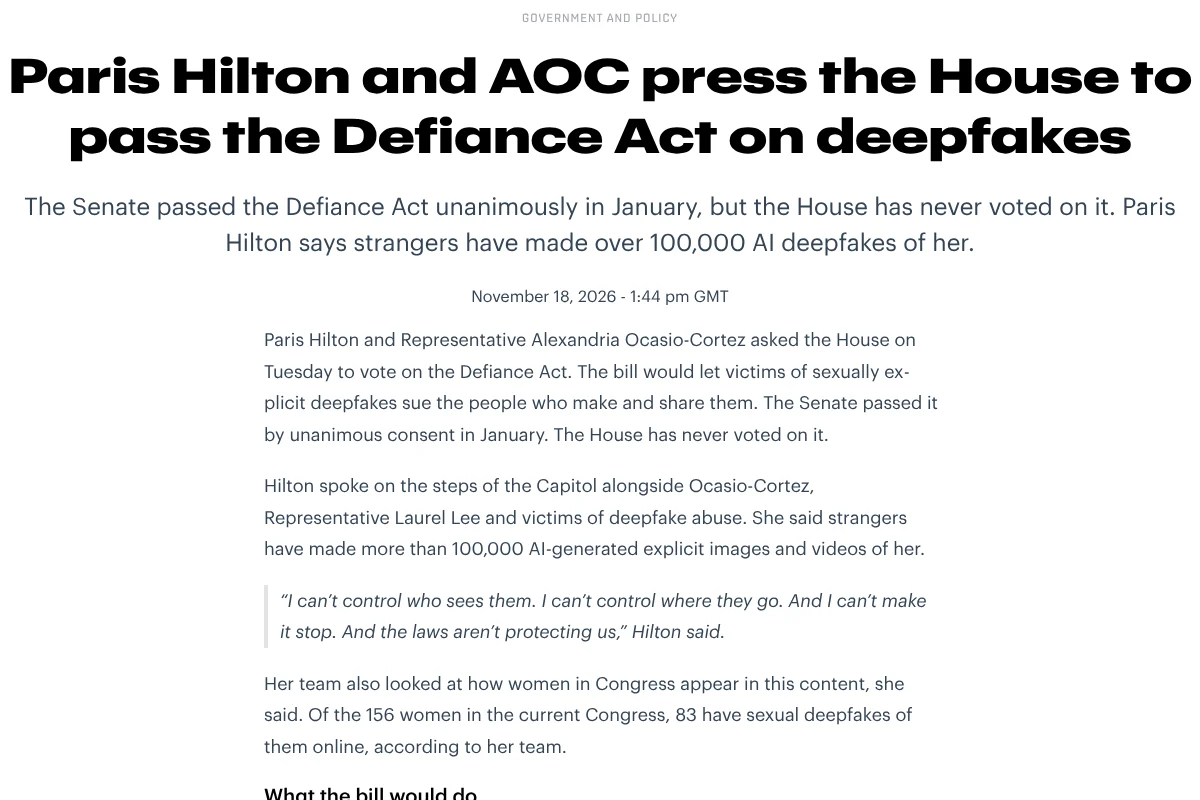
Source: The Next Web, captured on November 21, 2026.
Paris Hilton spoke alongside the two lawmakers behind the bill, Democrat Alexandria Ocasio-Cortez and Republican Laurel Lee, and victims of deepfakes. She says strangers have made more than 100,000 AI-generated sexual images and videos of her. "I can't control who sees them. I can't control where they go. And I can't make it stop," she said, quoted by The Next Web.
Her team also looked at what circulates about women in Congress: according to her, 83 of the 156 women in the current Congress have sexual deepfakes of them online. That figure comes from her team, not from an independent study.
She addressed House Speaker Mike Johnson, Majority Leader Steve Scalise and Judiciary Chairman Jim Jordan directly. If the bill isn't passed before this Congress ends, it will have to be reintroduced in January.
What the DEFIANCE Act says
According to The Next Web, citing CNBC:
- A civil right to sue. Victims could take action against anyone who creates, shares, publishes or threatens to share these images without consent.
- Legal costs recovered, and the option to ask a court to order the content removed.
- Broad support. The House version has 70 cosponsors, 35 from each party. Microsoft, Snap and OpenAI back it.
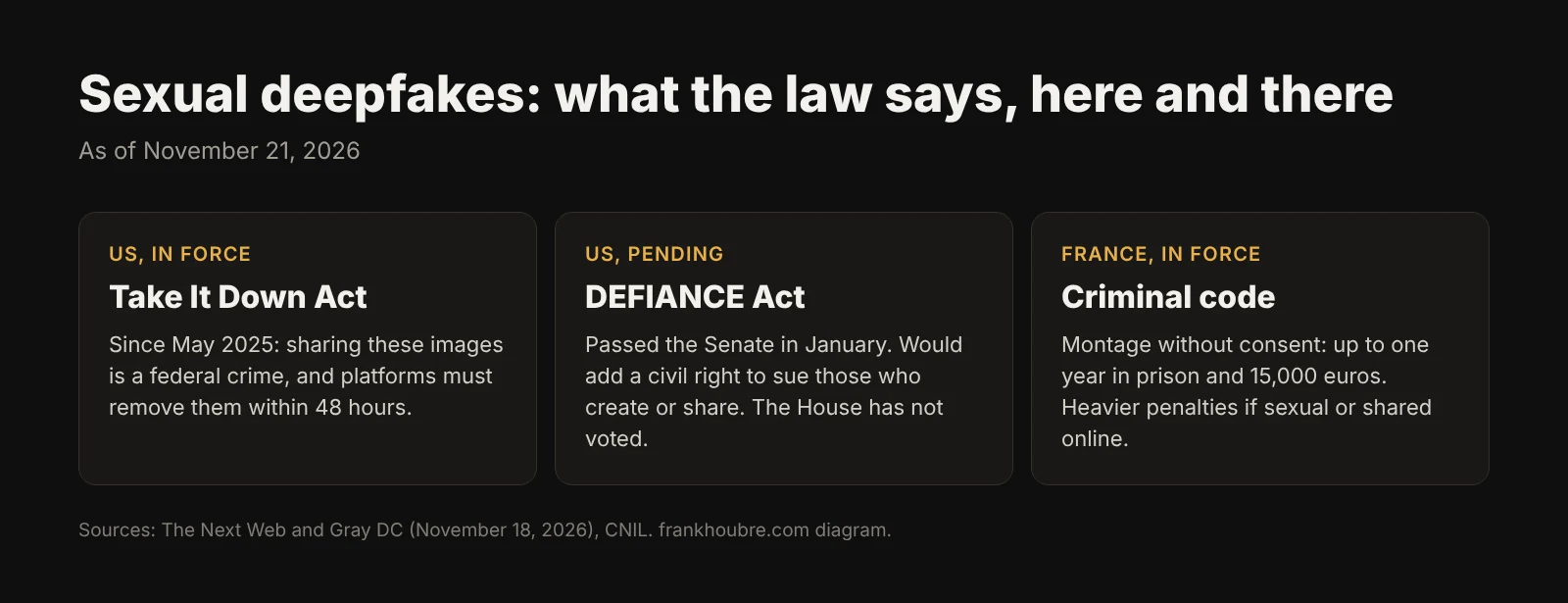
It would complement the Take It Down Act of May 2025, which already makes sharing these images a federal crime and requires platforms to remove them within 48 hours. The difference: with DEFIANCE, a victim no longer has to wait for a prosecutor.
And in France?
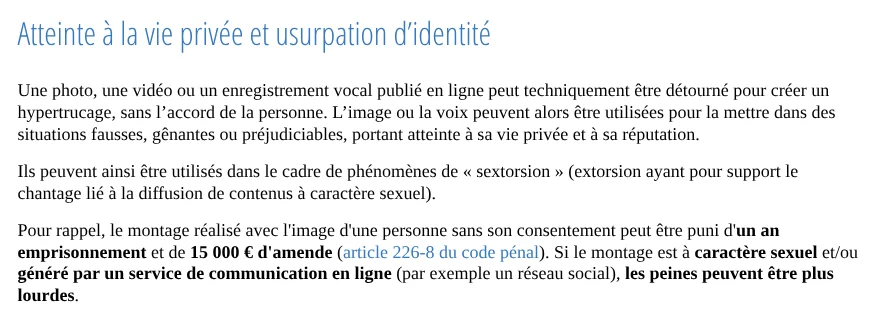
Source: CNIL, captured on November 21, 2026.
In France, criminal law already covers it. The CNIL, France's data protection authority, puts it plainly: a montage made with a person's image without their consent can be punished by one year in prison and a 15,000 euro fine (article 226-8 of the criminal code), and penalties are heavier if it's sexual or posted on a social network. The CNIL advises victims to keep evidence, report the content to platforms and to Pharos, the national reporting service, and file a complaint.
What it changes for you as a creator
No serious tool will let you make a sexual deepfake, and that's not the point. The point is that a real person's face has become legal minefield, and the trend runs one way: more recourse for victims, more responsibility for those who create and share.
- No real face without written consent. Even for a parody, a music video or an ad, get a specific release signed. I covered the possible contracts in my guide to AI clones of actors.
- Sharing counts as much as creating. DEFIANCE also targets those who spread the content. Resharing a deepfake "to denounce it" can put you on the wrong side.
- Keep track of your sources. For every generated face, note whether it comes from a real person, a licensed reference or pure invention. It also protects your work when you sell it, as I explain in selling AI-generated images.
- Prefer invented characters. For an extra or a supporting role, a face made from scratch spares you these questions. Copyright on generated images is a separate topic, but at least you're not touching someone's likeness.
What we don't know
- Whether the House will vote before the end of the year. Mike Johnson called the bill "good policy" in September, according to The Next Web, without setting a date.
- How the law would treat the tools used to make these images. The sources read talk about people who create and share, not software makers.
- Whether Europe will follow with a similar civil right. Nothing in the sources read says so.
Frequently asked questions
Quick answers to the questions readers ask most about this article.
What is the DEFIANCE Act?
A US federal bill that would give victims of sexual deepfakes the right to sue those who create, share, publish or threaten to share these images without consent, and to ask for their removal.
Where does the bill stand?
The Senate passed it unanimously in January 2026. The House of Representatives has never voted on it. Paris Hilton and the two lawmakers sponsoring it asked for that vote on November 17, 2026.
Who supports the DEFIANCE Act?
In the House, 70 cosponsors, 35 Republicans and 35 Democrats, according to CNBC cited by The Next Web. Microsoft, Snap and OpenAI also back it.
How is it different from the Take It Down Act?
The Take It Down Act, signed in May 2025, makes sharing these images a federal crime and requires platforms to remove them within 48 hours. DEFIANCE would add a civil remedy that victims can pursue themselves.
What does French law say about deepfakes?
According to the CNIL, a montage made with a person's image without consent can be punished by one year in prison and a 15,000 euro fine, with heavier penalties if it's sexual or shared online.
What should you do if you're the victim of a deepfake?
The CNIL advises keeping evidence (screenshots, links), reporting the content to the platform and to Pharos, and filing a complaint with the police or gendarmerie.
Related articles
 Actualité01
Genie 4: worlds you can walk through to scout your sets
Google opens Genie 4 to AI Ultra subscribers and developers: interactive worlds with sound, editable live. What a filmmaker can do with it, and where it falls short.
 Actualité02
Artificial: the trailer for Guadagnino's OpenAI film
Neon releases the full trailer for Artificial, with Andrew Garfield as Sam Altman. What it shows, how Amazon dropped the film, and when it comes out.
 Actualité03
Suno Visuals: AI video clips for your songs
Suno launches Visuals: 15-second clips that follow your lyrics, lyric videos and album art. With filters that block the faces of famous artists.