Genie 4: worlds you can walk through to scout your sets
Google opens Genie 4 to AI Ultra subscribers and developers: interactive worlds with sound, editable live. What a filmmaker can do with it, and where it falls short.
Contents · 7 sections
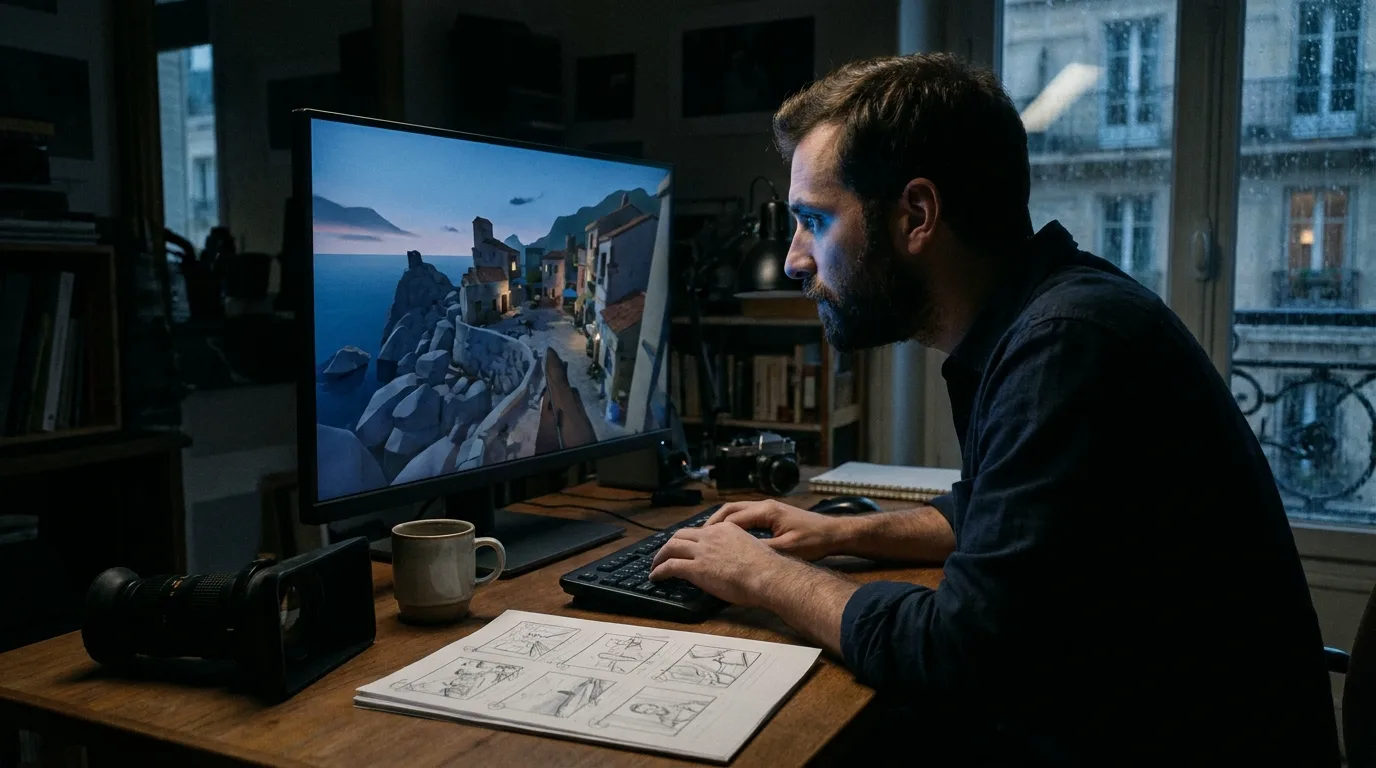
Imagine walking through the set of your scene before you write it. Turning the street corner, making it rain, hearing the wind. That is the promise of Genie 4, Google DeepMind's world model, opened on November 18, 2026 to Google AI Ultra subscribers, then the next day to developers.
What follows comes from Google's announcement, signed by Diego Rivas (Google DeepMind) and Pavan Kumar (Google Labs), and from the Gemini API post of November 19, read on November 20. I haven't tested Genie 4: access is limited to the Ultra plan, not open in every country, or to the API.
What Google opened
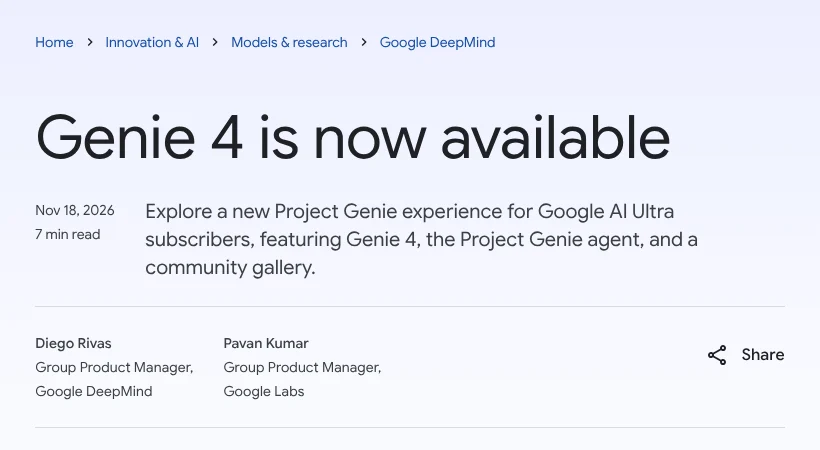
Source: Google's blog, captured on November 20, 2026.
Project Genie is a research prototype that lets you generate an interactive world and walk around in it from the browser. The November 18 update brings four things:
- Genie 4, Google's most realistic model according to the announcement. You can type a new prompt while you explore to change the weather, add a character or restart the action.
- Native real-time sound, a first: ambience, effects and dialogue that follow the scene.
- An agent that builds the world from a plain-language description, with starting visuals and music that fits the mood.
- A gallery of worlds to explore and remix.
Genie 3 is still available, with sessions extended to 3 minutes per generation (up from 60 seconds) and the option to start from a 360-degree panoramic image.
The API, for people who build tools
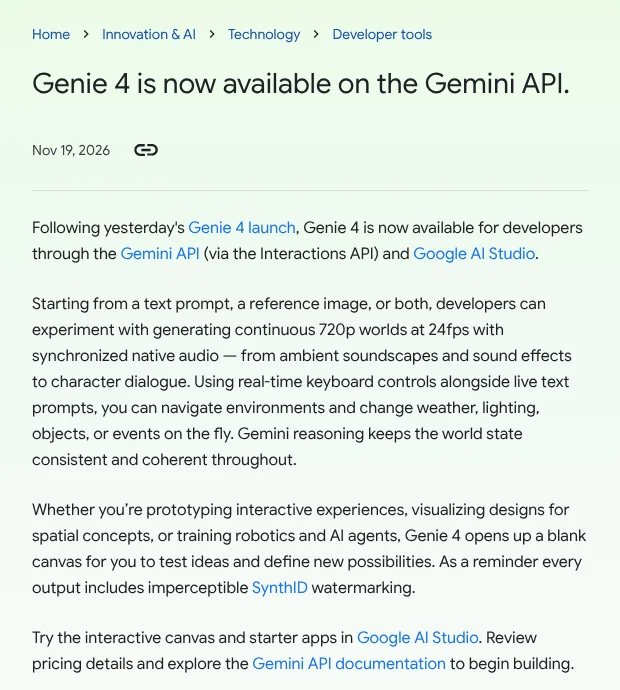
Source: Google's blog, captured on November 20, 2026.
Since November 19, Genie 4 is also available in the Gemini API and Google AI Studio. The post gives the numbers that matter: continuous worlds in 720p at 24 frames per second, with synchronized sound, from text, a reference image or both. You move with the keyboard and change the weather, light, objects or events live. Among the use cases, Google mentions visualizing spatial concepts.
All generated images and sounds carry the invisible SynthID watermark.
What a filmmaker can do with it
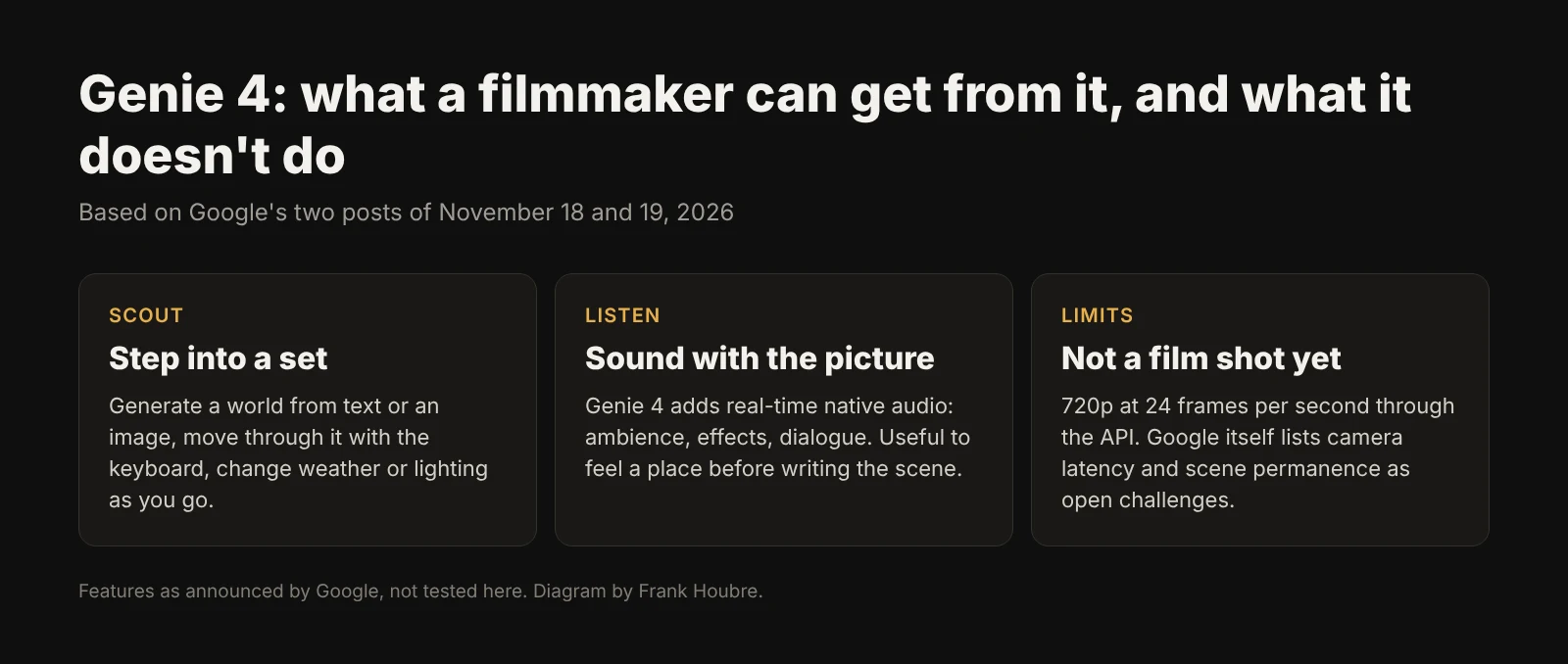
I see three concrete uses, to test before believing in them.
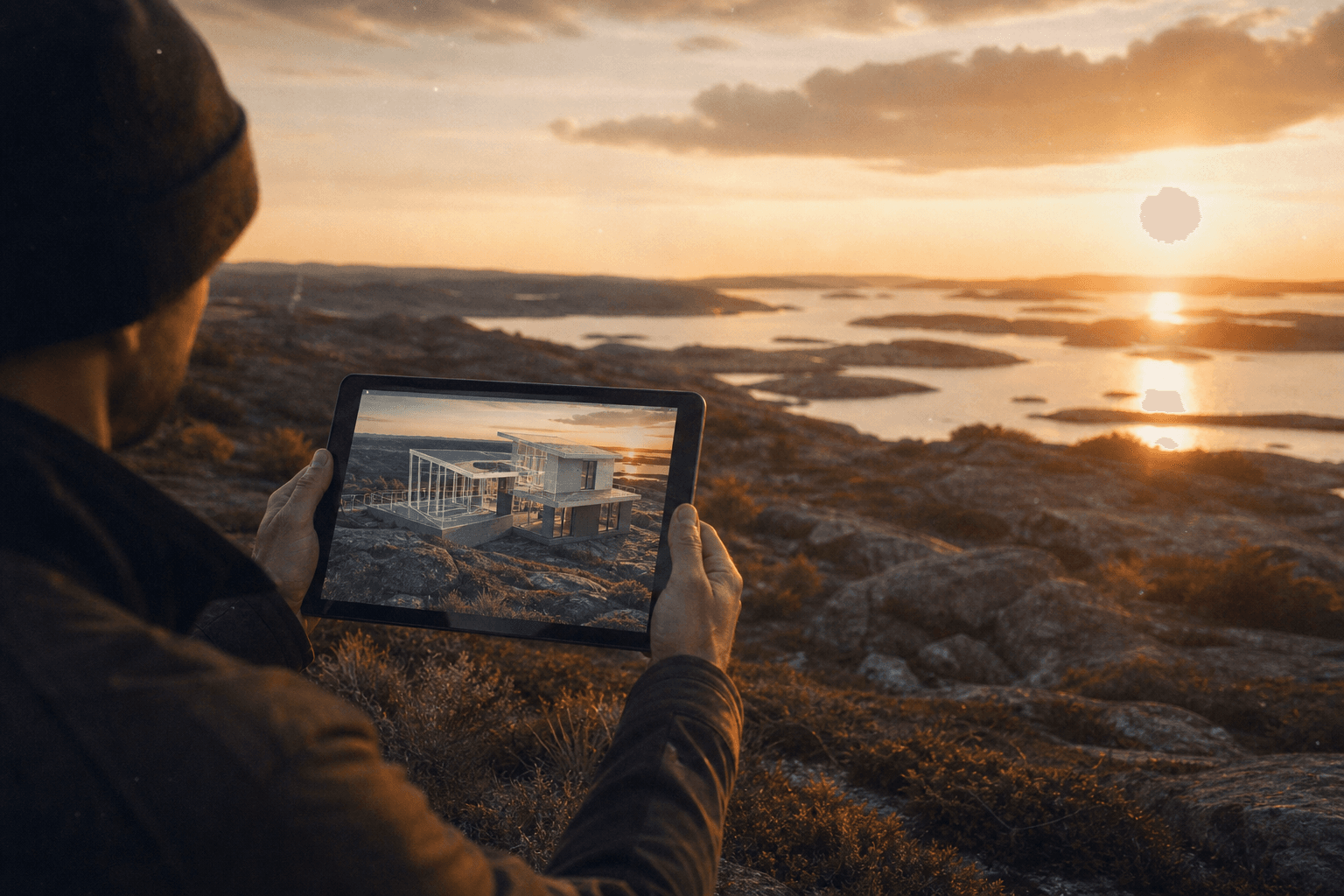
Scouting before the scout. Before you look for a real location, you can generate the one in your head and walk through it: where the light is, where the character comes from, what we see behind them. It doesn't replace the field, as I explained in my method for location scouting with AI, but it helps you know what you're looking for.
Previz that breathes. Classic 3D previz is silent and frozen. Here, you can change the weather in the middle of the scene and hear the ambience. For a tense sequence, hearing the rain before writing the lines changes the writing. If you already do 3D previz with AI, it's one more tool to try.
The reference set. Once you find a world, you can pull images from it for your location bible, which then serves as a reference for your image and video generations.
Google leads by example with two creators: filmmaker Anand Gandhi built "The Life of Ants", an ant colony to explore at insect height, and artist Will (BLVCKL!GHT) built "Villa Giallo", a room-by-room mystery in a gothic mansion.
The limits, stated by Google itself
It's rare, so I'll note it: the announcement lists its own open problems. Google mentions camera latency, complex physical interactions, real-time audio accuracy and set permanence over time. In other words, a place can change when you come back to it, and the camera doesn't yet respond like a real one.
And 720p is very far from a film image. Genie 4 is a tool for thinking through a scene, not for shooting it.
What I'd do this week
- If you have Ultra: take a scene from your project, describe the location in three sentences, and walk around in it for ten minutes. Write down what you discover that you hadn't written.
- If you don't: look at the gallery worlds Google shows, especially Anand Gandhi's, to judge the level without paying.
- Keep your captures as location references, with the prompt that produced them.
- Don't promise a client anything on this basis: it's a research prototype.
What we don't know
- The API price, which the post leaves to a pricing page without quoting it.
- The maximum length of a Genie 4 session, which the announcement only gives for Genie 3.
- The countries where Project Genie is open, since the announcement speaks of "eligible" subscribers.
- The usage rights for generated worlds in a commercial film.
Frequently asked questions
Quick answers to the questions readers ask most about this article.
What is Genie 4?
It's Google DeepMind's world model: it generates an interactive environment you move through in real time, with native sound. Google presents it as its most realistic and interactive world model to date.
Who can use Genie 4?
Since November 18, 2026, eligible Google AI Ultra subscribers, in Project Genie. Google AI Pro subscribers can join a waitlist. Since November 19, developers can access it through the Gemini API and Google AI Studio.
What is Genie 4's image quality?
Through the API, Google announces continuous worlds in 720p at 24 frames per second, with synchronized sound.
Can you change the world while exploring it?
Yes. You can type a new prompt along the way to change the weather, add a character or modify the action, according to Google.
Can Genie 4 be used to shoot a film?
Not directly. The resolution and the limits Google cites (camera latency, set permanence) make it more of a tool for scouting, previz and mood research.
Are generated worlds marked as AI?
Yes. Google says all videos and sounds generated in Project Genie carry the SynthID watermark.
Related articles
 Actualité01
Film schools teach AI to screenwriters: 90% craft first
The Los Angeles Times shows how LMU, USC and Chapman teach AI to young screenwriters: 80 to 90% craft, 10% tools. What it changes for you.
 Tutoriels02
How to use AI for cinema location scouting
Practical method to preselect, test and validate cinema locations with AI without losing the field realism.
 Actualité03
iQIYI opens an AI film studio in Shanghai
iQIYI films real actors on a 110 m² stage in Shanghai, then AI rebuilds sets and light around their performance. What the November 1 release says.