Film schools teach AI to screenwriters: 90% craft first
The Los Angeles Times shows how LMU, USC and Chapman teach AI to young screenwriters: 80 to 90% craft, 10% tools. What it changes for you.

Contents · 6 sections
Three years ago, Hollywood told young screenwriters to stay away from AI. This week, the Los Angeles Times tells the opposite story: in Los Angeles film schools, teachers now teach it, and some students find their way into the industry through it. With one rule every teacher repeats: craft first, tools second.
The piece is called "Hollywood warned young screenwriters about AI. Now it may be their ticket in". It is by Ada Tseng and dated November 11, 2026. I read it on November 15, along with the summary published by LMU. The Los Angeles Times site blocks automated captures, so the screenshot below is LMU's page.
What the Los Angeles Times reports
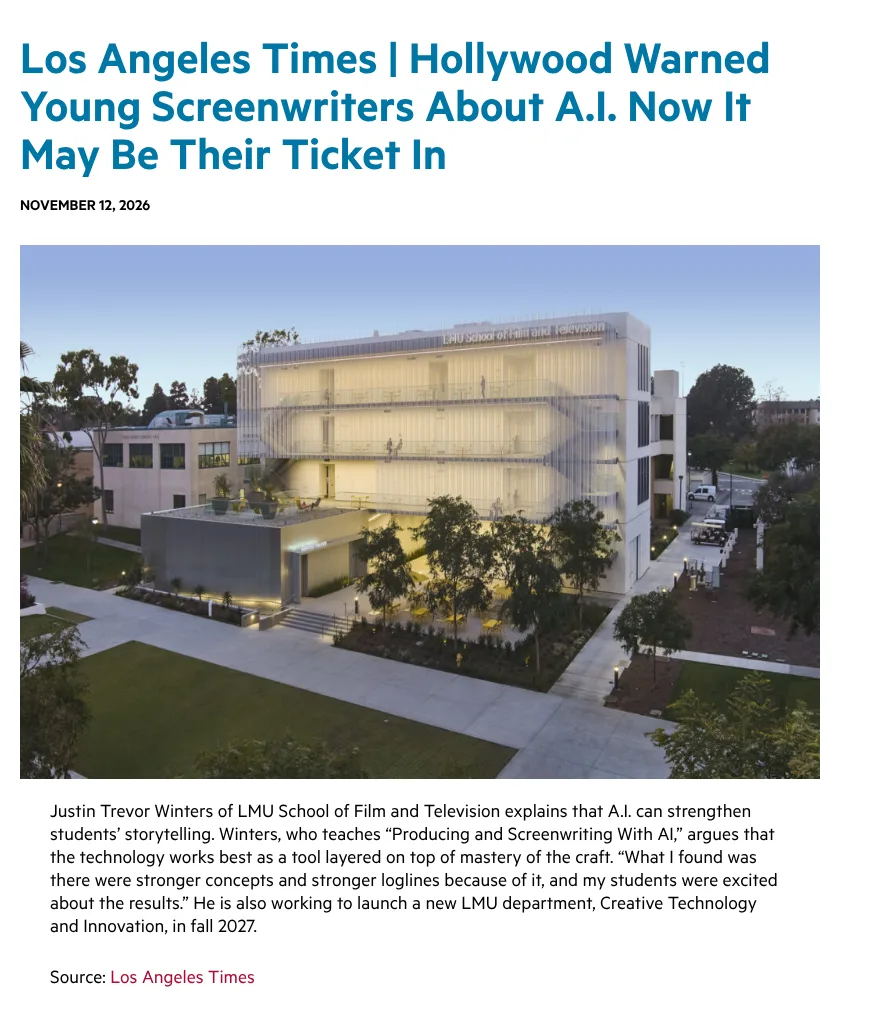
Source: LMU's website, captured on November 15, 2026.
The thread running through the piece is Justin Trevor Winters, a screenwriter and professor at Loyola Marymount University (LMU). In 2022, he was stuck on the logline of a project he was developing with his writing partner. He gave ChatGPT his own screenwriting lectures to guide it. Within an hour he had his logline. Within a few weeks, the project sold.
He showed the tool to his students. His conclusion is measured: "It wasn't like, all of a sudden, the students became amazing screenwriters. But what I found was there were stronger concepts and stronger loglines."
Today he teaches a course called Producing and Screenwriting With AI and is building a new LMU department, Creative Technology and Innovation, planned for fall 2027. According to the paper, top film schools have taught AI for at least two years: a six-week workshop at NYU's virtual production center, a dedicated initiative at USC.
The 80/10 rule
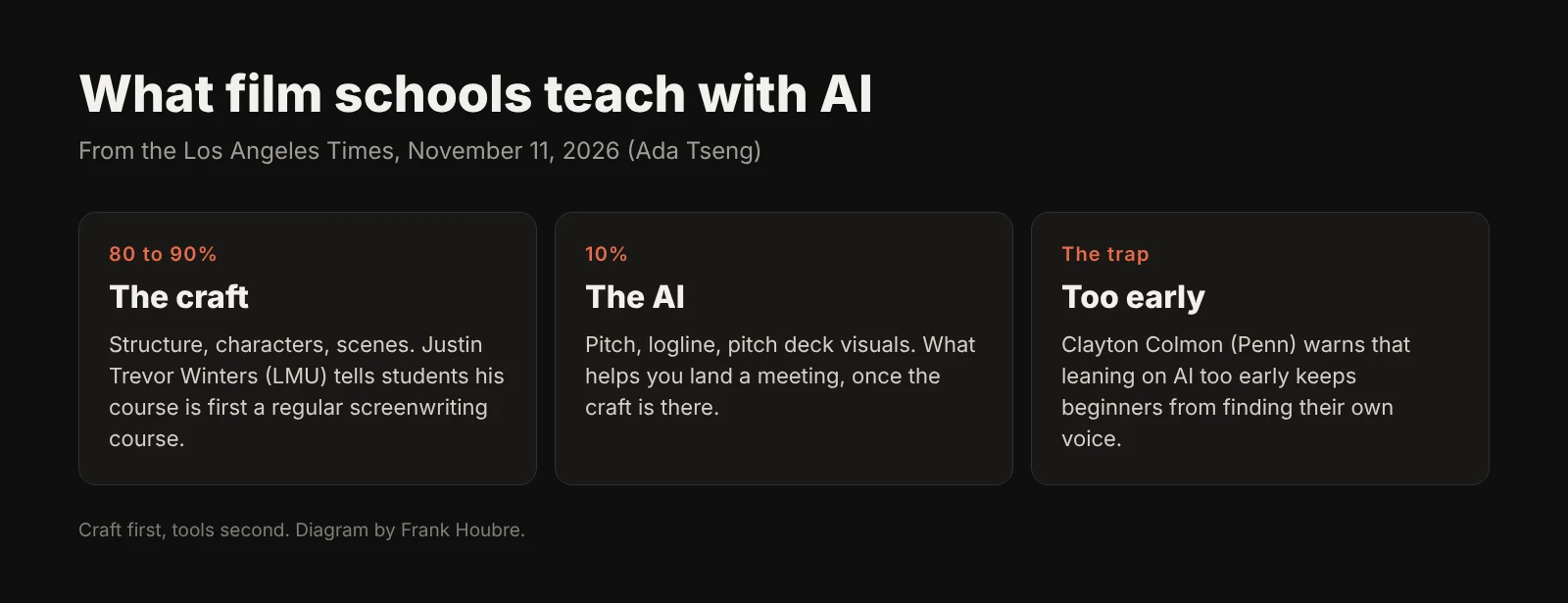
The line that struck me most is what Winters tells his students: "I tell them from the very beginning, this is 80 to 90% craft. You are basically taking a normal screenwriting course I usually teach, but I'm going to give you 10% that will be your superpower, once you've understood the craft and mastered it."
He puts that 10% where AI really helps a beginner:
- The logline and the concept, as a brainstorming partner.
- The pitch deck: he uses Midjourney to put an actor he imagines in the 1920s wardrobe and location of the project. The production value of his students' decks went up right away, he says.
- A proof-of-concept short. One of his students made an animated short with AI that led to several industry meetings and job offers, according to the paper.
The piece also quotes Fred Grinstein, who teaches cinematic AI at USC and Chapman: "You don't have to wait for a director to come on board." And Dara Resnik, a writer on Jane the Virgin and Daredevil, who won't use AI on work she is hired to write, but uses it on her own projects, for example to imagine medical scenarios she then checks with doctors.
The trap: using it too early
Not everyone is enthusiastic. Clayton Colmon, from the University of Pennsylvania, warns that leaning on AI too early in the creative process can keep a beginner from finding their own point of view, because AI tends to flatten distinct voices into generic storytelling.
That is exactly the subject of the study I wrote about two days ago, on what AI does to your ideas when you write: it all depends on when you bring it in.
💡 Frank's take: I tell the people I train the same thing with different numbers: AI does not rescue a weak story, it just shows it faster. What I like about this piece is that screenwriting teachers are talking, not tool vendors. Their order is right: learn to write a scene, then use AI to pitch it and show it. And that is the real change: a writer can now walk into a meeting with a teaser instead of a PDF.
What I would do this week
- Write your logline by hand first. Three versions, no help. Only then ask an AI to critique it, not rewrite it.
- Build a five-page pitch deck: logline, characters, tone, three reference images, why now. The images are where AI saves you the most time.
- Pick one key scene and turn it into a short teaser. My guide to writing a short film with AI from A to Z gives you the method.
- Keep what you wrote yourself separate. The day someone asks where your ideas came from, you should be able to show it.
What we don't know
- How many students actually find work this way. The examples in the piece are teachers' anecdotes, not a study.
- Where the studios stand. The paper notes that AI remains polarizing in Hollywood, mostly over jobs.
- What happens outside Los Angeles. The piece only covers LA schools.
Frequently asked questions
Quick answers to the questions readers ask most about this article.
What does the Los Angeles Times story say?
Published on November 11, 2026 and written by Ada Tseng, it describes how Los Angeles film schools (LMU, USC, Chapman) teach AI to young screenwriters for pitching, visuals and proof-of-concept shorts, while insisting on the craft of writing first.
Who is Justin Trevor Winters?
A screenwriter and LMU professor who teaches Producing and Screenwriting With AI. He is building a new department, Creative Technology and Innovation, planned for fall 2027.
What does "80 to 90% craft" mean?
It is Winters' formula: his course is first a regular screenwriting course. AI is only the remaining 10%, useful once you know how to write a scene.
Can AI help a young screenwriter get noticed?
According to the teachers interviewed, yes: a sharper pitch deck or a proof-of-concept short can open meetings. These are examples, not a guarantee.
What is the risk for a beginner?
Leaning on AI too early, before finding your own voice. Clayton Colmon, from the University of Pennsylvania, says AI tends to flatten distinct voices into generic storytelling.
Where should I start if I want to write with AI?
Write without it first, then use it to critique, pitch and visualize. The craft stays the foundation, the tool comes after.
Related articles
 Actualité
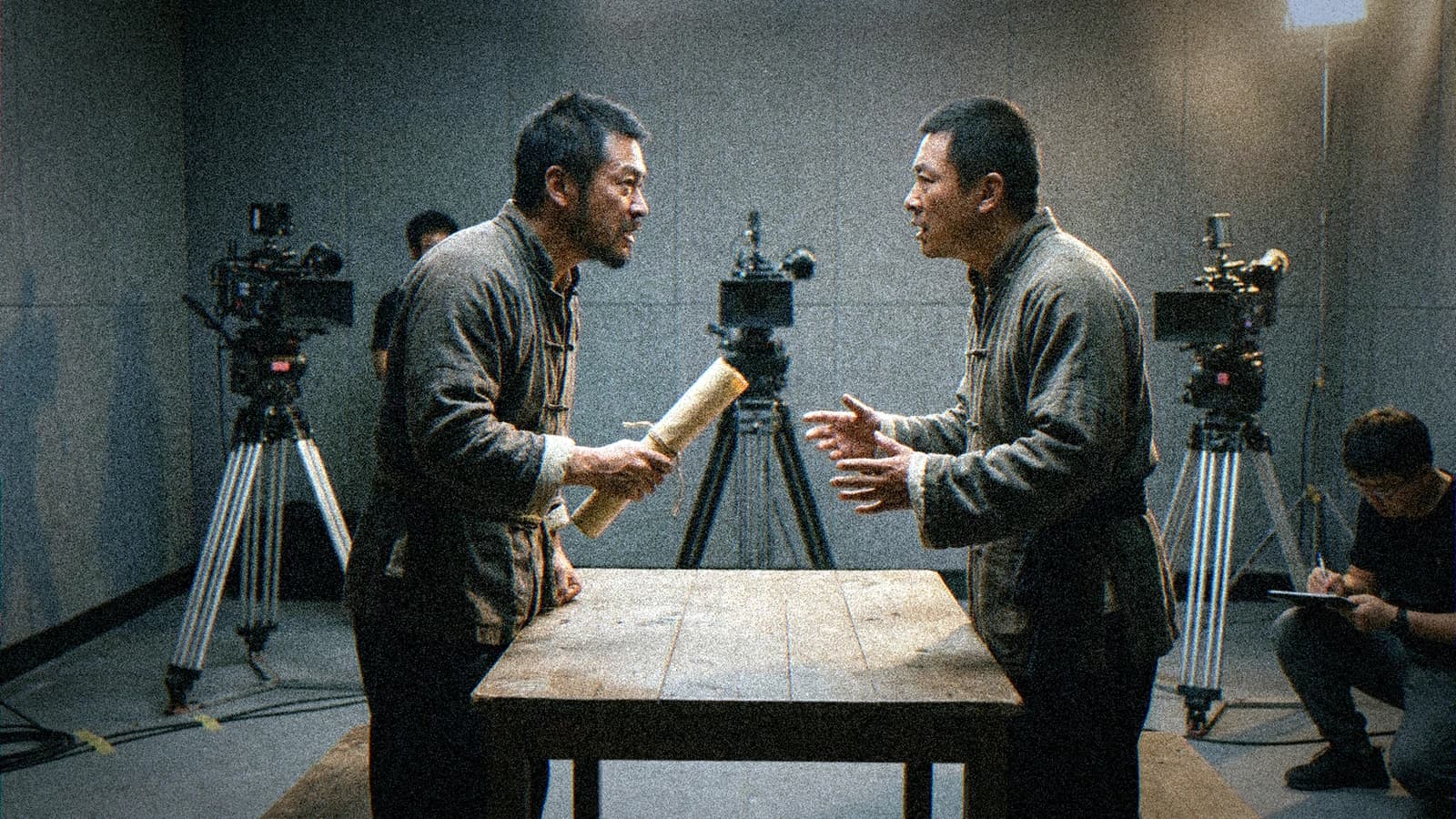
iQIYI opens an AI film studio in Shanghai
iQIYI films real actors on a 110 m² stage in Shanghai, then AI rebuilds sets and light around their performance. What the November 1 release says.
 Actualité
Adobe MAX 2026: what changes in Premiere for cutting a film
Color Mode grading, generation in the timeline, object removal, AI agents: what Adobe shipped for Premiere at MAX, and what is still in beta.
 Actualité
Chomet accused of AI over his Dior film: his answer
Sylvain Chomet denies any generative AI in his Dior short and admits some automated interpolation. What the row teaches anyone making films with AI.