Designing Effective AI Video Hooks in 3 Seconds
Opening techniques to grab attention instantly, with no clickbait and no empty promise.
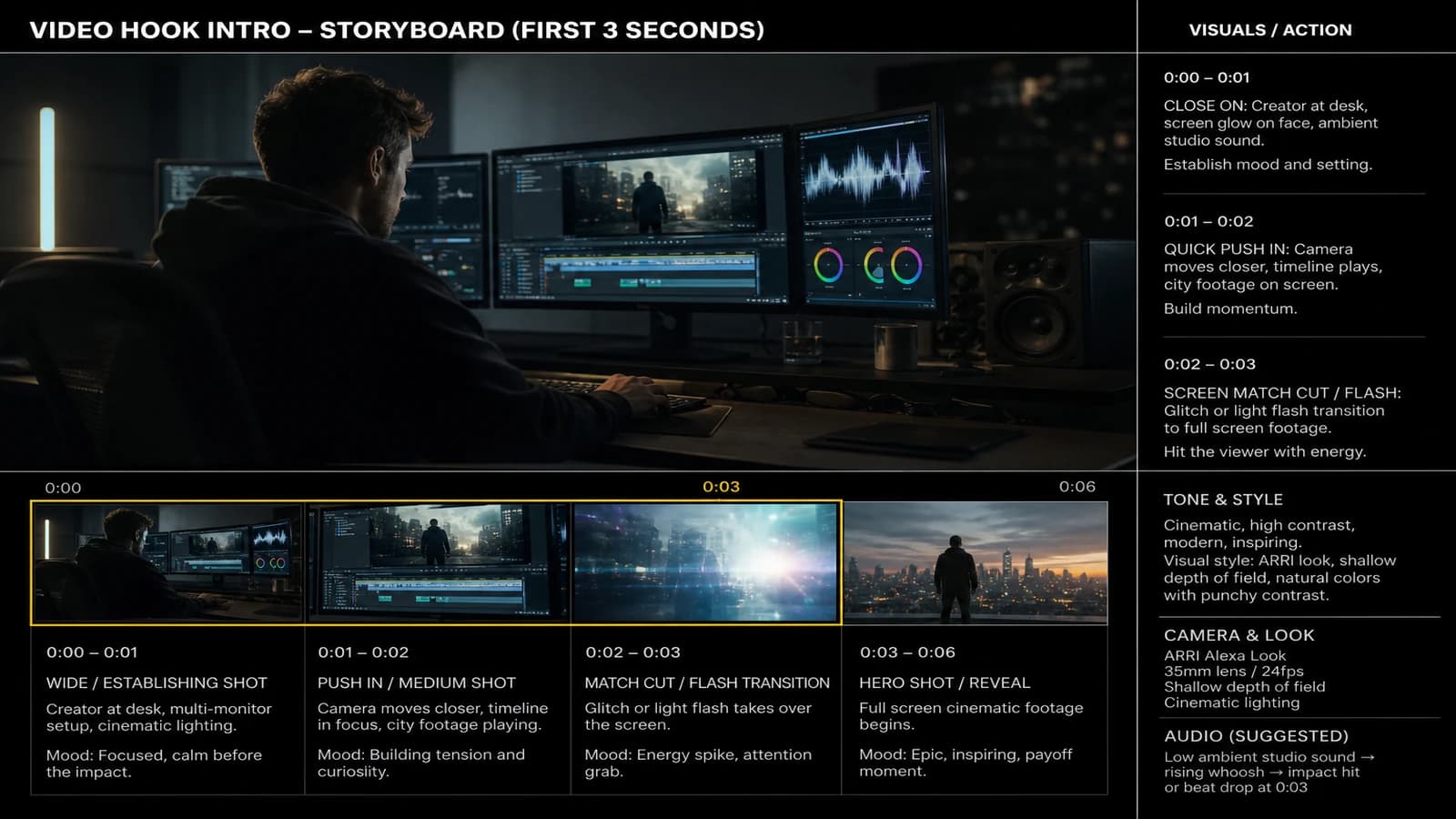
Three seconds. That is how long a viewer gives you before scrolling away. With AI, the temptation is to compensate with a spectacular effect. The result: attention captured, trust lost. Designing effective AI video hooks in 3 seconds takes more precision than a two-minute shot.
I have seen technically perfect AI videos die in the first second because the hook promised one thing and the content delivered another.
What a hook really does
A hook is not disguised clickbait. It is a visual and sonic promise that the rest of the video will keep. It asks a question, creates tension, or shows an intriguing result.
Effective hooks rest on: curiosity, identification, contrast, or proof.
To calibrate the duration, cross-reference with choosing the right shot length for your AI intention.
💡 Frank's Cut: test your hook on mute on mobile. If the image alone cannot hold three seconds, sound will not save a weak hook.
Anatomy of the first three seconds
0-1s: visual impact. Clear subject, strong movement or detail, readable composition.
1-2s: information or tension. The viewer understands what it is about.
2-3s: engagement. Look to camera, short text, cut to the action.
| Hook type | Mechanism | Risk to avoid |
|---|---|---|
| Visual question | Intrigue | Too abstract |
| Relatable problem | Identification | Stock cliche |
| Before/after | Contrast | Unrealistic after |
| Incoming movement | Dynamic | AI jitter |
| Partial reveal | Shows without telling all | Resolving too early |
Field workflow
Step 1: the promise in one sentence
The hook is the compressed version of "After this video, the viewer will know/feel ___".
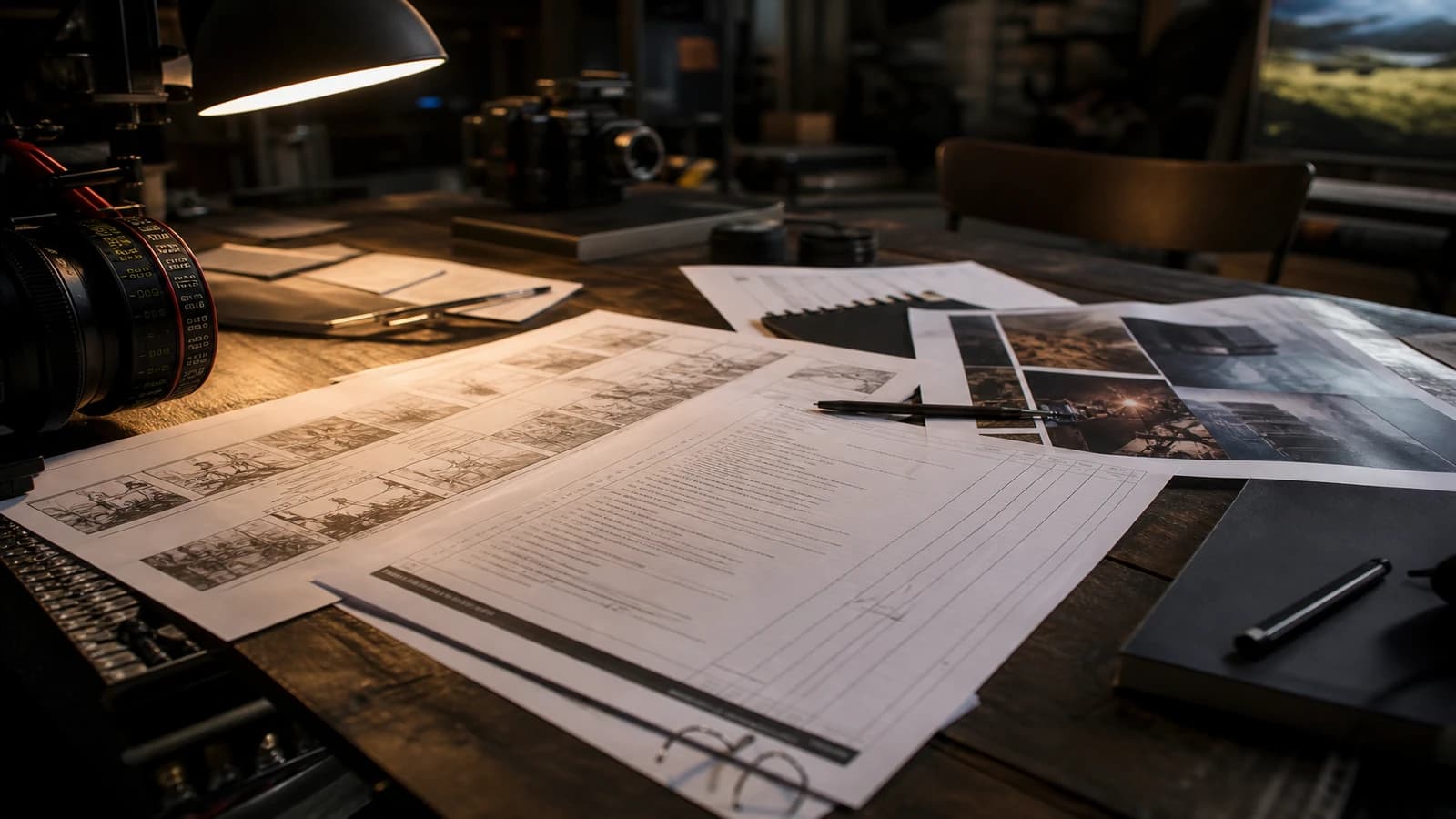
Step 2: storyboard the hook
Three frames: 0s, 1.5s, 3s. See AI storyboarding: turning your script into a cinematic vision.
Step 3: dedicated generation
Four to six variations, one lever changed per iteration. Generated duration: 3-4 seconds.
Step 4: hook-specific A/B/C sorting
A if: readable on mute, one clear idea, consistent with the video, no distracting artifact.
Step 5: sound and text together
Sonic impact at 0s or voice from 0.5s. Overlay text, three words max.
Step 6: A/B test
Two hooks, same promise, different compositions.
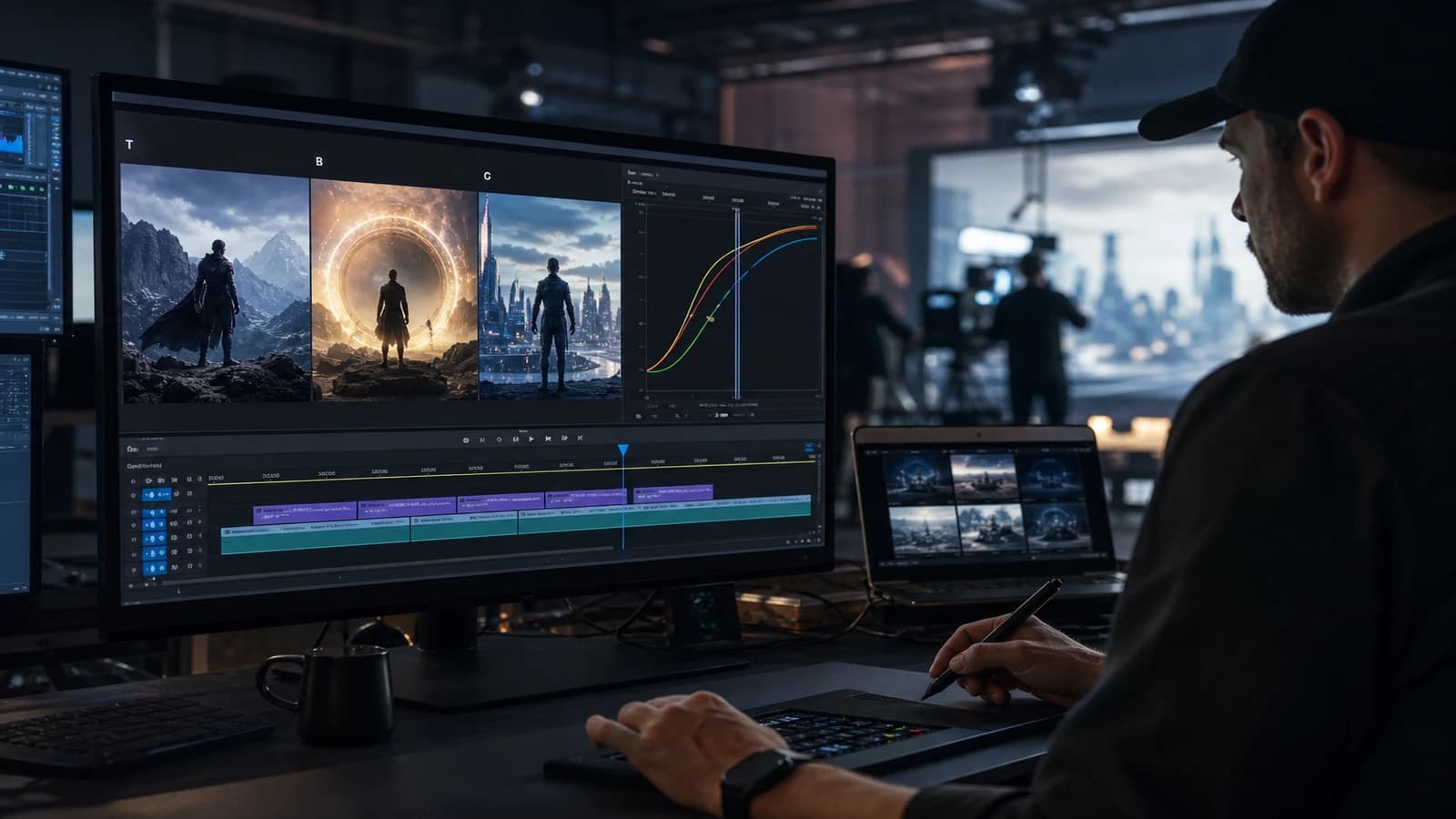
Step 7: hook-to-body transition
Plan a bridge at second 3 to 5. See mastering transitions between AI video shots.
Real scenarios
AI tutorial. Final result at 1s, then "how I got there".
6s ad. Problem at 1.5s, product at 1.5s. Logo at the end.
Fiction. A narrative detail, not the climax.
LinkedIn. Stat plus a sober metaphor.
E-learning. A common mistake visible in 1s.
The hook and the algorithm
A hook that lies gives a CTR spike then a drop at second 5. An honest hook builds retention. Note CTR and 30-second retention per variant.
Common mistakes
Spectacular hook, ordinary body. Fix: validate the body's style first.
Too much information in 3s. Fix: one idea.
Text unreadable on mobile. Fix: three words max, strong contrast.
Jittery movement. Fix: static shot or very slow dolly.
For thumbnails, see creating YouTube thumbnails consistent with your AI video.
YouTube research on the first seconds and Nielsen's documentation on attention confirm that image-sound coherence comes first.
Foire aux questions
Réponses rapides aux questions les plus fréquentes sur cet article.
Does a hook always have to be spectacular?
No. A close-up that asks a question can beat an AI explosion with no link to what follows.
How do I hook without lying about the AI?
Show a result you are going to explain. Not a frame from another project.
A different hook per platform?
Often yes. Vertical is tighter. Long-form YouTube can start more contemplative.
Does the hook count for SEO?
Indirectly, through algorithmic retention.
How many versions should I generate?
Minimum four, ideally six.
Stock for the hook?
Avoid mixing stock and AI body without an owned hybrid format.
A hook with no character?
Product, set, animated text, macro. A single focal point.
Branding in the first second?
Rarely in a short ad. Never a full-screen logo that replaces the hook.
Too strong a hook?
Yes, if the body does not keep the promise. Calibrate the intensity.
Iterate six hooks without losing the thread?
Number them H1-H6, one variable per version, note the metrics.
Three seconds are a contract with your viewer. Apply this method to designing effective AI video hooks in 3 seconds, and your videos will hold the attention they deserve.
A hook library by format
Build a personal library over time: tutorial (result 1s plus process), ad (problem 1.5s plus product), fiction (atmospheric detail), corporate (stat plus a sober metaphor). Each format has its register. Copying the TikTok hook onto LinkedIn corporate breaks credibility.
Hook and thumbnail aligned
The video hook and the thumbnail form a double promise. If the thumbnail shows a before/after, frame 0 of the video must be the same before, or an immediate zoom out. See creating YouTube thumbnails consistent with your AI video.
Mandatory mute test
Most feeds start without audio. Clear movement, readable contrast, minimal overlay text. Sound enriches, it does not save a weak visual hook.
FAQ (extras)
Can a hook be too strong?
Yes, if the body does not keep the promise. Calibrate the intensity of the hook to the real intensity of the content.
How do I iterate six hooks cleanly?
Number them H1-H6, one variable per version (framing, movement, text). Note CTR and 10-second retention.
Three seconds are a contract. Apply this method to designing effective AI video hooks in 3 seconds.
Hook, thumbnail and title: a triple promise
The video hook, the YouTube thumbnail and the title form a triple promise. If one lies, the other two betray too. Align all three before generation: same subject, same register, same intensity level. See creating YouTube thumbnails consistent with your AI video.
A personal hook library
Build it over time: tutorial (result 1s plus process), ad (problem plus product), fiction (atmospheric detail), corporate (stat plus metaphor). Copying the TikTok hook onto LinkedIn corporate breaks credibility, even if the CTR spikes temporarily.
Honest A/B iteration
Number them H1 to H6. One variable per version: framing, movement, overlay text. Note CTR and 10-second retention. After three videos, you see which lever works for your channel.
The spectacular hook with no link to the body of the video is visual clickbait. The algorithm measures the retention drop at second 5. A modest but honest hook builds long-term distribution.
Anatomy second by second (deep dive)
Second 0-1: visual impact, clear subject, composition readable vertical and horizontal. Second 1-2: information or tension, the viewer understands the direction. Second 2-3: engagement, look to camera, short text, or cut to the action.
Test six variations with a single lever changed: framing, movement, text presence. Sort A/B/C with hook-specific criteria: readable on mute, one idea, consistent with the body, no artifact on the subject.
For the storyboard of the hook alone, see AI storyboarding: turning your script into a cinematic vision. Five minutes of sketching avoid hours of random generation.
The second 3 to 5 transition is critical: a strong hook followed by a drop in pace makes people leave. Plan a musical bridge or a match cut.
The viewer decides while scrolling at a wild speed. Your hook must work with no sound, no read title, no context. If you have to explain the hook in a meeting, it is too weak. Generate six versions, test on five people in your target, time the moment they look away. It is brutal. It is effective.
Hook mistakes that kill retention
Spectacular hook, ordinary body: generate the hook after validating the style of the body. Too much info in 3s: one idea only. Text unreadable on mobile: three words max. Jittery movement: static shot or very slow dolly. Sound that announces a different tone: the sonic hook sets the contract for the whole video.
For hook-to-body transitions, see mastering transitions between AI video shots. Second 3 to 5 is as important as second 0 to 3.
YouTube research on the first seconds confirms: initial retention predicts distribution.
Detailed hook scenarios
Tutorial. Final result for 1 second, cut to "how I got there". The promise is the result, the content holds.
6s ad. Problem 1.5s, product 1.5s. No logo first.
Fiction. A narrative detail (a door ajar, a sound). Not the climax.
LinkedIn. Stat plus a sober metaphor. No cheap camera shake.
E-learning. A common mistake visible in 1s. The viewer knows they will learn.
Each format has its hook register. Copying TikTok onto corporate breaks credibility.
Invest a disproportionate share of your generation time on these three seconds. It is the most profitable shot to optimize. Four to six versions minimum. The hook deserves as many iterations as a hero shot in an ad.
Hook types table
| Type | Mechanism | Risk |
|---|---|---|
| Visual question | Intrigue | Too abstract |
| Relatable problem | Identification | Cliche |
| Before/after | Contrast | Unrealistic after |
| Incoming movement | Dynamic | AI jitter |
| Partial reveal | Tension | Resolving too early |
Choose the lever before you generate. One per hook.
Nielsen's documentation on attention confirms: the initial hook conditions engagement. With AI, you can iterate six hooks in an hour. Use that speed for promises kept, not hollow shocks. Note CTR and 30-second retention per variant. Honest hook plus clear title plus aligned thumbnail equals a channel that grows. A lying hook equals spike then drop. Choose your horizon.
Apply this method to designing effective AI video hooks in 3 seconds, and your videos will hold the attention they deserve. Three seconds are a contract with your viewer. With AI, you have the most powerful tool to waste them or to master them. Design the hook as a promise kept, not as a trap. The hook is the door. The body of the video is the room. If the door promises a palace and the room is a garage, you lose.
Generate the hook in a dedicated batch. Four to six variations. One lever per iteration. Sort A B C with hook criteria: mute, one idea, body coherence, no distracting artifact. Hook C is a rejection with no discussion, even if it is spectacular.
For the exact hook duration, see choosing the right shot length for your AI intention. Hook 1.5 to 2.5 seconds in the edit, 3-second generation. A 0.5-second margin to pick the most stable segment.
Conclusion
Three seconds are not a technical detail. It is the moment your viewer decides to stay or to scroll. With AI, you can iterate six hooks in an hour: use that speed for promises kept, not for hollow shocks that crash retention at second 5.
Storyboard three frames (0s, 1.5s, 3s) before the batch. One lever per variation. Mute test on mobile. Musical bridge or match cut between second 3 and the body. Hook, thumbnail and title aligned. That is the discipline that turns a channel into a recurring audience.
Apply this method to designing effective AI video hooks in 3 seconds. The hook is the door. The body is the room. If the door promises a palace and the room is a garage, you lose. Design the hook as a promise you are proud to keep.
Note your metrics per variant: CTR at 24h, retention at 10 and 30 seconds. After three videos, you will see which lever works for your channel: contrast, movement, overlay text, or partial reveal. This personal library is worth more than an AI model updated every week.
The first three seconds checklist
Frame 1: subject identifiable without reading the title. Frame 30: clear conflict or promise. Frame 60: a reason not to scroll. Contrast: movement or light that breaks the feed. Sound: impact or voice from second 1 if the platform allows it. Text: three words max in overlay, never competing with the face. Test on mobile with no sound: if you do not understand the subject, the hook is dead. Regenerate the opening shot before the body of the video.
💡 Frank's Cut: edit the hook before you polish the middle. A weak intro kills a perfect video.
Document the validated version with the date: the memory of the project is worth more than the latest winning prompt.
Publishing threshold: do not validate until the mobile-without-sound test has passed.
Related articles
 Tutoriels
How to Write an Effective Script for an AI-Generated Video
Page format, beats, usable visual descriptions, and dialogues that survive the generation.
 Tutoriels
Choosing the Right Shot Duration According to AI Intention
A practical guide to calibrate the duration of each shot according to emotion, action and editing rhythm.
 Tutoriels
Flicker in AI Video: Causes and Solutions
Your AI video flickers between frames? Here are the real causes of flicker and a concrete method to fix it, at generation as much as at the edit.