Generating the Original Score of Your Film or Clip With AI Music
A complete method to generate an AI score that serves the narration, the rhythm and the emotion of a film or a clip.
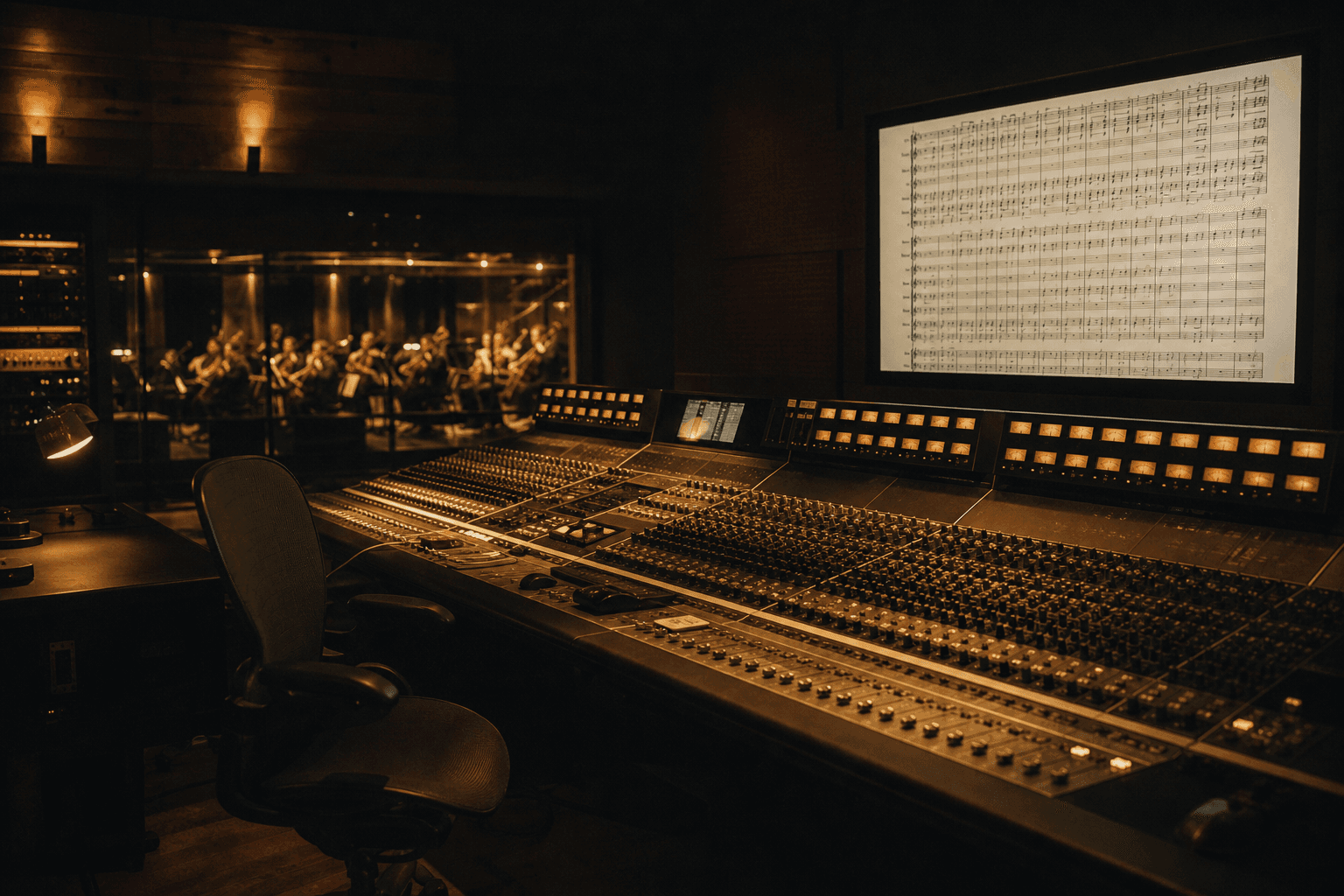
You have a beautiful sequence. The image holds. The edit tells something. Then you lay a "cinematic" loop found in 30 seconds, and everything flattens, brutally, for nothing. The emotion becomes generic. The viewer no longer enters your film, they just hear "AI background music". It is the number-one trap.
I am going to be clear. Generating a score with AI music is not choosing a style and clicking Generate. It is a musical direction. You must steer tension, silence, dynamics, texture, and the relationship to the image. With no this direction, you get a clean but narratively useless sound.
In this guide, we are going to work like in a post-production studio: emotional mapping, creation of short motifs, arrangement by dramatic blocks, timeline integration, then mix and distribution control. The goal is simple: produce a score that serves the scene, not a music that uses the scene to exist, durably, really.
Core concepts: what separates a credible AI score from a generic loop
First concept, the music is not a carpet. It is a parallel dramaturgy. It must open, support, restart, suspend, then release. When the score stays at the same intensity level from start to end, it tires and ends up crushing the narration. In film as in a clip, the emotional arc counts more than the isolated beauty of a sound.
Second concept, the motif wins against the block. Beginners want to generate a final track in one go. Bad approach. Instead, create cells: an intro texture, a tension motif, a transition impact, an ending fall. Then you assemble these cells according to the edit. This method gives you enormous control.
Third concept, the silence is a narrative tool. Many AI scores fail because they fill all the space. A silence of 300 to 800 ms before a revelation can be more powerful than a 20-second crescendo. The viewer's ear needs contrasts to feel.
Fourth concept, the voice-music relationship. If you produce a video with narration, interview, or dialogue, your score must let the intelligibility zones breathe. Otherwise the video "sounds rich" but becomes painful to follow. To prepare this vocal base well, our guide on AI dubbing and voice-over will help you avoid the conflicts from the audio pre-production.
Fifth concept, the sound identity must stay consistent with the visual identity. An organic image with grain and material rarely calls for an ultra-synthetic brilliant score, except for a precise narrative intention. If you want to keep this global consistency, our complete workflow from idea to realistic AI film gives you the ideal decision structure.
Sixth concept, the musical memory. A good score leaves a simple trace in the ear, often thanks to a short recurring motif. Beginners complicate too fast with several themes and counter-themes. Result, nothing stays. In AI music, this problem is even more frequent because it is easy to generate seductive but incompatible ideas. Keep a clear main motif and make it evolve instead of changing sound identity every twenty seconds.
| Situation | Musical goal | Recommended AI construction | Common mistake | Effective fix |
|---|---|---|---|---|
| Short dramatic film | Tension + breathing | Progressive motifs + targeted silences | too many permanent layers | remove 20-30% of the elements |
| Stylized clip | Impact + identity | Signature texture + scripted drops | build-up with no payoff | mark the pivots with clean impacts |
| Video ad | Clarity + conversion | Strong intro + cleared voice zone + CTA impact | music too present under the voice | dig the music mids |
| Series teaser | Mystery + memory | a short repeatable motif + timbre variation | too-complex theme | simplify the main line |
The trench workflow: a field method to compose a useful AI score
You start with an emotional map of your timeline. Yes, even for 30 seconds. Note the tipping points: entrance, tension, revelation, release, call to action. Each point must correspond to a sound decision. With no this map, you will lay the music "by ear" and lose the story.
Then, define a project sound vocabulary. Example: a muffled low pulse, a grainy organic texture, a minimal prepared piano, discreet impacts. This vocabulary avoids wandering between a hundred presets. You stay in a coherent sound family, even when you test several AI generators.
Third step, generate short and often. Segments of 8 to 20 seconds are enough to validate an idea. Many creators waste time producing long tracks that will be re-cut anyway. In short form, you test faster and make better decisions.
Finally, assemble in the timeline with narrative logic before mixing finely. You must already feel the emotional progression in the raw version. If it does not work at this stage, do not compress everything hoping for a miracle. Come back to the structure.
A field tip that changes everything: work with a "skeleton version" of the score, very simple, before the final version. This version contains only the essential narrative supports, with no dressing. If the scene works with this skeleton, you can enrich without losing the meaning. If it does not work, no point adding layers. It is the most effective test I use with beginner creators to avoid overloaded sound edits.
Step 1: map the emotion scene by scene
Take your timeline and place markers. Beginning, turn, climax, fall. For each marker, write a clear intention in three words maximum. For example: "fragile, uncertain, cold", then "urgency, density, pressure". This simple constraint forces a real musical direction.
Then associate a dynamic to each zone: weak, medium, strong, silence. You must avoid the emotional plateau. A constant score tires. A contrasted score tells. Even in a rhythmic clip, you need micro-variations to keep the attention.
Do this work before opening the AI tools. It is the best investment of time. You avoid generating 25 stylish but unusable versions. In practice, this preparation reduces the number of retakes by half.
When you hesitate between two intentions, choose the one that reinforces the narrative point of view of the scene. The music is not there to "make it pretty". It must clarify what the viewer feels.
Step 2: generate musical cells, not a locked track
Create short cells by function. An atmospheric intro, a tension motif, a build-up, an impact, an exit. Each cell must be able to combine with the others. It is the modular logic. It gives you flexibility when the edit moves.
Test several densities for each cell. Minimal version, standard version, dense version. You will be able to swap them according to the space left by the voices and the effects. In real production, this flexibility is an enormous advantage.
Avoid the vague instructions like "cinematic epic emotional". Be precise: perceived tempo, texture, dominant frequency register, percussion level, degree of harmonic saturation. The more musical your instructions, the less generic the result.
Keep a cleanly named project library: score_intro_a1, score_tension_b2, score_drop_c1. You must find a variant in 5 seconds. File chaos kills the creative speed.
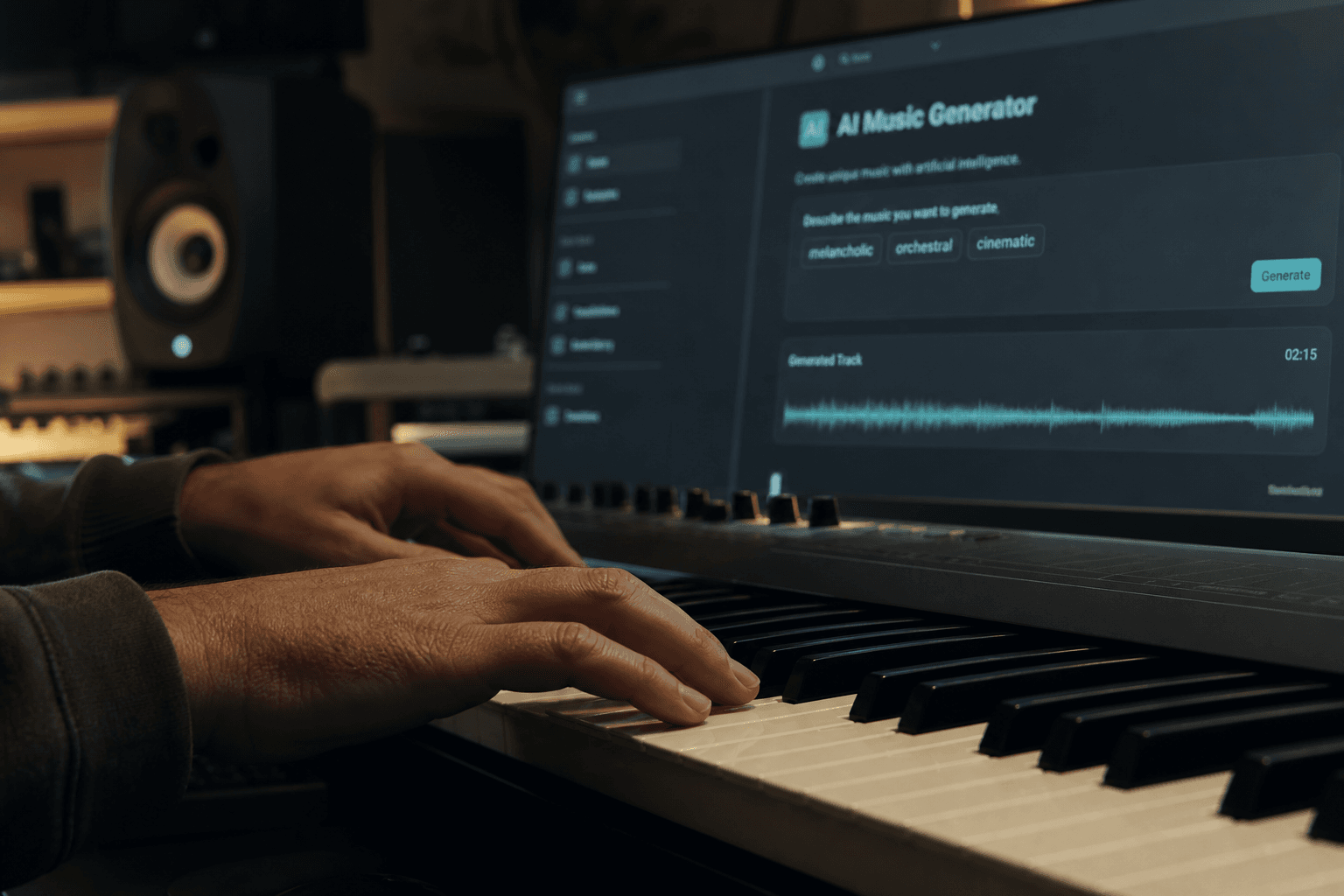
💡 Frank's Cut: if a cell is "impressive" but matches nothing, archive it. Never force the edit to save a sound idea.
Step 3: edit the score in image context with impact points
First place the cells at the narrative markers. Do not try to cover the whole timeline immediately. You lay the anchor points, then you link them. This method makes the progression readable from the first minutes of work.
Then align the sound impacts with the major visual actions. A glance, a door opening, an axis change, text appearance, product reveal. The impact does not need to be strong. It must be accurate. A subtle synchronization is often more elegant than an aggressive accent.
Plan breathing zones with no music. On a strong narration, these zones increase the attention and improve the comprehension. Many AI videos fail because they fill every second. Silence is a persuasion tool.
When the image changes, adapt the sound color, not only the volume. An intimate passage does not just demand -3 dB. It demands a different timbre, a lower density, sometimes a complete percussive removal.
Also think about the invisible transitions. A good musical transition must not always be perceived as an effect. It can be a texture shift, a register change, a harmonic breath. These fine transitions give a high-end fluidity feeling that distinguishes a handcrafted score from a hastily assembled one.
Step 4: mix for clarity and real distribution
The mix starts with the priority of the messages. In general: voice, critical narrative elements, then music. If your score masks the diction, you lost. Cut into the music mids where the voice lives, then adjust the global level.
Apply a controlled music compression, never crushing. You want sustain, not a sound brick. The dynamics participate in the emotion. Compressing too much kills the dramatic breathing.
Test your version on headphones, simple speakers, laptop, smartphone. A score can be perfect in the studio and invasive on mobile. This multi-support control is non-negotiable for a pro publication.
If your video includes very textured generated shots, also harmonize the global sound feeling with the visual render. To stabilize this image-sound link, our AI-assisted video editing guide helps you keep an end-to-end consistency.
Before the final export, do an "auditory fatigue" pass. Listen at low volume, then come back to normal volume. The density flaws, the frequency conflicts and the too-aggressive elements appear better in this alternation. It is a simple but formidably effective trick when you have spent several hours on the same sequence.
Troubleshooting: what beginners break in an AI score
Mistake number one, continuous music with no breathing. Everything is full, all the time. The viewer tires and the emotion crushes. Correction: introduce troughs, targeted silences, and low-density zones.
Mistake number two, voice-music conflict. The narration becomes hard to follow. Correction: dig the conflicting frequencies, reduce the instrumental density under the voice, and adjust the level automation.
Mistake number three, a collage of incompatible styles. An ambient intro, an aggressive trap middle, an epic orchestral ending with no logic. Correction: define a project sound palette and limit the aesthetic gaps not motivated narratively.
Mistake number four, a lack of narrative impacts. The music is beautiful but underlines nothing. Correction: place accents on the tipping points of the edit and precisely synchronize the important transitions.
Mistake number five, dependence on a single tool. Some engines excel on the textures, others on the rhythmic motifs. Correction: combine the strengths intelligently or at minimum test two engines before the final lock.
Mistake number five bis, ignoring the duration variations. A score that works over 60 seconds can collapse over 30 seconds if the emotional pivots disappear. Correction: prepare from the start a short version and a long version, with impact points adapted to each format.
Mistake number six, absence of versioning. After 20 retouches, impossible to come back to a version that worked. Correction: strict naming, regular snapshots, and a decision log.
To structure your learning, lean on solid resources like the EBU R128 recommendations, the principles of LUFS, and the DaVinci Resolve Fairlight documentation. These bases help you mix cleanly beyond the passing fads.
💡 Frank's Cut: a good AI score is not noticed right away. It is felt. If people talk about the music before talking about the scene, it often means it takes too much space.
FAQ: essential questions about the AI score for film and clip
-
Which AI music tool to choose to compose a credible score?
Choose according to the project, not the buzz. For a filmic score, favor a tool capable of dynamic nuances and evolving textures. For a fast social media clip, an engine more oriented toward rhythm and hooks can be enough. The best test stays practical: take a real scene from your project, generate three variants, then evaluate in the complete timeline. If the music holds in a voice + image + effects context, the tool is valid. Otherwise, even with a seductive isolated render, it does not serve your pipeline. -
Should you generate a complete track or short segments?
The short segments almost always win in production. They let you finely adjust the narration, replace a weak zone without redoing the whole track, and stick to the edit that evolves. A complete track can be useful as a direction reference, but it quickly becomes rigid when the timeline moves. In practice, a modular approach with intro, tension, transition, climax, exit cells offers much more control. It is also the best strategy to avoid the monotonous render that betrays many beginner AI scores. -
How to avoid an AI music sounding generic?
The generic render mostly comes from vague prompts and the absence of narrative direction. Be precise about the emotion, the texture, the rhythm, the density, and the function of each segment. Avoid the catch-all formulations like "epic cinematic emotional". Build a limited but owned sound identity, then decline it. In the edit, favor the contrasts and the silence rather than a constant density. Finally, adjust the score to your real images. A music thought for your scene will always sound more specific than a seductive but story-disconnected preset. -
What music volume to aim for when there is a voice-over?
There is no single number valid everywhere, but the rule is simple: the voice must stay intelligible with no effort. Start by placing the voice cleanly, then adapt the score around it, with automation and EQ. Reduce the instrumental density in the speech zones, not only the global volume. The conflict often plays out in the mids. Then test on mobile, because that is where the maskings become obvious. A correct mix in the studio can be messy in real distribution if you have not controlled the common consumption supports. -
How to synchronize the musical impacts with the edit without overloading?
First select a few major narrative points, not every cut. A well-placed impact on a meaning shift is better than ten decorative accents. Use timeline markers and check that each accent brings emotional or narrative information. If an impact brings nothing, remove it. The impact overload is a frequent problem in AI content because the tools make the creation of effects too easy. Keep a logic of strategic sobriety. What is rare becomes precious to the viewer's ear. -
How to handle the usage rights of an AI-generated score?
You must precisely check the license conditions of the tool used, especially for a commercial distribution. Some platforms authorize pro use under conditions, others impose restrictions of territory, monetization, or exclusivity. Always keep a trace of the generated versions and the applicable terms at the moment of the creation. In case of a client or a distribution, this traceability is indispensable. The main risk is not technical, it is legal and contractual. An effective but badly licensed score can block a whole project. -
How to know if my score really serves the narration?
Do three simple tests. Watch the scene with no music, then with music, then with very low music. If the music version clarifies the emotion without harming the comprehension, you are on the right track. If it diverts the attention, it is because it is too present or badly oriented. Also observe the first-listen returns: do people talk about the story or only about the sound? A successful score supports the scene discreetly. It reinforces the meaning without stealing the narrative center of gravity. -
What work routine to apply this week to progress fast?
Do a structured 90-minute sprint. 20 minutes of emotional mapping, 30 minutes of short cell generation, 25 minutes of timeline assembly, 15 minutes of basic mix and multi-support control. Keep a clean "safe" version and a more ambitious "bold" version. Document what works and what breaks. Repeat on two different scenes. This routine will give you a real progression system instead of a succession of scattered tries. It is the best way to quickly raise the quality of your AI scores.
Related articles
 Tutoriels
Copyright and AI Music for a Film Soundtrack
What the tool licenses cover, client clauses, and hybrid composer + AI alternatives.
Tutoriels
Generating a Complete Professional Storyboard With AI
A step-by-step masterclass to create a complete, coherent and production-ready AI storyboard, with no visual drift or unusable shots.
 Tutoriels
Generating a Realistic Crowd With No Clones or Identical Faces
Breakdown, depth, costume variation and post for credible crowd shots in fiction and advertising.