AI film director: a real job or a LinkedIn title?
Is AI film director a real job or a padded title? What the DGA contract says, what real 2026 job ads ask for, and my five-question test to tell them apart.
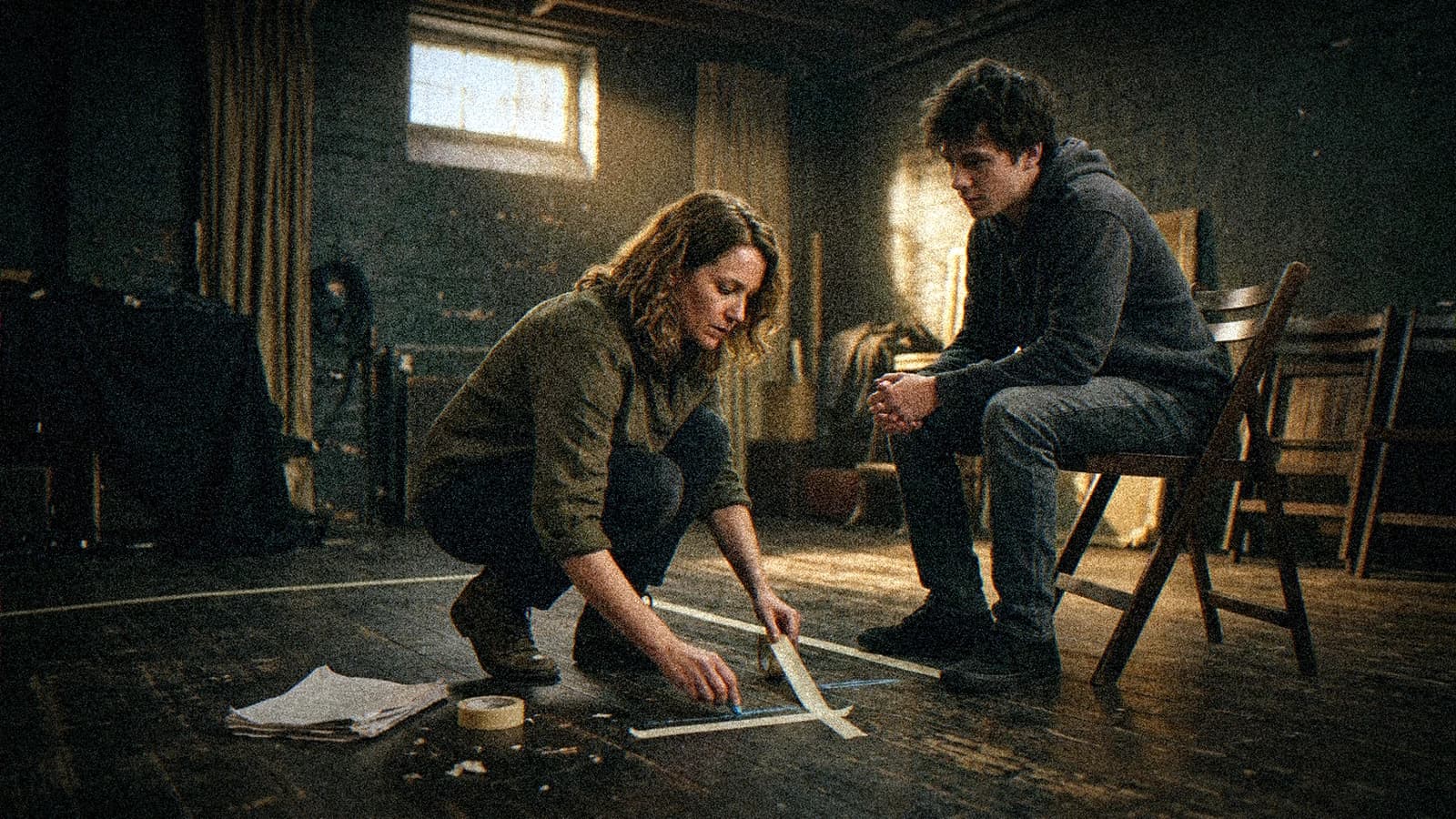
Search "AI film director" on LinkedIn. You'll get hundreds of profiles. Some of these people have a feature film behind them. Others generated four eight-second clips last month and updated their headline the same evening. Both use the exact same words, and a client looking for someone to run a campaign has no way to tell them apart from the bio.
I'm in no position to sneer: "AI filmmaker" sits right at the top of my own website. I directed VOIDBORN, Ronces and the first two episodes of Lost Garden. So when people ask me whether the title means anything, I can't answer from the sidelines. The job exists, and contracts and job ads prove it. The title has become so easy to wear that on its own it proves nothing.
Why the title gets under people's skin
"Director" carries weight. In traditional film you earn it over years: assisting, self-funded shorts, a first feature scraped together against the odds. When someone claims it after a week on a video generator, people in the industry feel robbed, and I get why.
That irritation mixes two things, though. One is speed: you can now finish a short film without a crew, and that stings for people who paid full price to learn. That's a shift in the era and nobody can reverse it. The other is fraud: people who have never made a single directing decision calling a typed prompt "directing". That one is a real problem, and it's the one worth going after.
The title itself is innocent. Nobody blinks at "animation director" or "commercials director". You name the medium, and skill gets judged somewhere else. "AI director" follows the same logic: it says what you make things with. About whether you can run a film, it says nothing, and clients end up settling that question themselves.
💡 Frank's Cut: when you see "AI director" on a profile, look for what comes next. "AI director of what?" A title followed by a named film, series or campaign is worth something. A title followed by a list of tools, much less.
What the contracts already say about directors
In the US, the question "can a machine be the director?" got a written answer back in 2023. In the agreement the Directors Guild of America signed with the studios that year, the DGA's official summary says members' duties must be assigned to a person and that generative AI does not constitute a person. Employers also can't use generative AI on creative elements without consulting the director.
Consulting doesn't mean getting a yes. Plenty of members found the wording too soft at the time, and they had a point: a studio could listen to the director and then do whatever it wanted. Three years later, the text moved.
On June 9, 2026, the DGA reached a new tentative agreement with the AMPTP, the producers' alliance. The national board unanimously recommended ratification of a four-year contract, with the member vote closing on June 25. The DGA press release lists two AI points: the 2023 safeguards are renewed (the work must still be performed by a person), and a new provision establishes the director's control over AI-generated footage, along with a skills program funded by employers.
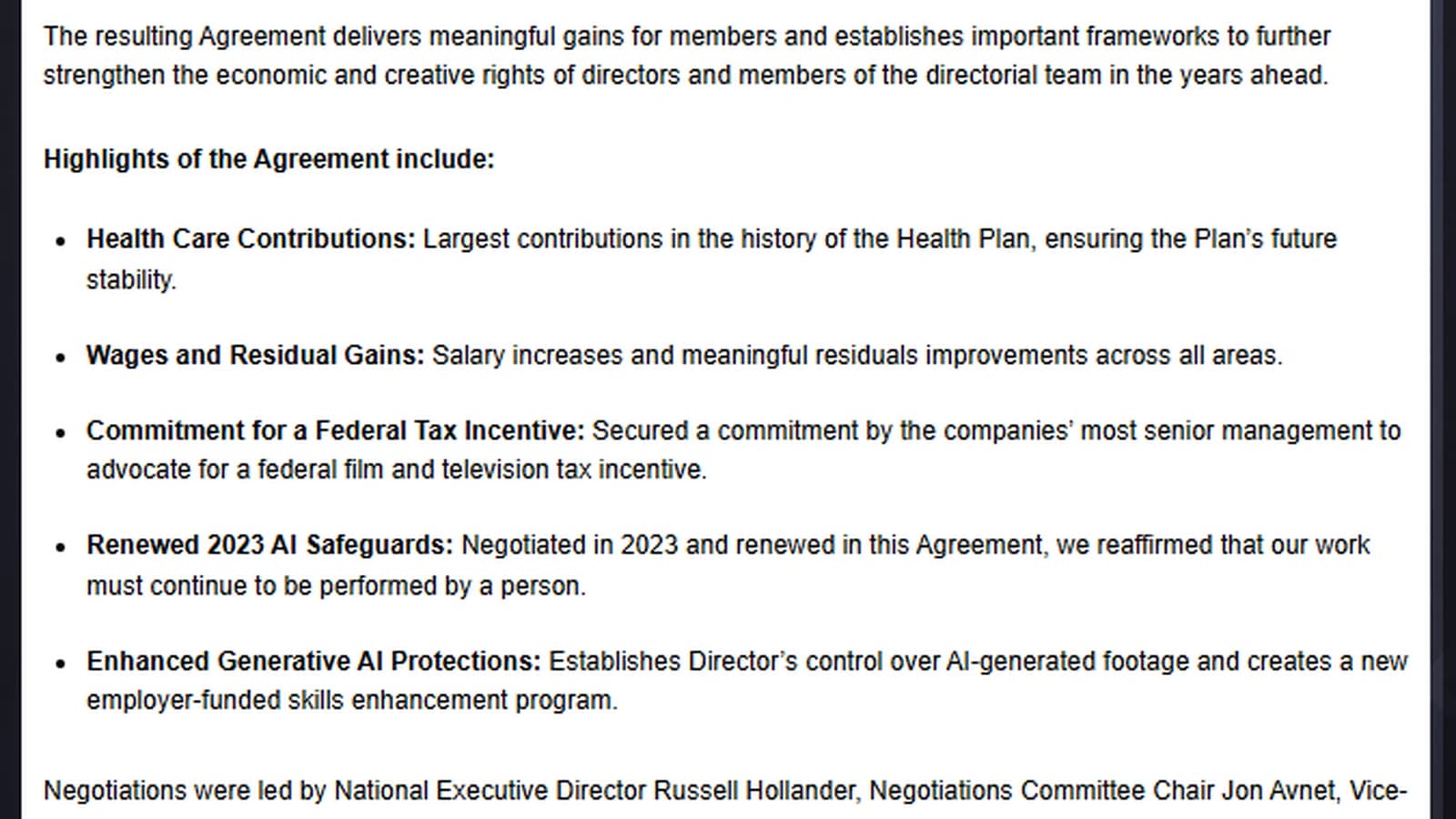
Source: Directors Guild of America press release of June 12, 2026, captured on October 15, 2026.
Read the union's wording again: the person directing stays human, and generated images fall under that person's control. So AI has a place in its members' films, provided a director is running it. What vanishes, on paper, is the idea of a film "directed by AI".
For the record, actors got their own framework the same year with the SAG-AFTRA contract that runs until June 30, 2030. I cover it in detail in my forecast of the film studio in 2030.
What real job ads ask for
Contracts set the frame. Job ads tell you what companies actually pay for. I went through three posted in 2026 that use the word "director" around AI. They tell three different stories.
The first comes from Higgsfield AI, a company that builds video generation tools. In May 2026 it was hiring a "Film / Commercial Director" in Almaty, Kazakhstan. You'd expect an AI company to put prompting skills first. Look at the list:
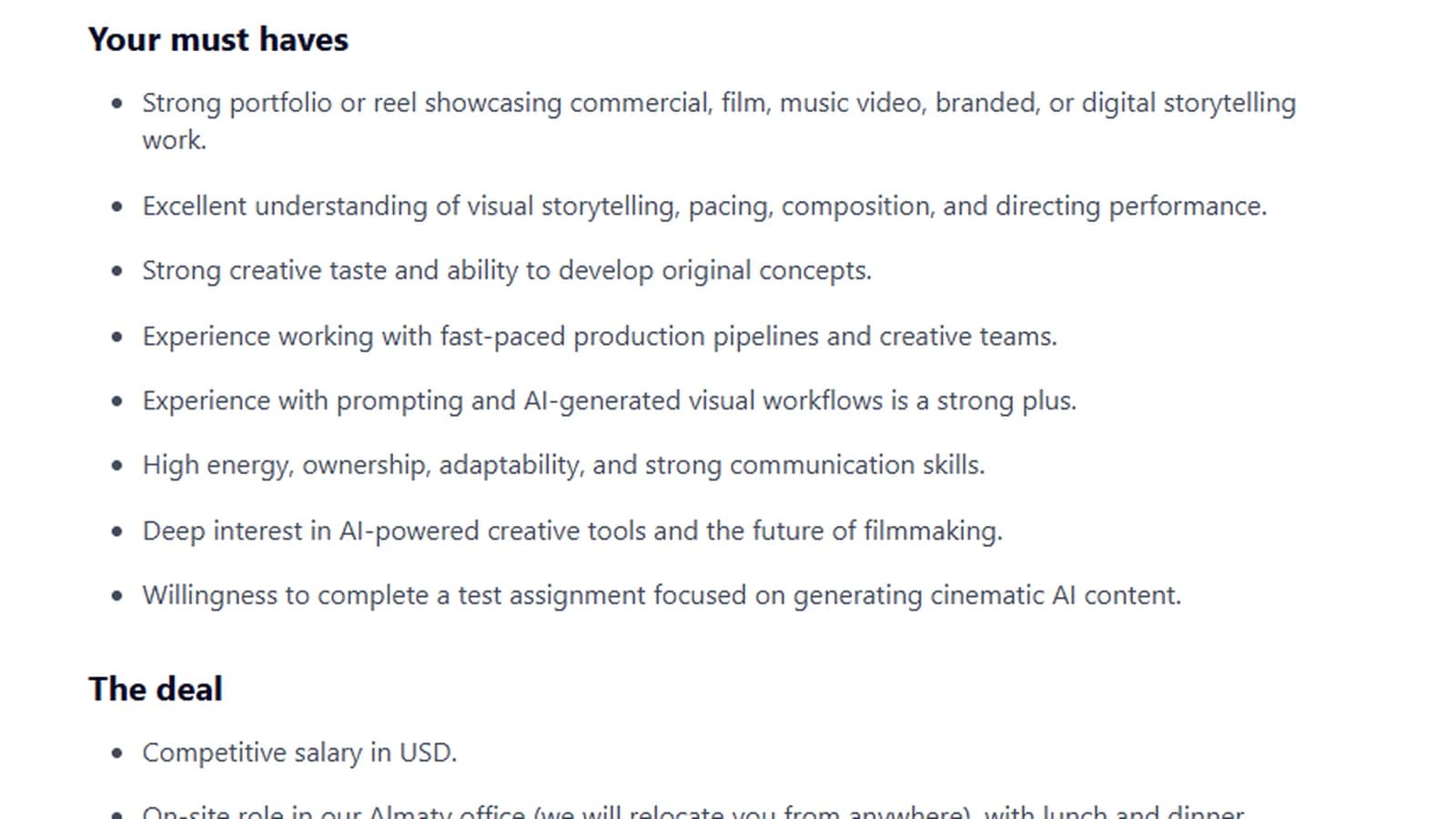
Source: "Film / Commercial Director" job ad from Higgsfield AI, posted May 29, 2026 on Accel's job board, captured on October 15, 2026.
A portfolio or reel. An excellent grasp of visual storytelling, pacing, composition and directing performance. Taste, and the ability to develop original concepts. Experience with prompting and AI-generated visual workflows comes later, framed as "a strong plus", and higher up the ad says a candidate who is excited to learn extremely fast is welcome too. A company that sells AI tools hires a director for directing skills and treats the tool as the part you can pick up.
The second, posted in June 2026 by a company called Reppls on Techstars' job board, was looking for a "Film Director & Showrunner (AI-Tech)" based in Spain to lead short-drama series. The ad calls the role a "one-person studio". Candidates need proven experience as a director or showrunner, a strong feel for pacing and emotional storytelling, expert editing in Premiere Pro, DaVinci Resolve or Avid, After Effects compositing to clean up artifacts, and working knowledge of tools like Midjourney, Runway or Luma. The detail I find most telling: the application requires a 1 to 5 minute AI film plus a breakdown of your responsibilities and workflow on it. They want to know who decided what.
The third is a vocabulary trap. Lionsgate posted a "Director, Creative AI & Production Technology" role in Santa Monica. Here "director" is a management title: set the studio's AI roadmap, run pilots, design workflows for artists. The ad asks for eight-plus years in media production. It's a real, well-paid job that sits in production management. If you see it translated as "AI film director" in a LinkedIn post, someone got it wrong.
Across those three ads, the market pays directors who know how to use AI. I didn't find a single ad paying someone to use AI and calling them a director for it.
My five-question test
When a client asks me to help pick a provider, or a student asks whether they can call themselves an AI director, I ask the same questions. They don't measure talent. They only check that someone has made directing decisions.
First: have you finished a film, even a short one, with a beginning, an end and a cut you locked yourself? A compilation of nice shots doesn't count. Finishing means you decided what stays and what goes, and that's the most painful call in the job.
Second: can you explain why the camera sits where it does in a given shot? "Because it looked nice" doesn't count. You need to say how that point of view serves that moment of the story. I break this decision down in how to think like a director with AI.
Third: have you ever thrown away a technically perfect generation because the performance rang false? This question sorts people fastest. An operator usually keeps everything that looks good, while a director will cut a gorgeous shot without a second thought if it slows the scene down.
Fourth: can you show your breakdown? The script or director's statement, the shot list, a few abandoned versions, the edit. Exactly what Reppls asked for in its ad.
Fifth: has someone other than you watched the film to the end without being asked? A festival, an audience, a client who paid. It's the only validation that doesn't depend on your own bio.
Three yeses out of five and you're doing directing work, with AI as the tool. Zero or one, and you're doing something else, which can be worth a lot: generation operator, motion designer, content creator. Those jobs exist and they sell. They just deserve their own name.
| What the profile shows | LinkedIn title | Directing job |
|---|---|---|
| What gets put forward | A list of tools (Kling, Veo, Runway) | A named film or campaign |
| Proof of work | Isolated clips a few seconds long | A film cut from start to finish |
| What they can explain | The prompt they used | Why this shot, this length, this cut |
| What they throw away | Technically broken generations | Also perfect generations that play false |
| Validation | Likes on their posts | A festival, a broadcaster, a paying client |
| When the tool changes | They change their title | They switch tools and keep their method |
What I actually do when I direct with AI
Take a Lost Garden episode. The first runs 17 minutes, the second 21. Generation is the most visible part, yet it's not where I do most of my thinking.
Before I open a single generator, I decide what each scene has to make you feel, where we watch it from, and how it cuts into the next one. I write, I break it into shots, I storyboard. Keeping that link between the script and the storyboard is why I co-founded ScreenWeaver with Thibaut, who wrote the software. Only then do I generate, in batches, with fixed references so characters stay the same from shot to shot.
Then comes the edit, and that's where the title gets earned. A generated shot has no "right" length by default. I'm the one who decides a look lasts two seconds longer, that we cut before a move finishes, that a whole scene goes because it repeats the one before. Sound, music, silence: no tool decides any of that for me. I describe a typical day of this work in a production day in a solo AI studio.
When VOIDBORN won awards, including at the Mondial Chroma Awards and the Australian AI Festival, the juries watched a film: the choice of animation over realism, a rhythm, an ending. The generators I used were available to everyone.
💡 Frank's Cut: keep a "rejected" folder for every project. The shots you generated and dropped, each with one line on why. It's the best proof of directing you can show a client, far more convincing than your reel.
Three habits that cheapen the title
The most common is the renamed prompter. Someone genuinely knows a tool, gets beautiful images, and calls it directing because "director" sells better than "generation operator". The day a client asks them to hold a character across thirty shots or kill a scene that doesn't work, they find out they never learned how.
Then there's the one-person studio used as cover. The phrase is appealing, and I use it myself to describe how I work. But some companies use it to ask one person for the work of a director, an editor, a compositor and a VFX artist, at the price of one. Reread the Reppls ad: directing, editing, compositing, artifact cleanup, brand compliance. Nothing illegal about it, but if you take on that scope, price it accordingly.
And there's the reverse case, quieter: experienced directors who refuse the title because they don't want to be lumped in with the first two. They use AI on their projects and keep quiet about it. I think they're wrong, for legal reasons as much as ethical ones: since August 2, 2026, Article 50 of the EU AI Act requires certain generated content to be disclosed. Hiding your AI use is now a real risk. I cover transparency job by job in my take on audiovisual jobs facing AI.
How to wear the title without it sounding hollow
If you want to use the AI director title, put these forward, in this order.
- A finished film, named and watchable. Even three minutes. With a title, a link, a date.
- Your exact role. Script, shot list, art direction, edit: say what you did and what others did. I always point out that Thibaut wrote ScreenWeaver, for example.
- A breakdown. One page or a short video that follows a scene from intent to final shot, with the dropped versions.
- Outside validation. A festival selection, a broadcaster, a client. Even a modest one weighs more than a thousand followers.
- Tools last. They change every quarter. Your profile shouldn't go stale the day one of them shuts down.
That last point has already cost people. When OpenAI shut down the Sora API on September 24, 2026, profiles built entirely around that tool lost their main selling point overnight. The directors switched generators and kept making their films.
And if you're just starting, don't get stuck on the title. Make a short film, even a rough one, and finish it. The film is what earns you the title.
My verdict
Real job or LinkedIn title? Both exist under the same name, which is why the question keeps coming back.
The job is real. The American directors' union has written down that directing stays human and that generated footage falls under the director's control. Companies, AI tool makers included, hire directors for their directing skills and treat AI as the part you can learn. Films made with AI get selected and win awards at festivals.
The title is only worth what stands behind it. "AI director" with no film to show is a profile keyword. With a finished film, a breakdown and someone who watched it to the end, it's a job. Which one you wear is up to you.
Foire aux questions
Réponses rapides aux questions les plus fréquentes sur cet article.
Is AI film director a real, recognized job?
Yes, in practice, even though there's no specific degree or legal status for it yet. The work is a classic director's work: write or adapt, break down into shots, direct the look, edit, sign off on sound. AI replaces part of the means of production. The decisions stay yours. In the US, the DGA contract already says directors' duties are performed by a person, and the agreement reached in June 2026 gives directors control over AI-generated footage. On the market side, companies post ads for directors who work with AI, and they ask for a portfolio and directing skills first. Recognition comes through contracts and employers.
What's the difference between an AI director and a prompter?
A prompter, or generation operator, knows a tool and gets good-looking images. A director decides what those images need to say, in what order, for how long and from which point of view. The simplest test: ask the person to show you a technically successful shot they threw away because it didn't serve the story. A director has dozens. An operator usually keeps everything that looks good. Both jobs have value and one person can do both, but they don't sell at the same price or meet the same needs. A client who wants a whole film needs the first. A client who wants visuals can get by with the second.
Do you need film school to become an AI director?
No, but you need to learn what film school teaches: shot breakdown, the grammar of shots, pacing, editing, sound. A lot of beginners learn the tool and skip that part, and it shows on screen right away. Higgsfield's May 2026 ad makes the point well: it requires an excellent grasp of visual storytelling, composition and directing performance, while prompting experience is only a plus. You can learn all of it on your own by watching films shot by shot, remaking existing scenes and, above all, finishing short films. The degree matters less than the films you can show.
How much does an AI director earn?
I don't have a reliable figure to give you, and I'd rather not invent one. The few public pay ranges cover different roles. The Lionsgate ad mentioned above, for example, is listed at $150,000 to $170,000 a year on the job aggregator The Ladders, but that's a creative technology management role inside a studio, a different job from directing. For a freelancer, income depends on the kind of work: ads, music videos, branded content, series. My advice stays the same: price the real scope, especially when you're asked to be director, editor and VFX artist at once.
Can AI be credited as the director of a film?
On productions covered by the DGA in the US, no: the official summary of the 2023 agreement states that generative AI does not constitute a person and that members' duties must be assigned to a person, a safeguard renewed in the June 2026 agreement. Outside that framework, nothing technically stops a producer from writing whatever they like in the credits, but a human still made the decisions. When a film is billed as "entirely directed by AI", it's almost always a marketing line that erases someone's work. I'd rather credit the people and list the tools separately.
How do you prove to a client that you're an AI director?
Show a finished film. A reel of isolated shots proves very little. Add a breakdown: one scene followed from intent to final shot, with the abandoned versions and the reason for each choice. Spell out your exact role and the roles of everyone else involved. If you have a festival selection, a broadcaster or a past client, name it with a link. Finally, talk about your method before your tools: a client feels safer knowing you'll adapt if a generator shuts down mid-project, the way the Sora API did on September 24, 2026. The Reppls ad asked for the same thing in its application.
Should you disclose that you use AI when you direct a film?
Yes, and it's less and less a matter of choice. Since August 2, 2026, Article 50 of the EU AI Act requires certain generated or manipulated content to be flagged in Europe, with adjustments for works that are clearly artistic or fictional. Beyond the law, festivals and broadcasters ask more and more often how a film was made. Hiding your AI use can cost you a selection or a client's trust. Saying it clearly, and spelling out what was generated and what you decided, strengthens your position as a director.
Related articles
 Tutoriels
How to Structure an AI Video Like a Real Film
Acts, transitions, rhythm, and grams of editing to go beyond the single-shot clip.
 Analyses
The film studio in 2030: my room-by-room forecast
What will a film studio look like in 2030? The dates already locked in, the rooms that change, the new jobs, and what I'm building right now to be ready.
 Tutoriels
Google Veo 3: a Director's Brief for a Credible Long Take
How to frame light, action and duration for Veo 3 like on a real set, with rejection criteria and client deliverables.