The film studio in 2030: my room-by-room forecast
What will a film studio look like in 2030? The dates already locked in, the rooms that change, the new jobs, and what I'm building right now to be ready.
You've been sold both versions already. In one, the 2030 studio fits on a laptop: one director types three sentences and gets a feature film. In the other, Hollywood waits out the wave, the unions block everything and nothing moves. Neither helps you decide what to buy, what to learn or how to set up your company over the next three years.
I have to make those calls for real. I set up Outerframe Studio, I make films and a series with AI, and every investment forces me to bet on 2030. So instead of predicting "the future of cinema", I'm doing something more down to earth. I'm walking through a studio, room by room, and looking at what will have changed in each one. Some of it is already written into contracts and law. The rest is my bet, and I flag it every time.
What's already locked in until 2030
A serious forecast starts with the dates we already know. There are more of them than people think, and they put up the studio's walls before we even get to technology.
The first one comes from American actors. In June 2026, SAG-AFTRA members ratified their new TV and theatrical contract with the studios, a four-year deal instead of the usual three, running from July 1, 2026 to June 30, 2030. It covers synthetic performers. A producer who wants one in a role a human could play has to notify the union, bargain, and go to arbitration if talks fail. They also have to show "significant additional value" over a living actor. For our purposes, that means one thing: until mid-2030, for the signatories of that deal, swapping an actor for a generated character is a three-step process with a union across the table.
The second comes from Europe. The transparency duties in Article 50 of the AI Act have applied since August 2, 2026. Generated or manipulated content that looks like real people, places or events has to be disclosed as such, with lighter rules for work that is clearly artistic or fictional. So a European studio in 2030 will keep a record of what was generated, where, and with which tool, and it will keep that record because the law pushes it to.
The third is a production fact that has already been measured. On Amazon MGM Studios' House of David, the team went from 73 generated shots in season 1 to 253 in season 2, according to VP Land. The details matter more than the number: a 600-person production, a stack of tools (Midjourney, Runway, Kling, Magnific, Topaz, plus After Effects and Unreal Engine), and generated environments sent to an LED wall. Director Jon Erwin calls it a hybrid of AI, live action and traditional visual effects. None of those tools delivers a broadcast-ready shot on its own.
The last date is a warning. OpenAI shut down the Sora API on September 24, 2026, and whole pipelines had to migrate in a hurry. For 2030 the lesson is simple: a studio that doesn't control its inputs runs on someone else's business calendar.
The stage shrinks, but it stays at the center
My first bet, and I've held it for a while: in 2030, a studio making fiction will still have a stage. It'll be smaller, more often rented than owned, and each film will spend fewer days on it. But the shooting days that remain will be the ones that matter most.
Why? Because the hard things to generate convincingly are faces in close-up holding a specific emotion for several seconds, hands handling an object, two people touching. A wide shot of a village at dusk already generates very well. So the 2030 studio shoots the performance and generates the environment. That's the House of David LED wall logic, pushed one notch further.
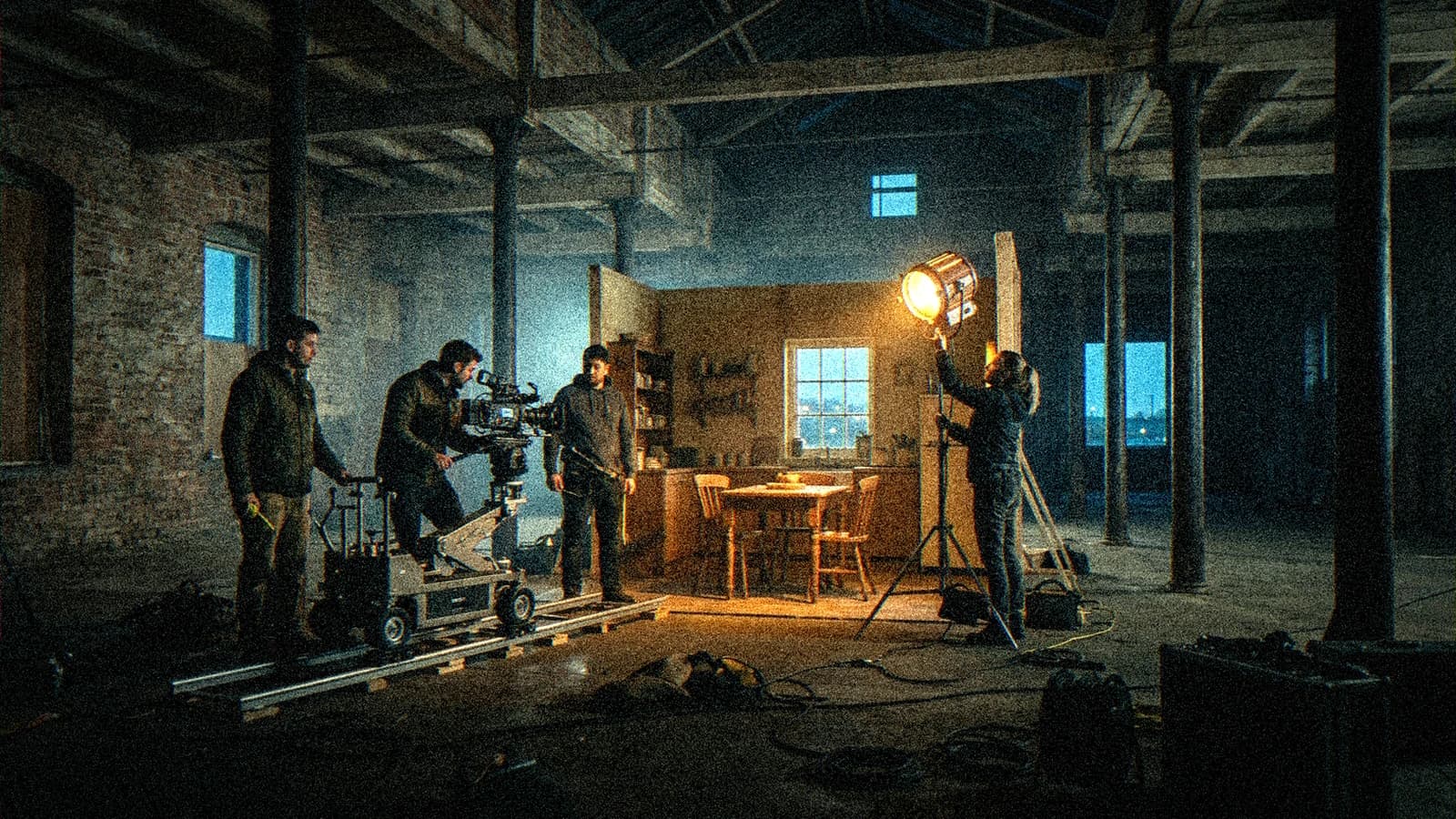
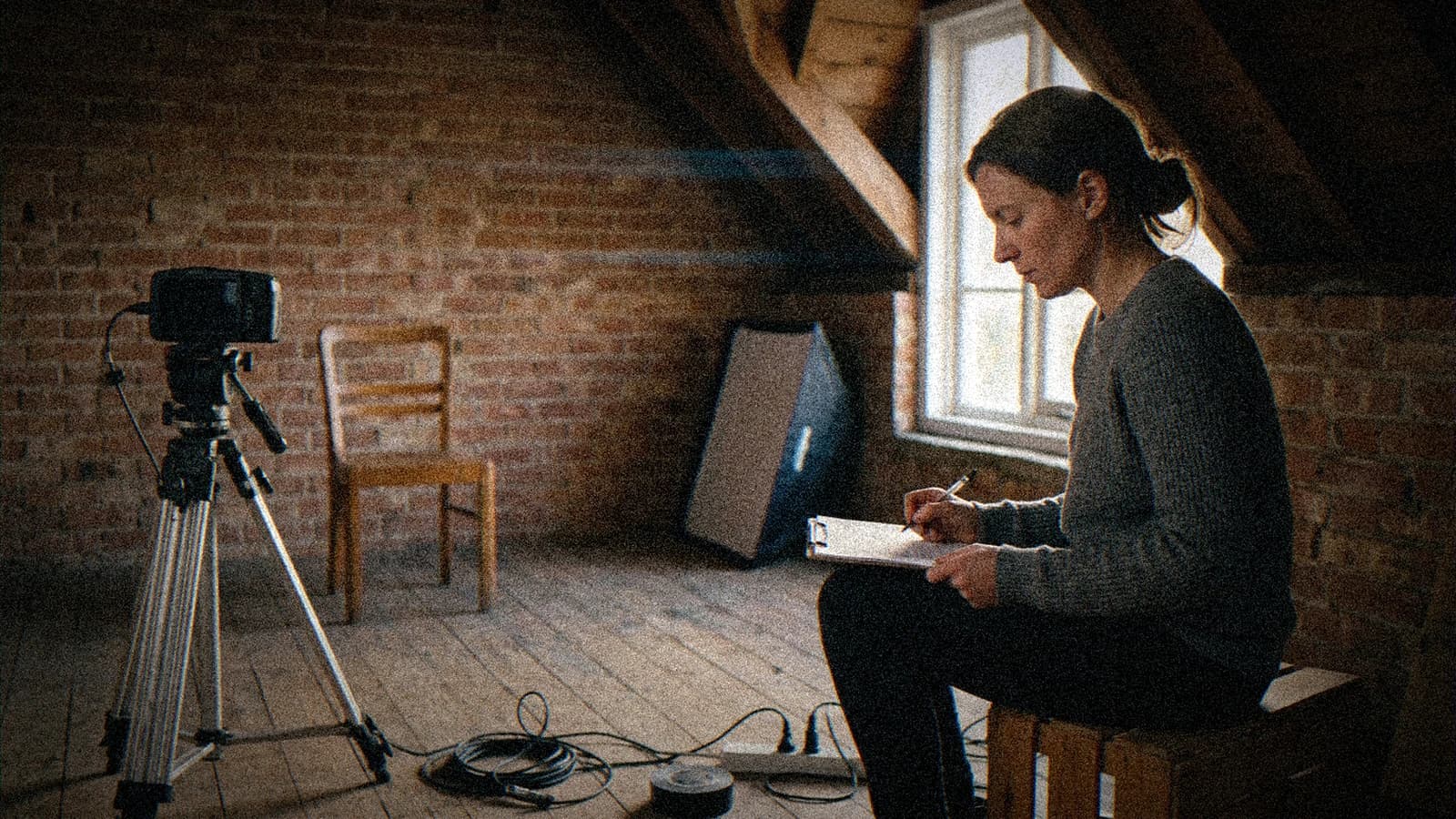
In practice I picture a stage like the one in the image above. A big, almost empty space, one corner of real set (a table, a window, a piece of wall someone can touch), and everything else supplied by generation, either live on a screen or in post. The production designer doesn't disappear. They build fewer square meters, with more care, because every real object will also serve as a reference for the machine.
For the real estate, that means the 2030 studio needs less stage floor and more space for everything around the shoot.
💡 Frank's Cut: if you're buying production gear between now and 2030, put the money into what captures performance (lenses, lighting for faces, sound recording) before anything that builds sets. Generated sets get better every quarter. A clean recording of a voice that trembles doesn't.
The machine room becomes a budget line
Right now, in a lot of small companies, generation gets paid for with scattered personal subscriptions. Three credit cards, five accounts, credits that expire. By 2030 I think every production budget will have a "compute" line as readable as the camera rental line. My estimate, and it is an estimate, is that it'll be negotiated the same way: flat fee, volume, penalties if the service goes down.
That machine room will look different depending on the studio's size. Big players will own part of their capacity, or a piece of the supplier. That's what Lionsgate taking a stake in Runway is about, which I covered in the piece on the Lionsgate and Runway deal. Small studios will rent, but they'll spread the work across several engines so they never depend on one.
The job that goes with it barely exists yet. I call it generation supervisor, for lack of a better name. This person knows each engine's strengths, knows which model takes the wide shots and which one takes the faces, watches the costs, and decides when a shot will be faster to film than to generate. On House of David, a team that trained on the tools every day covered that function. By 2030 it'll be a credit at the end of the film.
The input archive, the room nobody plans for
This is the room I think people underestimate most. A traditional studio archives its rushes, its edit projects, its masters. A studio that generates has to archive something else: whatever made the generation possible.
Prompts, reference images, exact model versions, settings, seeds when the tool exposes them, and above all the human decisions between two renders. Without that, you can't redo a shot six months later, you can't prove who did what the day a rights holder asks, and you can't fill in the record that Article 50 makes necessary.
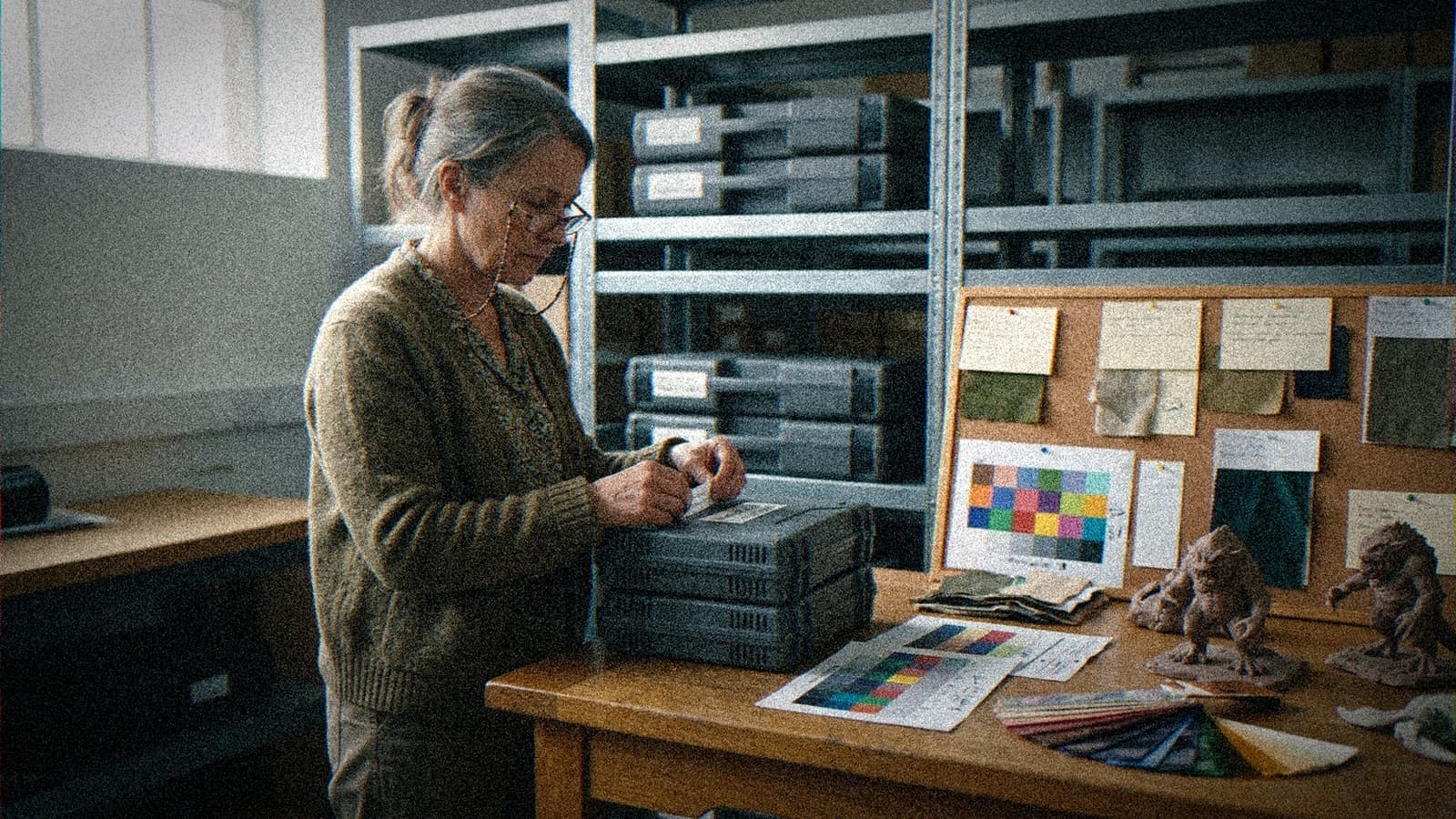
I learned this the hard way on my own projects. When I threw out the first realistic version of VOIDBORN, what saved me was an art direction that lived somewhere other than a generation history. Since then I store my inputs the way people used to store negatives. In 2030, a studio that doesn't will have the same problem as a photo lab that kept the prints and threw the negatives away.
The matching job looks like a cross between an archivist and an assistant editor. They name, file and link every delivered shot to its sources. Nobody dreams of this job out of film school, and I'd still bet it'll be one of the hardest to hire for, because it takes someone who understands both production and rights.
Physical references are back
Here's a paradox I already see: the more you generate, the more you need real objects. A model keeps a character consistent from shot to shot much better when it has photos of a real costume, from several angles, in known light. It sticks to a palette better when you give it real materials to copy.
So I see the 2030 studio keeping a costume and props workshop, smaller, but pointed at a new job: making references. You sew a real coat, photograph it on an actor standing on a turntable, and those images then feed every shot where the character crosses a forest nobody ever built.
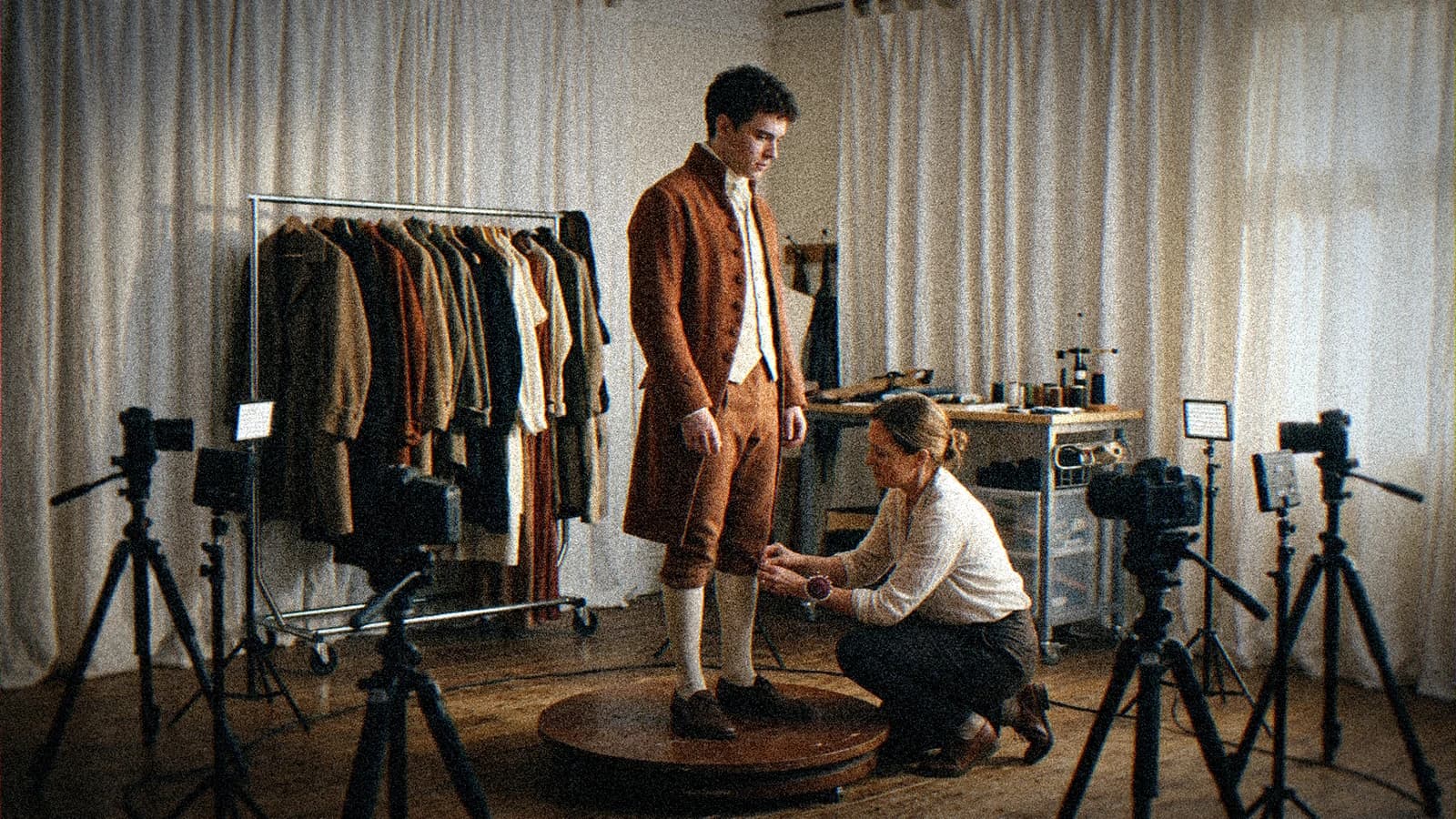
That changes what some jobs consist of without wiping them out. The costume designer is still a costume designer; their work just gets seen once by the camera and a hundred times by the machine. The cinematographer keeps their eye, but part of the day goes into lighting references instead of scenes. I dig into this, with employment figures, in my look at film and TV jobs facing AI.
The rights office moves from the hallway to the center
In a 2026 studio, rights questions often show up at the end, at delivery. In 2030 they'll show up at the start. Between the SAG-AFTRA contract on synthetic performers, Europe's Article 50 and broadcasters' delivery requirements, every generated shot will need paperwork from the moment it's made.
I expect a provenance lead: someone who approves acceptable training sources for a project, checks permissions on faces and voices, and signs off the record before delivery. Netflix has already published internal rules that require written approval as soon as generated content touches the final deliverable. Rules like that will spread, and somebody will have to enforce them day to day.
In a small studio this office will often be one part-time person or a contractor. But it'll exist. Ignore it and you'll get a delivery rejected, or a festival release blocked, at the worst possible moment.
The 2026 studio and the 2030 studio, function by function
The last column separates what you can already see from what is my bet.
| Function | Typical studio in 2026 | My forecast for 2030 | Status |
|---|---|---|---|
| Stage | Every scene shot, large built sets | Fewer days, partial sets, generated environments | Already visible (House of David) |
| Generation | Personal subscriptions, one or two engines | Dedicated budget line, several engines split by shot type | Bet |
| Archive | Rushes and edit projects | Rushes plus generation inputs (prompts, versions, references) | Bet, pushed by Article 50 |
| Costumes and props | Made for the camera | Made for the camera and for reference capture | Bet |
| Rights | Checked at the end | Provenance lead from prep onward | Partly visible (Netflix rules) |
| Performers | Actors, occasional digital doubles | Actors, synthetics governed by a process until mid-2030 | Locked in by contract |
| Writing and prep | Script, then a separate storyboard | Script, shot list and storyboard linked in one tool | Already visible |
The last row involves me directly, so I'll say it up front. I'm a co-founder of ScreenWeaver, a pipeline where the script, shot breakdown, storyboard and video production all stay linked to the screenplay. Thibaut wrote the software, I co-founded it, and we started it because that junction between writing and production kept breaking on our projects. So I'm biased here, and I still think every film prep in 2030 will run through a tool like it, ours or someone else's.
Three sizes of studio, three different faces
In 2030 the word "studio" will cover very different realities, and that's where most predictions get muddled.
The one-person studio will exist. It already does. I described a typical day in a solo AI studio: breakdown in the morning, generating in batches, editing, sound, archiving at night. In 2030 that creator will make shorts, short series, ads and music videos. I don't think they'll make a photorealistic fiction feature alone that holds up in a theater. They could make a stylized animated feature with a very small team, though, and that's a market I'm watching closely.
The independent studio of five to fifteen people is, in my view, the one that gains the most. Big enough for a real rights office and a generation supervisor, small enough to switch engines in a week. That's the format I chose with Outerframe Studio, a French SAS based in Strasbourg, precisely because working solo kept hitting a wall on long projects.
The majors will keep their stages and their unions, and absorb generation from the bottom up: previs, environments, fixes, short formats built on their franchises. Contracts will set their pace as much as technology. The SAG-AFTRA deal expires on June 30, 2030. The negotiation leading up to that date will tell us more about the 2031 studio than any demo.
What could prove this forecast wrong
If someone rereads this in 2030 looking for a laugh, here's where they'll probably find it.
The engines could get so good at faces that stages empty out faster than I expect. I don't believe it for 2030, mostly because of contracts and audiences, but if a largely generated film becomes a real theatrical hit before then, I'll have underestimated the shift.
The opposite could happen too: a legal crackdown on training data, with rights holders winning lawsuits, would make some engines unusable for commercial work. In that case the input archive and the rights office matter even more, but the machine room shrinks.
Then there's money. If compute prices don't drop, generation stays limited to shots where it replaces something very expensive (a crowd, a destroyed city, a period set) and doesn't touch the rest. Counting iterations, generation is already far from free today.
And then dependency. Another Sora, one central engine that shuts down or changes its terms, and a whole generation of studios loses its ability to make things. My answer hasn't changed: several engines, archived inputs, and an art direction that lives in documents and objects rather than in a prompt history.
What I'm building now to be ready
I don't know if my forecast will hold. I do know what stays useful in almost every scenario, and that's where my time goes.
I archive everything that goes into the machine, not only what comes out. One folder per shot, with the model version and the references. It's tedious, and it's the only thing that will let me redo a shot in two years.
I keep at least two working engines for each type of shot I use often. When one raises its prices or closes, I switch without relearning everything.
On the workshop side, I make real references: costumes, maquettes, color charts, location photos. They feed the machine today and they'll serve the stage tomorrow.
I keep a simple record of what's generated in each film, with the tool and the date. Festival juries already ask about it. For European compliance, that record will be expected.
And I keep shooting. Not much, but I shoot. Directing an actor, lighting a face, recording a voice in a real room: generation is making those skills rarer, which makes them worth more.
Foire aux questions
Réponses rapides aux questions les plus fréquentes sur cet article.
Will film studios disappear by 2030?
No, and nothing in the available facts points that way. The big American studios signed a contract with actors that runs until June 30, 2030 and tightly governs the use of synthetic performers. The productions furthest ahead on generation, like House of David, still employ hundreds of people and mix live action, traditional visual effects and AI. What changes is how the work is split inside the studio: fewer stage days, more prep, archiving and rights management. The word studio will also cover much smaller outfits than today, but those outfits will sit alongside the big ones rather than replace them.
Will one person be able to make a feature film with AI in 2030?
For stylized animation, I think yes, with a very small team and a lot of time. For photorealistic fiction meant for theaters, I doubt it. Faces holding a long emotion, physical interaction between characters and sound are still where generation needs the most iterations and human correction. Distribution matters too: broadcasters, festivals and insurers want guarantees on rights that few solo creators can provide. The 2030 solo creator will mostly make shorts, short series, ads and music videos, which is already a big market on its own and growing every year.
What new jobs will a film studio have in 2030?
Three functions look the most likely to me. A generation supervisor, who picks engines by shot type, watches costs and decides when to shoot instead of generate. An input archivist, who keeps prompts, references, model versions and human decisions for every delivered shot. A provenance lead, who approves sources, checks permissions on faces and voices, and keeps the transparency record. None of these titles is standard yet. They're my working names for tasks I already see happening informally on the projects I know, my own included, and I expect the names to settle within a few years.
What does the EU AI Act say about films?
Article 50 of the AI Act sets transparency duties that have applied since August 2, 2026. AI-generated or manipulated content that looks like real people, places or events has to be disclosed. For work that is clearly artistic, creative or fictional, the text sets a lighter duty: you disclose that such content exists in a way that doesn't get in the way of showing the work. In practice, a European studio needs to know exactly which shots were generated and with which tools. That's why I keep coming back to a record and an input archive for any studio working in 2030.
Do I still need to learn to shoot if I want to make AI films?
Yes, and I'd say it matters more than before. Shooting skills (directing an actor, lighting a face, recording clean sound) are getting rare because many new creators skip them. Those are exactly the skills a hybrid studio needs for the stage days that remain, and the ones that make the difference on the shots generation handles badly. Knowing how to shoot also makes you better at generating. You know what a focal length is, where light comes from, what a match cut needs. That vocabulary makes your requests to the machine far more precise and your fixes much faster.
How much will an AI studio cost in 2030?
Nobody can put an honest number on it today, and I'm wary of anyone who does. Compute prices move every quarter, supplier terms change, and legal duties add documentation costs that few budgets include yet. What I can describe is the spending structure I expect: less stage rental and set building, a compute line negotiated like equipment rental, and human time for archiving and rights. If you want a figure to work from, start from what a short film really costs today and track how it moves over the next few years, line by line.
Will synthetic actors replace human actors?
Not for producers bound by the SAG-AFTRA contract, at least until June 2030. Before using a synthetic performer in a role a human could play, they have to notify the union, bargain, and can end up in arbitration. They also have to show significant additional value over a living actor. Some commentators point out that the contract doesn't define that phrase, which leaves grey areas. Outside that framework, in advertising, animation or independent work, people will have more freedom, but audiences, festivals and transparency rules will weigh on those choices too.
Where I land
If I had to sum up my forecast in one image, it would be the one at the top. A big, almost empty building, a small corner of set lit with care, four people shooting what the machine still does badly. Around them, out of sight, a compute room, an archive and a rights office.
I'll come back to this piece every year. If I got it wrong, you'll see it in the update.
Related articles
 Business
Creative career change with AI: from business to film
Why I left online business content for AI filmmaking, what came with me, what I had to drop, and a method to plan your own creative career change.
 Business
AI film YouTube channel: what I learned the hard way
A real account of running an AI film YouTube channel: which format survives, which YouTube rules to read first, and what breaks before anything else.
 Tutoriels
ScreenWeaver: From Screenplay to Storyboard Without Losing the Film's Soul (Studio Guide)
Why file fragmentation kills your AI projects, how ScreenWeaver reconnects writing and images, and a field workflow with concrete settings to stay master of the render.