Topaz Video AI: full test and review on video restoration
Complete field test of Topaz Video AI to restore old videos, with a pro workflow, useful settings and real limits.
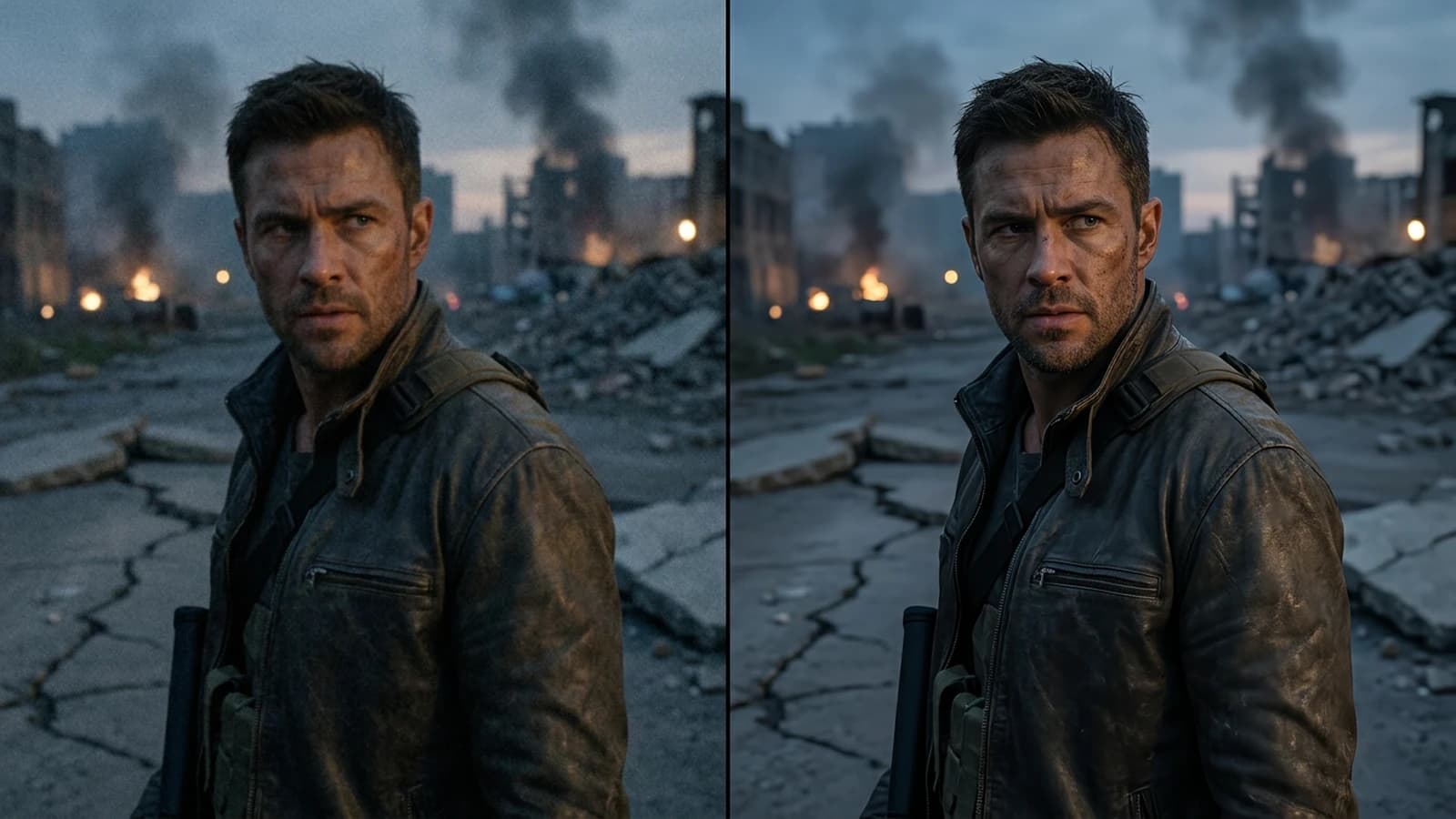
You find an old short film again. The image is soft, noisy, sometimes unstable. You run Topaz Video AI in "automatic enhancement" mode and you get a sharper version, yes, but also a more artificial one. Plasticky skins, invented details, weird motion on the edges. It is the classic when you confuse restoration and overprocessing.
Topaz Video AI is an excellent tool, but it punishes impatience. If you drive it like a one click, you lose the substance of the shot. If you drive it like a controlled finishing step, you can save archives, weak rushes and old masters with a real readability gain.
This test sums up a real usage: what Topaz does very well, what it breaks fast, the settings that hold, and the workflow that avoids the costly mistakes.
For the image-before-video chain, link to how to turn an AI image into a fluid and credible video and to the complete workflow to go from an idea to a realistic AI film.
What Topaz Video AI really changes in restoration
The first concrete gain is the recovery of readability. On old or compressed sources, Topaz can improve the texture perception, separate the shapes better and make an image more usable in modern distribution. "More usable", not "magically perfect".
The second gain is the controlled upscaling. Going from weak HD to 4K can serve if your final pipeline requires a high-resolution output. The gain only has value if the micro-texture stays credible. An aggressive and false 4K shows immediately on a big screen.
The third gain is the stabilization of certain temporal defects on shots degraded by compression or playback artifacts. Topaz can offer a cleanup comfort before grading.
The main limit: Topaz does not invent a truth absent from the source. It proposes probable reconstructions. The more fragile the source, the more you must keep a light hand. The good reflex: judge a narrative improvement, not an isolated technical curve.
Trench workflow: restore with no plastic effect
Step 1: prepare the source before Topaz
Sort the shots by degradation level: light, medium, heavy. Export test segments of 5 to 12 seconds: a face in motion, a fine texture, dark zones, a detailed background.
Check the final usage. Mobile: a clean 1080p often beats an overprocessed 4K. Festival or big screen: a more conservative strategy on the sharpness, more demanding on the consistency.
Keep an intact source master. Pro workflow, non-destructive from start to finish.
Step 2: choose the right type of processing
The trap: the most spectacular preset. Start with the most neutral mode that improves with no breaking of the original texture.
Fiction: protect the skin and the human motion. Documentary: protect the organic render of the set. Compressed archive: noise and artifacts first, detail next.
Two comparative versions only: moderate and slightly pushed. Evaluate in real-time playback, not only on a still frame.
Field tip: if the shot impresses but no longer looks like your original material, you have already gone too far.
Step 3: set without breaking the material
Intensity moderate: a brutal rise of detail creates halos and artificial edges, especially on faces.
Noise: reduce yes, smooth to excess no. A light organic noise beats a wax skin.
Inter-shot consistency: a too-restored shot next to a natural shot breaks the series. You process sequences, not islands.
Motion: edges of silhouettes, hair, hands. The temporal artifacts appear there.
Step 4: integrate Topaz into a finishing pipeline
Topaz is not the last step alone. Typical chain: restoration, edit, grading, mix. After Topaz, readjust contrast, saturation and grain in your NLE or your grading to avoid the "shot processed apart" effect.
Validate on several screens: monitor, laptop, smartphone. Document the winning settings by source family.
Comparison table: aggressive vs pro
| Approach | Immediate gain | Artifact risk | Consistency | Distribution |
|---|---|---|---|---|
| Aggressive one-shot preset | very high | high | low | variable |
| Shot by shot with no method | medium | medium | medium | unstable |
| Segmented workflow, moderate settings | high | low to medium | high | solid |
| Segmented + color finishing | high | low | very high | solid |
Express troubleshooting
Sharpness to prove: halos, hard edges. Lower the intensity, compare in motion.
Same preset everywhere: inconsistencies per scene. Categorize the shots.
Skin ignored: waxy face. Keep some organic texture.
A single validation screen: bad surprises in distribution. Systematic multi-support.
Field scenarios (summarized)
Low-light fiction. Protect skin, eyes, grain. Short test with face motion. Harmonize in the timeline.
Compressed archive. Artifacts before detail. No false invented precision. Color unification at the end of the chain.
Old clip. Do not over-modernize the vibe. Two possible outputs: a faithful archive and a more readable social version. The final test is done with the music.
Resources and internal links
Documentation Topaz Video AI, bases DaVinci Resolve, delivery culture Frame.io.
For the image engine comparison: Flux vs SDXL: which AI to choose for realistic images. For the visual continuity: how to create consistent scenes with several AI shots. For agency-type deliverables: how to create an AI video ad like a pro agency.
Field deep dive: Topaz Video AI: full test and review on video restoration
This chapter extends the angle "Complete field test of Topaz Video AI to restore old videos, with a pro workflow, useful settings and real limits." for the real subject behind topaz-video-ai-test-avis-restauration-video. The goal is not to stack adjectives, but to install a short QA loop you can reuse on each deliverable: capture, note, compare, decide, archive. Most creators lose time because they mix three variables in one session, then blame the model. When you separate light, composition, texture, intention, you get back an honest diagnosis and a measurable progression.
"One variable" protocol (30 minutes)
Minute 0 to 5: write the sentence "what the viewer must believe with no caption". Minute 5 to 12: list three possible visual proofs (cast shadow, usage prop, consistent reflection). Minute 12 to 22: generate two images that differ only by one of these proofs. Minute 22 to 28: test in mobile thumbnail and in full screen. Minute 28 to 30: choose A or B and name the winning criterion in the project file. This protocol avoids the drift where each regen changes everything except the initial problem.
Scenarios A, B, C with pivot
Scenario A. Render too clean, too showcase. Pivot: add a localized trace of usage and a more marked side light, with no touching of the subject if the geometry is good. Scenario B. Loaded image with no hierarchy. Pivot: remove two objects from the prompt, recenter the contrast on the subject, or tighten the framing. Scenario C. Spectacular but cold image. Pivot: slightly lower the global saturation, add a fine homogeneous grain in post, then regenerate only if the geometry or the perspective still lies.
Trench warfare: ten frequent traps
- Fixing everything at once. You no longer know what saved the image.
- Comparing only in full screen. The mobile often betrays the fake luxury.
- Ignoring the rhythm upstream of the video. Even upstream, think about the cutting and the breathing of the shots.
- Copy-pasting prompts with no local brief. The words must stick to your real subject.
- Aggressive global sharpen. The garish edges read "digital".
- Too many contradictory adjectives. One dominant intention is enough at the start.
- No text archive file. You lose the seed, the version, and the reason of the choice.
- Validating tired. Fatigue makes "beautiful" what is only familiar.
- Multiplying the models the same day. You compare different chains, not settings.
- Delivering with no A/B. The client or your future self will not know what was acceptable.
Quick decision table
| If you observe | Priority action |
|---|---|
| light inconsistency | simplify the sources |
| drowned subject | framing or contrast hierarchy |
| plastic texture | fine grain or less HDR |
| impossible hands | off-frame or trivial action |
| catalog set | micro wear and functional prop |
| empty sky | cloud volume or motivated haze |
| impossible reflections | reduce the contradictory sources |
Client or commissioner workshop
Even for yourself, write a mini brief: audience, channel, expected reading time, forbidden items (violence, brands, real faces). For a team, add a "compliance proof" column: capture of the service terms, model version, export date. This column saves you when a broadcaster asks where the image comes from.
Extended FAQ
Should I deliver two versions? Yes, A and B with a named difference sentence, otherwise the discussion stays vague. Should I document the prompts? Yes, even partially: it is your internal quality assurance. What to do if the model changes? Set a test brief and compare before continuing a series. Does manual retouching cheat? No if you assume the chain and the contractual limits. How long per serious image? Often longer in validation than in raw generation, plan it in the quote. Do you need a technical target? Yes: final resolution, color space, headroom on the highlights if social compression. And the intellectual property? Check the terms and the rights on the references included in the prompt.
Multi-screen control station
Minimal chain: main monitor, standard laptop, smartphone. If you only have two screens, send a test export to your phone via a clean channel (not a messenger that recompresses infinitely). Note the perceived difference on the skins, the edges, and the micro-contrasts. Many "AI" images become that mostly after an involuntary second compression.
Useful internal links
Cross with why your prompt does not work, and how to fix it, the prompt mistakes that make an AI image artificial, and how to control the visual style in an AI generation. If your subject touches video, also link to how to structure an AI video like a real film and to how to improve the realism of movements in AI video.
End-of-session log (template)
Date:
Slug / file:
Hypothesis of the day:
Variable tested:
Result A vs B:
Decision:
Next test:
Operational synthesis
For topaz-video-ai-test-avis-restauration-video, keep three lines in your notebook: intention in one sentence, light law in one sentence, material proof in one sentence. If one is missing, you are not ready to regenerate massively: you are ready to diagnose. The long-term quality comes from this discipline, not from the last model released on Tuesday.
Series B extension: deliverables, risks and governance
Topaz Video AI: full test and review on video restoration: the excerpt "Complete field test of Topaz Video AI to restore old videos, with a pro workflow, useful settings and real limits." often poses an implicit expectation: a stable, defensible, reproducible deliverable. The slug topaz-video-ai-test-avis-restauration-video serves as a thread: each export must be linkable to an intention, a proof, a limit. This section adds a governance + risks + deliverables layer you can copy into your internal Notion or your project drive.
Deliverables: what you really promise
A deliverable is not "an image": it is a package (master, social variants, light note, naming, date). For a series, set a convention: slug prefix, suffix _v02_client, social_exports folder separate from the masters. If you deliver a video, add a line on the target bitrate and the safety recrop for the stories. If you deliver AI shots, specify if the manual retouching is included or optional. These details avoid the discussions where everyone talks about a different object.
Risks: the contractual and technical blind spots
The risks are not theoretical: a broadcaster can ask for the provenance, a client can compare two differently compressed versions, a tool can change its pipeline overnight. Document the service version and the date on a text file in the folder. If you use external visual references, note if they are authorized by your contract. If you work with faces, clarify if you stay in non-realistic generations or if you go through specific consents. For the chain topaz-video-ai-test-avis-restauration-video, the goal is simple: reduce the uncertainty when you reopen the project six months later.
Governance: minimalist roles (even solo)
Even alone, you can split three hats: brief, execution, control. The brief forbids touching the model as long as the intention is not written. The execution forbids changing three variables at once. The control forbids validating with no mobile. When you grow into a team, these hats become columns in a table: who validated, with what proof, at what time. The light governance beats the theoretical governance: five mandatory fields are often enough.
Export pipeline: zero surprise at the upload
Before uploading, go through a short checklist: metadata cleaning if necessary, color profile consistent with the platform, cold screen test (low brightness). For long formats, check the black chapters and the gray backgrounds that reveal the banding. For very textured visuals, a light homogeneous grain sometimes masks the artifacts better than an aggressive sharpen. For topaz-video-ai-test-avis-restauration-video, think about the viewer who will see the thumbnail first, not the 4K version.
Collaboration: how to avoid the infinite loops
The infinite loops are born when nobody decides. Set a rule: two rounds of feedback then decision, except for a blocking bug. Each feedback must name one criterion and propose one action. "I do not like it" is forbidden; "the subject is too low in the frame, raise it by 8%" is allowed. If you are a provider, write in black and white how many variants are included. If you are an internal creator, keep a decision log to avoid redoing the same debates.
Useful metrics (with no heavy spreadsheet)
You do not need complex analytics: count the average time per iteration, the abandonment rate (thrown images), and the first-try validation rate. If the first try is always rejected, your brief is probably vague. If you throw everything, your protocol mixes too many variables. For Topaz Video AI: full test and review on video restoration, these metrics tell you if you progress or if you move laterally.
Quality escalation: when to stop regenerating
Stop when you fix a detail that only appears at 400% zoom, except for a giant print usage. Stop when the geometry is good but only a micro-texture bothers: switch to targeted post. Stop when you change the model to flee a light problem: you reset all the rest. The slug topaz-video-ai-test-avis-restauration-video must stay a mastered project, not a spiral.
Archiving: what a future you will thank
Archive: main prompts (even partial), two captures A/B annotated, the list of tools and versions, and a sentence "why we decided this way". If you deliver to a client, a clean zip with a short README is worth more than ten badly named files. For the angle "Complete field test of Topaz Video AI to restore old videos, with a pro workflow, useful settings and real limits.", the archive proves you followed a process, not just a momentary intuition.
Test bench: comparing without getting it wrong
When you compare two outputs, align: same duration, same test framing, same screen. If you compare two different models, note that you measure two chains, not two settings of one same chain. For the videos, sync on a fixed shot before judging the motion. For the images, compare first in full frame, then in detail on a problematic zone agreed in advance.
"Ready to deliver" checklist
- Intention readable in three seconds on mobile.
- Light consistent with the action and the set.
- No useless "burned" zone on the main subject.
- Stable naming and clear version.
- Light note or delivery email summarizing the known limits.
Series B FAQ
Do you need a written contract for a micro-service? A short email exchange with scope and number of round-trips avoids 80% of the tensions. Should I deliver the prompt? Depending on the contract; otherwise, deliver an equivalent functional description. What to do if the platform compresses? Plan headroom on the highlights and test a "worst case" export. How to handle a late feedback? If it is out of scope, propose a quantified addendum rather than a vague negotiation.
Series B synthesis
For Topaz Video AI: full test and review on video restoration and the scope topaz-video-ai-test-avis-restauration-video, keep: deliverable = package, risk = written trace, governance = roles and dated decisions. The excerpt "Complete field test of Topaz Video AI to restore old videos, with a pro workflow, useful settings and real limits." becomes actionable when you link each sentence of the brief to a visual proof or an assumed limit. It is not pessimism: it is what lets you deliver fast with no regret.
Foire aux questions
Réponses rapides aux questions les plus fréquentes sur cet article.
Is Topaz worth it for an independent?
Yes if you have a real need for restoration or upscaling and a test method. No if you want a miracle with no control.
Old video in "cinema" 4K?
You can gain readability. You do not recreate absent details. Aim for "better and consistent".
Riskiest setting?
Strong sharpness + high denoising: recipe for the plastic. Go up by steps with A/B in motion.
Process everything with Topaz?
No: some shots only need a grading. Process what justifies the cost, harmonize the rest in post.
Before or after the edit?
Often after a pre-edit or on selected segments to save time and compare what stays in the timeline.
How to judge the success?
Useful readability, preserved texture, temporal stability, consistency between shots, multi-screen hold. A sharper but less credible shot is not a victory.
Related articles
 Comparatifs
Adobe Firefly: Full Review, Quality, Limits and Use Cases
My field test of Adobe Firefly in 2026: real quality, limits, marketing workflow, practical comparison and a method to avoid artificial AI renders.
 Analyses
Audiovisual Jobs Threatened or Transformed by AI: My Take
An honest reading of the jobs that resist, those that recompose, and the skills that become rare when everyone generates 'correct' images.
Actualité
The 5 Best AI Video Makers for Creating a Music Video in 2026
An expert comparison of the best AI video makers in 2026 for creating a cinematic, consistent, broadcast-ready music video.